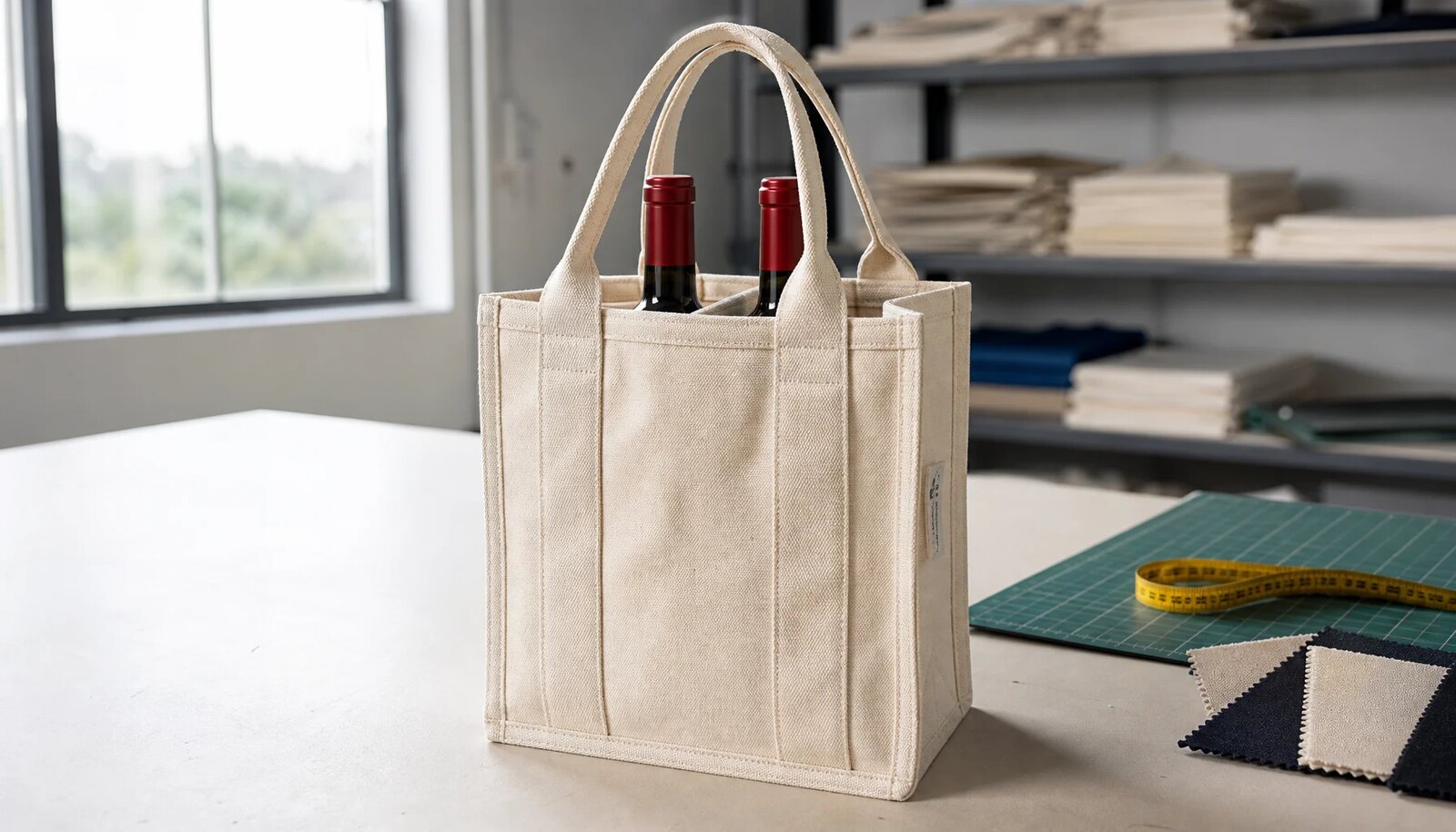
Start with the handling route
A custom canvas wine carrier is presentation packaging, branded merchandise, and a load-bearing item around glass bottles. For event planners and procurement buyers, durability starts with the way the carrier will move, not with the logo size. A carrier handed empty at a registration desk has a different risk profile from a two-bottle carrier preloaded by staff, placed in hotel rooms, stacked at a sponsor table, or carried through a parking lot after a winery event.
Write the handling route into the brief. Include factory packing, freight, warehouse receipt, venue delivery, staff loading, guest handoff, carry-home, and any retail or e-commerce step. This makes the custom canvas wine carriers durability testing checklist for event planners a working purchasing tool rather than a generic quality note.
The route also affects packing. If bags ship flat and are loaded at the venue, fold marks and logo scuffing may matter more than standing shape. If they ship prepacked with bottles or inserts, base support, carton compression, and version sorting become more important.
- Map each touchpoint: factory, forwarder, warehouse, venue receiving, setup table, guest handoff, hotel room drop, retail shelf, or packing bench.
- State the load: one bottle, two bottles, sparkling wine, heavy glass, tasting notes, openers, inserts, or sponsor materials.
- Define the use expectation: single-event packaging, reusable guest item, retail merchandise, winery pickup carrier, or premium gift.
- List constraints: fixed event date, multiple destinations, sponsor artwork versions, carton labeling rules, and staff handling limits.
Control bottle fit first
Bottle fit is the first technical decision because wine bottles are not one standard shape. Bordeaux, Burgundy, tall slim, champagne, and premium heavy-glass bottles can vary enough to change the opening width, gusset, bottom depth, divider size, and balance of the loaded carrier. A sample that looks fine with a generic bottle can fail when the actual bottle has a wider shoulder, taller capsule, wax seal, or heavier base.
For a one-bottle carrier, the bottle should slide in without forcing, stand upright, and come out without catching on the neck or shoulder. For a two-bottle carrier, fit includes separation. A shallow or loose divider may allow bottles to knock together while guests walk, which makes the carrier feel unstable even if the fabric is strong.
Send measurements with the RFQ whenever possible: body diameter, overall height, shoulder style, neck diameter, cap or capsule type, wax seal, neck tag, and final bottle quantity. If champagne or sparkling wine may be included, call it out early because wider bottles usually need more gusset depth, stronger base support, and more careful divider placement.
- Test with the largest and heaviest approved bottle, not only the easiest bottle to fit.
- Ask for fit photos showing insertion, loaded lifting, standing position, and removal.
- Put top opening width, bottom depth, side gusset, divider height, and divider width on the measurement sheet.
- Check for rubbing against labels, foil capsules, wax seals, and neck tags during insertion and removal.
Specify fabric in finished terms
Canvas weight should be measurable. For many one-bottle event programs, 10 oz to 12 oz cotton canvas, about 340 to 410 gsm, is a practical baseline. It balances hand feel, printability, strength, and freight cost. For two-bottle carriers, heavier bottles, premium gifting, retail merchandising, or repeated use, 12 oz to 14 oz canvas, about 410 to 475 gsm, is often a stronger starting point.
Ask for finished outer fabric weight, not just a catalog description. Dyeing, washing, softening, coating, and finishing can change final hand feel and sometimes final weight. Lining, interlining, dividers, and base boards can make a product feel substantial without improving the strength of the outer canvas. Keep those components separate in the quote.
Fabric weight should not carry the whole durability conversation. A heavy canvas with weak handle stitching can fail before a moderate-weight canvas with proper reinforcement. The useful specification combines finished gsm or oz, agreed tolerance, color standard, construction details, decoration method, reinforcement, and load testing.
- Ask suppliers to quote finished outer canvas weight in both oz and gsm when possible.
- Set a fabric weight tolerance only after the supplier confirms what they can control and verify.
- Confirm whether fabric is dyed to order, stock dyed, washed, softened, coated, or untreated.
- Keep lining, divider fabric, and base board material separate from the stated outer canvas weight.
Engineer stress points
Most failures happen at predictable points: handle bases, bottom corners, side gussets, top opening, and divider attachments. The handle bases take the shock of every lift. The bottom corners carry concentrated bottle weight. Side gussets distort when bottles push outward. In two-bottle designs, the divider is structural because it controls bottle movement.
Use production language in the RFQ. Instead of asking for a strong handle, specify box stitch with cross stitch, bar-tack, multiple rows of lockstitch, or a reinforcement patch at each handle end. Instead of asking for a sturdy bottom, name the desired construction: boxed bottom, double-layer base, bound bottom seam, stitched-in divider, or removable PE/PP board insert.
Handle length and width matter too. A very short handle can force an awkward grip and concentrate stress. A very long handle can make bottles swing. For event distribution, a controlled hand-carry length is often better than a shoulder-tote length unless the carrier is intentionally designed for reuse beyond the event.
- Specify handle width, handle length, attachment area, stitch pattern, reinforcement layer, and placement tolerance.
- Inspect handle bases for skipped stitches, broken threads, loose back-tacks, uneven tension, needle damage, and weak corners.
- Use boxed or double-layer base construction when the carrier must stand upright or carry two bottles.
- Check divider attachment at the side seam and bottom so it does not collapse under loaded movement.
Make the sample prove durability
A sample should not be approved because it photographs well. It should prove that the selected fabric, pattern, decoration, reinforcement, and packing can survive the planned handling route. The approval sample should use the same material and process intended for mass production. Substitute fabric, simplified stitching, temporary packing, or a different ink system weakens the approval value.
The test can stay practical. Load the carrier with the intended bottle or bottles, lift it repeatedly, walk with it, set it down, and inspect stress points. For a two-bottle carrier when final bottle weight is not confirmed, a documented working load such as 5 kg can help compare samples, but the final test should be updated if the actual bottles are heavier.
Decoration belongs in sample approval. Screen print can work well on cotton canvas, but coarse texture may reduce small-text clarity. Embroidery can feel premium, yet it can pucker lighter panels or stiffen the logo area. Woven labels and patches can look clean, but backing, edges, and carton rubbing still need review.
- Record sample date, fabric weight, bottle weight, decoration method, packing method, dimensions, and approved sample reference.
- Run repeated lift cycles and inspect handle bases, bottom corners, side gussets, top opening, and divider seams afterward.
- Insert and remove bottles several times to check neck clearance, shoulder friction, label scuffing, and capsule rubbing.
- Check logo edge quality, rub resistance, registration, placement, color, and small-text readability on the actual canvas.
Use a focused test matrix
Separate sample approval from bulk inspection. Sample testing proves the design is suitable for the event. Bulk inspection proves the factory repeated the approved design across cartons. When those two purposes are mixed, defects can become harder to resolve late in production.
Write pass and fail criteria in observable language. Do not say the handle must be strong. Say the loaded carrier must hold the agreed load for the agreed time with no seam opening, fabric tearing, stitch breakage, yarn slippage, or permanent distortion. Do not say the print should look good. State the placement tolerance, color reference, edge clarity, and rub-test expectation.
Share the test matrix before quotation. Suppliers can then price the correct construction and flag any cost or timing effect. If a supplier says a test is unsuitable for the material or decoration method, ask for an alternate measurable check.
- Fabric check: finished gsm or oz, shade consistency, surface cleanliness, fabric defects, and hand feel against the approved sample.
- Measurement check: body width, body height, gusset, bottom depth, opening width, handle length, divider height, and logo placement.
- Load check: static hold, repeated lifting, post-test seam condition, handle distortion, and visible shape change after unloading.
- Fit check: largest approved bottle inserted, carried, removed, and checked for label, capsule, shoulder, and neck-tag rubbing.
- Decoration check: rub resistance, cure or adhesion, color, registration, edge clarity, small-text readability, and placement tolerance.
- Packing check: fold direction, logo protection, carton quantity, carton marks, gross weight, and separation of mixed versions.
Compare quotes against one spec
Canvas wine carriers can look nearly identical in supplier photos while carrying different production costs. One quote may include 12 oz finished canvas, reinforced handle bases, a stitched divider, print protection, and documented inspection. Another may include lighter fabric, simpler stitching, no divider, and loose bulk packing. Both may be called custom canvas wine carriers, but they are not the same purchase.
Send every supplier the same specification before comparing prices. Include bottle dimensions, finished fabric weight, finished size, reinforcement, decoration method, artwork count, packing format, inspection requirement, and delivery date. Ask each supplier to list exceptions or substitutions directly on the quote.
Supplier route affects control. A direct factory with bottle bag, structured tote, or reinforced cotton bag experience may answer construction questions more clearly and manage sample-to-bulk consistency. A trading company can be useful for mixed merchandise, but confirm the production factory and inspection access. A local decorator may help urgent small programs, though construction options may be narrower.
- Normalize quotes to the same Incoterm, currency, fabric weight, dimensions, decoration method, reinforcement, packing format, and inspection scope.
- Ask each supplier to mark exclusions, assumptions, substitutions, setup fees, and optional upgrades on the quotation.
- Request recent production photos of bottle carriers or reinforced structured bags, not only generic tote images.
- Confirm whether the approved sample and bulk order will be made in the same facility.
Protect branding quality
Decoration durability matters because event carriers appear in guest photos, sponsor reviews, retail displays, and post-event reuse. A logo that cracks, bleeds, scuffs, or sits visibly off-center can make a structurally sound carrier feel poorly sourced. Treat decoration as a QC item, not a final visual add-on.
Screen printing is often suitable for bold logos, limited colors, and event marks on cotton canvas. Coarse fabric can break fine edges, and small reversed type may fill in. Embroidery creates a premium textile effect but adds stitch tension and may pucker lighter panels. Woven labels and patches can be consistent if edge finish, backing, placement, and carton scuffing are checked. Heat transfers need careful testing on textured cotton because adhesion and cracking risk depend on the process.
Approve decoration on final bulk fabric whenever possible. Define logo size, color reference, placement point, and tolerance. The inspector should be able to measure from the top edge, center line, pocket seam, or side seam and compare the result with the approved sample.
- Use screen print for bold logos, limited colors, event dates, and cost-efficient sponsor marks.
- Use embroidery, woven patches, or woven labels when the panel can support added thickness and the program needs a premium finish.
- Avoid hairline logos, tiny reversed type, and complex multicolor artwork on coarse canvas unless a strike-off proves clarity.
- Check decoration after packing tests because rubbing, fold pressure, and carton contact can damage the logo before delivery.
Treat packing as QC
Packing can protect a well-made carrier or damage it before the event team receives it. Canvas can crease, printed panels can scuff, embroidery can rub, handles can bend awkwardly, and structured bases can flatten when cartons are overfilled. Because event dates are fixed, weak packing can create last-minute sorting, steaming, replacement, or air freight pressure.
For simple venue handouts, organized bulk packing may be acceptable if the logo is protected and carton weight is manageable. For retail-ready programs, VIP gifts, hotel distribution, or e-commerce shipments, individual tissue, polybags, barcode labels, or inner cartons may be needed. Multiple artwork versions should have carton labels showing version, color, quantity, purchase order, destination, and carton number.
Collect carton-level data before shipment. Ask for units per carton, dimensions, gross weight, and stacking assumptions. For two-bottle carriers or structured bases, a carton drop handling check and carton compression review can reveal whether bags are likely to arrive crushed or distorted. The aim is not excessive packaging; it is predictable arrival condition and fast event distribution.
- Confirm fold method so the print, patch, handle, divider, and base are not damaged by packing pressure.
- Use tissue, separators, or individual bags when decoration can rub against canvas, hardware, carton walls, or another carrier.
- Keep master carton weight practical for warehouse receiving and event staff handling.
- Mark cartons by color, artwork version, quantity, PO number, destination, and carton number when the order has multiple SKUs.
Specification comparison for buyers
| Spec decision | Practical procurement choice | Best fit | Risk to verify before PO |
|---|---|---|---|
| Bottle fit baseline | Measure actual bottle diameter, height, shoulder, neck, closure, and bottle count before approving the pattern | Corporate gifts, hotel amenities, winery pickup, sponsor kits, and events using non-standard bottles | A pattern that fits a standard Bordeaux bottle may not fit Burgundy, champagne, wax-sealed, or heavy-glass bottles; require fit photos or a sample test with the largest approved bottle |
| Canvas weight | 10 oz to 12 oz cotton canvas, about 340 to 410 gsm finished outer fabric | One-bottle carriers, moderate reuse, registration desk handouts, and budget-sensitive event gifts | Confirm finished outer fabric weight and tolerance; do not let lining, divider fabric, or insert board be counted as the main canvas weight |
| Higher durability build | 12 oz to 14 oz cotton canvas, about 410 to 475 gsm, with reinforced handle bases and bottom support | Two-bottle carriers, premium gifting, retail merchandising, wine club pickup, and heavier sparkling bottles | Heavier canvas adds seam bulk and carton weight; check fold thickness, needle holes, bottle clearance, and factory ability to sew cleanly through layers |
| Base and divider | Boxed bottom, double-layer base, bound bottom seam, stitched divider, or removable PE/PP insert where useful | Upright display, preloaded distribution, two-bottle formats, and retail-ready packing | Poor inserts can shift, bend, expose edges, or absorb moisture; confirm material, thickness, placement, removability, and edge finish |
| Handle reinforcement | Box stitch with cross stitch, bar-tack, multiple lockstitch rows, or reinforcement patch at each handle end | Any loaded wine carrier, especially two-bottle styles and guest carry-home programs | Decorative stitching is not a load standard; request stitch pattern, stitches per inch, reinforcement layer, and sample load-test result |
| Decoration method | Screen print, embroidery, woven label, woven patch, or heat transfer only after testing on final fabric | Sponsor marks, hotel branding, winery identity, retail labels, and repeat event programs | Fine artwork can fill in on coarse canvas, embroidery can pucker, and transfers can crack; approve a strike-off on actual bulk fabric |
| Measurement tolerance | Set feature-level tolerances, such as +/- 5 mm for placement points and +/- 10 mm for larger body dimensions when the supplier agrees | Inspection plans, repeat orders, bottle-fit-sensitive programs, and carton-controlled packing | A single loose tolerance is not enough; opening width, gusset, bottom depth, divider height, handle length, and logo placement need separate ranges |
| MOQ and versions | Clarify MOQ by style, fabric color, artwork version, and packing version; supplier-dependent examples may sit around 500 to 1,000 pcs | Seasonal events, sponsor versions, destination splits, and first purchase orders | Low MOQ may mean higher unit price, limited colors, stock fabric, shared dye lots, separate setup fees, or simpler packing |
| Packing control | Define fold method, units per inner pack, master carton quantity, carton marks, gross weight, and mixed-SKU sorting | Venue delivery, hotel room drops, retail-ready programs, and multi-destination orders | Bad packing can crease prints, flatten bases, bend handles, or mix sponsor versions; require carton photos and packing specs before shipment |
Buyer checklist before sampling
- Define the program use: guest takeaway, VIP gift, retail resale, hotel amenity, sponsor package, winery purchase-with-purchase item, or staff-distributed preloaded carrier.
- Record bottle count and bottle dimensions, including body diameter, overall height, shoulder profile, neck diameter, cap or capsule type, wax seal, neck tag, and whether champagne or heavy-glass bottles must fit.
- Specify finished outer canvas weight in oz and gsm, and state that reinforcement, lining, dividers, and base inserts are separate from the main canvas weight unless otherwise agreed.
- Create a measurement sheet for body width, body height, side gusset, bottom depth, top opening, handle length, handle width, divider height, print position, label position, and tolerances.
- Define handle attachment, stitch type, stitches per inch, seam allowance, bottom reinforcement, binding, bar-tacks, divider attachment, and any base insert material.
- Approve decoration on the same fabric weight, color, surface texture, and finishing process planned for bulk production.
- Run sample checks before PO approval: loaded static hold, repeated lift cycles, bottle insertion and removal, divider stability, print rub, logo placement, and packing simulation.
- Use the actual bottle set for testing; if final bottles are not selected, use the largest likely bottle and a documented working load, then update when the bottle list is final.
- Confirm packing format, units per master carton, carton dimensions, gross weight, carton marks, barcode requirements, and mixed-SKU sorting method.
- Lock the PO by fabric color, artwork version, approved sample reference, print method, measurement sheet, packing method, inspection plan, and acceptable quality limits before cutting starts.
Factory quote questions to send
- What is the exact finished outer canvas weight in gsm or oz, and what production tolerance will you control?
- Is the quoted fabric weight measured before or after dyeing, washing, softening, coating, lining, or reinforcement?
- What handle construction, side seam, bottom panel, divider, and top opening construction are included in the quoted price?
- How many stitches per inch will be used at the handle base, side seam, bottom seam, and divider attachment?
- What reinforcement method do you recommend for our stated bottle load, and is it included or optional?
- Can the approval sample be made with the same fabric, color, print method, reinforcement, divider, insert, label, and packing format as bulk production?
- Can you confirm fit using our actual bottle dimensions or the largest bottle expected in the event?
- What is your MOQ by style, color, logo version, and packing version, and which changes trigger new setup charges?
- Which items are included in the unit price: main canvas, reinforcement, divider, base insert, print, labels, polybag, tissue, barcode sticker, carton, and export packing?
- What is the production lead time after sample approval, and which steps are most schedule-sensitive: fabric procurement, dyeing, printing, embroidery, label making, insert cutting, or carton production?
Quality-control points to confirm
- Finished outer canvas weight should stay within the agreed tolerance; +/- 5 percent is a common supplier-dependent example only when confirmed in writing.
- Finished dimensions should match the signed measurement sheet, with separate checks for top opening, bottom depth, side gusset, handle length, divider height, and logo placement.
- Bottle fit should be checked with the buyer's bottle or largest approved bottle, including insertion, loaded carry, removal, and inspection for label, capsule, wax seal, or neck-tag scuffing.
- Seams should be straight and secure, with no skipped stitches, broken threads, loose ends, uneven tension, seam slippage, needle cuts, or untrimmed thread clusters.
- Handle attachment should pass the agreed load without seam opening, yarn slippage, tearing, stitch breakage, or permanent distortion after the load is removed.
- Bottom corners and boxed base should hold shape after loading, setting down, and lifting, with no twisting, uneven gusset collapse, or exposed insert edges.
- Dividers for two-bottle carriers should stay anchored at the bottom and side seam, reduce bottle contact, and avoid sharp fabric edges or loose stitches.
- Print adhesion should pass the agreed dry rub, tape, or light abrasion check with no major flaking, bleeding, cracking, poor curing, or unreadable logo edges.
- Embroidery and patch application should lie flat without puckering, exposed backing, sharp trim edges, loose threads, missed stitches, or misalignment beyond tolerance.
- Panel color, strap color, label color, and print color should remain within the approved shade band across cartons and production lots.