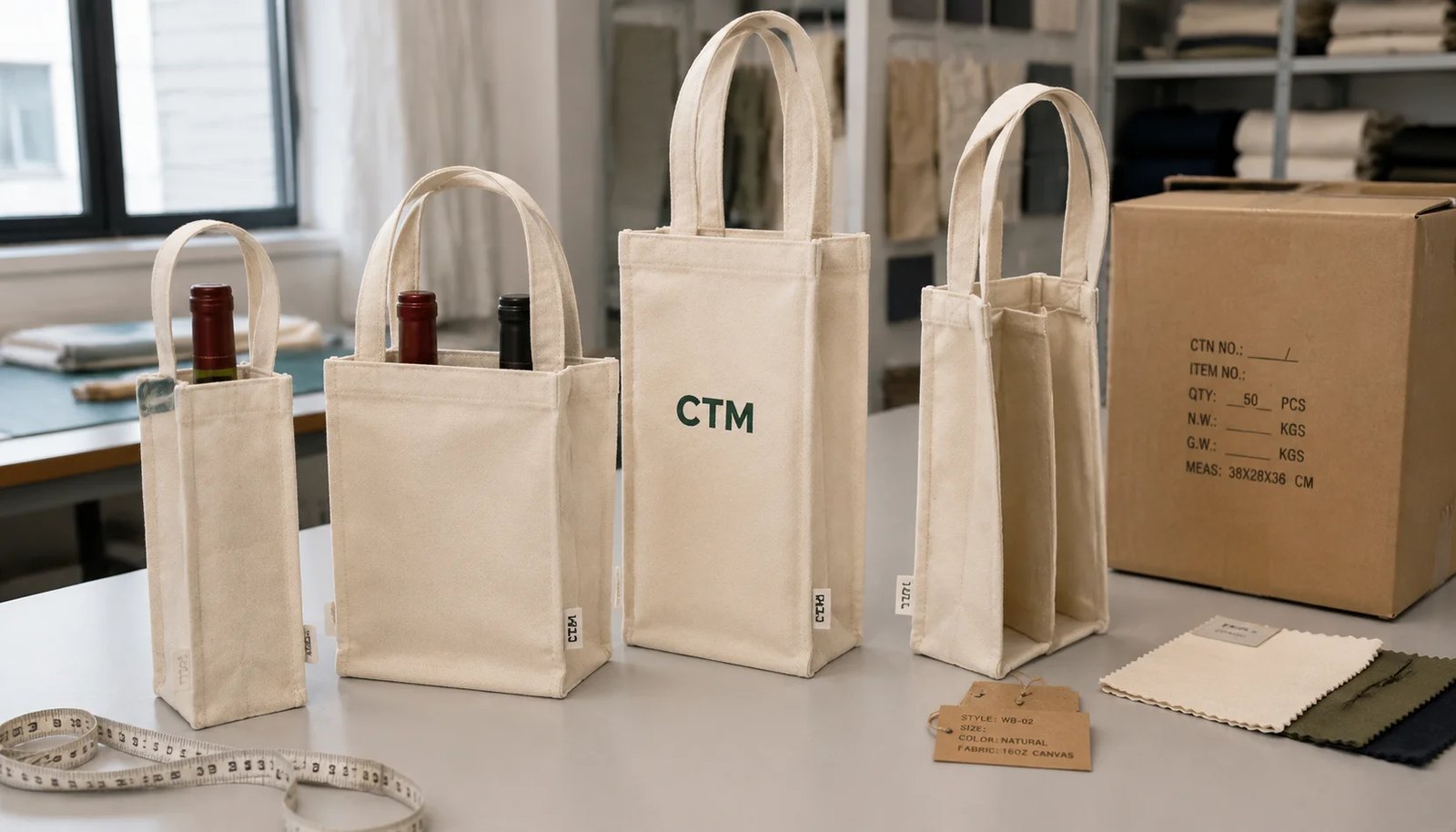
Why the carton plan matters more than most wine bag RFQs
Many wine carrier RFQs stop at bag size, logo, and fabric weight. That is enough to get a price, but not enough to control freight cost or in-store usability. For grocery retail, the carton plan affects how many units fit into a DC location, whether cartons can be moved safely by warehouse staff, and how often the bags arrive with pressure marks, bent top hems, or distorted print panels. A canvas wine carrier is soft goods, but it carries a fragile product. If the bag shape, divider bulk, and folding method are not locked before sampling, you can receive a quote that looks competitive and still lose money in inbound handling or damage claims.
Natural Grocers-style programs also tend to care about material simplicity, lower-plastic packing, and clean natural presentation. That makes the packing plan more sensitive because uncoated natural canvas shows transit dirt more easily than dark synthetic bags. A workable RFQ should therefore tie together fabric GSM, bag construction, print process, and carton count. If those pieces are quoted separately or left open, suppliers will optimize for their easiest production route, not for your landed cost and retail receiving needs.
- Carton planning is not only freight math; it directly affects wrinkle level, print scuffing, and carton breakage
- The same bag can ship 50 pcs or 100 pcs per carton depending on divider thickness, fold method, and handle layout
- Natural canvas programs need cleaner in-carton handling than dyed synthetics because marks show faster
Choose the wine carrier format before you discuss cartons
Carton efficiency starts with the bag profile. A single-bottle carrier for a standard 750 ml Bordeaux bottle usually packs flatter and nests more cleanly than a two-bottle gift style. If your retail program is mainly impulse purchase, seasonal promotion, or branded checkout add-on, a single-bottle shape often gives the best mix of lower unit cost, simpler sewing, and better pieces-per-carton. A common finished size range is roughly 10-12 cm gusset width and 30-35 cm body height depending on exposed neck allowance and top opening style.
A two-bottle carrier changes the equation. The center divider adds material, labor, and packing bulk. It also changes fold behavior; bags with loosely integrated dividers trap air and lose carton density. If your assortment includes wider Burgundy bottles or sparkling bottles, the internal dimensions must be based on the widest approved bottle set, not the standard bottle only. Otherwise the sample may pass with the merchandiser's office bottle but fail at stores when buyers load real shelf stock.
- Single-bottle style suits promo and checkout use where lower landed cost matters most
- Two-bottle style needs divider engineering and bottle-width approval early in development
- Do not approve dimensions using only one bottle sample if stores stock mixed bottle shapes
Fabric GSM: where durability, print quality, and freight meet
For custom canvas wine carriers, 10 oz to 12 oz canvas, roughly 280-340 GSM, is usually the safest working band for grocery retail. At this weight, the bag body holds shape better, carries a filled bottle without looking flimsy, and gives a cleaner print face than lightweight cotton. It also resists seam distortion during carrying. Going lighter can shave unit cost, but if the bag walls collapse too easily, the product feels cheap in hand and the side seams take more stress. Going heavier than needed can add a premium feel, but every extra layer of cotton affects carton weight and volume.
Buyers should quote GSM with tolerance, not only '10 oz canvas' language. Factories may convert oz differently or quote greige versus finished weight. A direct RFQ line like '12 oz finished natural cotton canvas, target 340 GSM, tolerance plus or minus 5%' creates fewer disputes. If the body uses one GSM and the handles use another, that should also be stated. For many wine carriers, self-fabric handles are acceptable, but they should be folded and stitched from stable material, not cut from soft underweight fabric that stretches under bottle load.
- Recommended working range for most grocery wine carriers: 280-340 GSM
- State finished GSM and tolerance in the RFQ to avoid quote mismatch
- If using self-fabric handles, include handle ply and finished width in the spec
Print and branding choices that affect production yield
Most natural-canvas wine carriers for grocers work best with one-color or two-color screen printing on flat cut panels before sewing. This method gives cleaner registration and better logo placement control, especially when the artwork sits near the center body. It is also more cost-stable than trying to print over seams, gussets, or completed handles. If your program needs a rustic organic appearance, a one-color print on natural canvas usually communicates that better than overbuilt decoration. Keep in mind that very fine lines can break on textured canvas, and large solid areas may show slight pinholes unless ink deposit and screen mesh are tuned for the fabric.
Branding can also be carried by a sewn side label, woven label, or small cotton patch instead of a large front print. This can reduce print setup cost if the order is spread across multiple seasonal SKUs with the same base bag. For retail programs with frequent artwork updates, a side label may be easier to standardize while changing only a swing tag or belly band. The tradeoff is visual impact. If the bag is intended as a paid add-on at the register, front branding usually sells better; if it is part of a reusable sustainability message, smaller branding can still work while keeping the sewing route simple.
- Print on flat panels before sewing whenever possible
- Natural canvas texture can reduce fine-line sharpness and smoothness of large solids
- A sewn CTM-style side label or brand label can reduce artwork setup changes across SKUs
MOQ logic: why the lowest unit price can still be the wrong quote
MOQ on custom canvas wine carriers is driven by a mix of base fabric procurement, cutting efficiency, print setup, and carton packing practicality. A supplier may quote an attractive price at 3,000 pieces, but if your assortment needs two sizes, two print colors, and split delivery by DC, the real production efficiency drops. In these cases, the better quote is not always the cheapest unit cost. Buyers should compare the effective MOQ by variant, not just total order quantity. For example, a supplier may accept 2,000 total pieces but require 1,000 pieces per colorway for stable printing and packing.
Carton planning interacts with MOQ because low-volume variants often cause partial carton inefficiency. If one design produces 76 pieces per carton and another produces 92, but your store allocation requires even packs, you may end up with open-carton handling, relabeling, or repacking after import. Include your preferred carton quantity logic in the RFQ. Some buyers want equal carton counts per SKU for easy warehouse counting; others want carton size standardized even if piece count changes by style. The right answer depends on your downstream operations, not on the factory's default.
- Compare MOQ by variant, not only total project quantity
- A low quoted unit price can hide inefficient split packing and repacking cost
- If store allocation matters, define carton-count logic at RFQ stage
Sample approval should include a packed-carton review, not only the bag
Procurement teams often approve a pre-production sample based on appearance and bottle fit, then skip validation of fold method and master carton loading. That is where many preventable issues begin. A wine carrier with acceptable stitching may still arrive with compressed top hems, handle twist, or print offset if the factory packs too tightly or folds against the print face. A proper sample path should include material swatch, print strike-off, sewn PP sample, and one packed sample carton or at minimum a documented carton-loading photo sequence with dimensions and gross weight.
For two-bottle styles, ask for the sample to be loaded with representative bottles before final review. The body should stand without severe torque, the divider should hold bottle separation, and the handle drop should allow comfortable carry without the necks hitting the hand. If the program is intended for retail display folded flat, ask the supplier to show the exact folded presentation. Folding method changes visible crease lines, and natural canvas can retain those lines after transit. Better to approve that look up front than argue over 'wrinkles' later.
- Approval stages should cover swatch, print strike-off, sewn PP sample, and packed sample review
- Demand carton loading photos or a trial carton if freight and shelf presentation matter
- Load sample bags with real bottle sizes before approving divider and handle geometry
Build a carton packing plan that works for DC handling and store replenishment
For most custom canvas wine carriers, a master carton target of 50 to 100 pieces is workable depending on style. Single-bottle bags in 280-320 GSM can often reach the higher range if folded flat and nested cleanly. Two-bottle bags with dividers usually need lower counts to avoid over-compression and excess gross weight. The goal is not to maximize every carton. The goal is to hit a carton size that protects the product, stacks reliably, and stays practical for receiving teams. Oversized cartons may save a few cents in corrugate per piece but create more warehouse complaints and handling damage.
Request exact outer carton dimensions, gross weight, net weight, and stacking orientation. If your importer or distributor uses palletized inbound, ask whether the carton footprint suits standard pallet optimization. Also define whether mixed packing is permitted. Many grocery buyers prefer one SKU per carton to simplify counting and replenishment. If mixed store packs are required, the carton should have a clear content map and proportion list. For soft goods like canvas carriers, mixed cartons can look efficient on paper and still create picking errors unless SKU labeling is very clear.
- Typical range: 50-100 pcs per master carton depending on style and divider bulk
- Do not optimize carton fill at the expense of gross weight, crushing, or bag deformation
- Specify one-SKU-per-carton or mixed-pack rules before bulk packing starts
QC thresholds for a bag that carries glass, not just groceries
A wine carrier needs different quality emphasis than a basic promo tote. The visual standard still matters, but load-bearing points matter more. The most common failures are weak handle reinforcement, seam slippage at gusset joins, inaccurate internal width, and divider drift in two-bottle styles. These do not always show up in casual final inspection unless the factory uses a loaded test sample. Your QC standard should include seam integrity under a representative bottle load, handle attachment consistency, print rub resistance, and dimensional tolerance after sewing.
Acceptance criteria should be stated plainly. For example, no skipped stitches in handle box-X reinforcement, no seam opening beyond agreed tolerance under manual load test, no major oil marks on natural canvas front panels, and print placement within the approved tolerance from top edge and side seam. AQL should be listed, but AQL alone does not replace product-specific checkpoints. If the item is sold in a premium grocery environment, visual consistency on natural canvas shade and neps should also be part of inspection notes because those variations drive retail complaints even when the bag is structurally sound.
- Use product-specific QC points beyond standard AQL language
- Key risk areas: handle reinforcement, gusset seam strength, internal width, divider position, print rub
- Natural canvas visual grading should be defined because shade and fiber specking vary by lot
Lead time and schedule risk: where wine carrier projects slip
Canvas wine carriers look simple, but schedule risk often comes from upstream decisions. Fabric confirmation can delay if the quoted GSM is not in the supplier's running program and must be woven or sourced specially. Printing can delay when buyers request late artwork changes after cut panels are prepared. Sampling slows further if bottle dimensions were not frozen and the supplier must rework gusset width or divider shape. These are not factory excuses; they are the normal friction points in soft goods development. Buyers who define the bottle set, print size, and packing logic early generally get the best adherence to lead time.
In quote comparison, break the schedule into separate stages instead of accepting one total lead time. A useful quote will show sample lead time, material booking time, print prep time, sewing production time, and packing window. It should also state what events reset the timeline, such as revised artwork or carton count changes. This matters because carton plan changes are often treated as minor by buying teams, but they can trigger new carton sourcing, revised pack-out training, and a fresh master carton mark file. Those changes are manageable if visible early and disruptive if hidden until production week.
- Common delays come from non-stock GSM, late artwork revision, and bottle-dimension changes
- Compare lead time by stage, not only one total production number
- Carton-plan changes can reopen packing approval and carton sourcing
How to compare landed cost, not just unit price
A sound buyer comparison should separate bag cost, print cost, packing cost, and freight impact. Two suppliers may quote almost the same FOB bag price while producing very different landed outcomes. One may use a heavier canvas and fewer pieces per carton; another may optimize packing but use thinner handles that increase claim risk. A practical landed-cost review compares unit FOB, units per carton, cubic volume per hundred pieces, gross weight, and expected repacking or inspection overhead. This is where the carton plan becomes commercial, not merely operational.
Even if exact pricing changes by season and region, buyers should request quote data in a consistent format. Example lines: bag body cost by GSM, print setup and run cost by color, divider upcharge, label cost, individual packing cost, master carton cost, and packed measurements. Then you can model total delivered cost per sellable unit. Sometimes a slightly higher FOB from a factory with tighter packing efficiency and lower defect risk gives the best total margin. That is especially true for grocery programs where the bag is a low-ticket accessory and handling overhead can erase any small FOB saving.
- Standardize quote lines so suppliers cannot hide packing or print cost in blended pricing
- Compare cubic volume and pieces per carton alongside FOB
- The best landed cost often comes from the cleaner pack-out, not the cheapest sewing quote
Specification comparison for buyers
| Spec decision | Recommended option | When it fits | Buyer risk to check |
|---|---|---|---|
| Base fabric weight | 10 oz to 12 oz canvas, about 280-340 GSM | Best balance for grocery wine gifting, repeat store handling, and carton efficiency | Below 250 GSM can collapse and print through; above 380 GSM raises freight and can reduce packed qty per carton |
| Single vs two-bottle format | Single bottle for promo and checkout gifting; two-bottle with center divider for holiday sets | Use single when shelf space is tight; use two-bottle when average basket value justifies larger pack | Two-bottle body width often causes poor nesting and fewer pieces per carton if gusset is not planned early |
| Handle construction | Self-fabric web handles with box-X stitch reinforcement | Good for natural grocery positioning and moderate bottle weight | Short stitch length or single-line attachment can fail during drop test with glass bottles inside |
| Internal divider | Removable or stitched canvas divider with bottom tack point | Needed for two-bottle programs or when bottle collision risk matters in transit | Loose divider shifts in use; stitched divider can distort print panel if seam allowance is too narrow |
| Print method | 1-2 color screen print on flat body panels before sewing | Best for simple brand marks, seasonal messages, and cost control | Printing after sewing can cause registration drift near gussets and handles; dark canvas may require underbase |
| Carton pack quantity | 50-100 pcs per master carton depending on size and divider bulk | Works for mixed store allocation without making cartons too heavy for warehouse handling | Oversized cartons save carton count but increase crush risk and receiving complaints if gross weight is too high |
| Individual packing | No polybag or recyclable band bundle if sustainability policy allows | Fits natural retail positioning and reduces unit packing cost | Without dust protection, natural canvas can pick up transit marks unless carton liners or clean in-carton handling are specified |
| Sampling route | Digital layout plus pre-production sewn sample from production-like canvas | Suitable when logo placement, divider fit, and carton nesting all need approval | Approving only artwork without a packed sample often leads to carton underfill, seam twist, or bottle fit issues |
Buyer checklist before sampling
- Define bottle format before RFQ: standard 750 ml Bordeaux bottle only, or a wider mix including Burgundy and sparkling
- State target fabric clearly in oz and GSM tolerance, such as 12 oz canvas around 340 GSM with acceptable variance
- Specify whether the wine carrier is single-bottle, two-bottle, or mixed assortment, and whether a divider is required
- Lock print method and print location on a flat dieline, not only on a lifestyle image
- Set handle drop, handle width, and reinforcement stitch requirement so quotes are comparable
- Request proposed pieces per carton, carton dimensions, gross weight, and whether the bags are nested flat or folded
- Clarify if inner polybags are banned, optional, or required for dust control during long transit
- Include sample approval stages: material swatch, printed strike-off, sewn pre-production sample, packed carton sample
- State acceptable carton burst and edge crush expectations if the shipment will stack in importer DCs
- Ask for AQL level, seam strength method, print rub test, and bottle-fit verification method in the supplier QC plan
Factory quote questions to send
- What exact canvas specification are you quoting: cotton content, weave, finished GSM, and GSM tolerance?
- Is the print done before sewing or after sewing, and what artwork size limit applies for this bag shape?
- For two-bottle styles, how is the divider attached at the bottom and side seams, and does it affect nesting quantity?
- What is the standard MOQ by fabric color, print color count, and size, and what surcharge applies below MOQ?
- How many pieces fit per master carton at your recommended folding method, and what are the final carton dimensions and gross weight?
- Will you use carton liners, tissue, paper bands, or polybags, and what low-plastic alternatives do you support?
- What lead time do you quote for lab dip or fabric confirmation, pre-production sample, bulk production, and ex-factory packing?
- How do you test handle attachment and seam strength for a loaded glass bottle application?
- Can you provide a packed drop-test sample or at least a bottle-fit and carton stack photo set before mass production?
- Which quote elements are fixed and which can change with GSM, divider style, print area, or carton quantity per size?
Quality-control points to confirm
- Fabric weight should stay within the agreed GSM tolerance and remain consistent across body panels and handles
- Print placement tolerance should be defined, especially distance from top hem and side seam on pre-sewn panels
- Handle attachment must use the approved reinforcement pattern and stitch count with no skipped stitches
- Divider position in two-bottle bags must keep bottles separated under normal carry load
- Finished internal width and gusset must fit the approved bottle type without forcing seams outward
- Master cartons must match approved dimensions, gross weight range, and pallet stack orientation if palletized
- Natural canvas should be inspected for oil marks, loom contamination, shade variation, and excessive neps
- Needle control, metal contamination control, and final carton cleanliness should be documented for retail import use