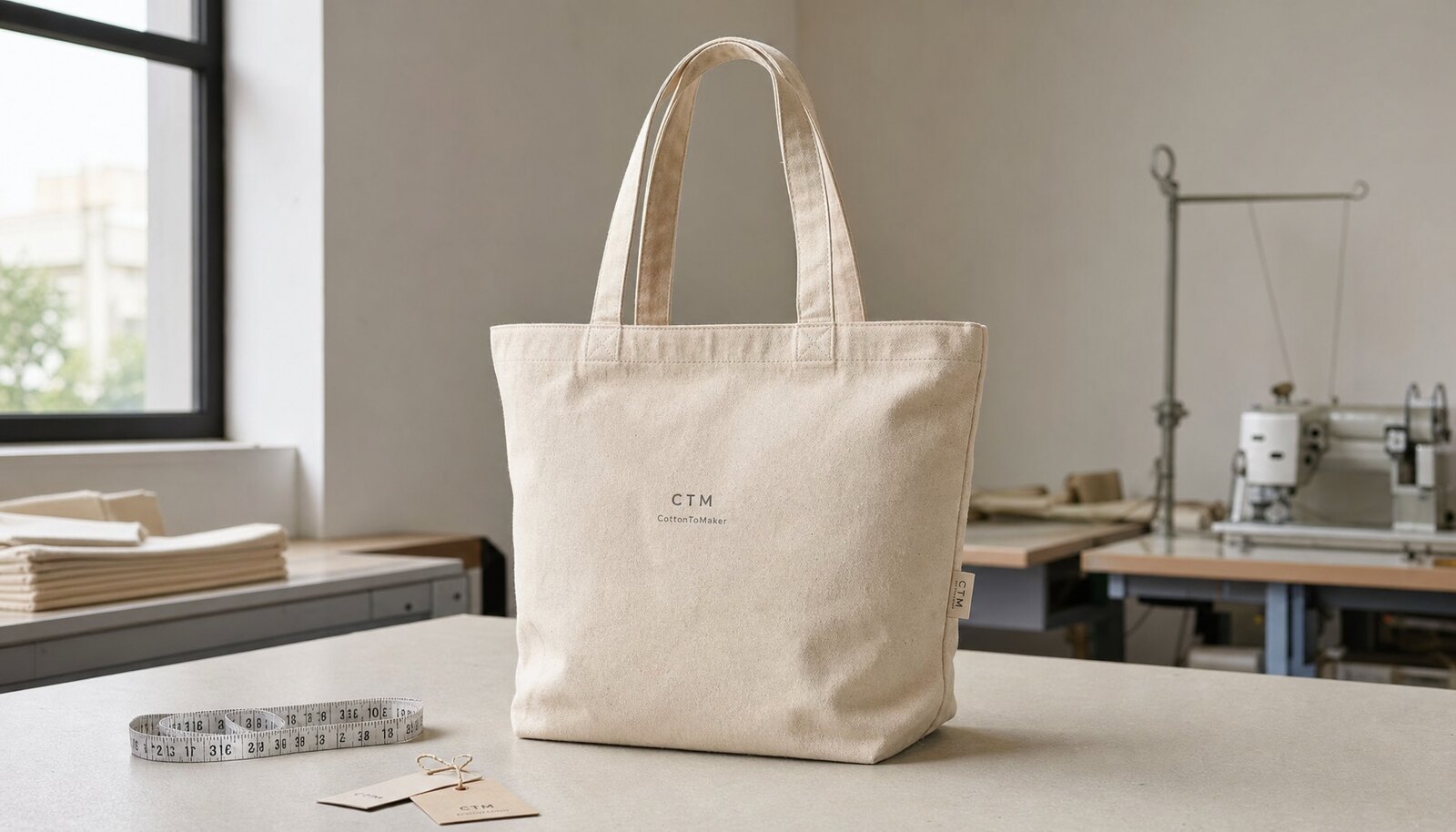
1. Start With the Use Case, Not the Logo
The fastest way to get bad quotes for custom canvas totes is to begin with decoration. Procurement gets better results when the first question is how the tote will be used, how long it needs to last, and what it will carry. A bag that is handed out once at a conference has a different cost structure than a tote sold at retail or used repeatedly in a customer loyalty program. The use case determines fabric weight, handle build, seam strength, packing format, and how strict the QC needs to be.
Use cases also change the economics of reorders. A one-time event bag can tolerate a faster decoration process and simpler packing. A tote that is part of a recurring merch program needs repeatability, consistent shade, and a supplier that can hold the same fabric and print result across production runs. If the buyer does not define the use case, the factory will usually price a generic blank and then add customization on top. That sounds efficient, but it often creates apples-to-oranges quotes that are impossible to compare.
The practical way to brief suppliers is to state the business outcome in one sentence. For example: reusable tote for trade-show kits, retail tote for seasonal sale, shoulder-carry bag for sample distribution, or premium gift tote for executive onboarding. Then add the expected load, folding requirement, and whether the tote must look shelf-ready or only perform in transit. That framing does more for quote quality than a page of logo notes.
For SEO and for supplier clarity, the term custom canvas totes should sit inside the use case, not replace it. Buyers searching that phrase usually need a supplier that can match the tote to a real commercial program. Your RFQ should do the same.
- State the end use before artwork decisions.
- Define load, carry duration, and whether the tote is for resale or giveaway.
- Tell suppliers whether the bag needs to hold shape, fold flat, or support repeat use.
2. Write the Fabric Spec Like a Buyer Who Expects a Defensible Quote
Fabric weight is one of the biggest drivers of both performance and price, but it is often specified too loosely. For many programs, 10 oz to 12 oz cotton canvas is the practical middle ground. It gives enough structure for clean print placement, feels substantial in hand, and still sews efficiently. Light promo totes often sit in the 8 oz to 10 oz range. Premium or heavy-load programs usually move into 12 oz to 14 oz. The important point is not to pick the heaviest possible canvas; it is to select the weight that actually supports the end use without paying for unused strength.
Weight alone does not finish the spec. You also need weave, finish, and shrinkage expectation. Ask whether the fabric is natural, bleached, dyed, garment-washed, or resin-finished, because those choices change print edge sharpness, hand feel, and shade consistency. If the supplier cannot tell you whether shrinkage is already accounted for in cut size, that is a signal that the quote may not be robust enough for production. A tote that fits the sample but arrives undersized after washing or finishing is a preventable commercial defect.
Buyers should also ask for material traceability. At minimum, the supplier should be able to say where the fabric was sourced, whether the lot is dedicated or mixed, and what documents are available if a retailer or compliance team asks for proof. If the order is going into a regulated market or a branded retail channel, request fiber content confirmation, country of origin, and any fabric test reports the supplier can provide. Even when the market does not force formal testing, traceability reduces the risk of surprises if a quality issue appears after shipment.
Comparing fabric on a quote sheet without matching the spec creates false savings. A cheaper quote may simply use lighter canvas or looser construction. The better comparison is the one where every supplier prices the same material, finish, and tolerance band.
- Use one unit system, GSM or oz, and keep it consistent across all quotes.
- Ask whether the fabric is pre-shrunk, washed, or resin-treated.
- Request the fabric source, lot control method, and available compliance documents.
- Do not compare prices until the fabric finish and shrinkage assumptions are identical.
3. Match Decoration Method to Artwork, Volume, and Failure Mode
Decoration affects both cost and the way the tote fails in use. Screen printing is usually the best answer for simple logos, flat spot colors, and repeat production. It scales well, gives clean edges on canvas, and is easy to inspect against an approved sample. Heat transfer is useful when the artwork is detailed or the order is smaller, but buyers should be realistic about edge lift, abrasion, and how the graphic will age if the bag is reused. Embroidery adds a premium feel, but it is usually best for small marks because large stitched fills can stiffen the fabric and distort the body of a lighter tote.
The right quote should name the decoration method, color count, print size, and exact placement. A one-color center-front print is not the same product as a two-color mark at the bottom corner or a woven label plus an oversized back print. When suppliers price the same artwork details, the tradeoff between setup, throughput, and durability becomes visible. That is useful because procurement can then decide whether the program is buying a marketing giveaway or a durable brand item.
For B2B buyers, the useful question is how the decoration can fail. Screen print may crack if the ink system is wrong or the cure is weak. Heat transfer may peel at the edges. Embroidery may pucker or tunnel the fabric if the backing is too stiff. Ask the supplier which failure mode they are guarding against and what test they use to confirm the decoration is stable. That gives you a much better basis for supplier comparison than a vague promise that the print looks good.
If the tote is part of a retail line or premium gift program, request a sample under the same lighting and handling conditions the end customer will see. This is the simplest way to reduce surprises on color density, print sharpness, and overall presentation.
- Screen print is usually best for simple logos and larger runs.
- Heat transfer suits shorter runs or highly detailed artwork if durability requirements are realistic.
- Embroidery is strongest for small premium marks, not large filled areas.
- Ask the supplier to state the expected failure mode and the test used to validate durability.
4. Treat Construction as the Core Product, Not an Internal Detail
Most tote problems show up in construction, not in artwork. Finished body size, gusset depth, handle drop, seam allowance, and reinforcement method determine whether the bag is comfortable, stable, and able to carry the intended load. If those dimensions are wrong, the tote may still look fine in a photo but fail in actual use. Buyers should write those dimensions into the RFQ as commercial requirements, not as design notes.
Handle construction deserves special attention. Self-fabric or folded canvas handles often perform better than thin webbing when the bag is expected to carry books, apparel, or sample kits. The attachment point matters as much as the handle itself. Require the supplier to specify the reinforcement method, such as X-box stitching or bar-tacks, and ask for a close-up photo on the sample. A supplier who says the handle is strong is not giving you a spec. The buyer needs a construction detail that can be checked on arrival.
A simple way to think about the tote is load path. Weight transfers through the handle attachment, the top seam, the side seams, and the bottom panel. That is where the bag must be engineered. If the tote will carry heavier items, ask the factory how they prevent seam distortion, handle tear-out, and panel collapse. The answers tell you whether the factory understands the use case or is just quoting a standard shape.
Construction details also affect freight and warehouse handling. A tote with a more rigid body may pack differently than a soft promo bag. If your warehouse expects a flat-pack carton, the supplier needs to know whether the tote must fold to a specific profile. These are not minor details; they are part of the deliverable.
- Define finished dimensions and handle drop in the RFQ.
- Ask for the exact handle material and reinforcement method.
- State whether the bag must stand upright, fold flat, or support a specific carry load.
- Approve a sample with final seams and reinforcement, not a partial build.
5. Compare Supplier Routes Before You Compare the Price
Not all sourcing routes create the same kind of risk. Factory direct sourcing usually gives the best visibility into material, sewing, and packout, which is useful when the tote will be reordered or used in a standard program. Trading companies can coordinate more moving parts and may be helpful when the buyer needs mixed product types, but that convenience should be visible in the commercial terms. Local stock converters are useful when speed matters more than exact custom construction, especially for urgent replenishment or small test runs.
The mistake is comparing those routes as if they were the same product. A factory quote may be low because it excludes certain packing steps or because compliance paperwork is not part of the base number. A trading company may charge more but include coordination, documentation, and more hands-on follow-up. Neither is automatically better. What matters is who owns each part of the order and where the execution risk sits if a defect appears.
For procurement, the more useful question is which route matches the buying pattern. If the tote will be reordered across campaigns, direct factory control usually gives better repeatability. If the brand needs a fast launch with modest risk, a stock-based conversion partner may be the safer route. If internal bandwidth is limited and the project involves several package elements, a trading company can reduce coordination load. Those are business decisions, not just cost decisions.
A good sourcing program also verifies that the supplier route is real. Ask whether the seller is the actual factory, a contract manufacturer, or an intermediary. Then ask for photos of the production line, sewing team, sample room, or packing area relevant to the order. The goal is not to overcomplicate the buy. It is to know who controls the fabric, the sewing, and the final carton.
- Use direct factory supply for repeatable, standardized programs.
- Use a trading company when coordination and broader sourcing matter more than transparency.
- Use a stock converter when speed is more important than custom pattern control.
- Verify the seller’s actual role before awarding the order.
6. Read the Quote as a Cost Build, Not a Unit Price
A quote for custom canvas totes should show how the price is built. If you only receive a unit number, you cannot tell whether the supplier is giving you the same deliverable as the other bidders. The useful cost elements are fabric weight, decoration method, setup charges, sample charges, packing format, carton data, and any destination-specific handling. If the quote does not separate those items, the buyer is being asked to accept an unknown mix of material and labor assumptions.
The practical comparison is landed cost, not ex-factory price. One supplier may quote a lower tote price but charge separately for screen setup, polybags, labels, and carton marking. Another may quote a slightly higher unit price but include the packing steps the warehouse would otherwise have to do later. In real procurement, the second quote can be better if it reduces receiving labor or avoids rework. This is especially true when the tote is going into retail or a campaign with a fixed launch date.
You do not need a complicated model to check this. Ask for a quote that lists unit price, setup, sample cost, packing, carton size, gross weight, and freight assumptions. Once those numbers are visible, the true commercial gap is easier to see. If a supplier refuses to break out the quote, that is not just an inconvenience; it usually means the buyer cannot verify what is being paid for.
A clean quote also helps natural SEO and buyer trust because it sounds like a real procurement conversation rather than a generic catalog pitch. The buyer should be able to read the quote and immediately know what changes if the fabric weight, print method, or packout changes.
- Ask for separate lines for unit price, setup, samples, packing, carton data, and freight assumptions.
- Compare case count and carton size because cube can change landed cost.
- Check whether labels, inserts, and barcodes are included.
- Award only after the deliverable is fully defined.
7. Approve Samples as the Production Baseline
A physical sample is the control point between quotation and mass production. It tells you whether the tote feels right, whether the logo sits correctly, whether the handles are comfortable, and whether the bag packs the way the warehouse expects. A mockup or digital proof can only show artwork placement. It cannot tell you how the canvas behaves, how the stitching lands, or whether the bag still looks clean once the seams and reinforcement are complete.
The best practice is to approve a pre-production sample after artwork, dimensions, and packout have been agreed. Ideally, that sample uses the same fabric, the same decoration method, and the same packing format planned for the bulk order. If the supplier can only provide a partial sample, then the missing steps should be documented. That prevents a common dispute where a buyer assumes a sample represented the finished order when it did not.
Use the sample to make operational judgments, not just aesthetic ones. Does the tote sit upright? Does the handle drop work on the shoulder? Does the logo size look balanced against the body? Does the fabric crease in a way that makes the bag look cheap? These are commercial questions because they affect acceptance by the end user. Good procurement turns those questions into sample-based approvals before the PO is released.
Keep the approved sample physically on file with the final spec sheet and carton photo. If a reorder is placed later, that record becomes the production reference. That is far more useful than a generic product description when the buyer needs to maintain consistency.
- Approve finished size, fabric feel, handle construction, logo scale, and packing method on the physical sample.
- Document any missing production steps if the sample is not fully finished.
- Keep one signed sample and one photo set for future reorders.
- Use the sample to confirm the tote will actually work in the intended channel.
8. Set QC Standards That Can Actually Be Enforced
QC is where a strong RFQ becomes a defensible order. If the acceptance criteria are vague, the buyer has no leverage when defects appear. The standard should be written in measurable terms: fabric weight tolerance, dimensional tolerance, stitch quality, print registration, stain limits, carton condition, and packing accuracy. That language gives both the supplier and the buyer the same reference point.
A practical starting point is an AQL inspection plan, often around AQL 2.5 for major defects and AQL 4.0 for minor defects, with tighter requirements if the tote is retail-facing. The exact target should match the risk of the program, but the key is to name it in advance. That keeps inspection from becoming a subjective argument after production. If the bag is for retail or a high-visibility brand program, many buyers also add a first-article check at the start of production and a pre-shipment inspection before release.
The most enforceable tote QC standards are the ones tied to actual failure points. Require clean seam lines, no open seams at stress points, no skipped stitches, no loose thread bundles, no obvious oil stains, and no major shade variation inside a lot. For print, specify allowable registration error, color match against the approved sample, and visible surface defects such as smearing, pinholes, or edge lift. If the tote is sold or reused, ask for a simple load test or carry trial on a sample unit at the expected use weight.
Carton QC matters too. Check case count, inner pack method, carton markings, and sample cartons from different positions in the shipment stack. If the cartons will travel long distances or be palletized, add a basic carton-drop or compression check. A simple field standard is a fully packed carton dropped from roughly 80 cm to 100 cm on one corner, one edge, and one flat face, followed by inspection for bag damage, label failure, or collapsed packing. That is not overengineering; it is preventing avoidable inbound claims.
If the buyer needs traceability, require lot records for fabric, print batch, and packing date. That makes it possible to isolate problems quickly if a defect is found after arrival.
- Use AQL 2.5 for major defects and AQL 4.0 for minor defects as a practical baseline, then tighten if the program needs it.
- Write stitch, print, and stain criteria in measurable terms.
- Add carton-drop or compression checks for export or palletized shipment.
- Require lot records for fabric, print batch, and packing date when traceability matters.
9. Make Packing, Compliance, and Lead Time Part of the Product
Packing is not an afterthought on a tote order. Bulk flat-pack cartons are usually the most efficient option for export and warehouse receiving because they reduce cube and keep handling simple. Retail-ready packout, by contrast, may include polybags, labels, inserts, hangtags, or barcode stickers. Each added step changes cost, lead time, and inspection needs. If the buyer does not define the packing method early, the supplier will either guess or price a generic format that does not match the actual channel.
Compliance should be handled with the same discipline. Depending on the destination market and customer requirements, the supplier may need to provide fiber content, country of origin, restricted-substance information, and test reports for the fabric or decoration system. Even when a formal certificate is not mandatory, asking for available documentation is a sensible commercial step. It reduces the risk of an order clearing production but failing a customer audit or internal QA review later.
Lead time is also easy to overstate. A real schedule includes fabric booking, sample approval, decoration setup, sewing, packing, inspection, and final shipping. If a supplier offers a fast turnaround, ask what assumptions make that possible: stock fabric, no artwork revisions, no new packout, and no lab testing delay. Those assumptions matter more than the headline number. The shortest lead time in a quote is not the most reliable one unless the process behind it is explicit.
This section often gets skipped in early sourcing, but it is where delays become expensive. If the tote is tied to a seasonal launch, internal event, or retail drop, one missed week can destroy the commercial value of the order. Build the schedule from the back end, not from the date the quote was requested.
- Confirm whether packing is bulk flat-pack or retail-ready.
- Request carton dimensions, gross weight, and case count before shipping is booked.
- Ask for fiber content, origin, and any relevant compliance documents.
- Define the lead-time start point and the assumptions behind it.
10. Use a Simple Go/No-Go Framework Before You Release the PO
Before you award custom canvas totes, sort the decision into three buckets: spec, commercial terms, and execution control. Spec covers fabric, construction, dimensions, decoration, and packing. Commercial terms cover MOQ, setup, payment, and freight assumptions. Execution control covers sample approval, QC standards, compliance documents, and who owns the defect fix if something goes wrong. If any one of those buckets is unclear, the order is not ready to release.
This framework matters because tote buying often starts as a branding task and becomes a supply-chain task by the time the shipment is due. A low unit price does not help if the tote arrives with the wrong fabric lot, weak handles, or retail labels applied incorrectly. A tighter RFQ reduces the chance of that outcome because it forces suppliers to price the actual deliverable, not an abstract tote concept.
For repeat programs, the first order should become the baseline for the next cycle. Save the approved sample, the final spec sheet, the carton data, and the QC acceptance record. When you reorder, quote against that baseline rather than re-creating the brief from memory. That is how buyers reduce quote drift and make supplier comparisons cleaner over time.
If you need a quick internal rule, use this: no PO until the buyer can answer what is being bought, how it will be checked, how it will be packed, and what documents will arrive with the shipment. If those four answers are complete, the order is usually ready to move.
- Keep one comparison sheet and make all suppliers quote the same assumptions.
- Do not approve price until spec and packout are fixed.
- Retain the approved sample and final QC record for reorders.
- Require the supplier to keep material and construction records for repeat programs.
Specification comparison for buyers
| Quote scenario | What you are really buying | Best-fit procurement use | Buyer check before award |
|---|---|---|---|
| Low-cost quote | Usually lighter canvas, simpler stitching, fewer QC steps, and minimal packing | Event giveaways, high-volume promos, short-life campaigns | Confirm fabric weight, handle reinforcement, print method, and whether the quote excludes polybags, cartons, or setup |
| Balanced production quote | Standard canvas with normal reinforcement, controlled printing, and export-ready packing | Corporate programs, retail support, reusable grocery or gift totes | Check that the sample matches bulk fabric, finished size, carton count, and defect tolerance |
| Control-heavy quote | Heavier canvas, tighter tolerances, documented inspections, traceability, and compliance files | Retail merchandising, premium gifting, programs with repeat reorders | Ask for QC records, material origin, test reports, and a written corrective-action path if defects are found |
| Fast replenishment quote | Stock-based blanks or partially stocked materials with limited customization | Urgent launches, event restocks, seasonal fills | Verify stock status, decoration lead time, and whether the supplier can hold identical shade and construction on reorders |
| Custom cut-and-sew quote | New pattern, fabric allocation, dedicated sewing, and fully defined packaging | Programs that need specific dimensions, structure, or brand presentation | Confirm MOQ by fabric color, decoration color, and packing format before you compare unit price |
| Material | 8-12 oz cotton canvas, 120-220 gsm cotton, recycled cotton, or blended fabric selected by use case and target price | Before price comparison | Different cloth weights, backing, or certification claims make quotes hard to compare |
| Construction | bag size, gusset, handle drop, seam allowance, stitch density, reinforcement patch, and loading expectation | Before sampling | Weak stress points create returns and failed inspections |
| Decoration | screen print, heat transfer, embroidery, woven label, or hangtag matched to fabric texture and brand durability needs | Before artwork approval | The wrong method can crack, bleed, pucker, or fail on the chosen fabric |
Buyer checklist before sampling
- State the exact end use: giveaway, retail, grocery, conference kit, onboarding gift, or resale item.
- Specify finished dimensions, gusset depth, handle drop, seam allowance, and whether measurements are taken before or after sewing tolerance.
- Write the fabric spec in GSM or oz, plus weave, finish, shrinkage allowance, and whether the canvas is natural, bleached, dyed, garment-washed, or resin-finished.
- Define the decoration method, logo size, number of colors, placement, and whether print bleed, overrun, or wraparound decoration is acceptable.
- Ask for a physical pre-production sample built from production materials, not a visual mockup.
- Separate unit price, setup charges, sample cost, packing cost, carton specs, and freight assumptions in the same quote.
- Confirm carton packout, inner polybag need, hangtag requirement, barcode placement, and whether retail labels are factory-applied.
- Ask the supplier to state measurement tolerances, print registration tolerance, stitch acceptance criteria, and defect limits in writing.
- Request carton dimensions, gross weight, case count, and pallet pattern before shipping terms are finalized.
- Clarify the lead-time start point: deposit, artwork approval, sample approval, or fabric booking.
Factory quote questions to send
- What exact canvas weight, weave, and finish are you quoting, and what tolerance do you hold on that spec?
- Is this quote for stock blanks, custom cut-and-sew, or a hybrid build with stock fabric and custom finishing?
- What setup charges apply for screen printing, embroidery, woven labels, heat transfer, or special sewing, and are they one-time or per color?
- What is the MOQ by style, fabric color, print color, and packaging format?
- Can you quote the same tote with bulk flat-pack, polybagged packout, and retail-ready packing so I can compare labor and cube?
- What are the finished size tolerances for body width, height, gusset depth, and handle length?
- What stitch count or reinforcement method do you use at the handle attachment, and can you show a construction detail photo?
- Which QC checkpoints are inspected before shipment, and can you share the defect classification standard?
- What documents can you provide for material traceability, fiber content, origin, and compliance?
- If fabric must be sourced after award, what is the additional lead time and what risks would change the ship date?
Quality-control points to confirm
- Use an AQL plan in the PO or inspection agreement. A common starting point for tote programs is AQL 2.5 for major defects and AQL 4.0 for minor defects, with a tighter target for retail programs if your business requires it.
- Approve a stitch standard by function, not by appearance alone. For handle attachments, require documented reinforcement such as X-box or bar-tack construction, with no skipped stitches, no thread break at load points, and no loose thread tails beyond an agreed limit.
- Set a measurable sewing benchmark. Buyers often specify a minimum seam margin of 6-10 mm, reinforced handle attachment with at least two rows of secure stitching, and no open seam at stress points after normal handling.
- Define print acceptance with a test method. Check registration against the approved artwork under daylight-equivalent lighting, and require no major cracking, peeling, pinholing, smearing, or color shift on the final piece.
- Use dimensional tolerance bands in writing. A practical starting point is +/- 0.5 cm to +/- 1.0 cm on small totes and a slightly wider band on larger formats, but the exact band should match the program and sample approval.
- Require a visual defect limit for stains, oil marks, needle damage, snags, and loose yarns. If the bag is retail-facing, even small stains can be unacceptable; write that into the acceptance criteria.
- Ask for carton-drop and compression checks on the final packout. A simple control is one corner, edge, and flat drop from roughly 80 cm to 100 cm on a fully packed carton, plus a stacked-storage check for crushed cartons if the route is palletized.
- Verify carton count accuracy at random positions from top, middle, and bottom layers, and require pack photos that show label placement, folding method, and case contents.
- If the tote will be reused or sold, request a basic durability test. A common buyer check is a loaded-carry trial at the expected working load for several minutes, followed by inspection of handle attachment, seam integrity, and distortion.
- For destination-sensitive programs, require color shade approval against the approved sample under the same light source used for inspection, not just against an on-screen image.