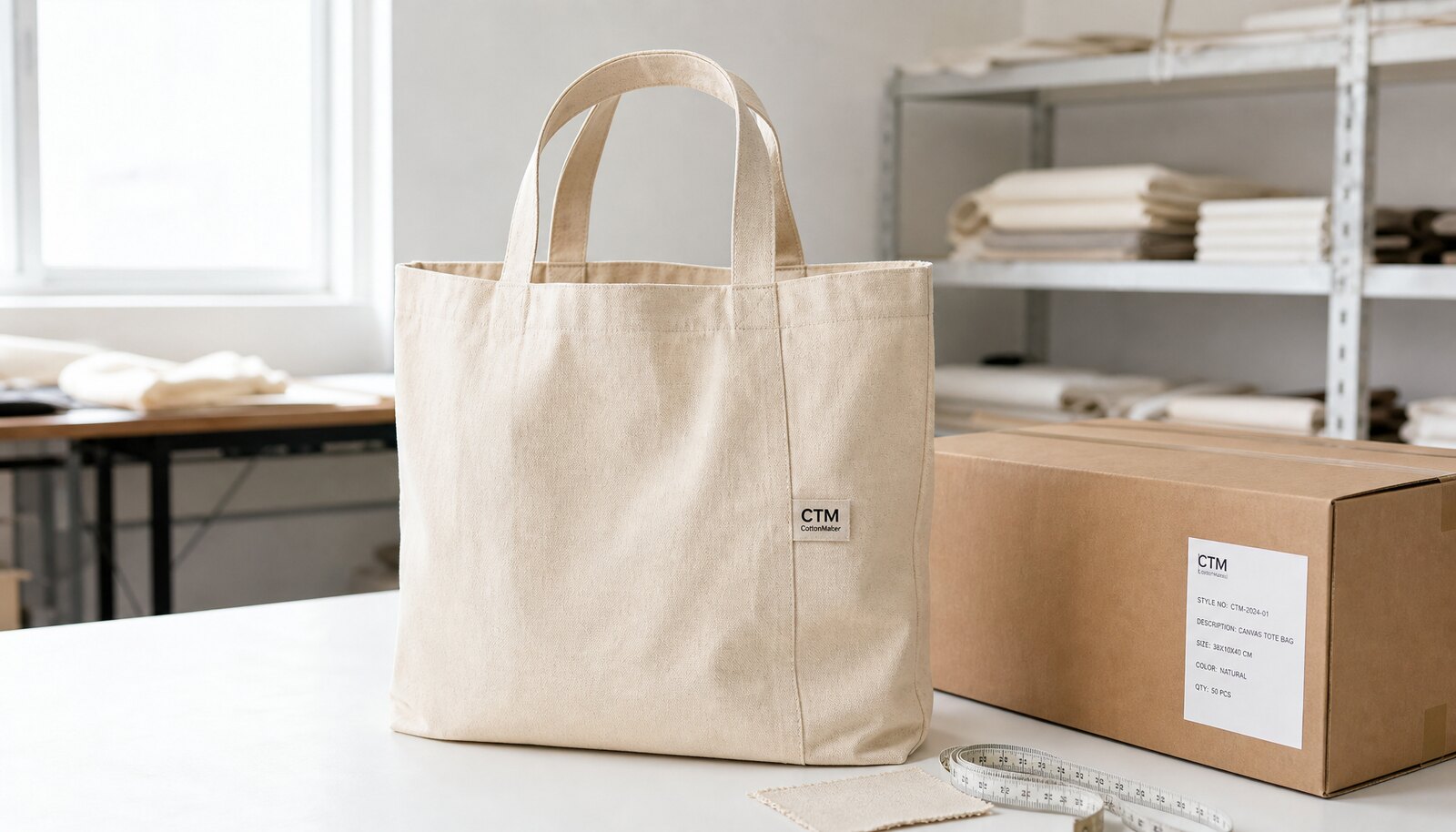
Start with the box, not the tote
Custom canvas tote bags for subscription boxes are rarely judged on the tote alone. They are judged on how well the bag fits the carton, how quickly it can be inserted, and whether it still looks deliberate when the customer opens the box. If the tote is treated like a generic promo item, the buyer usually discovers the mismatch too late: the bag takes up too much space, the print scuffs in transit, or the fulfillment team has to re-fold it by hand on every order.
The right spec starts with the physical flow of the box, not with a supplier's default catalog size. Measure the usable inner carton dimensions, the fold sequence, and the exact position where the tote sits relative to other inserts. If the bag is meant to stay flat under other products, the fabric choice and handle length should support that. If it is the hero item, the spec should prioritize presentation after unboxing and reuse after delivery. Those are different buying jobs, and they should not be priced as the same item.
- Treat the tote as a packaging component first and a merchandise item second.
- Measure the real carton interior and fold path before approving bag dimensions.
- Tie the spec to line speed, not just to visual appeal in a sample photo.
Write a fabric spec that a factory can actually follow
For most subscription box programs, 12 oz to 14 oz canvas is the practical range. A 12 oz bag is usually enough when the tote is a secondary insert and the purchase decision is driven by price control. A 14 oz bag gives more body, hides contents better, and tends to feel more substantial in hand, but it also adds cost and increases the bulk that has to be packed into the carton. The right answer depends on how the tote is positioned in the box, not on a generic idea of what a canvas bag should be.
The procurement issue is that suppliers often use the same word, canvas, for different constructions. Ask for finished gsm, weave description, color basis, and whether the cloth is natural, bleached, dyed, or washed. If you need batch consistency, ask for a retained swatch and a written tolerance band on weight and shade. If the supplier cannot describe the fabric in measurable terms, the quote is hard to compare and the repeat-order risk is high.
- Use finished gsm and oz together so the factory is quoting the same fabric basis you are buying.
- Ask for lot-to-lot shade control if the tote will be reordered across monthly subscription cycles.
- Define whether the canvas should be natural, bleached, or dyed before sample work starts.
Dimension the bag around fulfillment behavior
The most common sizing mistake is choosing a tote that looks good flat on a table but fails the carton test. A bag can be the right width on paper and still be awkward once it is folded around product inserts, stacked under tissue, or tucked beside a rigid item. That is why the finished body size should be set from the usable carton space, the required fold depth, and the labor model in the warehouse or co-packer. The tote should fit the process, not force the process to adapt to it.
A procurement-grade spec should define the finished body length, width, handle drop, seam allowance, and any gusset or bottom reinforcement. For small and medium bags, many buyers hold key dimensions to about plus or minus 0.5 cm on sample approval; larger bodies can often tolerate plus or minus 1 cm if the carton fit is still stable. Handle placement should be symmetrical, and the straps should not twist during sewing or when the tote is folded. If the tote cannot be packed the same way every time, the line will pay for that variation later.
- Match tote dimensions to the carton interior and fold allowance, not the printed box size.
- Set a tolerance band for body size and handle length before bulk approval.
- Avoid oversized bags that increase void space and slow packing.
Choose branding based on artwork complexity and wear
For simple logos and repeat orders, 1-color screen print is still the most practical option in many programs. It gives a clean retail look, keeps setup cost under control, and is easy to repeat when the same tote comes back in a monthly or quarterly cycle. If the artwork is small, busy, or has multiple colors, the buyer should not force it into a process that was never meant for that level of detail. That is how you get blurred edges, uneven coverage, and print placement that looks acceptable in a proof but weak on the finished bag.
Woven labels, sewn patches, and some heat-transfer methods can make sense when the tote is part of a premium identity system or when the brand needs a more durable finish. The tradeoff is usually cost, added setup, or greater sensitivity to fold lines and handling. The buyer should decide the branding method by asking two questions: how many times will this art need to repeat, and how much wear will the tote see after the customer takes it out of the box? That answer should drive the method, not the supplier's favorite process.
- Use screen print for simple logos and long-running reorder programs.
- Use heat transfer only if your team has validated fold, rub, and adhesion behavior.
- Use woven labels or sewn patches when repeatability and premium positioning matter more than lowest unit price.
Compare factory, trader, and hybrid sourcing on commercial risk
A low quote does not tell you who is actually making the tote. Direct factory sourcing is usually the best path when the style will repeat, the artwork is stable, and the buyer wants control over stitching, print, and packing in one production chain. It is easier to hold a factory accountable for sample accuracy and reorder consistency when the same line is expected to make the second and third batch. The downside is that minimums can be higher and the front-end quotation process may move more slowly.
Trader or distributor sourcing can be useful when the buyer needs lower MOQs, more design help, or a faster way to test a new subscription program. The risk is that the sample may come from one source while the bulk order is moved to another, or the production site changes without a clear notice trail. Hybrid sourcing can work when sewing happens in one place and final packing or bundling happens elsewhere, but then the buyer needs a very clear escalation path, a retained sample, and a written rule for what happens if a defect is found after the goods leave the first site. Sample ownership matters here. If nobody can point to the approved sample and the exact producer, repeat orders will drift.
- Direct factory is usually stronger on repeat consistency and production accountability.
- Trader routes can help with flexibility, but require stronger proof of the real producer.
- Hybrid setups need a named owner for sample control, change approval, and defect escalation.
Use the RFQ to force an apples-to-apples quote
The RFQ should read like a control document, not a design brief. It needs the final artwork file, fabric target, body dimensions, handle length, print method, packing format, carton assumption, and inspection rule in one place. If a supplier is quoting from an incomplete brief, the unit price may look attractive while hiding setup costs, special packing charges, or a different production assumption that will not survive first contact with the warehouse. Buyers save time by making every supplier quote the same spec, the same packing rule, and the same incoterm.
The best RFQs also separate base pricing from variable charges. Ask the supplier to show sample cost, print setup or plate cost, special packing cost, and freight assumptions as separate lines. If the supplier can only give one total price, you cannot tell whether they are competitive or just omitting costs that will appear later. For procurement teams, the useful comparison is not sticker price. It is landed cost under the same quality and packing assumptions.
- Quote the same body size, fabric weight, artwork, packing, and carton spec to every supplier.
- Separate sample cost, setup cost, packing cost, and freight assumptions into different lines.
- Ask for price breaks at 2 or 3 volume levels so the team can see where setup cost is absorbed.
Set sample approval rules before bulk starts
A sample should be treated like a production trial, not a souvenir. For subscription box totes, the sample has to prove that the bag folds the way the fulfillment team intends, fits the real carton, and still looks clean after being compressed with other inserts. The buyer should test the exact fold path, the packing count, and the unpacking sequence used in the program. If the tote springs open, steals space from another item, or creases the print into a bad visual position, the sample is not ready even if the logo looks right in isolation.
The sample should also be used to lock quality thresholds. Check body dimensions, handle length, handle symmetry, stitch consistency, and print placement against the approved master. Many buyers use an agreed inspection standard such as normal inspection under AQL 2.5 for major defects and 4.0 for minor defects, with critical defects at zero tolerance. That only works if major, minor, and critical are defined in the PO or quality appendix. Without that definition, the inspection report is just paperwork.
- Test the tote in the actual carton and with the same fold path the warehouse will use.
- Approve one golden sample and keep it at the receiving or QA site.
- Tie AQL levels and defect definitions to the PO so the factory knows the failure threshold.
Put stitch, print, and packing checks into production control
QC for canvas totes has to be specific enough to stop avoidable defects, not just obvious failures. On the sewing side, buyers should ask for a visible stitch-density target on the top edge and handle attachment, often around 7 to 9 stitches per inch for this type of bag, plus complete backstitching or bartacks at the stress points. That matters because handle failures are the defects that customers notice first. The bag may pass a simple visual check and still come apart early if the attachment zone is weak or the threads are uneven.
Print control needs the same level of detail. Ask for the allowed print position tolerance, the acceptable color match window, and the rub or fold test used on the approved sample. Buyers should reject visible cracking, flaking, bleed, ghosting, or misregistration that reduces brand readability. Packaging failures also need to be named: wrong bundle count, mixed style cartons, loose thread contamination, print scuffing, crushed cartons, and labels that do not match the PO. Those are not cosmetic nuisances. They create receiving delays, repacking labor, and preventable claims.
- Require stitch density targets and reinforcement at handle attachment points.
- Use a fold and rub check on print, then retain the approved result as the benchmark.
- Define packaging failures as defects, not just warehouse inconveniences.
Control packing, cartonization, and freight before the first shipment
Packing format can change the economics of the whole program. Loose bulk is cheap to prepare, but it can cause counting errors, scuffing, and folding inconsistency. Flat bundles are usually better for subscription box inserts because they are easier to count, easier to inspect, and easier for a fulfillment team to handle at speed. If the print is delicate, an inner polybag may be justified, but the buyer should treat that as a costed decision, not an automatic upgrade. Every extra layer creates more handling and more volume inside the carton.
The carton spec should be written with the warehouse in mind. Ask for carton dimensions, gross weight, quantity per carton, and carton labeling before the shipment is booked. A good carton is one that can be received, counted, and stored without repacking. It should also support the freight mode the buyer plans to use, whether that is parcel, LCL, or full container. When the carton is too heavy, too bulky, or inconsistently packed, the freight rate is only part of the cost. The real cost shows up in receiving labor and damaged pack-outs.
- Prefer flat bundles and stable counts when the tote is inserted into a box program.
- Use inner poly only when print rub or contamination risk justifies the extra cost.
- Lock carton size and gross weight before freight booking and warehouse intake.
Plan lead time and reorders around change control
The lead time for a tote is not just sewing time. It includes artwork confirmation, fabric sourcing, sample making, sample approval, print setup, bulk production, packing, inspection, and freight booking. If the art is still moving after the quote is accepted, the schedule is already at risk. For subscription box launches, that risk is usually amplified because the tote has to arrive before the box assembly window, not just before a generic ship date. Build the timeline backward from that assembly date and give yourself room for sample iteration and inspection.
Repeat orders deserve their own control plan. Keep the approved art file, retained sample, carton spec, and production notes in one place, and require the same factory or a formally approved alternate for the next run. If the supplier changes fabric lot, print method, or packing format, that change should be visible and approved before bulk starts. Cotton is a natural material, so some variation is normal, but the buyer should define what can drift and what cannot. That is how you keep the second run from becoming a different product under the same SKU.
- Build launch timing around sample approval and freight booking, not only around sewing lead time.
- Store the approved art, sample, carton spec, and defect log for reorder use.
- Treat any change in factory, fabric lot, or packing format as a formal approval item.
Specification comparison for buyers
| Decision area | Low-cost or flexible option | Best controlled option | Buyer acceptance criteria |
|---|---|---|---|
| Sourcing route | Trader or hybrid sourcing can reduce the barrier to entry and help with smaller runs, but the actual factory may change between orders. | Direct factory or named contract manufacturer is usually better for repeat subscription programs because sewing, print, and packing stay in one control chain. | Require the legal producer name, factory address, sample origin, and a written escalation path. For repeats, keep the same production site unless a new sample is approved. |
| Fabric weight | 12 oz canvas is lighter on cost and works when the tote is a secondary insert or giveaway. | 14 oz canvas gives more body and a more premium hand feel, but increases material cost and freight volume. | Ask for finished gsm and a permitted range, plus a retained swatch. Acceptance should be based on the approved sample's weight, shade, and hand feel, not a verbal label like 'heavy canvas'. |
| Branding method | 1-color screen print keeps setup cost low and usually wins on repeat runs with simple logos. | Woven label or sewn patch costs more up front but is more durable and less sensitive to slight registration drift. | Approve logo position, color match, and rub resistance. Reject visible cracking, bleed, or misregistration beyond the buyer's tolerance. |
| Packing format | Loose bulk or simple bundles reduce packing labor at the factory, but can create counting and scuffing issues. | Flat bundles with a defined count per bundle and master carton are easier to receive and recheck, though they add packing labor. | Require bundle count, inner protection if print rub is a risk, carton dimensions, and gross weight before booking freight. |
| MOQ strategy | Lower MOQ helps test a new subscription program or seasonal insert, but the unit price is usually higher. | Higher MOQ lowers per-piece cost and can secure better factory attention, but it ties up cash and storage. | Ask suppliers to price 2 or 3 volume breaks so you can see when setup cost is fully absorbed. |
| Inspection standard | A loose, visual-only check is faster but misses dimensional drift and hidden sewing defects. | Normal inspection with AQL 2.5 major and 4.0 minor is more defensible for procurement, with critical defects at zero. | Define major, minor, and critical defects in the PO, and keep the approved sample or golden sample at the receiving site. |
Buyer checklist before sampling
- Confirm the tote's role in the box flow: insert, gift item, or reusable carry bag after unboxing.
- Freeze the final carton interior dimensions and the exact fold method before asking for quotes.
- Specify finished fabric weight in oz and gsm, plus the allowed range for bulk production.
- Define bag body size, handle drop, seam allowance, and any gusset or bottom reinforcement.
- Choose the branding method, number of colors, artwork placement, and acceptable registration tolerance.
- State whether the tote must arrive flat, folded, bundled, polybagged, or packed inside a master carton.
- Request pack counts, carton dimensions, gross weight, and the expected carton label format.
- Ask for pre-production sample photos that show seam finish, handle attachment, and print placement.
- Define defect classes in the PO: critical, major, and minor, and tie them to your inspection standard.
- Clarify whether the supplier is quoting direct factory, trader, or a hybrid route with outside packing.
Factory quote questions to send
- What is the exact factory or workshop that will sew and print the tote?
- What finished fabric weight are you quoting in gsm and oz, and what tolerance do you allow?
- Is the canvas natural, bleached, dyed, or washed, and is there any expected shade variation between lots?
- What is the bag body size, handle length, seam allowance, and reinforcement method at the handle attachment?
- Which branding method are you pricing, how many colors are included, and what setup charges apply?
- What is the print position tolerance, and how do you control misregistration on repeat orders?
- How many samples will you provide, what is the sample cost, and is the sample sourced from the actual production line?
- What is the MOQ by fabric color, print version, and packing format?
- How will the bags be packed: loose, flat-folded, bundled, or polybagged, and how many per bundle or carton?
- What carton size, carton count, and gross weight are assumed in the quotation?
Quality-control points to confirm
- Use the approved sample as the master reference for fabric hand feel, color, print position, and construction detail.
- Check finished fabric weight against the approved target and allow only the agreed tolerance, typically within about 5% unless your spec says otherwise.
- Measure body length, width, and handle drop on a sample set and require consistency within the buyer's tolerance, often plus or minus 0.5 cm on small dimensions and plus or minus 1 cm on larger bodies.
- Inspect stitch density at the top edge, side seams, and handle attachment; a common target is 7 to 9 stitches per inch, with complete backstitching or bartacks at stress points.
- Reject skipped stitches, loose threads longer than the agreed limit, twisted handles, open seam ends, and raw edge exposure at the top turn-in.
- Check that handle attachments are symmetrical and that the strap does not drift more than the approved placement tolerance from left to right.
- Verify print alignment against the art proof and reject visible ghosting, pinholes, bleeding, or color shift that changes the logo's readability.
- Run an internal rub or fold test on the approved sample and require the print to avoid cracking, flaking, or transfer after handling that matches your packing process.
- Inspect for oil stains, dust, broken needle marks, and contamination from cutting or sewing tables before cartons are sealed.
- Confirm bundle counts, carton counts, and label data against the purchase order, including style, color, quantity, and buyer reference.