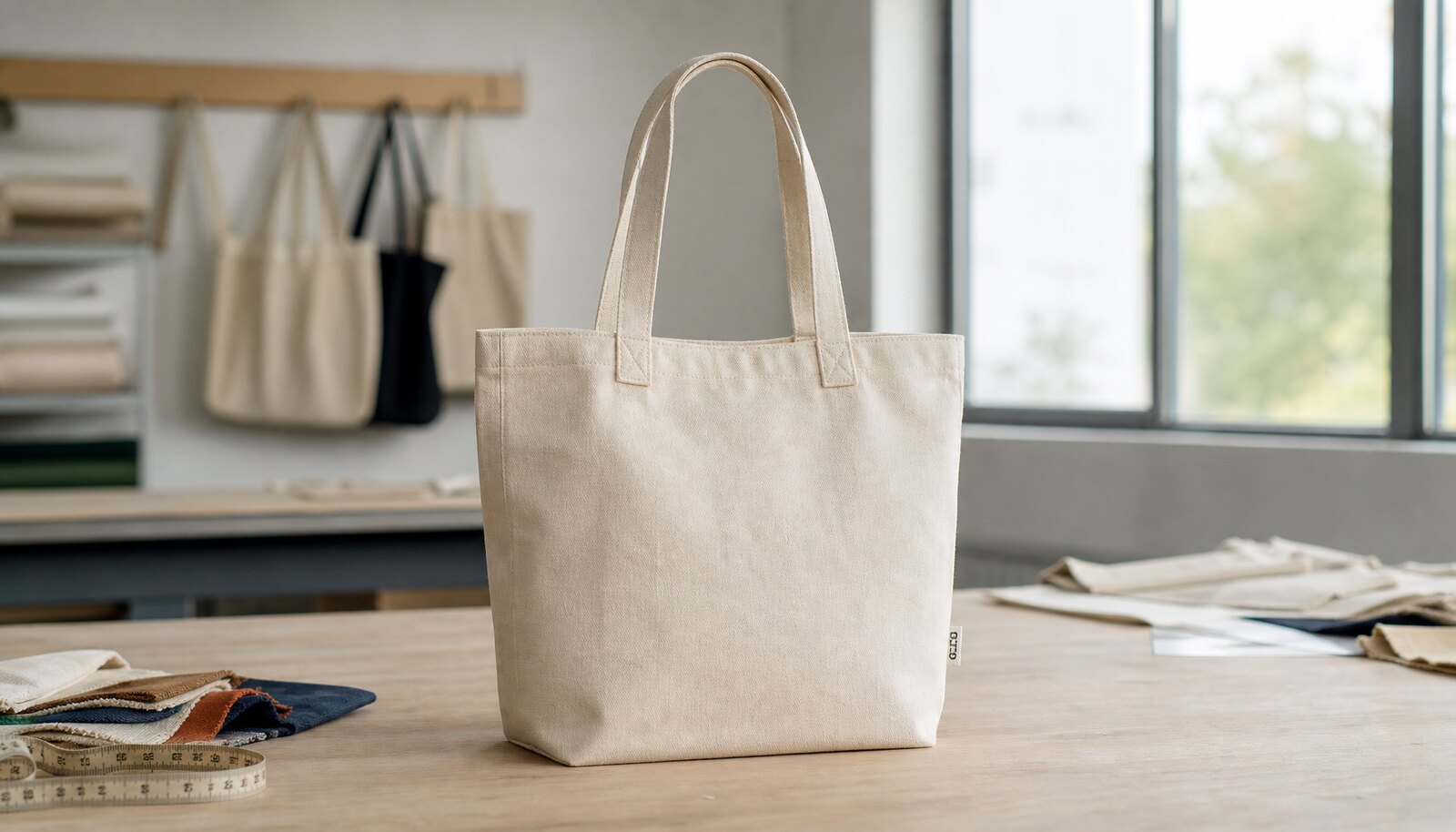
Start With the Use Case, Not the Tote
Wineries buy canvas totes for different jobs, and the job should decide the spec. A tasting room retail bag needs a different hand feel and print finish than a club gift, a bottle carrier, or a trade-show handout. If the bag is going to sit on a shelf and compete with other merchandise, it has to look finished. If it is meant to carry a bottle, it has to hold shape, protect the contents, and survive repeated use without stretching at the handle points.
Most quote confusion starts when the buyer names a tote but not the use case. A factory can price a light promotional bag very differently from a two-bottle retail carrier with reinforced seams and a premium print. Put the end use into the RFQ in plain language: how many bottles, whether the bag must stand upright, whether it is a purchase item or a giveaway, and whether the buyer cares more about shelf appeal, durability, or the sustainability story.
- State the bottle count and maximum expected load.
- Say whether the bag is for retail, club fulfillment, or event use.
- Define where the brand mark needs to sit and how visible it must be.
- Tell the factory if the bag must fold flat for shipping or display upright in-store.
Choose Fabric and Build That Survive Wine Merchandising
For winery totes, fabric weight is the first real decision. A 10 oz canvas, roughly 340 gsm, can work for a light promotional bag or a single-bottle giveaway, but it can feel soft if you want a more premium retail product. A 12 oz canvas, around 406 to 410 gsm, is the practical default for most winery programs because it balances body, print clarity, and cost. If the bag is meant to carry two bottles or support a heavier souvenir purchase, 14 oz to 16 oz, or roughly 475 to 540 gsm, gives you a better structure and a cleaner retail feel.
Construction matters as much as weight. Ask for seam allowance, bar tacks on the handle ends, and a bottom gusset if the tote needs to stand. Self-fabric handles are fine for a simple program, but cotton webbing usually gives better grip and better pull resistance on a loaded bag. If the product will sit in a premium channel, also look at stitch density and edge finishing. A slightly heavier fabric with sloppy stitching is still a weak product, so the quote has to cover both material and workmanship.
- 10 oz or about 340 gsm is a light promotional starting point, not a universal retail spec.
- 12 oz or about 406 to 410 gsm is the most common middle ground for winery programs.
- 14 oz to 16 oz is safer for two-bottle carry, higher-end merchandising, or repeated reuse.
- Ask for bar tacks, reinforced seams, and a gusset if the bag must handle weight without sagging.
Compare Sustainable Sourcing Routes
Sustainable packaging is not only about the fiber content. For a buyer, the real question is which sourcing route gives the best mix of material traceability, waste control, freight efficiency, and finished durability. A tote that lasts longer and ships in a compact carton can make more sense than a weaker bag with a better label claim. The sustainability story should survive procurement review, warehouse handling, and actual customer use, not just a sales deck.
For wineries, direct factory sourcing usually works best when the spec is repeatable and the buyer wants custom size, print, and packing under one roof. A regional decorator can be useful when speed is critical or the quantity is low, but the unit cost can rise quickly once blanks, decoration, and repacking are layered together. A trading company is only worth the margin if it adds real control on communication, QA, or consolidation. Ask how each route handles material proof, production control, and packing waste before you compare the quote numbers.
- Direct factory: best for custom build, repeat orders, and controlled unit economics.
- Regional decorator: best for short lead time and lower volume, but confirm blank quality and rework risk.
- Trading company: useful only if it adds sourcing control or consolidates multiple SKUs.
- Sustainability should include durability, rejected units, freight density, and packaging waste.
Pick a Print Method That Matches the Artwork
The print method should follow the logo, not the other way around. Screen print is usually the safest choice for winery branding when the artwork is simple, the colors are limited, and you want a clean result on natural canvas. It holds up well, gives strong opacity, and keeps unit cost under control. If the logo has fine lines, small text, or a soft gradient, that is where suppliers start cutting corners, so the artwork needs to be simplified or the buyer needs to accept a more expensive decoration method.
Woven labels, embroidery, and sewn side labels can fit a premium winery program because they communicate texture and permanence. They also reduce the risk of surface cracking that comes with some heat transfers. The tradeoff is setup cost, stitch limits, and the chance of distortion on thin canvas. A good sample should prove the print position, the edge sharpness, and the color match under warehouse light, not just on a screen. If the bag will be washed or handled often, run a rub test before approving the bulk order.
- Screen print suits bold winery logos, limited colors, and repeat orders.
- Woven labels and sewn side labels work well for a more premium retail look.
- Embroidery is durable but can distort on light canvas if the stitch density is too high.
- Heat transfer can be useful for short runs, but it needs a close look for cracking and surface wear.
Read MOQ and Setup Costs the Right Way
MOQ on canvas totes is usually driven by how many variables the factory has to switch. One size, one fabric weight, one print color set, and one packing format is the cleanest route. Every extra option changes sewing efficiency, screen setup, carton planning, and labor time. That is why one supplier may quote a clean number while another adds surprises for variant changes, label changes, or mixed packing. A quote that looks cheap can become expensive once the setup lines are fully counted.
To manage MOQ, reduce the number of unique decisions before you ask for pricing. Use a stock natural canvas shade if the brand allows it, keep artwork to one print location, and avoid mixed handle lengths unless they are functionally necessary. If you need multiple bottle styles or retailer-specific packing, ask the factory to quote each line separately rather than blending them into one average price. That makes it much easier to see which variant is driving cost and which one is worth keeping.
- Ask whether MOQ is set by total units or by each size and artwork variant.
- Separate one-color and two-color artwork into different quote lines.
- Treat special labels, inserts, and retail packing as cost items, not freebies.
- If you need a low MOQ, remove every nonessential customization before sampling.
Set Sample Approval and QC Thresholds
A digital proof is not a sample. For a winery tote, the physical sample is where the buyer sees fabric body, seam behavior, handle placement, and print finish. A pre-production sample should match the intended fabric weight, decoration method, and packing format. If the project is for bottle carry, load the sample with the actual bottles or a true weight equivalent and see how the base and handles behave. That step catches design problems that are invisible on a flat proof, especially if the tote needs to stand up on a retail shelf.
Write measurable acceptance points before mass production starts. Give the factory a size tolerance, a print placement tolerance, and a simple visual standard for stains, loose threads, and crooked stitching. If the tote is part of a premium wine purchase, the product should look symmetrical and feel stable when lifted by one handle. When a sample is approved, keep a signed reference sample or a photo set with dimensions, because that becomes the baseline if the bulk lot starts drifting.
- Check finished width, height, gusset, and handle length against a stated tolerance.
- Approve print position and color on an actual fabric sample, not only on a PDF.
- Test loaded handle strength and seam stability with real bottles or a true weight load.
- Keep one approved reference sample in case the production lot needs a dispute check.
Specify Packing for Tasting Room and Ecommerce
Packing is not a back-end detail; it changes cost, appearance, and receiving speed. If the bags go into a tasting room or retail store, the fold size needs to be consistent and the carton count should be easy to count on arrival. If the bags ship through ecommerce or club fulfillment, the buyer may want an outer polybag, a barcode label, or a paper belly band so the warehouse can scan and pick quickly. The wrong packing method can crease print areas, waste labor, or create a retail presentation problem at the store level.
For buyers trying to keep the sustainability message clean, the packing format deserves the same discipline as the bag itself. Bulk folding with clear carton marks is often the leanest option. If the market expects shelf-ready presentation, then use the minimum packaging needed to protect the print and keep the bag presentable. Ask the factory to quote the packing method separately if needed, because unit price often changes once bagging, inserts, labels, and carton artwork are included.
- Define the folded size if the bag must fit a shelf, drawer, or shipper box.
- State whether the pack should be bulk folded, individually bagged, or belly-banded.
- Ask for carton dimensions and gross weight so freight can be estimated correctly.
- If barcode labels are required, give the exact SKU format before production starts.
Manage Lead Time and Schedule Risk
Lead time for custom canvas totes is usually a chain of smaller steps, not one single production clock. Fabric reservation, sample approval, print setup, cutting, sewing, packing, and freight each add their own delay risk. The biggest mistake is treating the quoted lead time as fixed when the sample is still open. If the factory quotes from deposit date but the sample is approved late, the apparent schedule can slip by weeks before anyone notices. A better RFQ asks whether the clock starts from sample sign-off, artwork approval, or payment receipt.
Seasonal winery launches are especially sensitive to timing because they often sit near harvest, holiday sales, or tourism events. If the bags must land for a fixed in-store date, build in a buffer and ask the supplier what happens if one raw material changes or a screen needs rework. Freight mode also matters: sea freight gives better unit economics but needs more schedule cushion, while air freight can rescue a late order but changes the landed cost in a way that may erase the margin advantage. Buyers should compare the delivery plan, not just the factory promise.
- Ask what event starts the production clock: deposit, artwork approval, or sample approval.
- Build a buffer for screen revisions, fabric delays, and packing changes.
- Treat sea and air freight as separate cost and schedule decisions.
- Do not lock a retail launch date until the sample path and carton plan are both stable.
Compare Quotes on Landed Cost, Not Unit Price
A low unit price can hide a weak total outcome. On custom canvas tote bags for wineries, the landed cost depends on more than the tote itself. Freight density, carton size, packing labor, setup fees, sample charges, and quality rework all affect the final number. A heavier canvas tote may look more expensive on paper, but if it reduces rejects and presents better at retail, it can be the better commercial choice. Buyers should compare a quote matrix that separates the bag, the decoration, the packing, and the transport assumptions.
Supplier evidence matters here as well. Ask for photos of similar tote builds, recent in-line QC images, and proof that the factory can actually make the stitch pattern, print finish, and packing format quoted. A strong supplier does not just give a price; they show how the price was built. When two quotes are close, the more reliable one is usually the one with better control on dimensions, packing consistency, and documentation. That matters more than a small difference in the piece price once you are handling a retail program or a recurring winery order.
- Normalize all quotes to the same fabric weight, size, print method, and packing method.
- Include sample fees, setup fees, and freight assumptions in the comparison sheet.
- Compare carton count and carton size because they change freight and warehouse labor.
- Choose the supplier that can prove repeatable output, not just the lowest first quote.
Specification comparison for buyers
| Spec decision | Recommended option | When it fits | Buyer risk to check |
|---|---|---|---|
| Best sourcing route | Direct factory with in-house sewing, print, and packing | Repeat winery programs, private label, or custom size and handle work | Make sure one supplier owns quality control, artwork approval, and carton packing so responsibility does not split across vendors |
| Fabric weight | 12 oz canvas, about 406 to 410 gsm, as the default starting point | Single-bottle retail carry, tasting room resale, and most branded giveaway programs | Too light for two-bottle loads; too heavy can raise cost and make folding and packing less efficient |
| Print method | 1 to 2 color screen print or a woven side label for simple logos | Logo-led winery branding with solid color blocks and clean edges | Fine lines, gradients, or small type can blur or crack if the wrong print method is chosen |
| Handle build | Self-fabric handles with bar tacks or cotton webbing handles for heavier loads | Retail bags that need a premium hand feel or bottle carrying strength | Check handle attachment length, stitch count, and pull-out resistance on a filled sample |
| Sustainability claim route | Undyed or recycled-content canvas with lot-specific documents and controlled packing waste | When procurement needs a defensible sustainability story for brand or retailer review | Do not rely on recycled content language alone; the actual fabric lot and supporting paperwork must match the quote |
| Packing format | Bulk folded in master cartons for wholesale or simple retail-ready folding with labels | Club shipments, backroom inventory, and shelf-ready retail programs | Poor fold control can scuff print areas and create inconsistent carton counts at receiving |
| MOQ strategy | One size, one fabric, one artwork, one packing method per order line | When the buyer wants a clean quote and the lowest setup burden | Every added variant raises setup cost and can turn a simple tote into a low-efficiency custom job |
| Sample approval route | Pre-production sample plus production top sample before mass packing | Artwork, bottle fit, or packaging details must be approved before bulk work starts | A digital proof is not enough; stitching, print placement, and hand feel only show up on a physical sample |
| Lead time structure | Approve sample before bulk cutting and reserve fabric early | Seasonal promotions, harvest events, or retail launches with fixed in-store dates | If the schedule is quoted from deposit only, a delayed sample can push the whole shipment |
Buyer checklist before sampling
- Define the use case clearly: tasting room retail, bottle carry, club gift, event merch, or mailer insert.
- State the bottle count and target load so the factory can size the base, handles, and seam strength correctly.
- Choose a fabric weight target in oz and gsm before asking for quotes, then keep the same target across suppliers.
- Lock one print method and one artwork version unless you are deliberately comparing decoration options.
- Specify the sustainability claim you want to support and the document set needed to back it up.
- Choose the packing format, carton count, and label position before sampling starts.
- Request a physical pre-production sample and a production top sample for final approval.
- Compare quotes on landed cost, not just unit price, and normalize freight, packing, and setup charges.
Factory quote questions to send
- What exact fabric weight, weave, and finish are included in your quote, and is it measured by finished fabric or raw cloth?
- Is the MOQ based on total pieces, per size, per artwork color, or per packing configuration?
- What setup charges apply for screens, embroidery, woven labels, or artwork revisions?
- What are the finished dimensions and the tolerance on width, height, gusset, and handle length?
- Which print method are you recommending for this artwork, and what detail level will you guarantee on canvas?
- What sample stages do you offer, what is charged, and what is the approval point before bulk production?
- How are the bags packed per carton, what is the carton size, and can you share estimated carton weight?
- What quality records, in-line photos, or inspection reports can you provide before shipment?
- Which sustainability documents match the quoted material lot, and can they be tied to the actual production batch?
- What trade term is quoted, and what freight or duty assumptions are built into the number?
Quality-control points to confirm
- Measure finished dimensions against the agreed tolerance for width, height, gusset, and handle length.
- Verify fabric weight or lot declaration before bulk cutting so the production batch matches the approved sample.
- Inspect handle attachment points and top seams with a loaded bag test, not just a visual check.
- Check print registration, opacity, and edge sharpness after a rub test on the finished fabric.
- Confirm the bag can stand and carry the intended bottle load without seam distortion or bottom sag.
- Reject units with oil stains, loose threads, skipped stitches, puckering, or crooked handle placement.
- Check fold size, carton count, barcode placement, and retail label position before master carton sealing.
- Review odor, moisture, and carton crush resistance after packing, especially for long freight lanes.