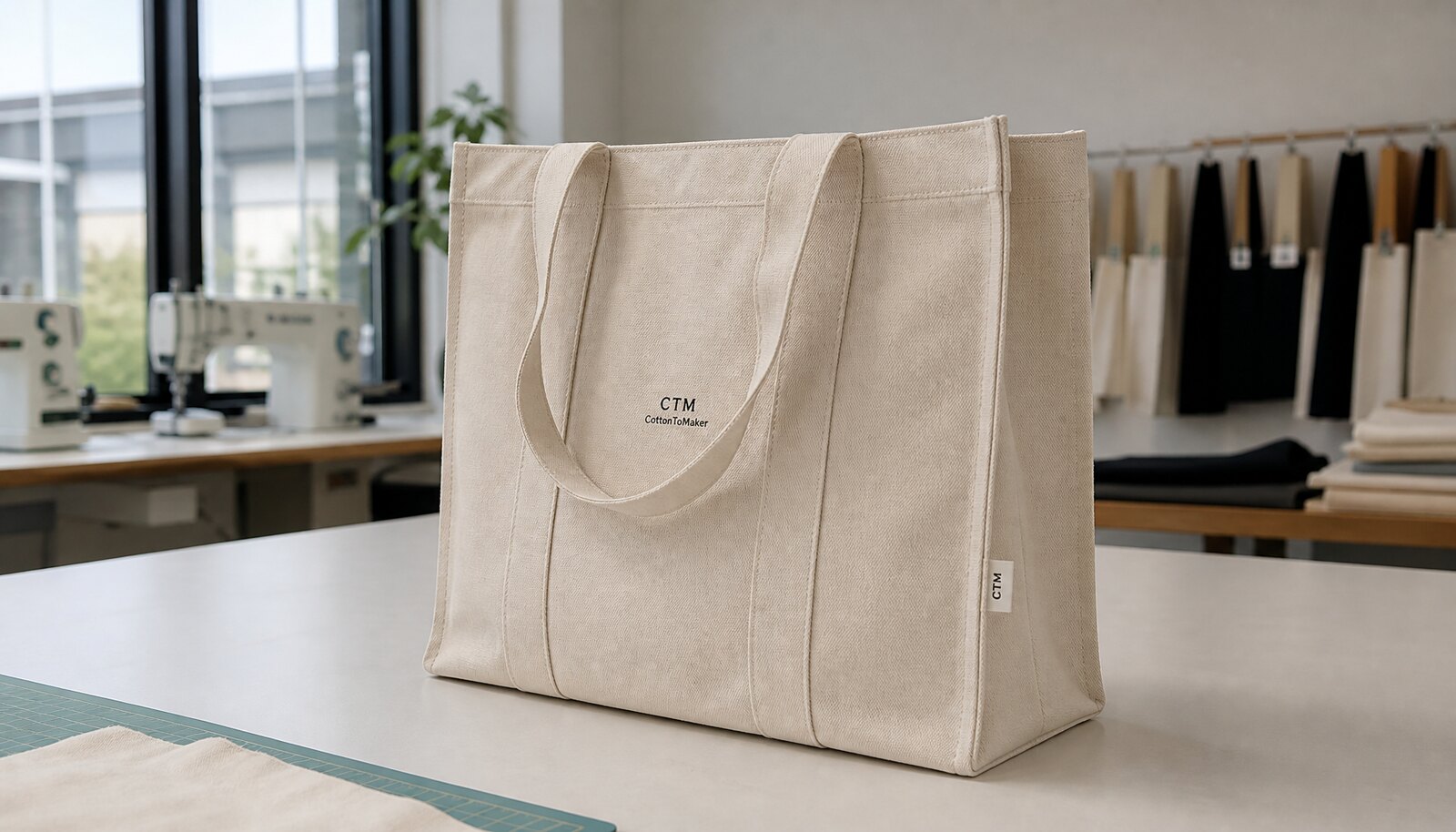
Start With the Retail Job, Not the Artwork
A winery retail tote is not the same thing as an event giveaway. For a retail launch, the bag has to sell on the shelf, survive repeated handling, and still look acceptable after customers load tasting-room purchases into it. That means the first buying decision is not the logo file. It is the use case: will the tote carry a bottle, brochures, a shirt, or small gifts; will it hang on a hook; will it sit folded on a display; will it be sold as a premium accessory or used as an entry-level add-on. If the buyer does not define that role early, the factory will guess the spec, and guessing usually shows up later as a weak handle, floppy body, or print that looks fine in a mockup but not in store light.
For winery launches, the common mistake is specifying a pretty bag that does not match the way customers shop. A tote that is too soft will collapse on a shelf and look cheap. A tote that is too small will fail once a bottle, tasting notes, and a shirt are added. A tote that is too heavy may feel premium but can push the landed cost too high for a first retail run. A clear buying brief should state the retail position, the functional load, and the shelf presentation. Once those three are fixed, the rest of the program becomes easier to quote and easier to compare across suppliers.
- Define the bag role: merch item, bottle carrier, gift bag, or point-of-sale retail SKU.
- State the expected load and contents, not just the outer dimensions.
- Decide whether the launch needs a structured premium look or a softer utility look.
- Tie the bag to the store environment: hook display, countertop stack, or backroom replenishment.
Choose Canvas Weight and Construction for Real Handling
Canvas weight drives the retail impression more than most buyers expect. A lighter natural canvas around 10 oz or roughly 340 gsm can work for entry retail and low-pressure merchandising, but it will feel softer and may show more shape variation from bag to bag. A mid-range 12 oz canvas around 400 to 410 gsm is often the safest launch point for a wine brand because it gives enough body for shelf presentation without making the bag feel overbuilt. Heavier 14 to 16 oz canvas, roughly 475 to 540 gsm, supports a more premium look and better structure, but it raises sewing effort, freight weight, and often the unit cost. The right choice depends on whether the tote is supposed to feel practical, premium, or giftable.
Construction matters as much as the GSM. A structured bottom gusset improves standing stability and makes the tote easier to pack. Reinforced stress points at the handle base are non-negotiable if the bag will carry bottles or heavier retail bundles. Handle width and handle drop need to fit real use, not just a spec sheet. Short handles may work for hand carry but become awkward when shoppers want to carry the bag on a shoulder. If the tote will be sold next to premium wine, ask the factory to quote the base bag, a reinforced seam version, and an optional insert or board if the display needs a firmer silhouette.
- 10 oz or about 340 gsm: acceptable for lighter retail use, lower cost, softer hand feel.
- 12 oz or about 400 to 410 gsm: balanced option for most winery retail launches.
- 14 to 16 oz or about 475 to 540 gsm: better structure, higher perceived value, higher freight weight.
- Check gusset depth, handle width, handle drop, and seam reinforcement before you compare price.
Match the Print Method to Shelf Life and Handling
The print method should be chosen for retail handling, not just for how the artwork looks in the first photo. Screen printing is usually the best fit for a winery tote when the design is one to three colors and the buyer wants durable, repeatable decoration on canvas. It gives solid coverage, holds up well to folding and shelf movement, and is easier to quote at volume. Water-based or discharge-style inks can look softer and more integrated into the canvas, which can suit natural or rustic winery branding, but the factory needs to confirm that the fabric and ink system are compatible. Heat transfer can reproduce complex art, but it is usually less forgiving on a rough woven surface and can show wear sooner if the tote gets frequent handling.
Embroidery can work for a premium badge or small logo, but on lighter canvas it may pucker or distort the body if the stitch count is too heavy. A sewn patch, woven label, or side label can be a better option when the brand wants a restrained finish and does not need a large front graphic. The key is to link decoration to the use case. If the tote will be folded into a shelf stack and sold in quantity, the decoration should be robust, simple to repeat, and easy to inspect. If the launch uses a premium gift angle, a sewn label or combination of print and patch may produce a cleaner retail read than a crowded front graphic.
- Screen print: best for simple logos, repeat orders, and durable retail handling.
- Heat transfer: best for complex art, but confirm wear resistance on woven canvas.
- Embroidery: best for premium cues, but check puckering on lighter fabrics.
- Sewn label or patch: useful when the brand wants a cleaner, understated retail look.
Build the RFQ Around Comparable Quote Data
A good RFQ for custom canvas tote bags should force the supplier to price the same thing, not a loosely similar bag. If one quote includes 12 oz canvas, reinforced handles, and individual polybags while another assumes a light blank body with bulk packing, the unit prices are not comparable. The RFQ should name the fabric weight, bag size, gusset, handle spec, print method, print area, label or patch details, packing format, and carton target. It should also ask for separate pricing where needed, such as sample fee, plate or screen setup, artwork revision, and special packing labor. That structure keeps the buyer from comparing a cheap-looking quote to a complete one.
For a winery launch, the quote should also distinguish first order from repeat order economics. A supplier may quote a fair bulk price but hide setup cost in the sample phase or add a high threshold for small color changes. Ask for MOQ by color, MOQ by print color count, and MOQ by packing variant. If the launch includes more than one store format or multiple winery labels, request a price break that shows what changes when only the artwork changes versus when the body color changes. That is the only way to understand what will happen when the program reorders.
- Include fabric GSM or oz, dimensions, gusset, handle length, and handle drop.
- State print method, number of colors, print placement, and any label or patch.
- Ask for sample fee, tooling or screen charges, and whether those fees offset bulk.
- Request pricing by MOQ break so reorder economics are visible.
Compare Sourcing Routes Before You Award the Order
Price alone does not tell you whether the supplier can execute a winery retail launch. A direct factory with in-house printing is usually the strongest route when the buyer needs control over fabric, stitching, print placement, and packing. It is also the easiest route for a future reorder because the same factory controls the same bill of materials. A trading company or sourcing agent can add value when the buyer needs more coordination or does not have a production team, but the buyer should verify exactly where the bag is made and who is responsible if the first shipment misses the approved sample. A domestic decorator on imported blanks can be attractive for a quick market test, yet the buyer should expect less flexibility on custom dimensions and fabric choice.
Stockists and marketplace sellers are useful for speed, but they are usually weak on repeatability. For a retailer or winery that wants the same bag back in six months, that is a problem. A launch tote should be sourced from the route that can answer four questions cleanly: who controls the fabric, who controls decoration, who controls packing, and who can repeat the same spec on the next order. If the answer is split across too many hands, the buyer may save a little on the first quote and spend more on corrections, freight changes, or inconsistent replenishment later.
- Direct factory: best control over spec and repeatability.
- Trading company or agent: useful if you need coordination, but traceability must be clear.
- Domestic decorator: useful for speed, but check blank consistency and customization limits.
- Stockist or marketplace source: acceptable for tests, weak for long-term replenishment.
Set Sample Approval Criteria Before Bulk Starts
A sample should not be judged only by appearance. For a winery tote launch, the sample has to prove the sewing structure, the handle balance, the print sharpness, the hand feel, and the retail presentation. The buyer should approve one master sample and keep it physically or photographically locked as the benchmark. If the supplier sends a pre-production sample, compare it against the master under daylight and on a flat table, not only by eye in the office. Pay attention to seam straightness, print alignment, fold behavior, and whether the bag sits well when empty. These are the things that show up on a shelf and in customer hands.
The approval standard should include tolerances. Give the supplier a clear line between acceptable natural variation and a reject. For example, if the print placement shifts, if the handle length differs enough to be visible, if the gusset width changes the shape, or if the fabric shade is off enough to look inconsistent in a stack, do not release bulk. For natural canvas, some weave variation is normal, but stains, broken threads, and uneven tension are not. A short written approval note with the signed sample prevents later arguments about whether the production run matches what was agreed.
- Approve a master sample and a pre-production sample separately if the order is important.
- Check print placement, seam symmetry, handle drop, and body shape in natural light.
- Define what variation is acceptable in natural canvas and what is not.
- Do not release bulk until the signed sample and written notes are aligned.
Specify Packing for Shelf Presentation and Backroom Control
Packing is not a minor detail for a retail launch. If the tote lands flattened, wrinkled, or packed in a way that hides the logo, the store team spends time fixing it before it can be sold. For smaller retail programs, individual polybags can protect the bag and keep it clean, but they can also create waste and make shelf presentation less premium if the film is too glossy or oversized. Belly bands or simple paper wraps can work better when the brand wants a cleaner look and the bag will be merchandised on a hook or folded stack. The right choice depends on how the buyer expects the tote to be sold, stored, and replenished.
Carton planning matters just as much as retail wrapping. Ask the factory to confirm master carton count, inner pack count, carton dimensions, gross weight, and carton mark format. If the order is being sent to a warehouse before retail allocation, a tidy carton pack can reduce handling damage and speed receiving. If the tote is part of a set, require the factory to state how the components will be packed together and how they will be identified on the carton label. Launches often fail in the back room long before they fail at the cash wrap, and packing is usually where the avoidable mistakes live.
- Choose packing based on the shelf story: polybag, paper wrap, or belly band.
- Confirm carton count, carton size, gross weight, and carton marks.
- If kitting is involved, define which items are packed together and how they are labeled.
- Avoid vague packing instructions such as standard export carton with no unit detail.
Plan the Schedule Around Sampling, Production, and Freight
Lead time for a custom canvas tote is usually longer than buyers expect once sampling and approval are counted properly. The sample stage can take about a week or more depending on artwork revisions, fabric availability, and decoration method. Bulk production then depends on whether the supplier is cutting, sewing, printing, and packing in one place or handing off between vendors. For a retail launch, the critical issue is not just total days. It is whether the factory can lock the production start date after sample approval and whether they can hold that slot if the buyer delays artwork or packaging decisions. The schedule should show each gate separately so the team knows where the time is actually spent.
Freight risk matters as much as factory time. A tote is not heavy compared with hard goods, but the launch date is often fixed by store opening or seasonal demand, which can force air freight or partial shipments if the production window slips. That is why the buyer should ask for the factory's earliest bulk start date, the estimated completion date, and the carton-ready date, not a vague promise of shipping by a certain month. Add buffer for print fixes, carton changes, and internal approvals. If the launch has no buffer, even a small artwork delay can turn a normal shipment into an expensive rescue.
- Separate sample time, bulk time, carton readiness, and freight time.
- Ask whether the production slot is reserved or only estimated.
- Build a buffer for artwork approval, packaging approval, and inspection.
- If the launch date is fixed, compare sea and air options before you commit.
Compare Landed Cost, Not Just Unit Price
The cheapest factory quote is rarely the cheapest launch. To compare properly, the buyer needs the landed cost: ex-works price, sample amortization if relevant, packing upgrades, export carton cost, freight, duty, customs clearance, inland delivery, and any warehouse or kitting fees. A tote that looks cheaper on paper can become more expensive if it needs thicker cartons, extra packing labor, or a freight upgrade because the delivery date is fixed. That is especially true for first retail launches, where the order quantity is often too small to absorb surprises.
The buyer should also look at yield and damage risk. If a lower-cost supplier produces more sewing defects or print rejects, the apparent savings disappear in rework, credit claims, or over-ordering. For launch programs, a small overrun may be cheaper than an underbuy that forces a rushed reorder. The right decision is not always the lowest ex-works number. It is the order that gives the best combination of acceptable quality, on-time arrival, and repeatable refill economics. If the tote will be reordered, ask the supplier to show repeat pricing separately from first-order setup cost so the brand can see the long-term cost curve.
- Compare ex-works price, freight, duty, packing, and inland delivery together.
- Watch for hidden costs in stronger cartons, custom labels, or kitting labor.
- Measure defect risk, not only quoted unit price.
- Request repeat-order pricing so the launch economics are realistic.
Release the Order With a Short, Clean Buyer Checklist
The fastest way to avoid production mistakes is to keep the release package short and complete. The factory should receive one spec sheet, one approved artwork file, one signed sample, one packing instruction, and one final shipment mark file. Anything more than that usually creates confusion unless the buyer has a formal tech pack system. For a winery launch, the essentials are fabric, size, print, packing, and carton detail. If those are clear, the production team can work without guesswork and the QC team can inspect against something real.
Before release, the buyer should verify that all commercial terms match the technical spec. This includes MOQ, lead time, payment stage, sample cost, packing format, and who approves substitutions. If the supplier needs to swap a fabric lot, alter a label position, or change the carton count, that change should be documented before bulk starts. A clean release process is not bureaucratic overhead. It is the cheapest way to protect a launch that depends on getting the tote right the first time.
- Keep one approved spec sheet and one signed sample as the production baseline.
- Verify commercial terms and technical terms together before release.
- Document any substitution before bulk starts.
- Use one clear contact path so changes do not get lost between sales and production.
Specification comparison for buyers
| Spec decision | Recommended option | When it fits | Buyer risk to check |
|---|---|---|---|
| Direct factory with in-house printing | Best when you need controlled GSM, print placement, and packing under one PO | Launches with clear artwork, repeat orders, and a buyer who can manage sampling directly | Check whether the factory actually controls cutting, printing, and final carton packing rather than outsourcing key steps |
| Trading company specializing in bags | Best when you need multiple product lines or extra coordination support | Buyers who want one point of contact across tote, pouch, and accessory SKUs | Check margin opacity, factory traceability, and whether the quoted sample is from the real production source |
| Domestic decorator on imported blanks | Best for short domestic launches or market tests with tight calendar pressure | Small retail trials, seasonal events, or quick brand pilots | Check fabric consistency, blank availability, and whether the blank body will match the final imported program |
| Local stockist or wholesaler | Best for urgent dates and very low MOQ | Soft launch, pop-up retail, or immediate replenishment needs | Check limited custom options, weaker brand control, and the risk that stock colors or sizes change without notice |
| Sourcing agent with factory network | Best when your team needs sourcing execution without building Asia-side capacity | Brands that need help with factory selection, negotiation, and production follow-up | Check who owns QC decisions, who pays for errors, and whether the agent can enforce fixes at the mill and print shop |
| General marketplace seller | Best only for rough prototype shopping | Early design exploration when you do not yet know the market response | Check traceability, artwork control, and whether the supplier can repeat the same bag after the first shipment |
| Eco-specialist factory | Best when sustainability claims are part of the retail story | Brands that need recycled or certified cotton discussions and cleaner label language | Check claim support, batch consistency, and whether the special fabric changes print adhesion or hand feel |
| Integrated packing and kitting partner | Best when totes must ship with hangtags, inserts, barcodes, and shelf-ready packs | Retail programs where the bag is part of a wider launch set | Check carton counts, barcode accuracy, and whether kitting labor has been included in the quote |
Buyer checklist before sampling
- Confirm tote dimensions, gusset depth, handle length, and handle drop before artwork is finalized.
- Lock fabric weight in GSM or oz, not just the word canvas.
- State the intended use clearly: carry bag, retail merch, bottle carrier, or gift-with-purchase.
- Define print method, number of colors, print position, and any side label or patch requirement.
- Request a pre-production sample and a signed golden sample for comparison.
- Specify retail packing, inner pack count, master carton count, and barcode placement.
- Ask for lead time by stage: sample, pre-production, bulk, and dispatch.
- Get a landed-cost view that includes freight, duty, packing upgrades, and any kitting labor.
Factory quote questions to send
- What canvas weight, weave, and finish are you quoting, and can you confirm it in GSM or oz?
- Is the unit price based on sewn blank only, printed blank, or retail-packed unit?
- What is the MOQ by color, print color count, and artwork version?
- What sample types do you provide, what do they cost, and are sample fees deductible from bulk?
- Which print methods can you offer on this fabric, and what are the durability tradeoffs?
- What are your standard size tolerances, stitch requirements, and print placement tolerances?
- What packing options are available, including polybag, belly band, hangtag, insert card, and barcode label?
- What carton count, carton dimensions, and gross weight should we expect?
- What lead time do you quote from sample approval to bulk completion, and what pushes it longer?
- What QC evidence do you send before shipment, such as photos, inspection report, or packing list verification?
Quality-control points to confirm
- Body size must match the signed sample within an agreed tolerance, with special attention to gusset depth and handle drop.
- Stitching at handle joins and side seams must be even, secure, and free of skipped stitches or loose ends.
- Print placement must sit inside the approved area with no skew, misregistration, or heavy ink bleed.
- Fabric must be free of holes, oil marks, dye streaks, and contamination that would show on retail shelves.
- Handle length and left-right symmetry must be checked on every size and colorway.
- Color and hand feel must match the approved sample under daylight, not only under warehouse lighting.
- Packing must preserve bag shape and keep barcode, hangtag, and SKU marks readable.
- Carton count, inner pack count, and assortment mix must match the packing list before release.