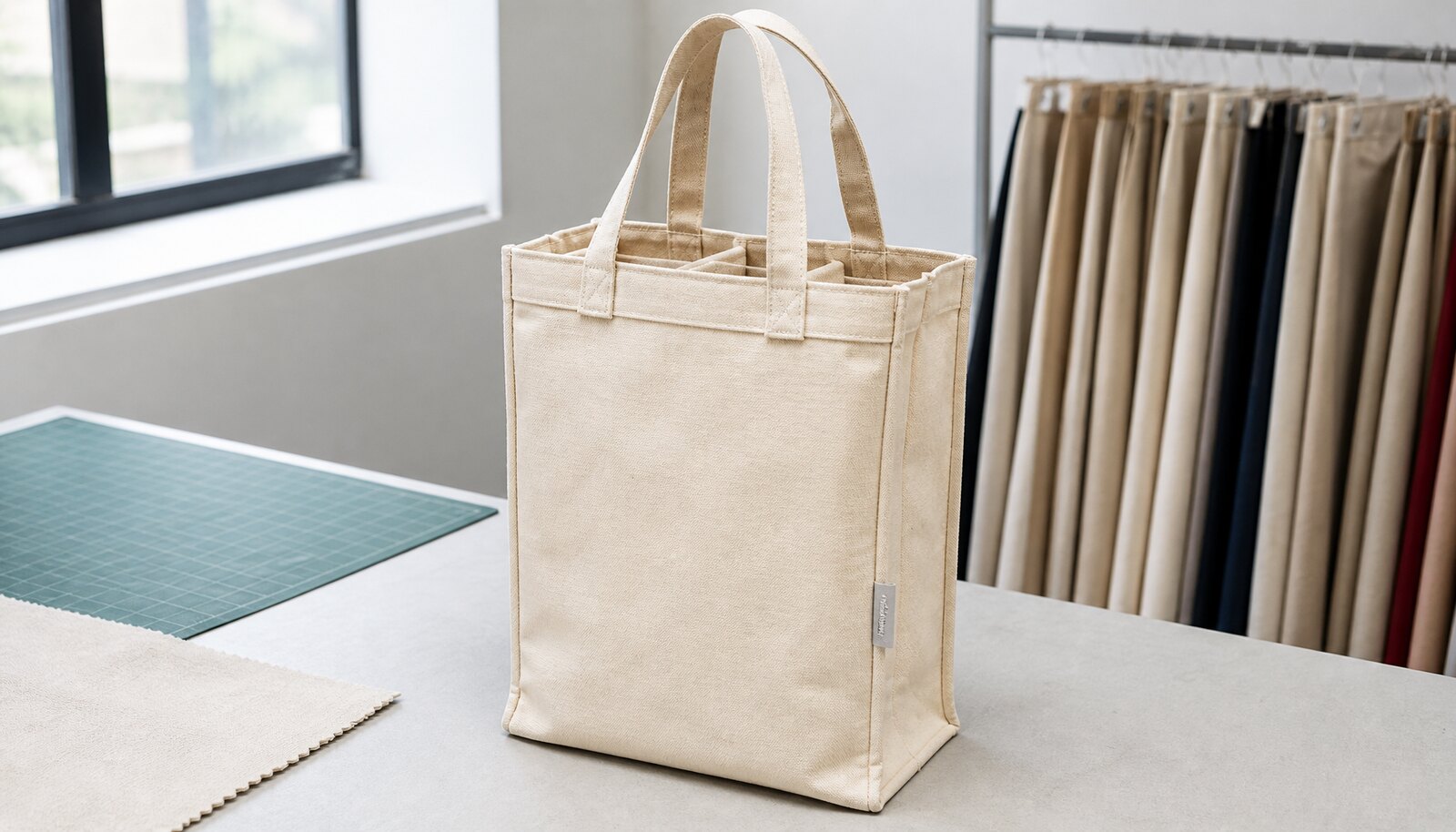
What a winery tote has to do in the real world
A tote for a winery is packaging, merchandise, and carrying gear at the same time. It has to fit the bottle cleanly, sit well on a tasting-room shelf, and still look acceptable after a customer has carried it through a parking lot, a cellar, or a club pickup line. That mix of jobs creates failures that are easy to miss in a vendor catalog. A bag can look premium in a flat lay and still feel unstable once a bottle shifts. It can print beautifully and still crease badly when folded for shipping. It can also pass a visual check and then fail the brand test because the handles twist or the bottom sags.
The right way to buy custom canvas tote bags for wineries is to define the use case first and the decoration second. A retail merch tote needs a clean front panel and repeatable folding. A gift-with-purchase tote needs enough structure to feel like part of the premium offer. A club pickup bag needs stronger handles and a more forgiving bottom seam because customers will handle it more than once. Once the use case is clear, the rest of the spec becomes much easier to compare.
- Single-bottle tote: prioritize bottle stability, handle comfort, and a bottom that does not collapse when the bottle moves.
- Two-bottle tote: prioritize width, handle reinforcement, and a square shape that stays balanced under load.
- Retail merch tote: prioritize front-panel print clarity, shelf presentation, and a fold that repeats cleanly in packing.
Start with the bottle, not the bag
The most common sizing mistake is to quote the tote by bottle count alone. That is too vague for procurement. A standard 750 ml Bordeaux bottle, a tall Riesling bottle, a Burgundy bottle with broader shoulders, and a sparkling bottle with foil or a neck label all need different clearances. A magnum changes the problem again. The bag has to fit the body, but it also has to leave room for the shoulder, the neck, and any accessory that sits above the glass. If the neck hits the top seam, the tote will feel cramped even if the bottle technically fits.
For a standard single-bottle program, many buyers start around 5 to 6 inches wide, 13.5 to 14.5 inches high, and 4 to 5 inches deep, then adjust to the actual bottle and decoration method. For two-bottle programs, the width becomes the critical dimension because shoulder-to-shoulder contact makes the bag feel cheap and unstable. The best practice is to send the supplier the actual bottle sample, the target bottle count, and any special constraints such as a neck tag, pour spout, foil, or gift card insert. That removes a lot of guesswork before quoting begins.
- Measure the actual bottle diameter and shoulder width, not just the nominal bottle size.
- Check clearance for foil, neck label, and any tag or closure before you approve the cut.
- Ask for a pattern proof against the real bottle, not only a flat spec sheet.
Choose construction that matches the load
Fabric weight is important, but it is not the whole story. A 12 oz canvas is a practical baseline for many winery retail programs because it offers a solid hand feel without making the bag overly stiff. Heavier finished cloth can make sense when the tote is sold at retail, reused often, or expected to support a more premium positioning. Lighter cloth may still work for low-cost event use, but it should be a deliberate choice, not a quote shortcut. The key word is finished. Buyers should ask for the finished weight after processing, not only the raw fabric description before washing, dyeing, or finishing.
Construction details matter just as much. Handles should have a clear width, drop, and attachment method, and the reinforcement should be visible and repeatable. Box-X reinforcement with bar-tacks is a common buyer target because it spreads the load and is easy to inspect. Self-fabric handles feel cohesive on natural canvas; webbing handles can add strength and consistency if the brand accepts the look. If the tote needs a lining, snap, zipper, or divider, that should be justified by use case. Those features can be useful, but they also add cost, more sewing steps, and more opportunities for variation.
- Use finished fabric weight in the spec, not just raw cloth weight.
- Define handle width, handle drop, and reinforcement style in the quote package.
- Only add lining, closure, or divider features when they solve a real use case.
- If the tote will carry wet or chilled bottles, check for seam stress and shape distortion after handling.
Control the print and branding details
The logo is often the easiest thing to send and the hardest thing to execute well on canvas. The weave texture of the fabric changes how fine lines read, how edges sit, and how much detail survives curing. A centered front-panel print with a clear safe area around it is the safest layout for most winery totes. That keeps the art away from top seams, side gussets, and fold lines. It also makes it easier for the factory to keep the logo consistent across sizes and reorders. If the design includes small type, a crest, or thin strokes, call that out directly. Otherwise the supplier may simplify the art to make it easier to print.
Screen print is still the default for many custom canvas tote bags for wineries because it is cost-effective for simple marks and stable for repeat orders. Embroidery can work when the brand wants a more tactile effect, but it changes the drape and can make folding less clean. Heat transfer and digital methods can help with detail, gradients, or short runs, but they need a clear rub and adhesion check. Buyers should not ask for a quote on the logo in general terms. They should specify the artwork size, placement, number of colors, print finish, and any effect the brand wants to avoid, such as a glossy hand-feel or a stiff patch on the face panel.
- Give the printer a safe area so the logo does not cross seams or gussets.
- State the print size in inches or millimeters, not just "large front logo."
- If the design has fine text or thin strokes, ask for a strike-off before bulk approval.
- Confirm whether the printed panel should feel matte, dense, soft, or more textured after curing.
Compare suppliers by process ownership, not by title
The label on the seller does not tell you where the risk sits. A direct factory may be the best option if it actually controls cutting, sewing, printing, packing, and final inspection. That is the route most buyers want for repeatable winery programs because the pattern, the print placement, and the carton plan stay under one roof. A broker or trading company can still be useful when they manage communication well or consolidate multiple products, but the buyer still needs to know who is touching the tote at each step. If that chain is fuzzy, so is accountability.
The useful questions are operational. Ask who cuts the panels, who prints the logo, who checks the bulk, and who signs off before cartons are sealed. Ask whether they can show a comparable bottle-carrier sample from a similar program. Ask how they isolate rejected pieces and what happens when a print lot or cutting lot drifts. In winery programs, the failure mode is often not a dramatic defect. It is a stack of small misses: one panel slightly short, one print slightly off-center, one carton with mixed counts, one reorder that does not match the first run. Process ownership is what prevents that.
- Direct factory: best for repeat orders, tighter control, and better bulk-to-sample matching.
- Broker or trading company: useful when coordination matters, but only if the production chain is transparent.
- Local decorator: useful for small or urgent runs, but often weaker on carton discipline and reorder consistency.
- Ask who owns final inspection signoff and how nonconforming stock is physically separated.
Write the quote so every bidder prices the same job
A good quote package is short, specific, and hard to misunderstand. It should separate the bag body from the print, labels, inserts, packing, testing, and freight assumptions. If one supplier quotes a woven label, tissue insert, and printed master carton while another only prices the sewn bag, the comparison is broken before it starts. For winery buyers, that matters because the product is part of the shelf presentation. The tote is not just a textile. It is a branded retail object that needs the right fold, the right carton count, and the right shipping cube.
The quote should also reflect the real commercial terms. Ask for the unit price, sample charges, setup fees, lead time by milestone, shipping term, carton dimensions, and units per carton. If the order may ship by ocean freight or feed a distribution center, ask for gross weight and pallet pattern too. That lets the buyer see whether the low unit price is being offset by a bigger carton, a heavier packing method, or hidden sample revisions. A quote that leaves too much unsaid is not a competitive quote. It is an incomplete one.
- Use one spec sheet for every bidder, with no hidden assumptions.
- Require separate lines for fabric, sewing, print setup, labels, inserts, packing, and testing.
- Compare quotes on the same shipping term and the same sample scope.
- Treat missing carton or packing data as a risk flag, not as a negotiation detail.
Approve samples like a production buyer, not a retail shopper
A sales sample only proves that the supplier can make something attractive once. It does not prove that the bulk run will match the approved reference. The sample that matters is the pre-production sample built from the final fabric, final print method, final reinforcement, and final packing method. That sample should be the physical standard for the order. If the bulk run changes the cloth weight, handle build, print cure, or folding method, the order is no longer on the same approval basis. For a winery, that can show up immediately on shelf or in a tasting room.
Review the sample in the conditions where customers will see it. Load it with the intended bottle count. Check whether it hangs straight, stands acceptably, and feels balanced when lifted from the handle. Look at the print under normal indoor light and at a slight angle, because texture and curing can hide or reveal flaws. Fold it the way the warehouse will fold it. If the bag only looks good when opened flat on a table, the packing plan still needs work. A useful sample process also confirms how the tote behaves after handling, not just how it looks in a still photo.
- Keep one sealed approved sample for the buyer record and one for the factory floor.
- Review the sample under the lighting used in the tasting room or retail space.
- Test handle comfort with the intended load, not with an empty bag.
- Approve fold direction, insert style, and carton layout before bulk cutting starts.
Use buyer acceptance criteria that are strict enough to matter
This is where quality control becomes useful instead of decorative. Example acceptance criteria should be framed as buyer targets, not as universal laws. That keeps the article honest and makes it easier for a winery buyer to adjust tolerances based on the bag style and price point. For custom canvas tote bags for wineries, the main checks are simple: size, symmetry, stitch integrity, load behavior, print placement, rub resistance, shade consistency, and visible cleanliness. The point is to catch the failures a customer will notice or a handle will expose.
A practical inspection plan separates cosmetic issues from functional issues. A tiny thread tail on a hidden seam is not the same as a handle attachment that opens under load. A small shift in print on the gusset is not the same as a logo that crosses a seam and becomes unreadable. A buyer can accept some variance if the bag still looks and works as intended. What should not pass is damage that undermines retail value or user safety. For a winery program, if the handle fails or the logo is visibly off, the bag has already missed the point.
- Use the approved sample as the benchmark and measure bulk against it.
- Separate minor cosmetic issues from functional failures.
- Write down what counts as minor, major, and rejectable before inspection begins.
- Ask the factory how rework is tracked so rejected bags do not re-enter good stock.
Pack for shelf value and transit safety at the same time
Packing is part of the product. A tote that passes sewing inspection can still arrive looking tired if it was folded too hard, stacked too tightly, or packed in a way that scuffs the front panel. Flat folding is usually the safest starting point because it protects the face panel and makes carton planning easier. If the tote will sit on a retail shelf or be handed over at a tasting room, an insert card or tissue sheet can help hold the shape and reduce deep creases. The fold direction should be fixed in the spec so the printed face lands the same way every time.
Carton planning needs the same discipline. Too many units per carton crush the body and create hard fold lines. Too few units waste space and raise freight cost. Ask for the carton size, units per carton, gross weight, and carton marks. If the route includes ocean freight, long inland transit, or warehouse storage, ask how the packing protects against compression and odor transfer. This matters more than buyers expect because canvas can hold fold memory, and a premium retail item should not arrive looking like a commodity textile.
- Specify fold direction so the printed face does not scuff or crease unnecessarily.
- Use inserts only when they improve shelf presentation or shape retention.
- Set carton fill to protect the tote without crushing the panel.
- Require carton marks that match the purchase order and packing list exactly.
Plan for reorders, seasonal releases, and winery-specific edge cases
Reorders are where many tote programs drift. Natural canvas can vary from lot to lot, inks can vary slightly, and a supplier may substitute a different print screen or packing method if the reference is not controlled. The approved sample, pattern file, artwork file, and material lot need to be stored in a way that the factory can actually use on the next run. If the program will repeat across seasons or support club shipments, the reorder process is not administrative detail. It is part of product quality. The buyer should know who owns the reference set and how the supplier avoids silent substitutions.
Wineries also have edge cases that generic tote sourcing guides usually miss. Sparkling bottles sit taller and can force the neck into the seam. Burgundy bottles push the shoulder width. Square bottles can twist the bag if the base is too narrow. A holiday gift set may need a wider opening for a corkscrew or note card. A retail bag sold after a tasting can come back to the customer damp from condensation or dusty from the cellar, which means print durability and cleanability matter. None of that is exotic, but it is where a generic tote becomes a poor fit for a winery program.
- Preserve the approved pattern, artwork, and reference sample for future runs.
- Revalidate fit whenever the bottle shape, insert, or packaging format changes.
- Treat seasonal artwork, limited editions, and club programs as separate approvals if the visual target changes.
- Ask how the supplier handles shade drift, print screen wear, and packing substitutions on repeat orders.
Specification comparison for buyers
| Spec decision | Recommended option | When it fits | Buyer risk to check |
|---|---|---|---|
| Bottle count and size | Single-bottle tote: typically around 5 to 6 in W x 13.5 to 14.5 in H x 4 to 5 in D; two-bottle tote: around 9 to 10 in W with similar height, adjusted to the actual bottle | Tasting-room retail, gift-with-purchase, club pickup, and carry-out programs | Confirm the real bottle diameter, shoulder shape, foil height, and whether the neck will contact the top seam |
| Fabric weight | 12 oz canvas is a common starting point; heavier finished weight can make sense for repeated reuse or premium retail | Most winery retail programs that need a sturdy look and better load margin | Verify the quote states finished weight, not only raw fabric before finishing |
| Handle build | Self-fabric or webbing handles with box-X reinforcement and bar-tacks | Bottles, gift sets, and bags that will be lifted often | Check handle width, handle drop, stitch count, and where the reinforcement lands |
| Branding placement | Centered front-panel print with a clear safe area away from seams and gusset folds | Tasting-room merchandising and shelf display | Make sure the logo will not wrap onto the side gusset or sit too close to the top seam |
| Print method | One- or two-color screen print for most winery logos | Simple marks, larger quantities, and stable reorders | Confirm ink cure, rub resistance, and whether fine lettering will survive the canvas texture |
| Closure style | Open top for retail use; snap or zipper only when the tote is part of a gift set | Retail display, club packs, or premium presentation | Closures add cost and can distort shape, so approve the final silhouette |
| Source route | Direct factory with in-house cutting, sewing, printing, and packing | Repeat programs and orders that need the same result on reorders | Verify which steps are actually in-house and who performs final inspection |
| Packaging route | Flat-folded tote with insert or tissue if needed, then master carton | Retail-ready programs and export shipments | Over-compression causes fold marks, print scuffing, and panel distortion |
| Inspection stage | Pre-production sample plus final shipment inspection with written defect limits | Any custom size, custom print, or retail-facing program | Without numeric limits, the supplier will use its own tolerance, which is often looser than the buyer expects |
Buyer checklist before sampling
- Define the use case first: one bottle, two bottles, gift set, tasting-room retail, club pickup, or corporate gift program.
- Measure the actual bottle, including shoulder shape, foil height, and any neck tag, before locking the tote size.
- Lock finished dimensions, fabric weight, handle drop, reinforcement method, and closure style before asking for price.
- Specify the branding area, print colors, logo size, and any small text or fine lines that need a tighter process.
- Ask for a pre-production sample made from bulk materials, not only a sales sample made from substitute cloth.
- Require written tolerances for body size, handle length, stitch placement, print position, and carton count.
- Confirm packing format: flat fold, tissue, insert card, polybag, retail tag, or shelf-ready master carton.
- Request carton size, units per carton, gross weight, and any pallet stack limit if the order will ship by ocean freight.
- Ask for load, rub, and stitching QC evidence, or at minimum a clear description of the factory's test methods.
- Compare all quotes on the same basis: same spec sheet, same sample scope, same shipping term, and same inspection standard.
Factory quote questions to send
- What is the finished internal size by bottle count, and can you show the cutting pattern or template used to make it?
- Is the body fabric, cutting, sewing, printing, and packing handled in-house, or is any step subcontracted?
- What is the exact finished fabric weight in GSM or oz, and is that measured after finishing?
- What is your MOQ by size, color, and print color count, and what changes the MOQ?
- What sample stages are included in the quote, and what charges apply for strike-offs, pre-production samples, or revisions?
- What seam allowance, stitch density, and reinforcement method will you use on the side seams and handle attachment points?
- How is the print cured, and what rub check do you use before bulk approval?
- What is the acceptable shade variation for dyed components or labels, and what reference sample will you hold against production?
- What packing format is quoted, including fold style, insert sheets, inner pack quantity, and carton marks?
- What carton dimensions, units per carton, and gross weight should we expect for freight planning?
Quality-control points to confirm
- Example buyer target: finished body dimensions within +/- 1/4 in (about +/- 6 mm) of the approved sample for width, height, and gusset depth.
- Example buyer target: handle drop within +/- 1/2 in (about +/- 12 mm), with left-right handle symmetry not varying by more than 1/4 in (about 6 mm).
- Example buyer target: finished fabric weight within +/- 5 percent of the approved specification.
- Example buyer target: stitch density roughly 7 to 9 stitches per inch on heavy seams and 8 to 10 stitches per inch on reinforcement areas, unless the approved sample calls for a different construction.
- Example buyer target: no skipped stitch run longer than 1/8 in (3 mm), and no open seam visible at the side seam, gusset turn, or handle attachment point.
- Example buyer target: handle attachment survives a static load check of 15 kg (33 lb) for a single-bottle tote or 20 kg (44 lb) for a two-bottle tote for 1 minute, with no seam opening greater than 1 mm or visible breakage.
- Example buyer target: print registration within 1/8 in (3 mm) of the approved placement, with no drift into seam allowances or gusset folds.
- Example buyer target: dry rub check shows no visible ink transfer after 20 firm passes on a white cloth, and wet rub check shows no staining after 10 passes with moderate pressure.
- Example buyer target: dyed components or labels stay within the approved strike-off or lab dip, with no obvious panel-to-panel mismatch visible at arm's length.
- Example buyer target: retail-face panels are free of holes, oil marks, heavy yarn slubs, broken threads, pen marks, and other visible contamination at a normal viewing distance.