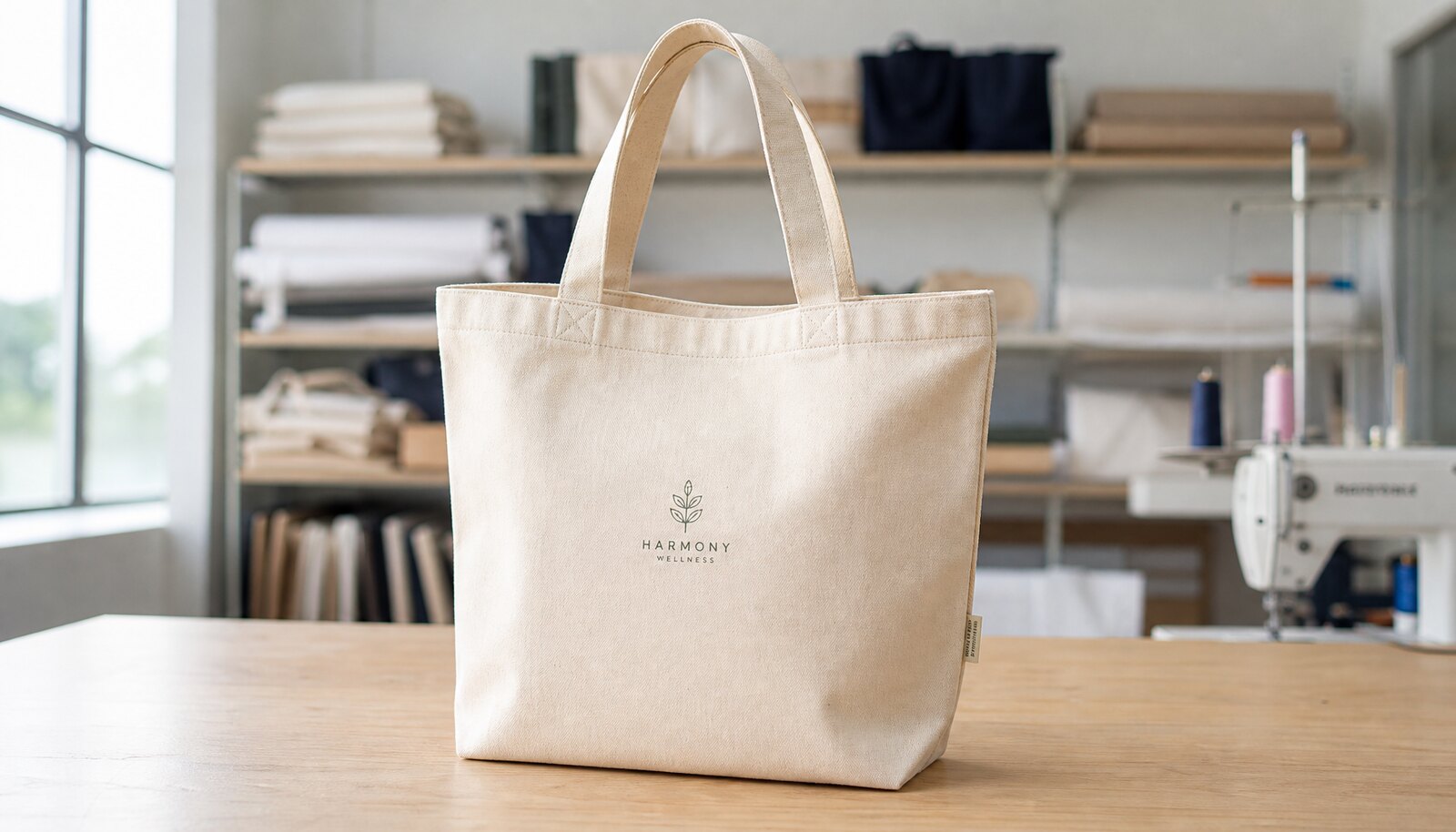
Why wellness event totes need a different spec
A wellness event giveaway tote is a different buying problem from a retail shopping bag. It has to carry samples, journals, water bottles, and handouts, but it also has to look calm and intentional in photos, at registration desks, and when attendees reuse it after the event. Procurement teams usually feel this difference as a tension between brand polish and unit cost. If the spec starts too light or the decoration is too busy, the tote reads as disposable. If the build is too heavy, the bag starts to compete with the rest of the event budget.
For that reason, the tote should be treated as an event utility item with brand value, not as a fashion accessory. The most useful brief says what the bag needs to hold, how many times it should survive reuse, and what type of brand signal is acceptable. That keeps quote comparisons honest and prevents a supplier from overbuilding one part of the bag while underbuilding another.
In practice, the brief should answer three questions before anyone asks for a price: what is going inside the tote, what impression should it make in hand, and how much variation can the receiving team tolerate without rework? If those are not clear, the quote will still arrive, but it will be hard to defend and harder to compare.
- Base the tote on actual event contents, not on a generic size or a guess about attendee behavior.
- Keep the decoration readable from 1-2 meters away and avoid artwork that depends on tiny details.
- Choose a bag that can be reused after the event; otherwise it will look like promotional waste rather than a useful gift.
The spec that actually changes cost: size, GSM, handles, seams
For custom canvas tote bags, the cost curve is driven less by the word canvas and more by the exact combination of body size, fabric weight, handle build, and seam details. A simple 14 by 16 inch tote with a 3 inch gusset and standard top hem can price very differently from a similar-looking bag that has reinforced handles, heavier webbing, or an inner facing. Buyers who only ask for a tote price usually receive a low-friction quote, but it is not a useful quote unless the dimensions and construction are already locked.
For wellness event kits, 10 oz is often the lowest practical fabric weight if the bag will carry anything with mass. Twelve oz is usually the safer middle ground because it feels more substantial in hand and tends to crease less when it is filled with bottles or packaged samples. If the event wants a more premium carry piece or expects repeated reuse, 12-14 oz makes more sense than trying to compensate with decoration alone. Heavier cloth is not automatically better, however, because it adds freight, may slow sewing, and can make a simple tote feel over-specified for a one-day activation.
Handles and seam structure matter just as much as the cloth. A good event tote usually needs a handle width that is comfortable on the shoulder, a bar-tack or equivalent reinforcement at the stress point, and a top hem that keeps the opening from collapsing. If the tote needs a gusset, specify the depth clearly. A supplier can easily interpret a vague gusset note in a way that changes the usable volume by a meaningful amount.
A practical starting spec for many wellness programs is a medium body, 10-12 oz cloth, 1 inch or wider handle webbing, and a reinforced handle attachment. That is not a universal answer. It is the point at which the bag usually stops feeling flimsy without turning into a premium retail item.
- 10 oz is the floor for light event loads, but 12 oz is a better default if the tote will be reused.
- Specify handle width and handle drop, not just handle length, so the bag carries the way your team expects.
- Lock seam reinforcement and gusset depth in the quote rather than assuming the factory will standardize them.
Decoration choices that change both quote and brand feel
For wellness giveaways, decoration should support the brand tone, not dominate the tote. Screen printing is usually the best fit when the artwork is simple and the order is large enough to absorb setup cost. It gives strong opacity on natural canvas, a clean edge, and a price that tends to scale well. If the logo has small fine lines or several colors, screen print can still work, but the buyer should make sure the supplier understands the minimum line thickness the artwork can survive on woven fabric.
Embroidery and woven labels create a more restrained, premium feel. They are often a better choice when the tote is part of a gift kit or when the brand wants the bag to feel closer to retail merchandise. The tradeoff is that embroidery can distort lighter canvas if the stitch density is too high, and woven labels add a separate sewing step that can slow production. That is not a problem if the event schedule is realistic. It becomes a problem when the bag is treated as a fast-turn give-away and still priced as if it were a premium branded accessory.
Digital print and heat transfer can be useful for small runs or highly detailed art, but they need careful proofing on natural canvas. The buyer should inspect opacity, hand feel, and edge quality before approving bulk. If the logo will be seen mostly at a distance, simpler usually wins. A clean one-color mark on a good canvas surface is often stronger than a crowded full-front treatment that makes the tote look noisy.
The right decoration choice is the one that matches the event context. A low-contrast woven label can make a tote feel more considered for a wellness brand, while a larger screen print can be better for a roadshow or conference where the bag must carry strong brand recognition from across a room.
- Use screen print for simple logos and larger runs where opacity and cost control matter.
- Use embroidery or a woven label when you want a quieter, more premium finish and the schedule can absorb the extra sewing step.
- Treat digital print as a proof-first option on canvas, not a default choice, because natural fibers can change how the image reads.
Sourcing routes compared side by side
The comparison table below is more useful when you read it as a risk map rather than a sourcing preference chart. Procurement teams often compare only where the bag comes from. For a wellness giveaway, the real comparison is fabric weight, build quality, decoration fit, lead time, and how much operational risk the route adds. A route that looks cheap can still be expensive if it creates rework, a second packing step, or a late shipment.
Factory-direct cut-and-sew is usually the best fit once the design is stable and the order is large enough to justify a dedicated production run. Trading companies are easier to manage if your team wants one point of contact, but the buyer should expect less transparency on the actual factory and the QC controls behind the quote. Blank-tote-plus-local-decoration is often the best speed play, but only if the blank inventory is already in hand and the local decorator can hold the same shade and quality across the lot.
The right route is the one that matches your event calendar and your internal bandwidth. If the event is fixed and the tote has to arrive with no drama, you should bias toward fewer handoffs and simpler packing. If the project is still exploratory, a small-MOQ specialist or a blank-plus-local route can reduce commitment. The important thing is to compare each quote against the same spec, not against a supplier's preferred interpretation of it.
A common mistake is to compare unit prices without checking whether the decoration method, packing standard, and QC burden are identical. That leads to false savings and makes the cheaper supplier look stronger than it actually is.
- Compare routes on the same fabric weight, construction, decoration, lead time, and QC burden, not just on the quoted unit price.
- Use factory-direct when you need control and repeatability, especially for 1,000 pieces or more.
- Use blank-plus-local only when the blank bag lot is controlled and the timeline is genuinely short.
What a usable quote should include
A useful RFQ for custom canvas tote bags should read like a production brief, not a shopping list. The supplier should see the finished size, gusset, handle length, fabric weight, decoration method, packing style, and ship-by date. If those elements are vague, the quote may still come back quickly, but it will not be comparable to other offers because each supplier will quietly fill in the missing assumptions differently.
For budgeting, many buyers use rough working bands rather than fixed market truths. As a planning baseline, a simple 10 oz tote with one-color screen print and bulk packing often falls somewhere around 1.10 to 2.00 USD FOB at 1,000 to 3,000 pieces. A 12 oz tote with reinforced handles and a gusset can move into the 1.60 to 3.20 USD FOB range, depending on size, decoration, and packing. Embroidery, lining, or individual polybagging can add roughly 0.10 to 0.80 USD per piece depending on labor market and complexity. Treat those as budgeting bands, not promises.
The best quote format separates the base bag, decoration, packing, sample fees, and any optional adders. That separation does two things. It lets procurement compare suppliers fairly, and it exposes where a low headline price is being subsidized by hidden work that will later reappear as a change order or a rushed shipping request.
If the supplier cannot quote by quantity tier and explain what is included and excluded, the quote is not ready for a buying decision.
- Ask for a price ladder at 500, 1,000, and 3,000 pieces so you can see how setup costs are being spread.
- Separate bag body, print, packing, and shipping assumptions into different lines.
- Ask which costs are excluded, including screens, embroidery digitizing, export docs, storage, and inland freight.
Sample approval and QC tolerances that prevent surprises
A sample is not only a visual approval. It is the simplest way to test whether the supplier understood the brief and can reproduce it under production pressure. When the tote is used in a wellness event, small inconsistencies become visible fast because attendees handle the bag in person and use it immediately. The buyer should therefore approve the sample against measurable criteria, not just a subjective impression that it looks close enough.
At minimum, measure finished width, height, gusset depth, handle length, and handle drop against the approved sheet. A practical tolerance for standard totes is about plus or minus 0.5 cm on the sample and plus or minus 1.0 cm on bulk, unless the product is unusually tight-fitting or decorative. Check fabric weight on multiple panels, not one display bag, and ask the supplier to explain any lot-driven variation before bulk starts. On print, the important questions are whether the logo is in the right place, whether the color is consistent with the approved sample, and whether the image still looks crisp after the ink has cured.
QC should also include a physical stress check. A tote intended for event kits should survive a simple load test with the actual contents or a 5 kg load for 30 seconds without seam lift, thread breakage, or visible distortion. Loose threads, stains, needle marks, and open seams are not minor issues on a giveaway tote; they are visible defects that lower perceived value immediately. If your program uses formal inspection, agree on AQL 2.5 for major defects and 4.0 for minor defects, or define a house standard with the same level of clarity.
Keep one approved master sample in the buyer file and one at the factory. If the bulk run is close but not exact, the master sample becomes the reference for correction instead of a memory of what looked acceptable during review.
- Measure dimensions and handle drop on the sample before you approve production.
- Test a finished bag with the actual event load or a 5 kg equivalent.
- Use a written defect standard for print, seams, stains, and size variance instead of accepting a vague good enough.
Packing, kitting, and carton rules for event teams
Packing often causes more problems than sewing. A bag can be perfect and still fail the project because it is packed in a way the warehouse cannot receive or the event team cannot distribute efficiently. For a wellness activation, the bag may need to travel directly to a fulfillment center, into a gift kit, or onto a registration table with little or no repacking. The packing instruction therefore needs to match the downstream process, not just factory convenience.
If the bags are going to a warehouse, bulk carton packing usually gives the best efficiency, provided the cartons are strong enough and the count is exact. If the bags are being inserted into gift kits, the supplier may need to pack by kit set or by component lot. That requires clear instructions on sequence and inner quantities. For receiving teams, carton weights around 10 to 15 kg are often easier to handle than very heavy master cartons, even if it costs a bit more in carton count.
Carton labels should be practical, not decorative. They need product name, color, quantity, PO number, carton number, gross and net weight if required, and any handling marks the warehouse uses. If you need barcodes or retail-style stickers, make sure those are included in the quote because they can add real labor. The simple rule is that every packaging detail you omit from the brief will be decided by whoever packs first, which is usually not the buyer.
If the tote is part of a broader giveaway kit, ask the supplier to confirm whether they can support kitting, subpacking, or carton-level segregation. Even when the answer is yes, do not assume they understand your warehouse's receiving logic. Spell it out.
- Choose bulk pack, polybag, or kit packing based on how the event team will actually distribute the bags.
- Target carton weights that your warehouse can receive without repacking, usually around 10-15 kg where practical.
- State carton marking, barcode, and insert requirements before production so they are priced and controlled, not improvised.
Lead time planning is usually a scheduling problem
Most tote delays are created before the factory starts sewing. Artwork approval takes longer than expected, sample revisions reset the timeline, and material booking gets pushed because the buyer assumes standard canvas will always be available. That means the production calendar should be built backward from the event date, not forward from the purchase order date. If the event is fixed, the supplier should quote a ship-by date, not only an ex-factory window.
A workable schedule usually separates three phases: sample approval, bulk production, and freight. Those phases should not be merged into one generic lead-time number because the risk is not evenly distributed. If the artwork is final and the design is standard, production can move quickly. If the buyer is still debating logo placement or bag color, the schedule should include extra buffer before the cutting stage begins. As a rule, every late design change is more expensive than the design decision itself.
For procurement, the best control point is the pre-production sample. If the sample is approved late, the production date moves. If the sample is approved on time but the freight booking is missed, the warehouse still gets the bag late. The event date only cares that the tote is in hand on the right day, so the plan should include freight, customs, and internal receiving as separate steps with their own owners.
If the supplier is promising speed, ask what they are assuming about fabric availability, print complexity, packing, and shipping mode. Speed claims are only useful when the assumptions are visible.
- Work backward from the event date and include buffers for sample revision, freight, customs, and receiving.
- Require the supplier to split lead time into sample approval, bulk production, and shipping rather than giving one blended number.
- Treat artwork changes after sample approval as schedule resets unless the supplier explicitly confirms otherwise.
Landedd-cost thinking that procurement can defend
The cheapest tote quote is rarely the cheapest delivered program. A proper landed-cost view includes the bag price, print setup, sample fees, packing adders, internal handling, freight, duties, and any local decoration or relabeling. That is especially important for wellness event giveaways because the bag may be only one line item in a larger activation budget, yet it is often the item everyone sees first. If the tote arrives late or inconsistent, the event loses polish even if the rest of the kit is on time.
For budget discussions, use the delivered, event-ready unit as the comparison point. That means one quote may be cheaper on the bag but more expensive once it is individually polybagged and cartoned for a warehouse. Another may look higher because the supplier included better stitching, a heavier fabric, and cleaner packing that reduces receiving labor. Procurement value is not just the lowest invoice; it is the lowest friction path to a usable event asset.
A good way to defend the budget is to score each supplier on five items: spec clarity, sample quality, QC transparency, lead-time certainty, and landed cost. If two quotes are within 5 percent of each other, the better sample and the clearer QC report usually win. That is not a soft preference. It is a practical way to reduce the chance of rework, late shipments, and chargebacks after the event.
If the program will repeat, ask for re-order pricing now. The best cost control is not a one-time discount. It is a supplier who can reproduce the same tote with the same print and the same packing without reopening the whole sourcing exercise.
- Compare total delivered cost per usable event tote, not only the factory price.
- Include inspection, packing, freight, duties, and any local decoration or relabeling in the model.
- Ask for re-order pricing and confirm whether the same screens, labels, or patterns can be reused.
Sustainability claims, compliance, and re-order planning
Wellness brands often want the tote to support a sustainability story, but the claim should stay inside what can actually be documented. Natural canvas, recycled cotton, organic cotton, or lower-ink decoration can all make sense, but only if the supplier can provide the right documentation and the marketing team is disciplined about the language. Do not call a tote eco-friendly, recycled, or organic unless the material evidence supports it and your commercial team is comfortable standing behind the claim.
A safer approach is to ask for the exact fiber content, any relevant test or origin documentation, and the packing material spec. If the program requires restricted-substance controls, ask the factory what test reports or declarations they can provide. The point is not to turn every tote into a compliance project. It is to stop unsupported claims from leaking into sales copy, event materials, or procurement records.
Re-orderability matters here as well. A tote that is easy to reorder is often more valuable than one that scores slightly better on a one-off sustainability narrative. If the design depends on a special dye lot, a very specific weave, or a decoration method that only one subcontractor can support, the next round may not match the first. For a repeat wellness event series, consistency is usually more valuable than novelty.
The best sourcing decision is the one the brand can repeat without rewriting the story each time. If the tote can be re-ordered, documented, and received without surprises, it is doing real commercial work for the brand rather than creating one more one-off project to manage.
- Only use sustainability language that is supported by supplier documentation.
- Ask for fiber content, origin, and any test or declaration records your brand needs for compliance.
- Prefer a tote spec that can be re-ordered without changing dye lots, decoration methods, or packing rules.
Specification comparison for buyers
| Sourcing route | Typical fabric weight | Construction details | Decoration fit | Lead time |
|---|---|---|---|---|
| Factory-direct cut-and-sew | 10-12 oz / 340-410 gsm | Self-fabric or webbing handles, top hem, bar-tacks, optional gusset | Best for one- or two-color screen print | 4-6 weeks production plus freight |
| Factory-direct premium build | 12-14 oz / 410-475 gsm | Wider handles, bound seams, inner facing or lining, reinforced base | Screen print, embroidery, woven label, or mixed finish | 5-7 weeks production plus freight |
| Trading company managed order | 8-12 oz / 280-410 gsm | Usually standard sewing with outsourced QC and packing coordination | Screen print, label add-ons, or mixed decoration | 5-8 weeks depending on handoffs |
| Blank tote plus local decoration | 8-12 oz / 280-410 gsm | Stock bag, local print or embroidery, usually limited customization | Good for urgent one-color print or small-run branding | 1-3 weeks if blanks are in stock |
| Small-MOQ specialist factory | 8-10 oz / 280-340 gsm | Simplified body, narrower options, lighter webbing or seam allowance | Best for minimal graphics, pilot events, or influencer kits | 3-5 weeks |
| Sustainability-led build | 10-12 oz / 340-410 gsm, natural or recycled content if verified | Natural finish, low-ink coverage, recyclable packing | Woven label, small print, or low-coverage screen print | 4-7 weeks |
Buyer checklist before sampling
- Lock finished bag width, height, gusset depth, handle length, and handle drop before sending the RFQ.
- State the fabric target in both oz and GSM, and ask the supplier to confirm whether the figure refers to cloth weight or finished bag weight.
- Specify the decoration method, artwork size, number of colors, and exact logo placement with a vector file.
- Define the construction details: top hem, handle width, bar-tacks, seam allowance, and whether the base needs reinforcement.
- Request a pre-production sample made on the same fabric, same print method, and same packing format as bulk.
- Set a simple pass/fail standard for inspection, such as AQL 2.5 major and 4.0 minor, or a clear house standard if you do not use AQL.
- Ask for carton size, carton count, carton weight target, and whether the warehouse wants bulk pack, polybag, or kit packing.
- Require the supplier to quote sample fee, plate or screen fee, packing adders, and any re-order price breaks separately.
- Ask for a production schedule broken into sample approval, material booking, printing, sewing, inspection, and export packing.
- Confirm overrun and shortage tolerance in writing and state what quantity will be invoiced if the shipment is short or over.
Factory quote questions to send
- What is the exact fabric specification, including weave, cloth width, and whether the quoted oz or GSM refers to greige fabric or finished material?
- What finished bag dimensions, gusset depth, handle length, and handle drop are you pricing, and what tolerances do you hold in bulk?
- Which decoration method is included in the unit price, and what is the cost for each added color, embroidery stitch count, or woven label?
- What is the MOQ by construction and by decoration method, not only by order value?
- Can you quote the same tote in 500, 1,000, and 3,000 piece tiers so I can compare the price curve?
- What is the sample fee, how long does the sample take, and is the fee refundable against bulk?
- What is the production lead time after sample approval, and what steps can extend it if I add carton labeling or inserts?
- What packing standard is included in the price: bulk pack, individual polybag, size sticker, master carton marking, or palletizing?
- What is your overrun and shortage tolerance, and what quantity will you invoice against if the shipment does not match the PO exactly?
- What QC checks do you perform before shipment, and can you share inspection photos, a measurement sheet, or a pre-shipment checklist?
Quality-control points to confirm
- Measure finished width, height, and gusset against the approved spec sheet. A practical buyer tolerance is usually plus or minus 0.5 cm on the sample and plus or minus 1.0 cm on bulk for standard totes.
- Check fabric weight on more than one panel or bag. Accept no more than about 5 percent variation from the agreed GSM or oz unless the supplier disclosed a natural-fiber lot effect in advance.
- Inspect handle attachments, side seams, and bottom seams for skipped stitches, weak bar-tacks, loose thread tails longer than 5 mm on the visible face, and open seams under light tension.
- Run a simple load test with the actual giveaway contents or a 5 kg test load for 30 seconds. Reject bags that show seam lift, broken stitches, handle distortion, or visible tearing.
- Review print registration, ink coverage, edge sharpness, and cure quality. On one-color logos, misregistration should not be visible at arm's length and bleed should stay within about 1 mm of the intended edge.
- Compare the bulk shade to the approved sample under daylight. Reject obvious tone shifts, especially on natural canvas where lot variation can make the brand mark look off.
- Look for stains, oil marks, yarn slubs, needle marks, frayed edges, and loose fibers on the front panel and handles. A wellness giveaway should feel clean and giftable, not merely usable.
- Confirm carton count, carton labels, and pack pattern before cargo leaves the factory. If the event team is receiving kits, verify that inner counts and carton marks match the packing list exactly.