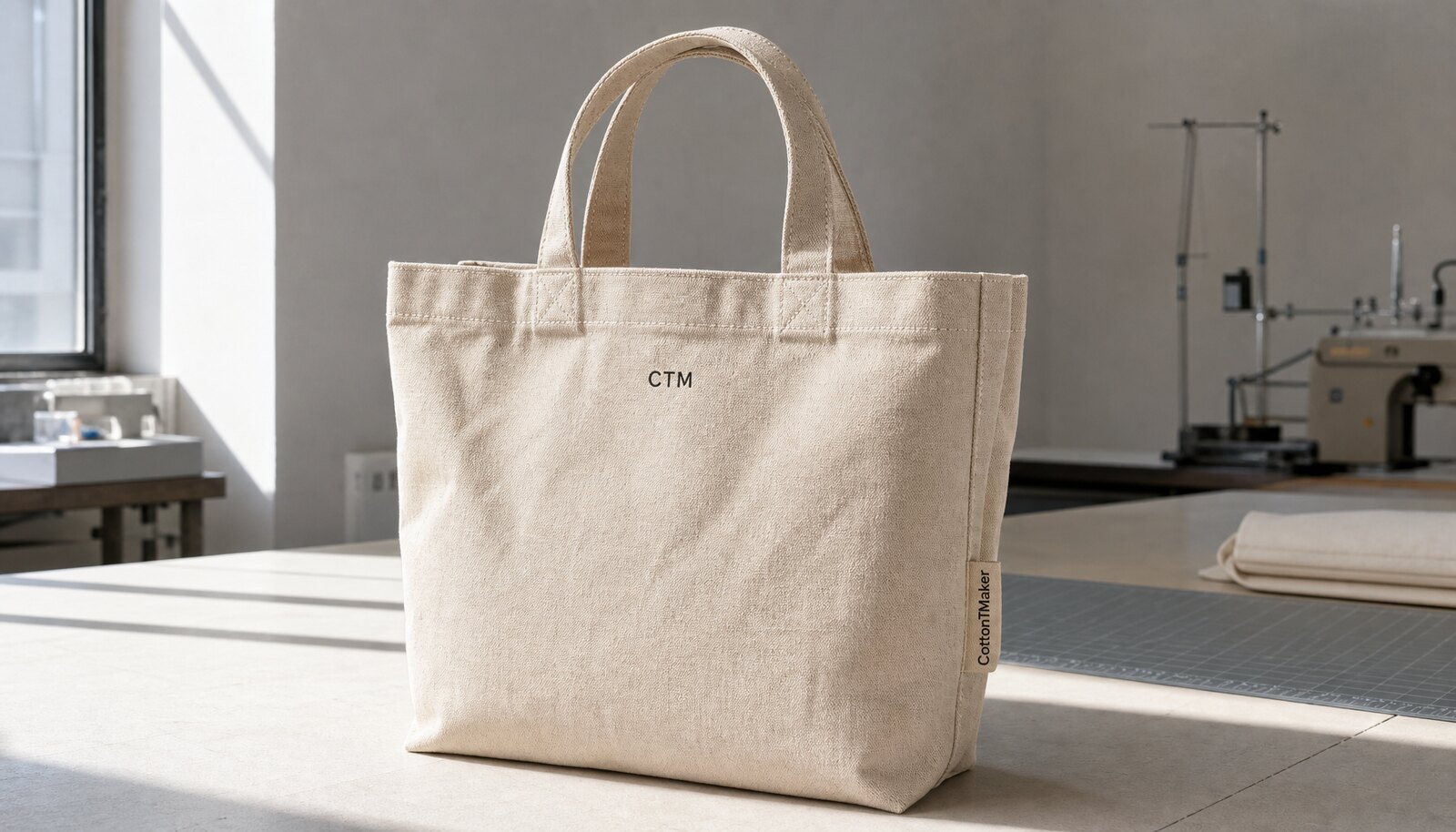
Why Trade Show Tote Samples Fail
Trade show buyers usually judge a sample by the logo first, then discover the bag is too soft, too small, or too weak for the actual giveaway load. That is the wrong order. A trade show tote is not a fashion accessory; it has to carry catalogs, inserts, and event samples while still looking clean after a few hours of use.
The sample approval process should prove that the bag can survive the real event, not just sit well on a desk. A good approval sample tells you how the fabric behaves, how the print sits on the weave, how the handles feel in hand, and whether the bag still looks branded when it is half full.
- Approve against the actual event contents, not an empty bag photo.
- Treat shape retention and handle strength as part of brand presentation.
- Use the sample to catch production issues before the bulk run starts.
Lock The Base Spec Before Decoration
Most sample problems start with an unclear base spec. If the buyer has not fixed fabric weight, body size, gusset depth, and handle length, the supplier may build a sample that looks close but behaves differently in production. On canvas totes, a small change in GSM can alter stiffness, print opacity, and how the bag folds for packing.
For trade show use, a common practical range is around 10 oz to 12 oz canvas, or roughly 340 to 420 GSM, depending on how much structure the bag needs. Lighter canvas can work for simple literature giveaways; heavier canvas makes sense when the tote will be reused, carry samples, or support a premium brand position.
- Freeze the finished dimensions before you talk about print placement.
- Specify whether the bag should stand upright or collapse flat.
- Confirm if the fabric is natural, bleached, dyed, or enzyme-washed, because each changes the final look.
Choose The Print Method For The Right Failure Mode
The print method should match the artwork, not the other way around. Screen print is usually the most reliable choice for flat logos, bold type, and repeat orders because it holds shape on canvas and gives a clear brand mark. Heat transfer can solve small runs or complex graphics, but it is more vulnerable to cracking, edge lift, and a less natural feel on coarse fabric.
Embroidery and woven labels can add a premium touch, but they also change the bag price, the lead time, and the approval standard. Embroidery can distort light canvas if the density is too high, while a woven label works best when the brand wants a controlled, repeatable identity mark rather than a large pictorial logo.
- Use screen print for solid brand marks and predictable bulk output.
- Use heat transfer only when the artwork or order size justifies the risk.
- If the logo has fine text, ask for a close-up strike-off before approving bulk.
Use A Sample Approval Checklist That Stops Rework
A proper sample approval checklist should read like a release document, not a marketing note. Measure the body, gusset, handle drop, and print position on the physical sample. Then test whether the bag still looks balanced when it is filled with the items it will actually carry at the trade show.
Do not approve from photos alone unless the sample is a very simple blank. Canvas texture changes how the ink sits, and hand feel matters on a tote that people will carry for a full day. If the supplier sends a photo of a hand sample, use it only to pre-screen the look; final approval should be based on the physical piece.
- Check 3 to 5 units if the supplier sends a small sample lot, not just one piece.
- Look for stitch density at the handle ends and top edge.
- Reject samples with visible needle holes, skewed print placement, or loose thread tails.
- Confirm the sample reflects the exact packing method planned for bulk.
Compare Sourcing Routes Before You Price The Bag
Two suppliers can quote the same tote and still be quoting different production routes. A direct factory with in-house sewing and printing can control the process better, but only if the supplier actually runs the same machines for sample and bulk. A trading company may be useful when you need project management, yet it can hide the real process owner and make it harder to compare setup charges and tolerances.
For a trade show tote, the right route is usually the one that matches your risk. If you need a first run for one event, a direct factory with a realistic pre-production sample is usually the cleanest path. If you need small batches of multiple graphics, a local decorator or stock blank route may be faster, but you must accept less control over fabric consistency and base bag quality.
- Direct factory: best for repeat orders and process accountability.
- Trading company: useful if the buyer needs one contact point, but request line-item detail.
- Stock blank plus decoration: fastest for simple projects, weakest for full brand control.
Read The Quote Like A Production Document
A usable quote should tell you more than a unit price. It should show the canvas weight, bag dimensions, handle construction, print method, print color count, sample charge, tooling charge if any, packing method, and the expected lead time after approval. If the quote leaves out one of those items, the supplier may be assuming a cheaper process than the one you expect.
This matters because the same bag can vary a lot on cost drivers. Moving from a lighter canvas to a heavier one changes fabric cost and carton weight. Adding a second print location changes setup time. Individual polybagging adds packing labor and volume. Even the handle width can change the amount of fabric used and the visual quality of the bag.
- Ask whether sample fees are deductible from bulk.
- Ask whether print setup is one-time or repeated by color and by location.
- Ask how the supplier counts spares, reject allowance, and overrun tolerance.
- Ask for carton dimensions because freight cost follows volume as much as weight.
MOQ And Lead Time Logic For Trade Show Programs
MOQ is not just a factory preference; it is a reflection of how many units the supplier needs to print, cut, sew, inspect, and pack efficiently. A single-color logo on one base bag is easier to price than a run split across multiple colors and sizes. Once a buyer asks for more versions, the effective MOQ per version rises because each setup has its own labor and waste.
Lead time should be treated as a chain, not a single number. Artwork approval leads to sample production, sample approval leads to bulk sewing, and bulk production still needs inspection and freight booking. A buyer with a fixed trade show date should build in a buffer for sample corrections and transit delays, especially if the order is the first time that exact tote spec has been produced.
- Expect longer timelines when the logo uses more colors or tighter registration.
- Expect slower sampling if the bag has lining, pockets, zippers, or complex reinforcement.
- Do not release bulk until the sample is signed off with the final artwork and pack plan.
Packing Rules That Matter On The Show Floor
Packing is part of the product for a trade show tote. If the bags are meant to be handed out by the thousands, flat-folded bulk packing is usually the cleanest route because it keeps the carton count manageable and lets the event team move quickly. If the tote is part of a premium kit, the buyer may want individual polybags or inserts, but that should be a deliberate choice because it changes volume and labor.
Carton labeling should make the receiving team faster, not slower. Use clear size marks, quantity marks, PO number, and shipping marks that match the packing list. If the supplier cannot tell you the carton dimensions and the inner pack count before bulk starts, they have not actually settled the packing plan.
- Specify whether the bag will be folded once, twice, or flat packed.
- Confirm if moisture protection is needed for ocean freight or humid storage.
- Keep carton dimensions in mind if the bags must be hand-carried at the venue.
- Match carton labels to the receiving warehouse format, not the factory's habit.
Build A Landed-Cost View, Not A Unit-Price View
A tote that looks cheap on paper can become expensive after packaging and freight are added. Canvas is bulky, so carton volume matters. A heavier fabric, a thicker handle, or an individual polybag can all raise the landed cost even if the base sewing price looks stable. That is why the buying decision should include packaging, freight mode, inspection time, and local handling, not just the piece price.
The better comparison is usually between finished cost and trade show utility. If a 10 oz bag lets you avoid double-bagging, reduces breakage, and improves brand presentation, it may be the better commercial choice even if it costs more than a thinner tote. The same logic applies to print method: a slightly more expensive screen print can be cheaper than rework from a transfer that cracks during transport.
- Compare unit price, carton volume, and freight weight together.
- Include sample charges and tooling in the real program cost.
- Treat packaging upgrades as part of brand value, not free add-ons.
Release Production Only After The Golden Sample Is Signed
The last approval step should freeze the exact standard that will go into bulk. Keep one signed golden sample, one signed spec sheet, one approved artwork file, and one packing instruction sheet tied to the PO. If those four items do not match, the factory can honestly produce something different from what the buyer thought was approved.
This is also the point where buyers prevent scope creep. If the sample is approved with one print position, one bag color, and one packing format, any later change should be treated as a new revision. That discipline protects the schedule and keeps the quote meaningful when procurement compares suppliers on a like-for-like basis.
- Sign off the golden sample before bulk cutting begins.
- Tie all artwork revisions to a single dated file name.
- Record any allowed tolerance in writing, including print shift and shade variance.
- Do not rely on verbal approvals once the order enters production.
Specification comparison for buyers
| Spec decision | Recommended option | When it fits | Buyer risk to check |
|---|---|---|---|
| Fabric weight | 10 oz to 12 oz canvas, usually around 340 to 420 GSM, for a tote that holds shape on a show floor | Standard trade show giveaways, brochure kits, and reuse after the event | Too light looks limp and prints unevenly; too heavy raises freight and unit cost without improving the buyer experience |
| Handle construction | Self-fabric handles with bartacks or an X-box reinforcement at the stress point | Bags expected to carry catalogs, samples, or a tablet plus literature | Short reinforcement or weak seam allowance causes top-edge failure after a few carries |
| Print method | Screen print for flat logos and 1 to 3 spot colors | Repeat orders, clear brand marks, and larger runs where setup is worth it | Fine text, gradients, and tight multicolor registration can blur on coarse canvas |
| Color strategy | Natural canvas or a factory-matched dyed canvas with a physical color reference | When the logo needs high contrast and the buyer wants a consistent first approval | Natural fiber shade variation can shift from lot to lot and change logo readability |
| Sampling route | Pre-production sample made with the same sewing and print route as bulk | Programs that need a realistic sign-off before PO release | A hand-built sample may approve a spec the bulk line cannot reproduce |
| Supplier route | Direct factory with in-house sewing and print control | Buyers who want lower process risk, repeat orders, and direct spec accountability | Trading layers can obscure where mistakes happen and may add markup without improving control |
| Packing format | Flat-folded bulk pack with carton marks and counted inner packs | Trade show distribution where venue labor and unboxing time are limited | Individual polybags increase carton volume and freight, even when the bag itself is unchanged |
| MOQ strategy | Single size, single base color, single logo version for the first run | Pilot orders, first-time programs, and buyers testing audience response | Mixing too many variants makes the effective MOQ per version too small and drives setup waste |
| Lead time path | Artwork approval, sample approval, bulk production, then booked freight with buffer | Any order tied to an event date or booth installation schedule | Compressing sample review creates rework risk and leaves no room for inspection or shipping delays |
Buyer checklist before sampling
- Freeze bag size, gusset, handle drop, and finished fabric weight before sample approval.
- Send vector artwork plus exact logo colors, placement, and any clear-space rule.
- State the tote's real use case, such as brochures, catalogs, product samples, or resale packaging.
- Approve a physical sample made on the same fabric, same stitch pattern, and same print method planned for bulk.
- Confirm acceptable fabric shade variation, especially on natural canvas.
- Define print placement tolerance, color density, and whether the back side must be blank or printed.
- Check handle reinforcement, seam allowance, and top-edge finishing under load.
- Lock packing format, carton count, carton marks, and whether individual polybags are required.
- Ask for sample cost policy, tooling charges, and whether sample fees are deductible from the bulk order.
- Keep one signed golden sample and one signed spec sheet with the PO file.
Factory quote questions to send
- Is the sample sewn and printed on the same process route you will use for bulk production?
- What exact canvas weight in GSM or oz do you quote, and what is the finished bag weight target?
- Which print method are you pricing, how many colors or screens are included, and what setup fee applies?
- What is the MOQ per size, color, and logo version, and what changes if I split the order across variants?
- What are the sample lead time and bulk lead time after sample approval?
- What carton pack quantity, carton size, and master carton markings will you use?
- What dimensional tolerance do you hold for body size, handle drop, and print placement?
- What inspection standard, photo set, or test report comes with the pre-production sample and the bulk shipment?
Quality-control points to confirm
- Fabric weight matches the agreed GSM or oz target within the factory tolerance and shows no obvious slubs, thin spots, or holes.
- Finished body size, gusset depth, and handle drop stay within the approved spec sheet.
- Handle anchors, top edge, and side seams include the agreed reinforcement and no skipped stitches or loose thread clusters.
- Print stays centered, opaque enough on canvas, and aligned to the approved artwork proof.
- Bag surface is clean, odor-free, and free from oil marks, needle damage, or visible discoloration.
- Carton count, packing method, labels, and shipping marks match the purchase order and packing list.
- Static load performance meets the buyer's internal carry requirement without seam failure or handle stretch that changes the bag shape materially.