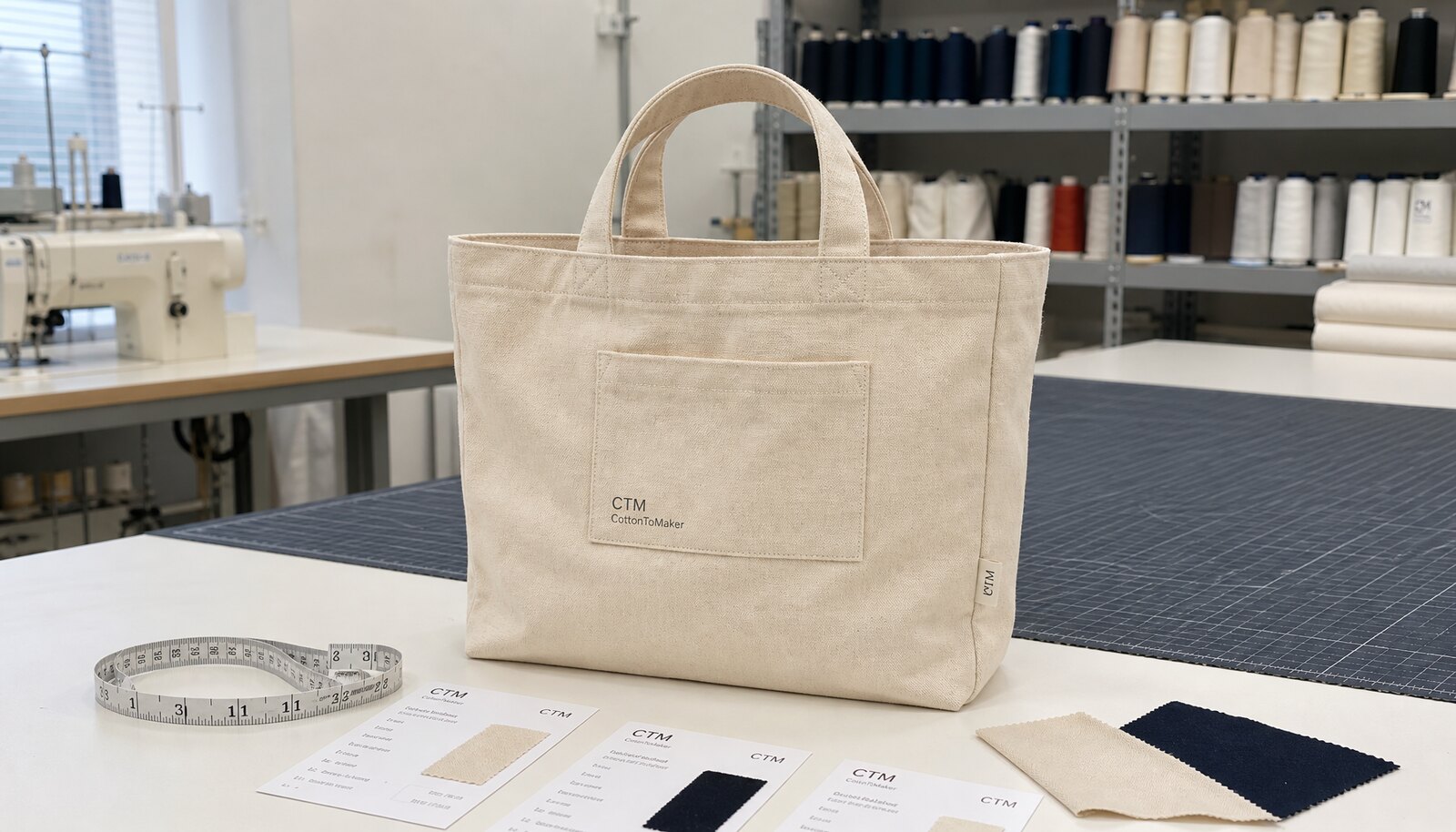
Why subscription box tote samples fail in ways retail tote samples do not
A tote for a subscription box is not only a branded carry item. It is part of the packing system, the unboxing sequence, and often the first reusable item a customer touches after opening the box. That changes the approval risk. A retail tote can tolerate small cosmetic variation if it still looks good on a shelf. A subscription box tote has to fit the insert or product set, fold cleanly for fulfillment, and arrive in a condition that makes the box feel intentional rather than improvised.
This is why sample approval matters more than the first price quote. A sample built by hand can hide the problems that matter in bulk: a different fabric lot, a lighter screen print, a handle sewn with extra hand support, or a fold pattern that the 3PL cannot replicate at scale. Once the buyer signs off the wrong sample, the supplier will treat that bag as the benchmark, and later complaints become harder to win because the reference itself was flawed.
- Treat the tote as part of the box system, not as a standalone accessory.
- Approve the sample against real pack-out conditions, not only against a visual spec sheet.
- Assume the cheapest quote will become expensive if the approved sample is not production-realistic.
Start with box fit and fulfillment flow before you talk about decoration
The first procurement decision is the geometry of the bag. For custom canvas tote bags for subscription boxes, size is not a style choice; it is a fit decision. The tote has to accept the actual box contents, the insert, tissue, or bundled product without forcing the bag to bulge, wrinkle, or expose awkward empty corners. If the subscription set includes rigid cartons, bottles, or mixed components, the gusset and base width matter as much as the print area.
You should also define the tote around the receiving process. A bag that looks excellent on the sample table can become a warehouse problem if it is too bulky in carton form, too difficult to fold consistently, or too prone to creasing. Ask the supplier how the bag will be packed, how many units fit in a master carton, and whether the fold direction keeps the front panel presentable for the customer. Those details affect both labor cost and the first impression.
- Build the tote spec around the actual box contents, not the artwork layout.
- Confirm the interior usable space after sewing, not just cut dimensions.
- Ask the 3PL or fulfillment team what fold and carton format they can receive without repacking.
Choose the supplier route that matches your risk profile
The procurement mistake most teams make is comparing unit price before they compare supplier control. A direct factory usually gives the best repeatability because the same team can manage fabric, sewing, print, and packing. That is useful when you expect repeat orders or seasonal variations and need the approved sample to be reproduced with minimal drift. The tradeoff is that the RFQ must be tighter, because the factory will price exactly what you ask for and will not fill in missing details on your behalf.
A trading company can be useful when your tote is only one element in a broader subscription box program and you need consolidation across categories. The downside is visibility. You may get convenience, but you need to verify who actually sews the bag, who prints it, and who signs the final sample. Local decorators can be useful for very small pilots or urgent proof runs, but they often rely on stock blanks and can limit control over fabric weight, gusset shape, and packing format.
- Use a direct factory when repeatability and production control matter more than fastest sample turnaround.
- Use a trading company when you need coordination across multiple box components and can tolerate another control layer.
- Use a local decorator only if you are willing to accept stock-bag constraints or a narrower spec.
Write the RFQ so suppliers quote the same bag, not three different versions
Most tote quotes are not actually comparable because the buyers did not define the same product. One supplier is quoting a stock 10 oz blank, another is quoting custom canvas with screen print, and a third is including polybags and carton labels that the others left out. That makes the lowest quote almost meaningless. A serious RFQ must lock the dimensions, fabric weight, handle construction, print method, pack-out, and any closure or trim so every supplier is pricing the same standard.
For subscription box programs, the RFQ should also separate first-order cost from repeat-order cost. Ask for sample charge, screen or setup charge, color change charge, packing charge, and carton details. Ask for unit price by MOQ tier and by reorder tier. If a supplier cannot separate those lines, you cannot build a defensible landed-cost comparison, and you will struggle to explain the decision to finance, operations, or the brand team.
- Specify finished dimensions, not just cut size.
- Specify fabric weight in both oz and GSM if possible.
- Specify print method, carton count, and pack format in the RFQ.
Use a procurement comparison table, not a generic spec checklist
A good tote comparison table should help a buyer decide between tradeoffs, not just collect facts. For example, 12 oz canvas with screen print may be the right middle ground if the bag must feel substantial but still stay economical in a monthly subscription program. A 14 oz bag may look more premium, but it can add freight weight, sewing difficulty, and carton volume. A heat-transfer logo may support complex artwork for a pilot run, but it may not be the best route if the bag will be handled repeatedly or reused often.
Use the comparison table to expose what the supplier is actually giving you. If one quote is based on a stock bag and another is custom-made from raw cloth, they should not be treated as equivalent. If one option reduces lead time by using a stock fabric color but creates shade variability across reorders, the buyer should see that as a tradeoff, not as an automatic win. That is the level of clarity procurement needs when the tote is part of a paid box program.
- Compare stock versus custom fabric, not just price per piece.
- Compare the real lead-time effect of each print method.
- Compare pack density and fulfillment handling, not only the bag itself.
Sample approval checklist: what to measure, test, and photograph
The sample should be reviewed as a production reference, not as a design concept. Begin with measurement: width, height, gusset, handle length, and handle drop must be checked after sewing. Then test the bag with the actual subscription box, insert, or representative weight so you can see whether the opening stays clean, whether the bag hangs properly, and whether the handle length feels right in the hand or on the shoulder. If the bag looks right empty but fails when loaded, it is not ready to approve.
Next, inspect the details that tend to drift in bulk. The print should stay aligned relative to the top hem and side seam, the stitch lines should be even, and the top opening should not twist. Photograph the approved sample from all key angles and keep those images with the approval record. If the factory later substitutes a different fabric, a different thread color, or a different folding method, you will need a clear baseline to prove the change.
- Measure the bag after sewing and again with the actual product load inside.
- Check print placement against seams and hem lines, not only against the center of the bag.
- Photograph front, back, side, inside seam, handle join, and folded pack-out.
Quality control thresholds: define defect classes before bulk starts
The most useful QC step is not a vague promise of inspection. It is a written pass/fail rule. For canvas totes, define critical defects first: the wrong size outside tolerance, the wrong artwork, a broken seam, missing bartacks at stress points, or contamination that would make the bag unusable. Those should have zero tolerance. Then define major defects that would damage the customer experience, such as obvious print shift, seam slippage near the handle, or a stain on the front panel. Minor defects can include loose thread ends or small fold marks if they do not affect function or presentation.
A practical inspection approach is to tie each defect type to a location. A loose thread on the inner seam is not the same as a loose thread on the logo panel. A small print variation near a gusset may be acceptable if the logo remains centered and legible, but a similar shift on the front panel may be a rejection. If you do not define where the defect matters most, inspectors will treat every issue as cosmetic, and the bulk run will drift toward the factory's convenience instead of your brand standard.
- Set zero tolerance for critical defects.
- Set separate rules for major defects on logo, handle, and load-bearing areas.
- Allow only minor cosmetic issues that do not affect brand presentation or use.
Supplier vetting and compliance checks buyers should not skip
If you are buying custom canvas tote bags for subscription boxes at scale, supplier vetting should go beyond product photos and a unit price. Ask for the business license, factory address, production scope, and the name of the actual plant that will cut and sew the bags. If a middleman is quoting the order, you need to know whether they control the factory schedule or are simply relaying messages. You also need a named contact who can sign off the approved sample and confirm when any material substitution happens.
Compliance needs depend on your market, but the principle is the same: make the supplier show what they can document. For some brands, that means test reports for dyes or finishes, country-of-origin documentation, and confirmation that packaging and labels match the intended market. If your internal team or retailer requires a social audit, ask whether the factory already has one and whether it is current enough for your procurement policy. If you care about restricted substances, get the proof before bulk release, not after a complaint.
- Identify the real factory, not just the sales contact.
- Request the documents your market or retailer requires before approval.
- Ask who has authority to approve substitutions and who must be notified if they happen.
Packing, cartonization, and warehouse handoff are part of product quality
For subscription box programs, the bag is only useful if it arrives in the correct packing format. Many tote programs fail at the handoff stage because the supplier treats packing as a shipping detail, while the warehouse treats it as a receiving requirement. If your 3PL wants a certain fold direction, carton count, label format, or inner pack structure, put that in the spec and confirm it on the sample. Otherwise the warehouse may repack the order, which adds labor and increases the chance of damage or delay.
Also think about how the bag presents when the customer opens the box. If the tote is meant to be visible, the fold should keep the front panel clean and the print centered. If the tote is packed inside the bag or alongside other goods, the fold must avoid distorting the handles or crushing the logo area. This is where a pre-production sample is valuable: it shows whether the tote can be built, folded, and packed the way the business actually needs it delivered.
- Approve the fold method and carton count with the fulfillment team, not only with the factory.
- Confirm whether polybags, tissue, or insert cards are required for your receiving or presentation standard.
- Check carton dimensions against warehouse receiving rules before production starts.
Lead time, escalation, and final release rules
Lead time usually slips in three places: material sourcing, sample revision, and final packing approval. If the factory is using custom-dyed canvas, fabric availability can become the schedule bottleneck. If the first sample uses substitute fabric or a different print method, the buyer may approve the look and later discover the bulk version feels different. If carton dimensions or pack-out rules change late, the production line may be forced to rework finished goods, which is one of the most expensive mistakes in a tote program.
The answer is to create hold points. Do not release bulk production until the pre-production sample matches the approved standard. Do not release shipment until the carton count, fold method, and label format are approved. If the factory proposes any change in fabric, trim, print, or packing, require written approval before the line moves forward. That discipline is what makes the final tote program defensible when finance asks why one supplier was chosen over another.
- Reserve time for one sample revision if the first sample is not production-real.
- Treat custom fabric or custom trim as a separate lead-time risk.
- Use written hold points before bulk release and before shipment release.
Specification comparison for buyers
| Procurement decision | Options to compare | Cost / lead-time tradeoff | Buyer risk to validate |
|---|---|---|---|
| Supplier route | Direct factory vs trading company vs local decorator | Direct factory usually gives the best repeatability and lower unit cost at volume; trading companies can bundle more items but add another layer of control; local decorators can turn samples faster but often rely on stock blanks | Confirm who actually cuts, sews, prints, inspects, and owns the final sample record |
| Fabric plan | Stock 10 oz canvas vs custom 12 oz canvas vs premium 14 oz canvas | Stock fabric shortens lead time and lowers setup cost; custom weight or custom dye increases control but can add mill time and more shade risk | Verify finished weight, weave density, and whether the sample uses the same cloth lot as bulk production |
| Print method | Screen print vs heat transfer vs embroidery | Screen print is efficient for simple art at scale; heat transfer can support short runs and more complex graphics; embroidery adds a premium feel but can slow production and change cost structure | Check edge sharpness, hand feel, wash durability if relevant, and whether placement shifts after sewing |
| Handle construction | Self-fabric handles vs cotton webbing vs reinforced shoulder-length webbing | Self-fabric handles are usually lowest cost; webbing improves comfort and load performance; reinforcement adds sewing time but can reduce seam failures | Test handle drop, bartack quality, and whether the filled bag twists or stretches under load |
| Closure and trim | Open top vs snap/button vs zipper | Open top is easiest and cheapest; closures increase material count, assembly time, and approval points | Confirm whether hardware creates scratch risk, added weight, or alignment issues on the finished bag |
| Packing format | Bulk carton vs individual polybag vs retail-ready insert card | Bulk carton minimizes material and labor; polybags and inserts improve presentation but can increase packing time and warehouse receiving cost | Validate fold method, carton count, barcode labeling, and how the tote will arrive at the 3PL |
| Approval stage | Visual prototype vs pre-production sample vs first production run audit | A visual prototype is fast but not reliable for final sign-off; a true pre-production sample takes longer but reduces rework risk before bulk release | Do not approve a hand-built sample if fabric, print method, trim, or packing differs from the quoted bulk spec |
Buyer checklist before sampling
- Measure finished width, height, and gusset after sewing, then confirm the usable interior space with the actual subscription box or insert inside the bag.
- Verify fabric weight in both oz and GSM, plus shade, weave density, and hand feel under daylight and office light before approving the sample.
- Lock the print method, artwork size, Pantone target if applicable, and placement distance from the top hem, side seam, and centerline.
- Check handle drop, total handle length, and how the straps behave when the bag is loaded to the expected shipping or reuse weight.
- Inspect seam quality at handle joins, side seams, gusset corners, and top hem for puckering, skipped stitches, loose ends, or distortion.
- Confirm the tote folds the way your fulfillment partner needs it to fold, including whether the front panel stays clean and the handles stay contained.
- Approve the packing format: inner pack, carton count, carton marks, moisture protection, and whether any tissue, insert card, or polybag is required.
- Ask the supplier to identify whether the sample is a prototype, semi-production sample, or true pre-production sample built with final materials and methods.
- Require a photo record of the approved sample from front, back, side, inside seam, handle join, and folded pack-out positions.
- Make any deviation from the approved sample a written change request, even if it looks minor, so the bulk order cannot drift quietly.
Factory quote questions to send
- Is this quote based on stock canvas or custom-woven canvas, and who owns the fabric once it is reserved for our order?
- What are the finished dimensions and tolerance after sewing, not just the cut size, and can you share a measurement sheet with the sample?
- Which print method is included in the price, how many colors are covered, and what setup charges apply per design or color?
- What is the exact MOQ by color, by artwork, and by handle or closure option, and what changes if we reorder the same spec later?
- What sample stages do you offer, what does each one include, and is the pre-production sample made with final fabric, final trim, and final packing?
- How do you pack the bag for our fulfillment center, including fold method, inner pack count, carton dimensions, and gross weight?
- What inspection method do you use before shipment, and can you provide defect photos or a pre-shipment report tied to the approved sample?
- What compliance documents can you provide for dyes, finishes, country of origin, and any market-specific requirements our brand needs?
- Who is the actual factory contact for sample approval, who signs the production file, and what changes require re-approval before bulk release?
- What is the production lead time after sample approval, and what happens if fabric, thread, trim, or packaging needs to be reordered?
Quality-control points to confirm
- Critical defects: wrong size outside tolerance, wrong artwork, wrong color family, missing handle attachment, broken seam, or contamination. Acceptance should be zero critical defects.
- Major defects: print shift that makes the logo look off-center, handle asymmetry that is obvious in use, seam slippage at load points, or visible stain on the front panel. Do not accept a batch with major defects on logo or stress areas.
- Minor defects: loose threads under an agreed threshold, small fold marks, or slight variation in thread trim that does not affect function or presentation. Cap minor defects under your agreed inspection plan.
- Finished dimensions: set a measurable tolerance before production, such as plus or minus 0.5 cm on width and height and plus or minus 1 cm on handle drop, unless your pack-out requires tighter control.
- Print registration: define maximum acceptable shift from the approved centerline and top edge, then check the same points on the left, center, and right of the run.
- Stitching: confirm consistent stitch density and no skipped stitches at handle ends, gusset corners, top hem, or closure points.
- Load performance: test the bag with the actual box contents or a representative weight and confirm there is no seam distortion, handle slippage, or stitch pop during the hold period you specify.
- Packing match: verify carton count, inner pack count, label format, and fold direction against the approved pack-out sample before shipment is released.