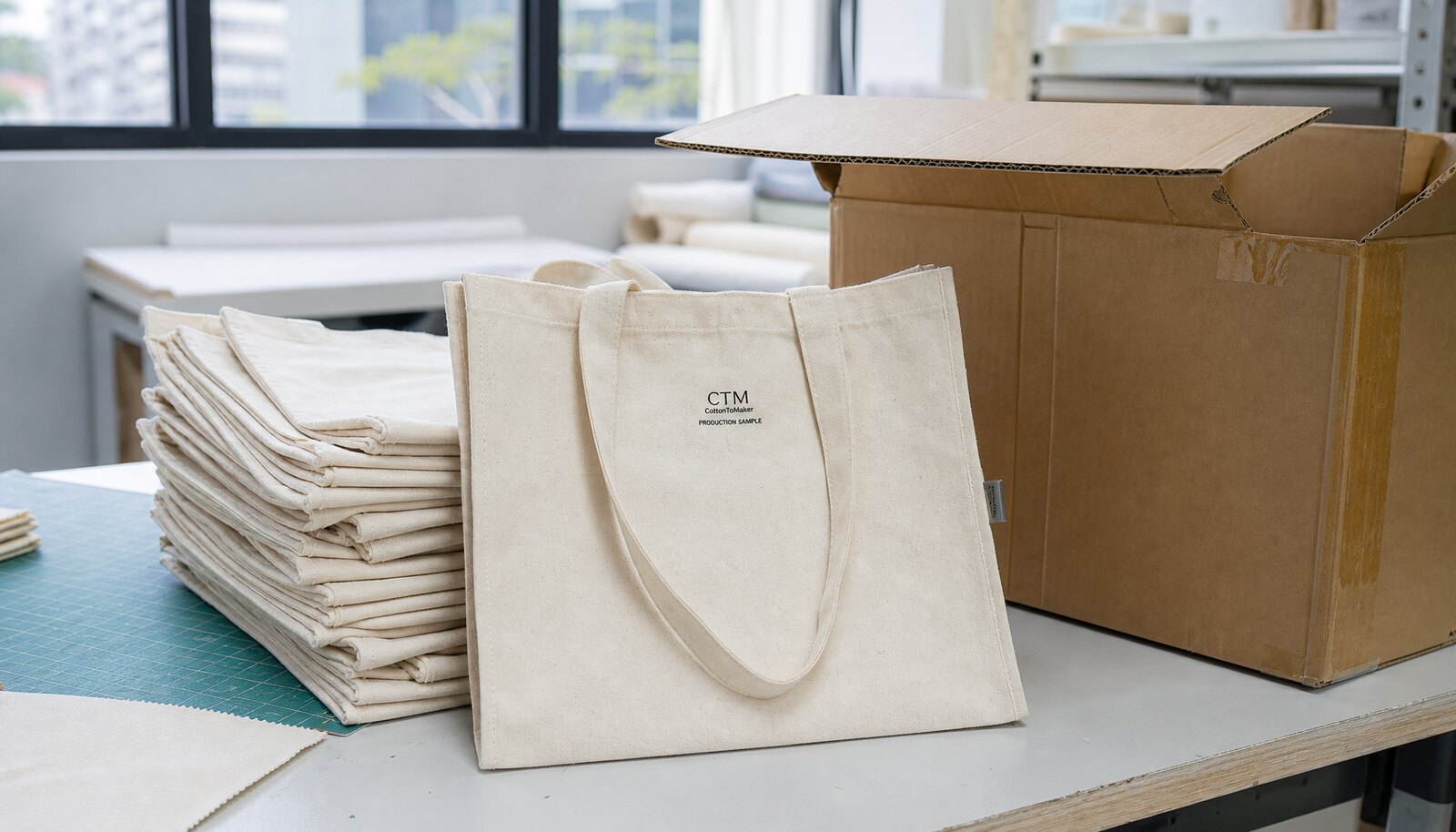
Why carton planning matters more for school totes than most buyers expect
For custom canvas tote bags for schools, the shipping carton is not just a warehouse detail. It affects freight cost, storage density, receiving speed, and whether the bags arrive in a condition a school, distributor, or retail buyer can actually use. A tote that looks correct in a sample room can still fail the program if the folded carton dimension is too large, the handles create pressure marks, or the pack count creates unstable cartons on a pallet.
School orders tend to have more operational pressure than a simple retail tote program. There may be multiple delivery points, fixed intake dates, and a need to distribute bags quickly into class kits, orientation packs, or book giveaway programs. That means the buyer needs a packing plan as part of the quote, not as an afterthought.
- Carton planning affects ocean freight, domestic warehousing, and school distribution labor.
- A correct print spec is not enough if the bag fold creates oversized cartons.
- Programs with multiple schools need clean carton labels and predictable pack counts.
Start with the right canvas weight for the school use case
The most common mistake in school tote sourcing is under-specifying the fabric. If the tote only carries paper handouts, 8 oz canvas may be enough. If it will hold textbooks, notebooks, water bottles, and a folder set, move toward 10 oz or 12 oz canvas. In metric terms, buyers often work around 280-340 GSM for lighter programs and 340-420 GSM for stronger, longer-use school bags. Heavier fabric costs more, but it can reduce seam failure and complaint rates when students overfill the bag.
The fabric choice also changes the shipping carton plan. A heavier canvas bag does not just weigh more; it folds thicker and takes more cube. That means the same carton size may fit fewer pieces, which can raise freight per bag even if the unit price only moves slightly. Good procurement teams compare fabric cost and freight density together, not separately.
- 8 oz / about 280 GSM: light promotional use, low-cost campaigns, short carry distances.
- 10 oz / about 340 GSM: balanced option for most school kits and bookstore-style distribution.
- 12 oz / about 400 GSM: stronger feel, better structure, lower risk for heavy contents.
- If the bag has a gusset, expect thicker folds and lower carton density than a flat tote.
Choose the print method based on durability, artwork, and reorders
For school programs, simple screen printing is usually the best starting point. One or two solid colors on natural or bleached canvas gives clean registration, stable cost, and predictable output across reorders. It is also easier for the factory to inspect because coverage, edge sharpness, and cure quality are visible at a glance. If the design includes small type, fine linework, or multiple school names, the art may need simplification before production.
Heat transfer and digital transfer can work for short runs or variable personalization, but they add more process control risk in carton shipping because the print face can scratch if the bags are packed while still warm or if the bundles are compressed too hard. Embroidery is durable and premium, but it changes bag thickness and can reduce carton count. Buyers should treat print method as a packing decision, not only a branding decision.
- Screen print: best for repeatable school logos and lower unit cost on mid-to-large runs.
- Heat transfer: useful for small quantities or multi-version school name personalization.
- Embroidery: premium feel, but thicker pack-out and higher sewing cost.
- Ask for a rub test on the print before approving mass production.
Build MOQ around print setup and carton efficiency, not just the factory’s default minimum
A useful MOQ is one that reflects how the order will actually run. If a supplier gives a low bag MOQ but forces a poor carton plan, the landed cost can rise quickly through wasted cube and extra handling. For school buyers, the right MOQ often depends on the number of artwork versions, colorways, and delivery splits. A single-logo order can usually absorb more efficient production, while mixed school names or district-specific labels will usually push the MOQ up because of print screens, packing labels, and changeover time.
The buyer should ask for MOQ by specification layer: fabric color, print color count, and carton configuration. That separates what is truly fixed from what is negotiable. A factory that can explain MOQ by sewing efficiency and print setup is usually more reliable than one quoting a blanket number with no packing detail.
- Single artwork version usually gives the best unit price and carton consistency.
- Multiple school names may need separate pack runs even if the tote body is identical.
- Packing inefficiency can be more expensive than the artwork change itself.
Carton design: the hidden cost driver in school tote programs
Shipping cartons should be defined before the PO is placed, not after production begins. The bag’s flat-fold dimensions, handle laydown method, and whether the tote has a gusset determine the carton size. A small change in fold width can alter carton count by 10-20%, which then changes freight pricing and warehouse intake time. If the buyer does not control this early, the supplier may choose the easiest packing pattern for the factory, not the most economical pattern for the buyer.
For many school programs, 50 pcs or 100 pcs per carton is practical, but the right number depends on fabric weight and carton strength. Heavier canvas may require 25 or 50 pcs per carton to avoid bulging. Lighter promotional tote programs can often run higher counts, but only if the folded bags stay flat and the carton can survive stacking. The best carton plan is the one that protects the product and uses freight space efficiently without creating receiving problems.
- Require the final folded dimensions in the quote, not only the bag dimensions.
- If the tote has printing, test whether printed panels stick together when stacked.
- Confirm whether the carton is intended for palletized sea freight or direct parcel shipment.
- Use a carton pack count that matches distribution labor at the destination.
Comparison of sourcing routes for school tote carton planning
School tote buyers often choose between a direct factory, a trading company, or a local decorator who outsources production. Each route can work, but the carton plan and quote structure are different. The right choice depends on how much control you need over fabric, print, bundle packing, and export cartons.
If shipping carton accuracy matters, the most transparent route is usually a direct factory with documented packing photos and pre-production sample sign-off. Intermediary routes can still work, especially for mixed merchandising programs, but the buyer should expect extra margin layers and less visibility into the actual carton build.
- Write decisions in measurable language, not only descriptive wording.
- Ask for sample photos plus one physical approval sample for important orders.
- Keep quotation, sample approval, and inspection notes tied to the same spec version.
Comparison table: supplier routes for custom school canvas tote shipments
Packing rules should cover fold method, inner bundle, carton count, carton mark, moisture protection, SKU separation, and warehouse receiving needs. These details affect cost, damage rate, receiving speed, and whether the goods can move directly into retail or distribution.
A canvas tote bag can pass product QC and still create claims if cartons are mislabeled, overpacked, crushed, damp, or mixed. Treat packing as part of the specification, not an afterthought.
- Write decisions in measurable language, not only descriptive wording.
- Ask for sample photos plus one physical approval sample for important orders.
- Keep quotation, sample approval, and inspection notes tied to the same spec version.
Sample approval should include the packed carton, not only the tote itself
A loose sample is not enough for a school tote program. The sample must reflect the real fold direction, printed side placement, bundle count, carton dimensions, and label position. Otherwise the approved sample may look perfect while the shipment arrives in cartons that are too large, too heavy, or too compressed to stack cleanly. Buyers should request a pre-production sample packed the way the mass order will be packed.
A good sample review catches practical problems early. For example, the handles may need a different fold to stop them from pressing a ridge into the print area. Or a thick screen print may need a little more carton headroom. These are small details, but they matter when you are shipping hundreds or thousands of bags to schools and need every carton to receive cleanly.
- Confirm finished size after pressing and folding.
- Inspect print color, registration, and ink feel.
- Open one sample carton and verify bundle count and label accuracy.
- Check whether the bag springs open inside the carton and increases volume.
Packing rules that reduce freight loss and warehouse complaints
Packing is where many tote programs lose money quietly. A carton that is too loose creates movement and corner damage. A carton that is too tight creates handle creases, print sticking, or crushed gussets. The factory should state how many bags go into each bundle, whether the bags are interleaved with tissue or left as a clean stack, and what tape and carton grade are used. For school orders, simple and repeatable packing usually beats elaborate retail-style presentation.
If the destination warehouse uses barcode receiving, the carton label should show the SKU, school name or district code, color, bag count, net weight, gross weight, and carton number sequence. When orders are split across multiple schools, the labeling system is what prevents mis-shipments. A clean label system often saves more labor than a small reduction in bag unit price.
- Use a single pack standard across all cartons in the same SKU when possible.
- Keep label format identical across production and shipping documents.
- If the order is palletized, confirm pallet height and stacking pattern before production ends.
- Avoid mixed packing in one carton unless the buyer has clearly approved it.
Lead time planning: where school tote orders usually slip
The real schedule risk in canvas tote orders is rarely sewing alone. Delays usually come from artwork cleanup, sample revision, carton approval, and packing changes after production is already underway. A typical timeline for a custom school tote order might include artwork confirmation, fabric booking, sample making, approval, bulk sewing, printing, final inspection, and carton loading. Even a small change in print placement can force a new screen or a new packing test.
A buyer should ask the factory to separate production days from packing and export days. That makes it easier to see whether the supplier is promising an aggressive sew schedule but underestimating the time needed for print curing and carton audit. For seasonal school buying, the safest plan is to lock the spec early and keep the shipping carton unchanged after sample approval.
- Expect more risk if the order contains multiple school names or personalized labels.
- Leave time for one round of sample correction if the artwork is not production-ready.
- Do not compress the schedule so hard that the factory skips carton testing.
- If the order is sea freight, build in a buffer for booking and export cutoff timing.
Specification comparison for buyers
| Spec decision | Recommended option | When it fits | Buyer risk to check |
|---|---|---|---|
| Direct factory with packing photos | Best for repeat school programs that need controlled carton counts and export-ready labels | When tote bags are the main item and the buyer wants visibility into sewing, printing, and carton loading | Confirm the factory is showing the actual production line and not a sample-room-only setup |
| Trading company with multi-item consolidation | Useful when tote bags are one part of a larger school kit or mixed merchandising order | When the buyer wants one purchase order across notebooks, pouches, and bags | Check whether carton dimensions are firm or only estimated after final subcontracting |
| Local decorator with outsourced sewing | Works for domestic rush programs or small-volume school events | When freight distance is short and lead time matters more than carton density | Risk of less control over fabric source, seam consistency, and carton count accuracy |
| Factory with in-house screen printing | Preferred for simple logos and recurring annual school reorders | When the artwork is stable and unit cost must stay competitive | Verify print cure consistency and whether the factory has proper color matching controls |
| Factory using transfer decoration | Short-run option for multi-version names or variable school branding | When quantities are low or artwork changes often | Check abrasion resistance and whether packed bags rub against each other in the carton |
| Standard 50 pcs carton pack | Good balance for medium-weight 10 oz school totes | When the tote is sturdy but not overly bulky and the destination wants easy handling | Make sure the carton does not over-compress handles or crease the printed face |
| Standard 100 pcs carton pack | Best only for lighter 8 oz tote programs with very flat folds | When freight cube efficiency matters and the tote will not be stored long before distribution | Watch for carton bulge, corner crush, and handling strain at receiving |
| Custom carton size by school SKU | Recommended for district splits or multiple delivery points | When each school needs its own label, count, and packing note | Confirm carton MOQ and whether custom sizing adds tooling or setup cost |
| Palletized export packing | Preferred for sea freight and warehouse receiving | When cartons will travel long distance or be stacked in bulk at a distribution center | Check pallet height limits, strapping method, and moisture protection |
Buyer checklist before sampling
- Confirm the school use case: student kit, library giveaway, bookstore resale, orientation pack, or staff pack, because the required GSM and carton count change with load weight.
- Specify fabric weight in oz or GSM, plus whether the canvas is bleached, natural, recycled, or dyed, and whether the bag needs reinforcement at the handle base.
- State the print area, number of colors, and whether artwork must sit on one side only, both sides, or include a side label or woven tag.
- Define the flat-fold size and the target carton pack count before requesting quotes so the supplier can calculate carton dimensions and freight cubic meters.
- Request a sample packed in the final folding method, not only an unfilled loose sample.
- Ask for carton materials, carton dimensions, net/gross weight, and whether the master carton will be palletized, strapped, or shrink-wrapped.
- Set an acceptable tolerance for bag count per carton and carton dimension variance.
- Request photos of the packed carton, folded bag bundle, and label layout before mass production release.
Factory quote questions to send
- What is the exact fabric construction, finished GSM or oz weight, and is the weight measured before or after printing and washing?
- What carton size do you recommend for the approved fold, and how many pcs fit per carton without compressing the seams or handles?
- What is the MOQ by print color, fabric color, and carton pack configuration?
- Which print method gives the best balance of durability, cost, and lead time for this artwork?
- Can you provide a sample packing photo with the proposed carton loading pattern before production?
- What is included in your quote: bag sewing, print, inner bundle packing, carton, carton marking, palletizing, and export documents?
- How many production days are needed after sample approval, and what events can push the ship date?
- What carton compression or drop-test standard do you use for export cartons on this route?
Quality-control points to confirm
- Fabric weight tolerance should stay within an agreed range, typically plus or minus 5% on the ordered spec unless the buyer approves a wider range.
- Handle stitch density should be consistent and reinforce the load area; loose ends or skipped stitches should not appear at the handle root.
- Print registration should remain centered within the approved artwork tolerance, with no smearing, ghosting, or pinholes in solid areas.
- Finished bag size should be checked after pressing and folding, because oversized seams can reduce carton count and distort freight calculations.
- Carton count should be verified at pack-out and again at pallet build; count variance should be zero-tolerance on final shipping documents.
- Carton corners should remain intact after tape sealing, stacking, and a basic drop simulation.
- Master labels should match SKU, school name or program name, colorway, carton count, and gross/net weight.
- Random carton opening at inspection should show the same fold direction and bundle count as the approved packing sample.