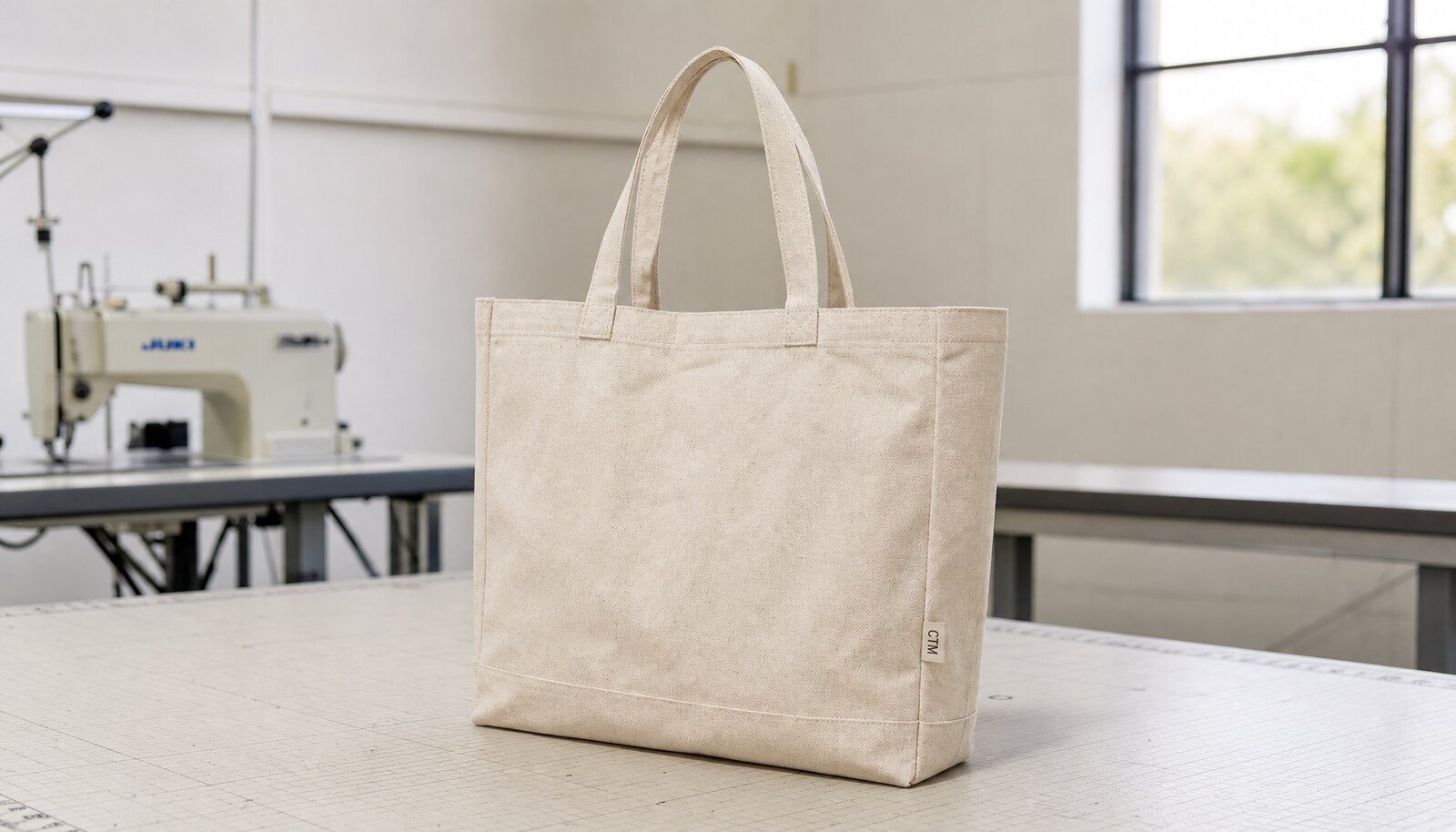
Why school retail tote launches go wrong at the quote stage
School retail launches often begin with a simple brief: a canvas tote, a school logo, and a deadline before the term starts. Procurement pain usually appears later, not because the bag is difficult to sew, but because the quote was never specific enough to control the result. One supplier quotes a lighter cloth, another quotes a smaller print area, another omits retail packing, and suddenly the “best” price is no longer comparable. That is how a launch loses margin before the first carton arrives.
The procurement mindset needs to shift from buying a decorated bag to buying a repeatable retail item. A tote that looks acceptable in a mockup can still fail once it is filled with books, stacked on a shelf, or handled by a store team. For school retail, the bag has to satisfy three audiences at once: the buyer who manages cost, the store team who needs clean intake and labeling, and the customer who judges the bag in a few seconds on the shelf. If the specification does not serve all three, the program becomes harder to replenish later.
The easiest way to avoid that problem is to lock the core spec before you ask for competing quotes. Define the tote size, fabric weight, handle construction, print method, and pack format first. Then ask every supplier to quote on the same basis. That sounds basic, but it is the difference between comparing offers and comparing assumptions. In retail programs, assumptions are expensive.
- Most quote errors come from hidden spec differences, not from sewing defects.
- School retail buyers need a tote that can be reordered without changing the look or feel.
- A low unit price is not useful if the bag must be reworked after sample approval.
Start with the school use case, not the design file
A school tote should be defined by use, not just by artwork. Students load these bags with notebooks, stationery, lunch items, water bottles, or even laptops. That means the tote has to carry weight, keep its shape, and survive repeated handling in a retail environment. If the bag is only designed around the logo file, the buyer may miss the practical details that determine returns and sell-through.
Begin by identifying where the tote will be sold and how it will be used. A campus bookstore item usually needs cleaner finishing than an event-only giveaway. A bag sold in a school shop during orientation week may need stronger seams and a more structured body than a souvenir tote sold to parents. If the item is meant for daily student use, the buy spec should move closer to durable merchandise than to promotional swag. The more direct and practical the use case, the easier it is to brief suppliers correctly.
This is also the point where procurement and merchandising should align. Retail teams often focus on colorways and visual appeal, while procurement teams focus on cost and lead time. Both matter, but they should be balanced against the actual carry requirement. A tote that looks good but collapses under a stack of textbooks will cost more in customer complaints than a slightly heavier bag that sells with confidence on shelf.
- Bookstore and campus retail need a cleaner finish than event-only bags.
- If textbooks are likely, choose a stronger canvas and reinforced handles.
- If the tote is a premium retail item, consider better print registration and seam finishing.
Fabric weight and structure: the first decision that affects shelf value
For custom canvas tote bags for schools retail launch buying guide decisions, fabric weight is one of the few specifications that influences both customer perception and performance. A lighter canvas can lower the quote, but it can also feel soft, wrinkle faster, and lose the structured shape that retail buyers often want on shelf. A medium-weight canvas is usually the safer starting point for school retail because it balances hand feel, print clarity, and cost. If the bag must regularly carry books, the buyer should look more closely at stronger options rather than assuming one standard canvas weight fits every launch.
Avoid vague terms like heavy canvas unless the supplier also gives you the actual figure in GSM or ounces. Even then, ask whether the measurement refers to finished fabric, raw fabric, or greige cloth before finishing. Two bags can both be called 12 oz and still feel different if the weave density or finishing process varies. If the supplier cannot explain the measurement basis, it is a warning sign that the quote may be loosely controlled.
From a procurement perspective, fabric weight should be tied to use case and shelf position. Lighter canvas may fit a lower price point or a temporary campaign. Medium-weight canvas is often the broadest retail choice. Heavier canvas may better suit premium school shops or carrying heavier loads, but it will also increase material cost and can make freight slightly less efficient. The right answer is not the heaviest cloth available; it is the cloth that matches the intended retail role and expected wear.
Structure matters as much as raw weight. A tote with a loose weave and weak stitching can feel cheaper than a slightly lighter bag with better seam control and a firmer body. Ask for photos of the fabric under close light, not only a clean studio shot. If possible, request a sample that has been folded, opened, and loaded. That gives a more realistic sense of whether the bag will stand up on shelf or collapse into a soft shape.
- 10 oz can work for light retail or souvenir use, but it is a softer value proposition.
- 12 oz is often the balanced starting point for most school retail launches.
- 14 oz or stronger may suit heavier loads or premium retail positioning, but it should be justified by the use case.
Decoration strategy: choose a print method the factory can repeat cleanly
School logos often look simpler in a PDF than they do on canvas. Fine type, narrow rules, gradients, and small crests can lose clarity once they are printed on textured fabric. The right decoration method is the one the factory can repeat cleanly across the full order, not the one that looks most impressive in a render. For many school retail programs, screen print remains the most dependable choice because it is economical, repeatable, and easy to specify when the artwork is straightforward.
Screen print usually works best for one to three solid colors and for logos with bold shapes. It gives strong color coverage and is relatively easy to compare against a signed sample. If the order is small or the artwork is too detailed for screen print, heat transfer or DTG can be considered, but only with a clear understanding of durability, surface feel, and registration consistency. Those methods can be suitable for short runs or trial programs, but they should not be selected simply because the art file is complex. In a retail launch, the buyer is paying for consistency as much as decoration.
Embroidery can be a premium option, but it is best used with restraint. A small badge, side mark, or tonal logo can look polished. Large embroidered areas on canvas can create distortion, increase cost, and add stiffness in ways that may not suit the bag’s intended retail price point. The question to ask is not whether embroidery is possible; it is whether the method supports the shelf price, the brand look, and the order quantity without creating avoidable risk.
When you request a quote, ask the supplier for the minimum line thickness, smallest readable text, and expected color tolerance for the chosen method. That forces the conversation away from “we can do it” and toward what the process can actually hold. If a supplier cannot explain where the logo will be placed, how it will be aligned, and what the tolerance is for placement drift, the quote is not yet production-ready.
- Screen print is usually the safest default for bold school logos and repeat orders.
- Heat transfer or DTG may suit short runs, but durability and surface behavior should be tested first.
- Embroidery works best as a small premium accent, not as a large filled design on canvas.
Supplier route and landed cost: compare the total order, not just the unit price
Supplier choice changes the commercial result as much as the bag spec does. A direct factory usually gives better control over fabric selection, stitch construction, and pack-out details. That control matters when the first order is also your retail test, because small inconsistencies can become expensive quickly. A trading company or sourcing agent may be helpful if you need design support, mixed-product bundling, or a lower-friction first quote, but buyers should be clear about whether the intermediary is quoting the same technical standard as the factory would use.
The best price is not the lowest unit price; it is the lowest landed cost that still meets the launch standard. A slightly more expensive factory quote can still be the better buy if it reduces inspection rejects, avoids re-labeling, ships in a carton format your warehouse can receive cleanly, and supports a repeat order without rework. Procurement should compare the order as a system: material, decoration, packing, freight efficiency, inspection risk, and replenishment ease.
The tradeoff is control versus convenience. Direct factories can be more transparent on spec control, but they may require stronger buyer discipline on approvals, documents, and timing. Intermediaries may reduce coordination work, but they can also make it harder to see where a cost increase is coming from. If you are launching a tote into school retail, ask every supplier to disclose who owns the fabric booking, who approves the sample, and who is responsible if carton markings or label placement are wrong. Those answers tell you far more than the headline price does.
- Direct factory quotes usually offer stronger control over repeatability.
- Intermediaries can help with coordination, but they may mask hidden packing or handling charges.
- Always compare landed cost, not just ex-factory unit price.
Comparison table: how to normalize supplier quotes before you choose
A procurement-grade comparison needs more than a row for unit price. For a school retail launch, normalize every quote to the same canvas weight, same size, same print size, same packaging, and same carton specification. If one supplier uses lighter cloth, a smaller print area, or bulk pack only, the quote is not directly comparable. Treat those differences as commercial variables, not minor footnotes.
A useful comparison also includes the cost implication of each decision. For example, a heavier canvas may raise unit cost but reduce the chance of returns and support a better retail story. A retail-ready pack may add labor cost, but it may reduce time at receiving and avoid store-side relabeling. The table below is designed to surface those tradeoffs so you can compare real program value rather than only headline price.
MOQ strategy for a school launch: keep the first SKU simple
MOQ is rarely just a manufacturer preference; it is the point where setup cost, material booking, and production efficiency meet. If you launch one tote style with one logo version, one color, and one print position, the factory can usually keep the order more efficient than if you ask for several body colors, multiple logo placements, and varied packaging. Each extra variable means more approvals, more material handling, and more room for inventory that does not move.
For a first retail launch, the safest commercial structure is often one hero SKU and one controlled variation. If the school wants multiple house colors, consider keeping the body neutral and changing only the print color or small trim detail. That approach lets buyers test demand while limiting dead stock. If sell-through is strong, the next reorder can broaden the line once the team has actual demand data rather than assumptions.
When reviewing MOQ, ask the supplier to break it into parts: MOQ by fabric color, MOQ by print color count, MOQ by logo version, and MOQ by packing format. That is much more useful than a single top-line number because it shows what actually drives the minimum. It also helps procurement decide whether to simplify the spec or accept a higher opening order in exchange for better unit economics.
- One fabric, one logo, one print location is the easiest way to control first-order risk.
- Every added color or print variation can raise setup cost and inventory complexity.
- If multiple school colors are required, consider keeping the tote body constant and varying only the print or trim.
Sampling: approve the whole bag, not just the logo
Sampling is where a school retail tote program either becomes controllable or starts drifting. A sample should prove more than appearance. It should confirm fabric hand, body structure, handle length, seam quality, print placement, and how the bag behaves when loaded. Buyers sometimes approve a sample because the logo looks right, only to discover later that the handles are uneven or the top edge twists after sewing. Once bulk production begins, correcting those issues becomes far more expensive.
A better approach is to use two levels of approval. First, request a pre-production sample after the fabric and artwork are locked. This sample should be made with the real construction and packing approach, not a generic display version. Second, retain a gold seal sample that both buyer and factory can use as the reference for bulk. That reduces ambiguity if there is a dispute later. The sample should be measured flat and, where relevant, loaded with the type of item it is expected to carry in retail.
The sample review should be practical and visual. Check handle drop on both sides, top edge alignment, logo placement, stitch density, seam finishing, and whether the bag keeps its shape on a shelf or table. If the bag is intended for students, test the way it opens and closes and whether the handles sit comfortably when carried. These are small details, but in retail they influence whether the item feels like a school-shop product or a low-grade promotional giveaway.
- Approve fabric, dimensions, handle length, stitch quality, and print placement together.
- Measure the sample flat and, if relevant, with a realistic load inside.
- Keep one signed gold seal sample for the factory and one for your receiving team.
Packing and retail readiness: specify what the warehouse actually needs
Packing is one of the easiest places for cost to hide. A tote may be cheap to sew but expensive to receive if the carton format, barcode sticker, fold method, or polybag spec is not defined up front. If the product is going to a school bookstore, campus retail network, or distributor warehouse, the receiving team may have strict requirements on carton labels, item codes, and pack counts. The factory cannot quote this accurately unless the buyer states it clearly.
Not every school retail launch needs retail-ready packing. Some buyers can accept flat bulk cartons and handle barcode labeling locally. Others need individual bags, fold direction control, or shelf-ready labeling because the stores cannot rework the goods on arrival. Each choice affects labor, materials, and carton efficiency. The right answer depends on your receiving workflow, not on a default assumption that “retail-ready” is always better.
Carton planning deserves special attention because tote bags can be deceptively bulky once folded and packed. A small change in folding method or inner packaging can alter carton dimensions, which then changes freight cost and warehouse handling. Ask the supplier to quote carton size, carton weight, and pack count before you approve the PO. That allows your logistics team to check pallet fit, container utilization, and warehouse receiving rules before the shipment is already moving.
- Bulk flat pack is often the most economical option for warehouse distribution.
- Retail-ready packing should be priced separately because it adds labor and material cost.
- Carton dimensions can affect freight more than buyers expect, especially on lighter-value programs.
Lead time planning: protect the back-to-school window
In school retail, schedule risk often costs more than a small unit-price increase. The most profitable tote can become a poor buy if it arrives after the selling window. Lead time should be planned backward from the shelf date and should include artwork approval, sample approval, material booking, production, inspection, packing, and shipment. If the quote only mentions sewing time, the buyer does not yet have a usable timeline.
Be careful with lead-time assumptions that are not tied to a start point. A supplier may say production takes a certain number of days, but that number is only meaningful if it starts after artwork is finalized, the deposit is received, and the sample is signed. If the supplier still has to source a particular canvas weight or print screen, add time. If carton artwork must be approved by a school brand team, add more time. The production calendar should be built around the slowest dependency, not the fastest one.
A practical procurement habit is to separate sample lead time from bulk lead time in every PO and quote comparison. That makes it easier to see where the schedule could slip. It also gives your team a better way to manage expectations with merchandising and operations. A launch that is slightly delayed but correctly made is usually better than a rushed shipment with the wrong print scale, incorrect fold, or missing labels.
- Count backward from the on-shelf date and include approvals, inspection, and freight.
- Do not treat bulk lead time and sample lead time as the same number.
- Build a buffer for rework, carton approval, and shipping booking delays.
Specification comparison for buyers
| Decision area | Lean option | Stronger retail-launch option | Cost or risk tradeoff to check |
|---|---|---|---|
| Fabric weight | 10 oz canvas | 12 oz canvas | 10 oz lowers unit cost and freight a little, but it can feel soft, wrinkle faster, and show print-through; 12 oz usually gives a better shelf hand feel and better structure for campus retail |
| Heavy-use carry strength | Standard canvas with basic seams | 12 oz to 14 oz canvas with reinforced handle joins | Heavier fabric increases material cost and may raise sewing time, but it reduces returns if students will carry books or laptops |
| Print method | Single or two-color screen print | Screen print with approved pantone matching and fixed placement jig | Screen print is usually the best balance of cost and repeatability; check minimum line thickness and whether the supplier can hold registration on textured canvas |
| Detailed artwork | Heat transfer or DTG | Artwork simplified for screen print, or a separate premium SKU for detailed art | DTG and transfer methods can handle complexity in small runs, but they may wear differently and require tighter test approval; use them only if the design truly needs it |
| Supplier type | Trading company or sourcing agent | Direct factory with stable tote experience and a named QC contact | Intermediaries can be useful for small programs, but they may hide fabric substitution or packaging markups; direct factories usually give better control over construction and reorders |
| MOQ structure | Multiple colors and multiple logo versions | One hero color, one logo version, one print position | Every added color or variation increases setup, approval, and dead stock risk; one core style is easier to replenish before the school term peaks |
| Handle construction | Standard cotton web handles | Reinforced web handles or self-fabric handles with X-box stitching | A better handle costs more in sewing time, but it reduces failure at the stress point and improves perceived value in store |
| Inside finish | Basic seam finishing | Overlocked seams, trimmed thread ends, and consistent top edge alignment | Cleaner finishing can be a small cost increase but matters in retail because customers inspect the inside before purchase |
| Packing format | Bulk flat pack only | Bulk flat pack with carton labels, barcode stickers, and fold orientation defined | Retail-ready packing adds labor and material cost, but it can save labor at receipt and reduce store-side handling errors |
Buyer checklist before sampling
- Freeze tote size, canvas weight, handle length, and logo placement before asking for final quotes.
- Specify whether the order is for school store retail, campus bookstore, orientation merch, or bulk event resale, because that changes the finish level and packing expectation.
- Send vector artwork and define whether the logo needs Pantone matching, spot colors, or a simplified print version.
- Request a pre-production sample made with the same fabric, print method, stitch construction, and packing plan intended for bulk.
- Write tolerances for body dimensions, handle drop, logo position, and seam alignment instead of using words like close enough or near the sample.
- Confirm whether you need flat bulk packing, barcode stickers, inner polybags, hangtags, or shelf-ready pack-out before the factory quotes.
- Ask for carton pack count, carton dimensions, gross weight, carton marks, and palletization assumptions before shipping is booked.
- Require a retained gold seal sample so receiving teams and the factory reference the same approved version.
- State acceptable defect limits for loose threads, skipped stitches, misprints, stains, and distorted logos.
- Ask the supplier how they will inspect measurements, print registration, and carton counts before shipment.
Factory quote questions to send
- What exact canvas weight will you use, and do you quote finished fabric weight or raw fabric weight?
- What tolerance do you allow on canvas weight, and how do you measure it?
- What are the finished body dimensions, handle length, and handle drop, and what tolerances do you allow on each?
- Is the quoted price based on one-side print, two-side print, or a defined print size in centimeters or inches?
- What is the minimum line thickness, smallest readable text, and approved artwork size for your print method?
- What is the MOQ by fabric color, by logo version, by print color count, and by total order quantity?
- Can you quote the same tote with and without retail packing, barcode stickers, hangtags, and individual polybags?
- What carton size, pack count per carton, and gross carton weight are included in the quote?
- Will you provide a pre-production sample, a size spec sheet, and a retained gold seal sample before mass production?
- What is your sample lead time, sample charge, and whether the sample cost is deductible after order confirmation?
Quality-control points to confirm
- Canvas weight matches the approved spec and is checked against the agreed GSM or oz range, not just described as heavy canvas.
- Body dimensions are within tolerance on height, width, and gusset if used; measure flat and at the same points for every sample and inspection lot.
- Handle length and handle drop are equal on both sides, and the bag hangs level when loaded.
- Handle joins are reinforced with consistent stitching, such as X-box or bartack construction, with no loose thread tails or missed reinforcement points.
- Seam lines are even, top edges are aligned, and the inside finish does not show raw fraying edges beyond the agreed standard.
- Print registration is centered and placed within the approved tolerance, with no major bleeding, cracking, ghosting, or color mismatch versus the signed sample.
- Logo size matches the approved artwork, and any text remains readable at retail viewing distance.
- If embroidery is used, stitch density, backing, and edge finish are checked so the fabric does not pucker or distort.
- Carton counts match the packing list, and the carton label format matches warehouse requirements.
- Packaging materials are correct for the agreed spec, including polybag thickness, barcode sticker placement, and fold orientation if those were approved.