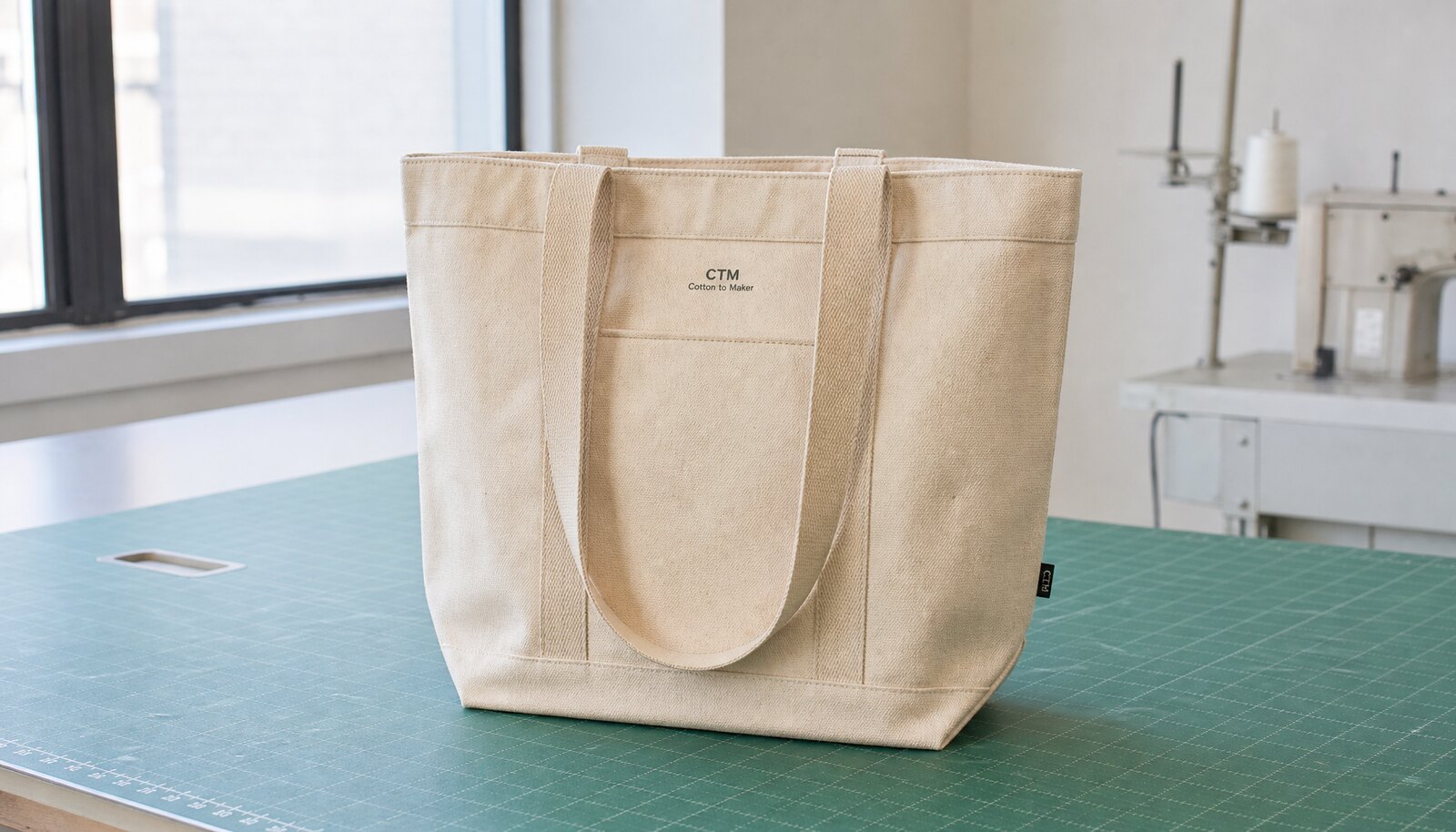
Why school tote sourcing fails when the bag spec is too vague
Most quality problems in school tote programs start before production begins. The buyer sends a logo and a target price, but the factory has to guess the fabric weight, handle build, print method, fold style, and packing format. That guesswork is where inconsistent quotes and avoidable defects begin. For custom canvas tote bags for schools, the spec has to be specific enough that two factories can price the same product on the same basis.
Schools usually need a tote that can handle books, stationery, snacks, or take-home materials without looking bulky or cheap. A bag that is too light may save a few cents, but it often creates returns, complaints, or early failure at the handle base. A bag that is too heavy can push the landed cost above the approval limit and still not improve utility if the stitch structure is weak.
- Give the factory the finished size, not just the approximate size.
- State whether the bag is for giveaways, classroom use, bookstore sales, or staff packs.
- Specify whether the print must survive repeated folding or occasional washing.
Choose fabric weight based on load, not on appearance alone
For school use, canvas weight is one of the first cost drivers and one of the easiest ways to create a mismatch between look and performance. An 8 oz canvas bag can work for welcome packs, event handouts, or paper-based take-home materials. Once the load includes books, notebooks, or a laptop sleeve, 10 oz to 12 oz is usually the safer commercial range. If the bag must feel more structured or carry heavier content, some buyers move to 14 oz, but that should be a deliberate decision because it affects sewing difficulty, material cost, and shipping weight.
Fabric weight alone does not tell the full story. A tightly woven 10 oz canvas can perform better than a loose 12 oz cloth that distorts under stress. Ask the factory for the fabric composition, weave density, and whether the canvas is pre-shrunk or enzyme washed. For school programs, a natural cotton canvas often prints cleanly and stays visually familiar, but if color control matters, bleached or dyed stock can give more consistent print contrast.
- 8 oz: best for lightweight handouts and low-cost event packs.
- 10 oz: practical middle ground for everyday school totes.
- 12 oz and above: better for heavier books and more premium retail presentation.
- Pre-shrunk fabric reduces dimensional drift after unpacking or light washing.
Print method decisions should follow art complexity and unit volume
Printing on canvas fails when the method does not match the artwork and the order size. For simple school logos, one or two colors, and medium to large runs, screen printing is usually the most controllable route. It gives strong opacity and cleaner repeatability if the factory manages mesh count, ink viscosity, and curing temperature properly. For small quantities or full-color artwork, digital or heat transfer can be used, but the buyer should accept a different feel, lower rub resistance in some cases, and potentially higher unit cost.
If the logo placement matters more than decoration, ask for a strike-off or print proof on actual canvas, not only a digital proof. On natural canvas, slight fiber texture can change logo edge sharpness, and light colors can look washed out if the underbase is weak. Buyers who are sourcing for schools should define the acceptable tolerance for logo shift, ink cracking, and color variation before mass production, especially when multiple campuses or departments share the same tote.
- Screen print works best for simple logos and stable repeats.
- Heat transfer is useful for low MOQ or variable names, but needs rub testing.
- Embroidery is not common for large front-panel logos, but it can work for a small premium mark or side label.
- Always match print method to order quantity, not only to artwork appearance.
Use supplier route comparison to avoid quote confusion
A quote from a factory is not the same as a quote from a trading company, even when the product photos look identical. Direct factories usually control cutting, sewing, printing, and carton packing more tightly, so the production chain is easier to audit. Trading suppliers can be useful if you need multiple bag styles or very small mixed programs, but the buyer then has to identify who owns the sewing quality, who controls the print line, and who absorbs rework if something changes in production.
For school programs, sourcing route affects more than price. It affects who can adjust handle reinforcement, who can redo a print panel if artwork shifts, and who can provide line photos or process evidence when a procurement team needs approval. If the quote is attractive but the supplier cannot say where the fabric comes from or how the bag is packed, the risk is usually hidden in lead time or defect resolution.
- Direct factory: better control, clearer process ownership, usually stronger for repeat programs.
- Trading supplier: useful for mixed categories, but quality accountability can be split.
- Local decorator: faster for very small urgent runs, often less competitive for volume.
- Importer/distributor route: good for stock items, not ideal for full custom specs.
Comparison of sourcing routes for school canvas tote programs
The right route depends on order size, artwork complexity, and how much process control your team wants. The table below is a practical way to compare supplier options before you spend time on samples. It is more useful than comparing only unit price because two quotes can be identical on paper but very different in defect risk, packing quality, and rework responsibility.
Use the comparison to decide whether you need a factory quote, a trading quote, or a hybrid model. For schools, the safe default is usually a direct factory if you need custom dimensions, a stable logo placement, and tight delivery control.
- Write decisions in measurable language, not only descriptive wording.
- Ask for sample photos plus one physical approval sample for important orders.
- Keep quotation, sample approval, and inspection notes tied to the same spec version.
What a usable quality inspection checklist should actually cover
A real inspection checklist for canvas tote bags should move from material to construction to presentation. Inspectors should not only count defects; they should verify whether the defect affects use. A minor loose thread on a non-load-bearing corner is not the same as stitch skip at the handle junction. For school bags, the most important failure points are handle reinforcement, seam slippage, print durability, and carton packing integrity.
Your acceptance standard should define what is cosmetic and what is a reject. For example, a slight natural-fiber shade difference can be acceptable on unbleached canvas if the lot is within the approved sample range. However, stain marks, broken stitches at the handle, or a print that drifts beyond the approved placement window should be treated as functional or brand defects. Buyers that write this clearly avoid disputes at final inspection.
- Inspect fabric shade, weave consistency, and stains before evaluating print.
- Check stitch density and bartacks on every critical load point.
- Measure size and handle length against the approved sample.
- Separate cosmetic defects from functional failures in the rejection plan.
Sample approval should be treated as a production control step
For custom canvas tote bags for schools, the sample process should not stop at a pretty prototype. You need at least one blank sample, one printed sample, and one pre-production sample if the order has any meaningful volume. The blank sample confirms size, shape, handle placement, and seam structure. The printed sample confirms logo size, ink density, and color tone. The pre-production sample confirms that the real line, real materials, and real packing method can be duplicated at scale.
Make the factory mark the sample with the revision date and approval reference. Keep one signed golden sample with the purchasing file and another with the supplier. If the supplier changes fabric lot, ink supplier, or handle webbing after approval, that should be reported before production continues. The goal is not paperwork for its own sake; it is to keep the bulk order tied to one approved reference.
- Approve dimensions, logo placement, and handle reinforcement on the sample.
- Keep one physical golden sample for final inspection reference.
- Reject sample substitution if the factory changes material without notice.
- Document any acceptable deviation in writing, not verbally.
Packing choices affect damage rate and warehouse speed
Packing is often treated as a low-value detail, but for school distribution it affects both receiving speed and damage rate. Bulk-packed totes are cheaper and easier to warehouse, which makes sense when the school or distributor will repack them later. Retail-ready packing with individual polybags, insert cards, or hanging labels is only worth the added cost if the bag will go directly onto shelves or into a branded welcome kit. If the quote includes individual polybags, the buyer should ask whether the film is clear, recycled-content, or anti-yellowing, because low-grade film can dull the visual presentation.
Carton specification matters too. The bag should be folded consistently so printed faces do not crease against seams or handles. Cartons that are too large can cause shifting and edge wear; cartons that are too small can crush corners and distort the bag shape. Ask for carton dimensions, gross weight, piece count per carton, and any moisture protection used for sea freight or warehouse storage. This is especially important for natural cotton canvas, which can absorb handling marks more easily than synthetic bags.
- Bulk pack for distribution efficiency and lower cost.
- Retail pack only if shelf presentation or gifting requires it.
- Lock carton count and fold method before production.
- Use moisture protection for long transit or humid storage.
Lead time and MOQ logic should be built around school calendars
A school bag program is usually date-driven, not price-driven. If the bags are needed for term start, orientation, book fairs, or enrollment campaigns, the production plan has to leave room for sample approval, material booking, printing, sewing, packing, and export handling. In many factories, the real lead time starts after artwork and sample approval, not when the order is first discussed. If the buyer waits to finalize print details, the schedule compresses quickly and shortcuts appear in the line.
MOQ should be evaluated with the number of colors, artwork versions, and packing requirements. A single logo across one color of canvas is straightforward. Once the buyer adds multiple campus names, two print positions, or alternate handle colors, the factory may need separate cutting and setup runs. In practice, it is often more efficient to reduce versions and increase quantity per version than to force a very small lot with many changes.
- Build a schedule backward from the school delivery date.
- Treat artwork approval as a schedule gate, not a side task.
- Separate MOQ by design version, not just by total order quantity.
- Allow time for a corrected sample if the first print proof is off spec.
Quote comparison should use landed cost, not only unit price
The cheapest factory quote can become the most expensive order once you add sample fees, setup charges, packing changes, inland transport, carton upgrades, and rework risk. Procurement teams should compare the full landed cost basis even before freight booking. For example, a lower unit price that excludes print setup or uses a thinner fabric may look better in the spreadsheet but create a higher defect rate or more customer complaints after delivery.
The best way to compare is to line up each supplier on the same cost model: bag spec, print method, packing format, MOQ, sample fee, lead time, and responsibility for defect replacement. If one supplier is quoting a bulk pack and another is quoting retail polybags, the two numbers are not directly comparable. The same is true if one quote uses 8 oz fabric and another uses 12 oz. Make the quotes speak the same language before you decide.
- Compare unit price, sample cost, setup fees, and packing charges together.
- Normalize fabric weight and print method before comparing suppliers.
- Include expected freight impact from bag weight and carton size.
- Price the risk of rework, not just the initial invoice.
Specification comparison for buyers
| Spec decision | Recommended option | When it fits | Buyer risk to check |
|---|---|---|---|
| Fabric weight | 10–12 oz canvas for everyday school use; 8 oz only for light giveaways | Book fairs, welcome packs, student events, library programs | Too-light fabric stretches at the handle base and turns bag body floppy after first use |
| Fabric construction | 100% cotton canvas with a tight weave and visible grain consistency | When the bag must feel premium and take print cleanly | Loose weave causes print bleed, seam distortion, and uneven dye penetration |
| Handle style | Self-fabric or reinforced webbing handles with bar-tack reinforcement | When bags carry books, notebooks, or classroom supplies | Short handle stitch lengths and weak bartacks fail under concentrated weight |
| Print method | Screen print for simple logos; heat transfer only for small runs or multi-color art; embroidery for premium identity accents | School logos, mascot marks, donor programs, open-house kits | Low-opacity print and poor cure lead to cracking, wash rub-off, or color shift |
| Closure | Open-top for speed; zip closure only if inventory or tech items must be protected | Student starter kits, staff gifts, book totes | Zippers add cost, delay production, and can deform the bag if tape is poor |
| Supplier route | Direct factory with in-house cutting, sewing, printing, and packing control | Repeat school programs and custom sizes/colors | Trading routes can hide which factory owns quality defects or lead-time responsibility |
| MOQ strategy | 500–1,000 pcs per design/color for efficient custom production; sample lots can be smaller but costlier per unit | District orders, seasonal campaigns, retail programs | Very low MOQ often means shared materials, slower scheduling, or limited print control |
| Packing method | Bulk pack 20–50 pcs per carton with moisture protection; retail fold-and-sleeve only if shelf presentation matters | Warehouse distribution or school event fulfillment | Poor folding and carton fill can crease prints and create dimensional disputes at receipt |
| Inspection point | Pre-production sample plus in-line and final AQL-based checks | Any order with multiple colors, large volume, or time-sensitive delivery | Skipping in-line checks lets the same defect repeat across the entire lot |
Buyer checklist before sampling
- Confirm finished size, fabric weight, handle length, and seam reinforcement on the spec sheet before RFQ circulation.
- Approve one physical pre-production sample with print position, color, and stitch density marked on the sample sheet.
- Require the supplier to state whether fabric is bleached, dyed, or natural, and whether shrinkage has been pre-tested.
- Ask for carton count, fold method, polybag use, desiccant use, and carton gross/net weight before PO issue.
- Lock the acceptance standard for print registration, loose threads, seam slippage, and size tolerance before mass production starts.
- Compare quotes on the same basis: bag spec, print method, packing, sample fee, mold/setup fee, and inland freight terms.
- Plan a sample signoff date and production buffer so school delivery is not dependent on a single shipping date.
- Request photos of fabric, print strike-off, sewing line output, and carton loading for every first-article or pilot run.
Factory quote questions to send
- What exact canvas weight, weave type, and shrinkage allowance are included in the quote?
- Is the print price based on one location, one color, and one size, or does it include multiple placements?
- What is the minimum order quantity by color and by artwork version, and can you combine schools or districts in one run?
- Which parts of the bag are outsourced, and which steps are done in-house at your factory?
- What is your standard stitch specification for handles and side seams, and how many bartacks are included?
- What packing format is quoted: bulk carton, individual polybag, insert card, or retail hang-tag?
- What sample types are available before production: blank sample, printed sample, and pre-production sample?
- How do you handle overrun, short shipment, and defect replacement if the final count misses the PO tolerance?
- What is the realistic lead time from artwork approval to ex-factory date, not including shipping?
- Which quote line items are excluded, such as sampling courier, plate fees, color matching, or export carton testing?
Quality-control points to confirm
- Fabric weight matches the approved spec within the buyer-agreed tolerance and does not feel underfilled or overly soft.
- Canvas weave is even, without thin streaks, broken yarn lines, oil stains, or obvious shade variation within the lot.
- Handle stitch lines are straight, bartacks are present at stress points, and thread tails are trimmed cleanly.
- Finished dimensions are within the agreed tolerance for width, height, and gusset, with no obvious asymmetry.
- Print position is centered within the spec window, with acceptable registration, color density, and edge sharpness.
- No skipped stitches, needle damage, seam puckering, or loose threads remain on visible or load-bearing areas.
- Cartons are properly labeled, count matches the packing list, and internal packing prevents crushing or moisture damage.
- Pre-production sample, golden sample, and bulk goods are matched by color, logo scale, and construction details.