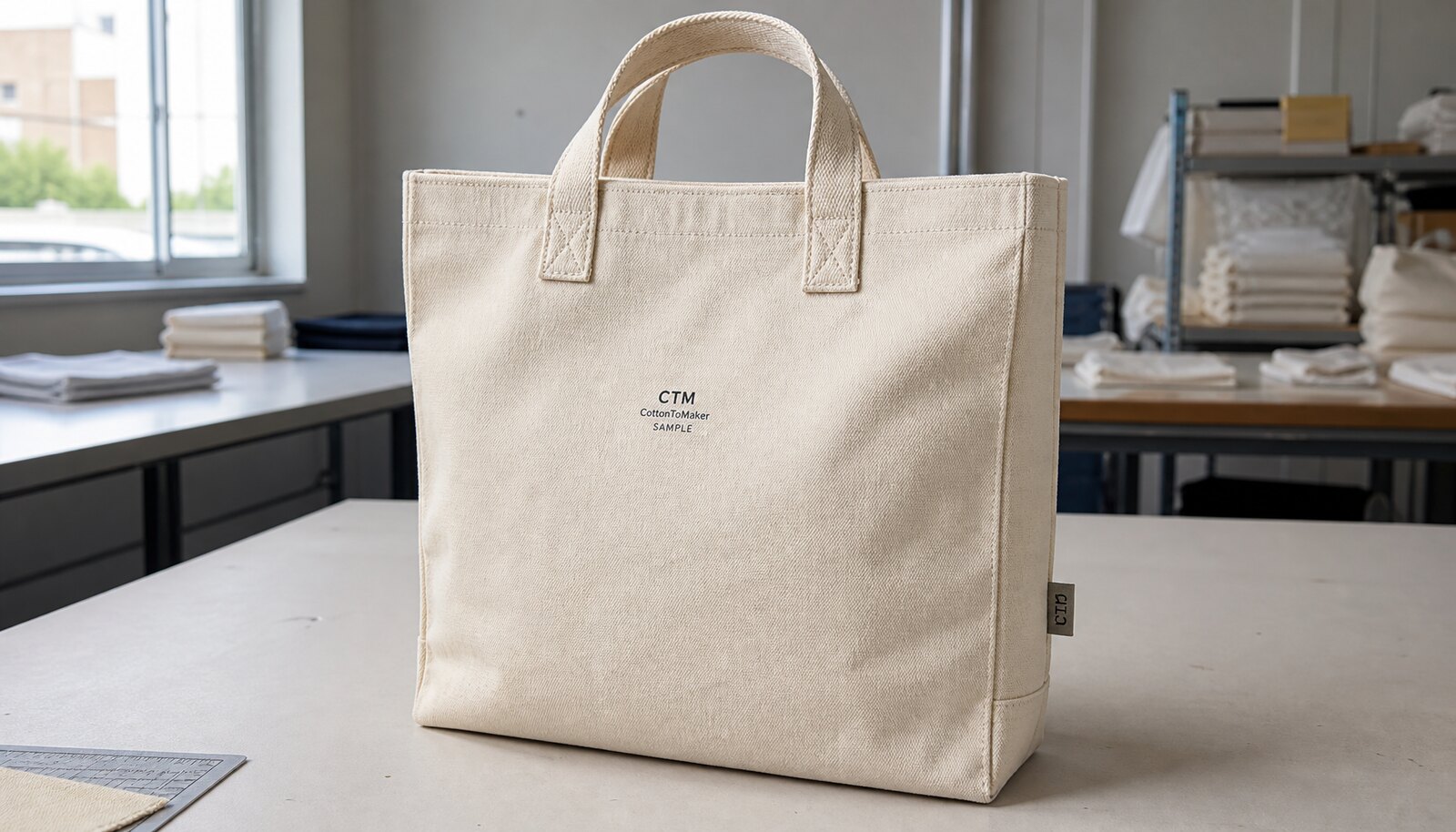
Why school tote sourcing fails when the fabric spec is vague
Most tote sourcing problems start with a brief that is too loose to support procurement. If a buyer writes "good quality canvas tote for schools," suppliers can quote very different builds and still look comparable on paper. One quote may assume 8 oz natural canvas, another 10 oz bleached canvas, and a third may quietly add a lining or different handle construction. The result is a pricing sheet that is not a true comparison. For schools, that is risky because the bag has to survive books, stationery, lunch items, and repeated handling, not just a photo shoot.
For custom canvas tote bags for schools material selection guide decisions, the right starting point is the load and the use pattern. A one-day event bag does not need the same spec as a tote for daily student use or a school shop retail item. If the tote will be carried home with books and folders every day, you should think first about fabric weight, seam reinforcement, and handle stress. Only after that should you decide on print decoration and finishing. This sequence keeps the RFQ grounded in use, not aesthetics.
- The use case should drive fabric weight, not the artwork.
- School tote bags fail first at the seams and handle anchors, not at the logo.
- A quote without finished size, fabric weight, and print method is not a comparable quote.
Start with the school load profile, not the bag photo
The practical school buyer question is simple: what must the tote actually carry, and how long must it last? A library tote for checkouts, a parent welcome pack, a student orientation bag, and a bookstore retail item all need different levels of structure. If the bag must hold an A4 binder, a water bottle, and a notebook without sagging open, the gusset depth and base construction matter as much as the fabric weight. If the bag must fit inside lockers or desk cubbies, oversized dimensions create their own problem even if the fabric is strong.
A good brief also separates daily carry from occasional carry. Daily carry usually justifies 10-12 oz canvas, reinforced handles, and a more conservative print layout that leaves room for seam allowance. Event giveaways can sometimes work at 8-10 oz if the contents are light. Retail and fundraising orders often push buyers toward 12 oz and above because the bag needs to feel substantial on the shelf and hold shape after repeated use. The key is to define the load in plain terms: books, binders, lunch items, tablets, or mixed school supplies.
- List the exact contents the bag must carry, not just the audience.
- Use desk, locker, and binder dimensions if the tote must fit school infrastructure.
- Separate one-day event use from repeated daily use before asking for quotes.
Canvas weights, GSM conversion, weave, and shrinkage
Canvas weight is the first real spec decision, and buyers should state it in both oz/yd^2 and gsm so suppliers do not translate it loosely. As a practical reference, 8 oz/yd^2 is about 271 gsm, 10 oz/yd^2 is about 339 gsm, 12 oz/yd^2 is about 407 gsm, 14 oz/yd^2 is about 475 gsm, and 16 oz/yd^2 is about 542 gsm. The numbers are approximate, but they are useful because they force the supplier to quote the same fabric class. Weight alone does not define quality, but it is the simplest way to avoid apples-to-oranges pricing.
The weave and finish affect usability just as much as the weight. A looser weave can make a bag feel lighter, but it can also reduce print sharpness and allow more show-through on dark logos or inner seams. A tighter weave usually gives better logo edges and a cleaner retail look. If the school wants washed or pre-shrunk canvas, put that into the brief early because finish changes both hand feel and dimensions. For printed bags, a practical shrinkage tolerance is often 3% or less in each direction after a wash test, unless the buyer has a different internal standard. That tolerance needs to be agreed before production because unwashed canvas can move enough to shift logo placement.
- State fabric weight in both oz/yd^2 and gsm.
- Ask for pre-shrunk or washed canvas if dimensional stability matters.
- Use a shrinkage tolerance in the RFQ so the supplier cannot define it after sampling.
- Do not approve a bag from a catalog photo if the weave or finish is different from your use case.
Construction details that control durability in school use
For school tote bags, construction is where the real durability lives. A strong canvas fabric can still fail early if the handles are too narrow, the stitch density is too low, or the stress points are not reinforced. For most school programs, buyers should ask for double-needle side seams with box-X or bar-tack reinforcement at the handle anchors. A stitched handle that simply joins into the top edge without reinforcement is cheaper, but it is also the first place a bag starts to deform when it is filled with books.
Handle length is also a practical school detail, not a style preference. Short handles are fine for hand carry, but they are awkward when students or staff want to wear the bag over the shoulder. For a school tote, a finished handle length in the 20-24 inch range is often more versatile, but the right answer depends on the bag height and intended user. Handle width matters too: broader handles spread the load better and feel more stable with heavier contents. If you need a lining, bottom insert, or zipper top, state that upfront because each of those choices changes the sewing plan, the MOQ, and the landed cost.
- Prefer box-X or bar-tack reinforcement at handle stress points.
- Ask for a stitch density target in the quote, not just a promise of "strong seams".
- Match handle length to actual use, including shoulder carry if needed.
- Add lining or a bottom insert only when the use case justifies the extra cost and labor.
Print and decoration should match the artwork, not the catalog template
The decoration method should be chosen from the artwork, the order size, and the durability expectation. For most school logos, screen printing remains the most dependable option because it handles simple spot colors well and scales cleanly across bulk orders. It is usually the most sensible choice for crests, mascots, event names, and sponsor marks with clean edges. The buyer should specify the number of colors, the print dimensions, and the exact placement on the bag face or pocket so the supplier cannot quote on a smaller, cheaper graphic area and then interpret the design differently.
Transfer methods can work for short runs, multi-color designs, or variable names, but they need a durability conversation before approval. A print that looks sharp on a sample can still crack or abrade if the base fabric is coarse or the coating is not suited to the use. Embroidery can create a premium effect, but it adds weight, cost, and thickness, so it is not always the best fit for large tote faces. The procurement question is not which method is newest; it is which method gives acceptable durability, repeatability, and cost at the required MOQ. If the school wants a dark bag with a light logo or a fine-line crest, ask for a proof on the real fabric before any bulk release.
- Use screen print for most simple school logos and repeat orders.
- Use transfer methods only when the art or order size justifies the tradeoff.
- State the print area and placement in centimeters, not as a verbal description.
- Ask for a fabric-specific proof for any logo with fine text or borders.
How MOQ changes when you alter fabric, color, and finish
MOQ is not one number; it is usually the factory's way of pricing setup complexity. Standard natural canvas is easier to source than custom-dyed fabric, and a one-color print is easier to run than a multicolor or multi-position layout. When you add lining, zippers, gussets with special structure, woven labels, or retail packing, the line has more setup work and the supplier usually expects a larger order to justify it. That is why a school buyer should always ask what part of the spec is driving the MOQ, rather than accepting the first number as fixed.
The other common mistake is not knowing whether MOQ is per design, per size, per color, or per packing format. A quote for 2,000 pieces might still mean 2,000 per artwork version, which is a very different commercial decision from 2,000 total split across the district. If the order needs multiple campus names, grade-level versions, or seasonal color options, the buyer should ask the supplier to quote a shared base bag and then separate the variable elements. That keeps the conversation honest about where scale is real and where it is not.
- Standard fabric and one-color print usually support the lowest MOQ.
- Custom dye, zipper tops, lining, and retail packing usually push MOQ higher.
- Clarify whether MOQ applies per design, per size, per color, or total order.
- Ask for separate pricing on the base bag, decoration, and packing so hidden setup costs are visible.
Sampling and approval: how to avoid expensive bulk surprises
A tote sample should be judged as a production reference, not as a marketing object. The buyer needs to check structure, decoration, and workmanship together. Structure means the bag opens, stands, folds, and carries the intended load. Decoration means the logo is the correct size, color, and location. Workmanship means the seams are even, the handles are symmetrical, the reinforcement is correct, and the inside finish does not show loose thread or distortion. If you only check the visual front face, you can approve a bag that still fails in use.
For school programs, the best sample process is usually a blank pre-production sample first, then a printed pre-production sample before bulk cutting. If the order is for a specific binder or folder size, put the actual item into the sample and check fit rather than assuming the dimensions will work. Keep one sealed approved sample and one approved photo reference for production and inspection. That seems basic, but it prevents a lot of arguments when the finished order arrives and someone says the tote looked different in the sample.
- Check finished dimensions, not pattern size.
- Test the tote with the actual school items it must carry.
- Approve both blank construction and printed decoration before mass production.
- Keep one sealed reference sample for inspection and dispute resolution.
Bulk QC for school tote programs should be more than a visual check
Bulk quality control needs a defined acceptance plan. A visual walk-through is not enough for a school order that will be distributed in volume. The factory and buyer should agree on an AQL-based inspection approach before production starts, with critical, major, and minor defect definitions written down. For many buyers, AQL 2.5 is a reasonable starting point for major defects, but the exact standard should be part of the purchasing policy rather than an afterthought. That gives everyone the same rule set for loose stitches, crooked prints, or wrong packing counts.
Fabric verification also needs to go beyond appearance. Ask for measured GSM or oz/yd^2, confirm weave and composition where it matters, and compare the incoming fabric against the approved swatch before cutting. For dyed or printed totes, include colorfastness on the base fabric and the print. ISO 105 or AATCC wash and rub methods are common reference points, but the important part is that the result is documented and tied to the actual production fabric. Seam strength and handle-load checks should be done on the actual configuration, not on a separate fabric scrap, because tote failures often happen at the seam or anchor point, not in the middle of the panel.
- Use an AQL plan with clear critical, major, and minor defect definitions.
- Verify fabric weight and appearance before cutting, not after finishing.
- Request documented wash and rub colorfastness data for dyed fabric and prints.
- Test seam strength and handle load on the real bag construction.
Packing and labeling should match the receiving channel
Packing is often treated as a minor detail, but it changes labor, damage risk, and how easy the order is to receive. If the bags are going to a school district warehouse, bulk folding by count with clean carton labeling is usually the most efficient format. If the bags will be sold through a school store or campus shop, they may need individual polybags, barcode stickers, and a more regular fold so they look consistent on the shelf. The same tote can succeed or fail commercially depending on whether the packed presentation fits the channel.
The packing brief should also cover carton count, master carton dimensions, gross weight, and moisture protection. Overpacked cartons can crush prints and distort folds, while underpacked cartons waste freight space and create count errors. If the order is seasonal or has to sit in storage before distribution, ask for a packing method that protects the canvas from dust and humidity. The right packing spec is not a cosmetic choice; it is part of the risk control for bulk fulfillment.
- Use bulk folding and count-based cartons for school distribution.
- Use individual polybags and barcode labeling for retail or resale channels.
- Ask for master carton dimensions and gross weight before booking freight.
- Match packaging to storage time and humidity exposure.
Lead time planning for school calendars needs stage-by-stage control
School tote lead time should be managed as a sequence of stages, not as one vague promise. The normal sequence is sample making, artwork approval, fabric booking, production, inspection, packing, and shipping. If the order is tied to a back-to-school campaign, a fundraiser, or an orientation event, the buyer should build a buffer for at least one round of artwork corrections and any sample revisions. The most common delay is not sewing; it is approval drift, where the school logo, color values, or placement keep changing after the factory has already prepared production materials.
Non-standard fabric can also move the schedule. If the order needs custom-dyed canvas, unusual trim, or special labels, the material stage may become the critical path. That is why the purchase order should freeze the artwork file, bag spec, and packing format before production begins. A buyer who locks those three things early is in a much better position to defend the delivery date. A buyer who leaves them open often discovers too late that the factory was quoting on a different version of the tote.
- Separate sample time from mass production time and from freight time.
- Freeze artwork before cutting begins.
- Expect custom dyeing or special accessories to extend the schedule.
- Build buffer time before school-event deadlines.
Specification comparison for buyers
| Spec decision | Recommended option | When it fits | Buyer risk to check |
|---|---|---|---|
| Canvas weight | 8 oz/yd^2 (~271 gsm) | Very low-cost giveaways, orientation packs, or short event use with light contents | Bag may sag with books; confirm handle stitching and bottom seam still pass a planned load test |
| Canvas weight | 10 oz/yd^2 (~339 gsm) | General school use, library programs, welcome kits, and book fair bags | Check weave openness, print clarity, and whether the tote stands up well after folding |
| Canvas weight | 12 oz/yd^2 (~407 gsm) | Daily student carry, heavier books, and district-issued program bags | Cost and freight rise; ask for sample wash and shrinkage data before approving artwork placement |
| Canvas weight | 14-16 oz/yd^2 (~475-542 gsm) | Retail store merch, alumni shops, and premium fundraising bundles | Heavier sewing and carton weight; confirm handle attachment, finished dimensions, and shipping cost impact |
| Shrinkage tolerance | Pre-shrunk fabric or <=3% after wash test in warp and weft | Printed bags that must keep artwork placement after use | Unwashed canvas can distort logo location or reduce usable pocket width after the first wash |
| Stitching spec | Double-needle seams with 7-9 stitches per inch; box-X or bar-tack reinforcement at stress points | Bags carrying books, tablets, lunch items, or repeated daily loads | Lower stitch density or weak reinforcement often fails before the fabric does |
| Print method | 1-3 spot-color screen print for most school crests; transfer only for short runs or variable names | Standard logos, mascots, event names, sponsor marks, or simple text | Need wash and rub test records, plus a proof on the actual fabric, not a generic swatch |
| MOQ breakpoint | 300-500 pcs for stock fabric and simple one-color print; 1,000-1,500 pcs for custom size or multi-color print; 2,000+ pcs for custom dyed fabric, lining, zipper, or complex packing | Use this to compare supplier quotes apples-to-apples | MOQ may apply per color, per size, or per design, not total order |
Buyer checklist before sampling
- Define the school use case before you ask for pricing: student books, classroom kits, library programs, event giveaways, retail merch, or fundraising bundles.
- Specify the fabric in both oz/yd^2 and gsm, and ask the supplier to confirm whether the canvas is pre-shrunk, enzyme-washed, bleached, or natural.
- State the finished bag size, gusset depth, handle length, and the real items it must hold, such as A4 folders, letter-size binders, or tablets.
- Lock the construction spec: seam type, stitch density, handle width, reinforcement method, and whether the bag needs a lining or bottom insert.
- Approve the artwork file with measured placement, print size, color count, and Pantone or CMYK references before any plates or screens are made.
- Request blank and printed samples if the fabric or construction is new, then test the sample with the intended school load before approval.
- Confirm MOQ by design, size, color, and packing format so you can compare quotes on the same basis.
- Ask for the exact packing method, barcode requirements, carton count, and whether the bags are folded for school distribution or retail presentation.
- Clarify lead time by stage: sampling, artwork approval, production, inspection, and freight booking cutoff.
- Ask the supplier to state the inspection standard and defect handling process in writing before you release the PO.
Factory quote questions to send
- What is the exact canvas specification by weight, weave, and finish, and can you share a fabric swatch photo or mill reference?
- Can you quote the fabric in both oz/yd^2 and gsm, and confirm whether the quote includes pre-shrunk or washed fabric?
- Is the quoted price based on finished bag size, cut size, or a sample only, and what tolerance do you hold for final dimensions?
- What seam construction do you use, what is the stitch density, and is the handle attachment box-X, bar-tacked, or double-stitched?
- What is the exact MOQ by size, color, and print design, and can mixed-color orders share one production run?
- How many colors are included in the print price, and what is the surcharge for extra colors or extra print positions?
- What sample stages are available before bulk order: blank proto sample, printed pre-production sample, or shipment sample?
- What packing is included in the quote, including fold method, polybag thickness, barcode sticker, and carton count?
- Do you have fabric verification records, such as measured GSM, weave count, shrinkage test results, or fiber composition confirmation?
- What inspection standard do you use for bulk production, and can you share a photo report or AQL summary after inspection?
Quality-control points to confirm
- Verify the incoming fabric against the approved swatch and mill spec before cutting, including measured GSM or oz/yd^2, weave appearance, and fiber blend where relevant.
- Set an inspection plan before production starts, such as AQL 2.5 for major defects and your internal standard for critical defects, so the factory knows the acceptance bar.
- Check colorfastness on both the base fabric and the print, especially for dark school colors; ask for wash and dry rub results using ISO 105 or AATCC methods, or an equivalent documented internal test.
- Run a seam-strength and handle-load check on pre-production and production samples using the intended school load, then look for stitch pop, seam opening, or handle elongation.
- Measure finished dimensions, gusset depth, handle length, and logo placement against the signed spec, not against the cut pattern or a catalog photo.
- Confirm shrinkage by wash-testing the fabric or a finished sample where the program expects laundering; a practical acceptance target is often 3% or less in both warp and weft, unless your spec says otherwise.
- Inspect stitch quality for skipped stitches, loose thread tails, needle holes, uneven topstitching, and weak reinforcement at handle anchors and stress points.
- Verify bag structure after folding and packing because canvas can relax, crease, or distort print position once cartons are compressed.
- Open random cartons and reconcile carton count, fold consistency, barcode accuracy, and master carton condition against the packing list.
- Keep one approved blank sample, one approved decorated sample, and one signed photo reference for the production and inspection teams.