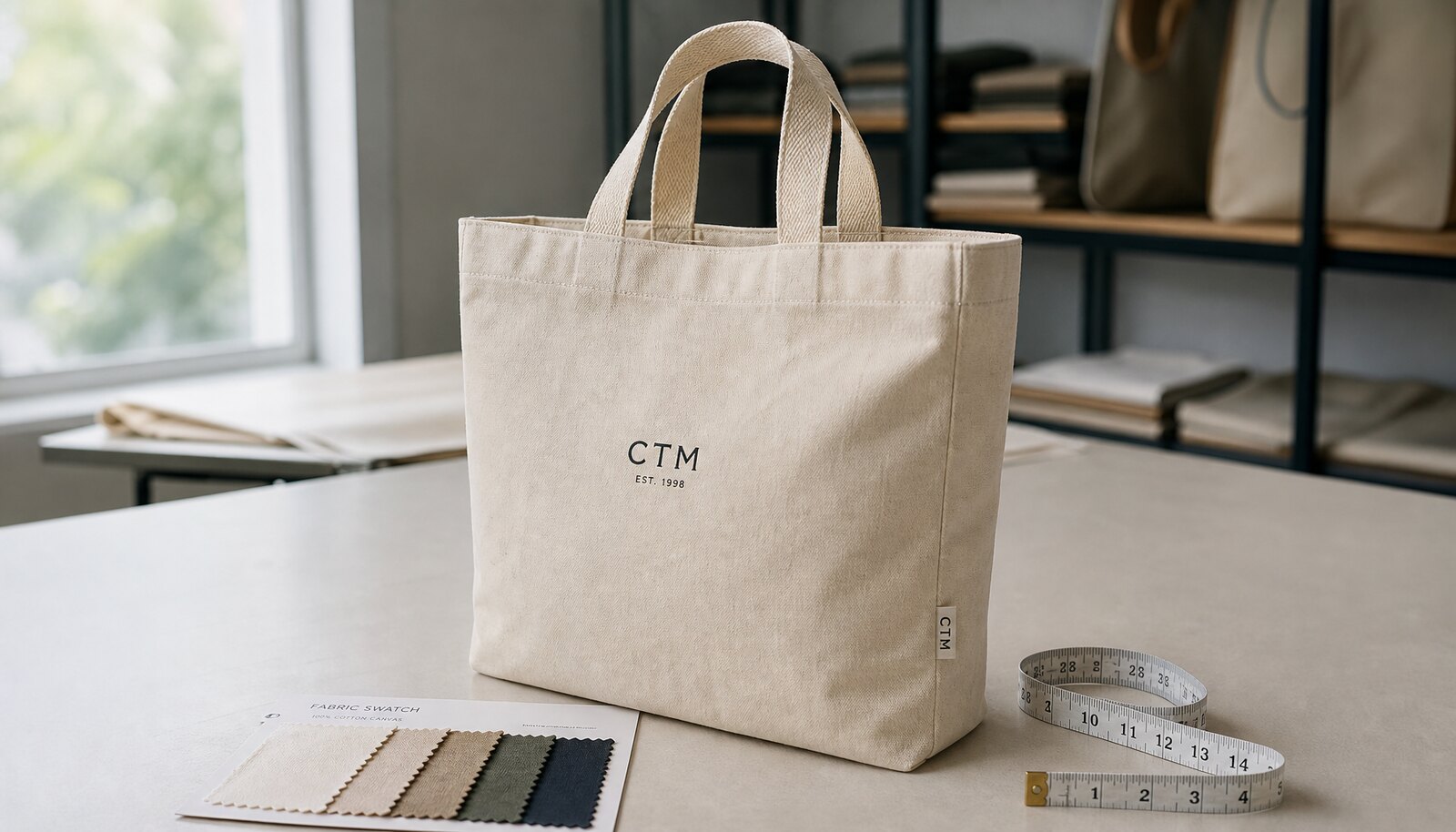
Start with the event job, not the tote shape
For school programs, a canvas tote is a logistics item first and a branding item second. If it does not fit the event load, procurement ends up paying twice: once for the tote and again for a workaround. The right spec depends on what the bag must carry, how it will be distributed, and whether the school wants the tote reused after the event.
Write the use case in plain operational terms. A parent night handout bag is usually a light carry item. A book fair tote needs more structure and a larger opening. An orientation kit may need to stand on a table while volunteers fill it. Those differences matter more than the logo treatment.
The most useful RFQ starts with the event context and only then moves to branding. Note the contents, estimated carry weight, whether the bag must stand upright, whether it will be given out flat or pre-packed, and whether the school wants a utility look or a more premium one. That gives suppliers the same brief and reduces quote drift.
A procurement team should also separate functional spec from decoration spec. Function covers size, fabric, seams, and handles. Decoration covers print area, colors, labels, and artwork complexity. Keeping those layers separate makes supplier comparisons cleaner and makes sample approvals easier to defend.
- Define what goes inside the tote: brochures only, books plus handouts, or mixed kits
- State whether the tote must stand upright when filled
- Clarify whether the order is a one-time event or a recurring school program
- Keep the functional spec separate from the branding spec
Use fabric weight as a capacity decision, not a style preference
Canvas weight drives feel, durability, and landed cost. For many school giveaway orders, 8 oz to 10 oz cotton canvas is the practical range. It is usually substantial enough for brochures, notebooks, and light event packs while keeping unit price and freight manageable. For most buyer teams, that is the range where the tote feels credible without becoming overbuilt.
If the bag will hold books, binders, or a fuller kit, 10 oz is often the safer default. The bag hangs better, holds shape more consistently, and tends to look less flimsy in a classroom or registration area. If the tote is meant to be kept and reused, the extra spend is often easier to justify than a weak first impression.
A heavier bag is not automatically better. A 12 oz tote adds structure, but it also increases sewing effort, carton weight, and shipping cost. If the actual contents are light, that premium may never translate into buyer value. The right question is not “what is the strongest bag?” but “what strength matches the load and reuse expectation?”
Ask suppliers to quote finished fabric weight in oz or GSM and to state whether the number refers to finished fabric, stock fabric, or nominal order weight. Also ask whether fabric lots are subject to measurable variance. That matters because a loose weave can feel lighter than its paper spec and can change print appearance.
- 8 oz: suitable for flyers, pamphlets, and low-cost handouts
- 10 oz: the most balanced option for books, notebooks, and reuse
- 12 oz: useful when structure and premium hand feel matter
- Ask for the weight basis and tolerance, not just the headline number
Match decoration method to artwork complexity and order size
For school giveaway totes, decoration should follow the art, not supplier preference. Screen print is often the best fit for simple logos, school names, and event wording. It is easy to quote, repeat, and inspect. On canvas, it generally gives buyers a straightforward approval path because the main variables are placement, opacity, and cure quality.
Two-color screen print is still commercially practical when the design needs a second color for emphasis or legibility. It adds setup, but it remains easier to control than more complex methods. Buyers should ask whether each color requires a separate screen fee and whether spot colors need a specific Pantone match or a visual match only.
Digital print and heat transfer have a place when the artwork is more detailed, but they should be selected with clear process questions. Ask how the print behaves on natural canvas, whether the finish changes the hand feel, and how durable the image is under abrasion. A method that looks sharp on a digital proof may not look or age the same on woven fabric.
Do not approve artwork only in a flat mockup. Ask the supplier to place the art on a sewn sample so you can see seam distortion, handle interference, and print shift caused by panel construction. This is especially important if the logo contains fine text or if the artwork runs close to the side seam.
- Use screen print for simple school branding and repeat orders
- Use digital print only when the artwork complexity justifies it
- Use heat transfer only after confirming finish and durability
- Approve artwork on a sewn sample, not only on a PDF
Read supplier routes before you read the unit price
The same tote can be quoted very differently depending on who actually makes it. A direct factory with in-house sewing, printing, and packing usually offers the best control over material, sample timing, and final packing. That route is often the safest choice when the event date is fixed and the buyer wants the fewest handoffs.
A trading company or sourcing agent can still be useful, especially when the program includes multiple products or when the buyer needs coordination help. The issue is visibility. Procurement should confirm who sources the fabric, who prints, who packs, and who owns the final inspection. Without that clarity, it is difficult to hold one party accountable if the sample and bulk run diverge.
Local distributors and stock converters are another path. They can be fast and convenient for urgent orders, but they usually offer less control over exact material, print method, and carton format. That can be acceptable for a simple rush order, but it is rarely the best route if the school needs a precise spec or a consistent look across multiple campuses.
A useful evaluation rule is to ask who signs off on the final product before shipment. If the answer is unclear, the supply chain is fragmented. That does not automatically disqualify the supplier, but it does mean the buyer should ask for facility names, process ownership, and the exact inspection handoff points.
- Direct factory: strongest control over sewing, printing, and packing
- Trading company: verify the actual maker and who owns QC
- Local distributor: faster, but usually less custom control
- If the route is fragmented, ask who signs off on shipment release
Use a more exact comparison table when the quotes arrive
A weak quote is not always obviously wrong. It may simply be missing the assumptions that determine real cost. One supplier can appear cheaper because the bag is lighter, the print area is smaller, the handle is shorter, or packing is loose and unprotected. Another can look expensive until the quote is broken into fabric, decoration, cartons, labels, sample fees, and freight assumptions.
When suppliers are compared across regions, this matters even more. Factory labor, local material sourcing, inland transport, and export handling can move the price in ways that are not visible in a single unit number. Procurement should insist on a like-for-like quote structure so the team can see whether the delta comes from the product or from the route to market.
A practical approach is to request one base quote and one alternate spec from each supplier. For example, ask for 8 oz and 10 oz versions, or flat pack and polybag versions, or one-color and two-color print. That makes the cost of improvement visible. It also exposes suppliers that are quoting from stock rather than from the spec you actually need.
The table in this article is designed to help buyers ask better questions. The goal is not to force every tote into the same configuration. It is to identify which spec combination fits the event and which one introduces avoidable cost or risk.
- Compare the spec, not just the total price
- Ask for one alternate quote so the tradeoff is visible
- Use the same artwork version and dimensions across all suppliers
- Keep packing assumptions consistent across all quotes
Treat MOQ as setup economics, not as a sales slogan
MOQ in tote production usually reflects actual setup work. Cutting fabric, preparing screens, sourcing a specific color, and packing to a defined count all consume labor. If the order is a simple natural-canvas bag with one print color, the MOQ may be flexible. If the job involves custom dye, multiple colors, labels, or special pack-out, the minimum can rise quickly.
That is why procurement should ask what drives the minimum. Is it fabric sourcing, print setup, sewing line efficiency, label application, or packing labor? Once the driver is known, the buyer can decide whether to accept the MOQ or simplify the spec. In many cases, it is cheaper to remove complexity than to push a small order through a setup designed for larger runs.
For recurring school programs, there is a second angle. A slightly larger initial order can sometimes lower the repeat price if the supplier can reuse the same setup. That is only useful if the school has a real repeat need. It should not turn into overbuying inventory just to chase a theoretical discount.
If a supplier claims a very low MOQ, ask what changed. Sometimes the answer is legitimate, such as stock fabric or a simplified print. Other times it means the factory is making concessions elsewhere. A low MOQ only helps if the bag still matches the buyer's functional and quality requirements.
- Ask what drives MOQ: fabric, print, labels, sewing, or packing
- Natural canvas and one-color art are usually the easiest ways to lower minimums
- Special colors and custom labels often raise the MOQ
- Simplifying the spec is usually more effective than pushing on price
Make sample approval prove the whole bag
A sample should validate more than logo placement. For school event totes, it should confirm the fabric feel, seam behavior, handle length, print position, fold behavior, and how the bag performs when filled. If the tote will be handed to families with books or brochures inside, the sample should show whether it sits flat, droops, or twists once loaded.
The most useful sample is usually a pre-production sample created after the artwork and finishing details are locked. That sample should be checked in normal light, not only as a photographed proof. Canvas absorbs ink differently than paper proofs suggest, and natural canvas can shift the apparent color of both the bag and the logo. Buyers should expect some difference between screen and sewn fabric, then manage it through written approval.
Sample approval should be documented. Save the approved measurement sheet, the sample photo, and the notes on acceptable variation. If the supplier later ships a bag with a different handle drop, a shifted print position, or changed trim, the approval record gives procurement a clean basis for rejection or rework.
It is also worth testing the tote with the actual event contents. Put in the brochures, notebook, or handouts that will be distributed, then check whether the opening remains usable and whether the print is hidden by folds. This is a low-cost check that catches many problems before bulk production starts.
- Approve a pre-production sample, not only a digital proof
- Check the sample under natural light with real event contents
- Record the approved photo and measurement sheet
- Test carry comfort, fold behavior, and print visibility
Specify packing, inserts, and carton labels before production starts
Packing is one of the easiest places to lose control of an order. If the factory does not know whether the bags are to be bulk packed, polybagged, or fitted with insert cards, the shipment may arrive in a format that is hard for the receiving team to handle. For a school event, that can create extra labor, delay distribution, or force repacking at the destination.
Bulk flat packing is usually the most economical choice when the bags go to a single distribution point. It reduces packing labor and keeps freight efficient. Individual polybags make more sense when the bags need dust protection, are being distributed across multiple sites, or must contain an insert card. The right answer depends on the receiving plan, not on supplier habit.
Carton labeling should be treated as a procurement requirement. Add the PO number, product description, quantity per carton, color, size, and destination mark if the receiving warehouse has a specific intake process. If labels are missing or inconsistent, even a good shipment can become a receiving problem.
If the supplier offers to insert handouts or cards at the factory, ask for the process in writing. That can be useful, but only if the insert count is controlled and the insertion method does not slow shipment or damage the bags. In some programs, it is cleaner to ship bags and inserts separately and assemble them locally.
- Use bulk flat pack for the lowest packing cost
- Use individual polybags when bags need protection or site-by-site distribution
- Specify carton labels, carton count, and destination markings
- Define who supplies inserts and how they are added
Plan lead time around proofing, production, and freight
When buyers ask for lead time, they often get a single number that hides the real schedule risk. Canvas tote production includes artwork confirmation, sample preparation, revision handling, fabric cutting, printing, curing, sewing, finishing, packing, carton booking, and shipment. If any one of those steps moves late, the delivery date moves too.
A better approach is to ask for milestone timing. When will artwork be confirmed? When is the sample ready? When can bulk production start? When does packing finish? When is the shipment handed over? That breakdown shows where the real bottleneck is and makes it easier to see whether the supplier is overpromising. It also helps the internal approvers keep pace.
Country of origin and delivery term can affect timing more than buyers expect. If the bag body is made in one place, printed in another, and packed in a third, the schedule becomes more fragile. Freight mode, customs clearance, and holiday shutdowns can also change the window. Procurement teams should ask where the goods are actually finished and what documents are needed for import or warehouse release.
The safest practice is to work backward from the school event date and build a buffer for approval and transit. A quote that looks fast but leaves no room for revisions is not a low-risk quote. In practice, the schedule is only as reliable as the slowest approval gate.
- Ask for a milestone timeline, not just a single lead-time number
- Build time for sample approval before bulk production starts
- Confirm where sewing, printing, and packing each occur
- Leave buffer for freight booking, customs, and internal sign-off
Use landed cost logic and regional sourcing checks
A tote quote should be reviewed as landed cost, not just as unit price. The real spend includes fabric weight, print setup, labor, packing, carton count, freight assumptions, and any added labels or inserts. A lower unit price can still cost more if the bag is heavier to ship, requires repacking, or includes hidden setup charges. That is common when comparing a factory quote with a reseller quote.
For school event planning, landed cost should also include receiving labor. If the bags arrive in a format that the warehouse can use immediately, the project is easier to execute. If the team has to recount, relabel, repack, or separate mixed cartons, the cheaper quote can become the more expensive one once labor is counted. Procurement should not ignore that part of the equation.
Region matters, but it should be treated as a sourcing path rather than a shortcut. If you are evaluating factories in China, India, Vietnam, or Pakistan, ask the same questions in each case: where is the fabric sourced, who does the sewing, who controls the print process, what compliance documents are available, and how stable is the packing operation. That gives the buyer a fairer basis for comparison than country name alone.
Useful compliance checks depend on the program, but common requests include factory-level quality certifications such as ISO 9001, social compliance audits such as BSCI or Sedex, and material declarations where relevant. If the school or district has sustainability requirements, ask whether the fabric is certified or whether the supplier can support recycled-content documentation. The key is to request documents that match the actual procurement risk, not a generic checkbox list.
- Compare bag price, print price, packing price, and freight assumptions separately
- Include warehouse handling if the packing format creates extra work
- Use the same quote structure across all suppliers
- Ask for factory and material documents that match the program requirements
Specification comparison for buyers
| Spec decision | Option A | Option B | Option C | Buyer tradeoff to check |
|---|---|---|---|---|
| Fabric weight | 8 oz canvas | 10 oz canvas | 12 oz canvas | 8 oz is usually acceptable for light handouts and flat inserts. 10 oz is the common procurement default for books, notebooks, and repeated reuse. 12 oz adds structure and a more premium feel, but it typically increases fabric cost, sewing time, and freight weight. Ask suppliers to quote the finished fabric weight in oz or GSM and confirm the tolerance band, such as +/- 5%. |
| Finished size | 14 x 16 in with 3 in gusset | 15 x 16 in with 4 in gusset | 16 x 18 in with 5 in gusset | Smaller sizes reduce material use and freight, but they may not fit books or binders. A 15 x 16 in bag with a 4 in gusset is often the most flexible school-event size. Ask for tolerance on finished measurements, such as +/- 0.5 in on body dimensions and +/- 0.25 in on gusset depth. |
| Print method | 1-color screen print | 2-color screen print | Digital or heat transfer | Screen print is usually the cleanest option for simple school logos and repeated orders. Two-color print adds setup but remains manageable. Digital or transfer methods can handle detail, but buyers should ask about hand feel, opacity on natural canvas, abrasion resistance, and whether the method changes the approved visual proof. |
| Print area | Centered logo, about 8 x 8 in | Large front print, about 10 x 12 in | Front plus side panel mark | A centered logo is easiest to align around seams and handles. Larger art improves visibility but increases the chance of distortion if the panel is not perfectly square. Side marks can improve branding, but they usually need tighter placement control and a clearer approval sample. |
| Handle build | Self-fabric handles, 20 to 22 in | Cotton webbing handles, 24 in | Reinforced long handles with bar-tack | Self-fabric handles are cost-efficient but can feel thinner in the hand. Webbing handles are better for comfort and load stability. Reinforced handles are preferred when the tote carries books or bundled kits. Ask for handle width, length, drop, and stitch count at the attachment point. |
| Supplier route | Direct factory | Trading company with factory network | Local distributor or stock converter | Direct factories usually give the best control over fabric, sewing, printing, and packing. Trading companies can help consolidate programs, but buyers should verify who actually performs each operation. Distributors are fast for urgent orders, but they often limit material choice and raise landed cost. |
| Packing format | Flat bulk pack, 50 pcs per carton | Individual polybag, 1 pc per bag | Bulk pack with insert card and carton marks | Bulk packing is usually lowest cost and easiest to receive. Individual polybags help if the bags move across multiple sites or need dust protection. Insert cards and special carton marks should be defined up front so the supplier does not treat them as a change order. |
| Carton planning | Cartons of 50 to 100 pcs | Cartons of 100 to 200 pcs | Mixed cartons with site labels | Smaller cartons are easier to lift and count, but they increase carton count and freight handling. Larger cartons reduce carton cost, but they may exceed internal warehouse limits. Ask for carton size, gross weight, carton count, and pallet count so receiving teams can plan storage and lift requirements. |
| QC method | Visual check only | Pre-production sample plus inline checks | Sample plus final inspection with AQL | A visual check is not enough for a fixed-date school event. Add measurement checks, print placement checks, and a final inspection standard. If the supplier refuses to define pass/fail criteria in writing, treat that as a sourcing risk rather than a minor process detail. |
Buyer checklist before sampling
- Define the event use case: book fair, orientation kit, family handout, alumni merch, or campus welcome pack
- Write the finished bag size, gusset depth, and handle drop in inches or millimeters
- Specify canvas weight in oz or GSM and state whether the fabric is natural, bleached, dyed, or recycled content
- Attach the final artwork file and note the number of colors, Pantone references if needed, and exact print area
- State the quantity by size and color, plus the acceptable overrun or short-ship tolerance
- Choose the packing format: bulk flat pack, individual polybag, or pack with insert card
- Name the internal sample approver and the deadline for written approval
- Ask for carton dimensions, carton count, carton labels, and palletization if required
- Confirm delivery term, destination, customs paperwork, and whether origin certificates are needed
- Request production photos, packing photos, and final inspection records before shipment release
Factory quote questions to send
- What is the exact fabric weight, weave, and finished width of the canvas you are quoting, and what tolerance should we expect on bulk production?
- Is the price based on screen print, digital print, or heat transfer, and what are the setup fees, re-screen fees, or color change fees by method?
- Please confirm whether sewing, printing, and packing happen in one facility or across multiple facilities, and identify the factory that owns final QC.
- What is the MOQ for this bag size, this fabric weight, and this print layout, and which part of the process drives the minimum?
- Please quote the bag with 50-piece cartons and with 100-piece cartons, and show the difference in carton count, carton dimensions, and freight impact.
- What are your standard tolerances for finished size, handle length, print position, and stitch count, and how are out-of-tolerance pieces handled?
- What sample stages do you provide: artwork proof, pre-production sample, revision sample, and sealed approval sample?
- Which inspection standard do you use before shipment, and can you share defect categories and photo evidence for any failures?
- What adders should we expect beyond the base unit price, including screen fees, label fees, hangtag fees, carton markings, and rush charges?
- Please confirm country of origin for the fabric, sewing, printing, and final packing, and whether any step changes the customs documentation or lead time?
Quality-control points to confirm
- Set a numeric fabric specification before production starts, including oz or GSM, weave type, and an accepted tolerance band such as +/- 5%.
- Check the finished bag size against the approved spec with a clear tolerance band. A tote that is 0.5 in short on body height can reduce usable capacity and alter print placement.
- Require print placement to stay within an agreed tolerance, such as +/- 0.25 in from centerline or top edge, because canvas panels can shift during sewing.
- Inspect print opacity and edge quality on the actual woven fabric, not only on paper proofs. Fine text should remain legible at normal viewing distance.
- Write stitching criteria for side seams, bottom seams, and handle joins. Reject skipped stitches, loose thread chains, broken bartacks, or weak stress points.
- Check handle length, handle drop, and handle symmetry on a filled sample so the bag can be carried comfortably during the event.
- Agree on a defect threshold in advance for critical faults such as torn seams, wrong color, major print misregistration, or missing components.
- If the supplier uses AQL, ask for the inspection level, sample size, and defect classification before bulk production starts.
- Confirm that sample approval covers fabric color, print shade, stitching, fold behavior, and packing method, not artwork alone.
- Ask for first-article photos and packed-carton photos before shipment release, especially for a first order or a fixed-date event.