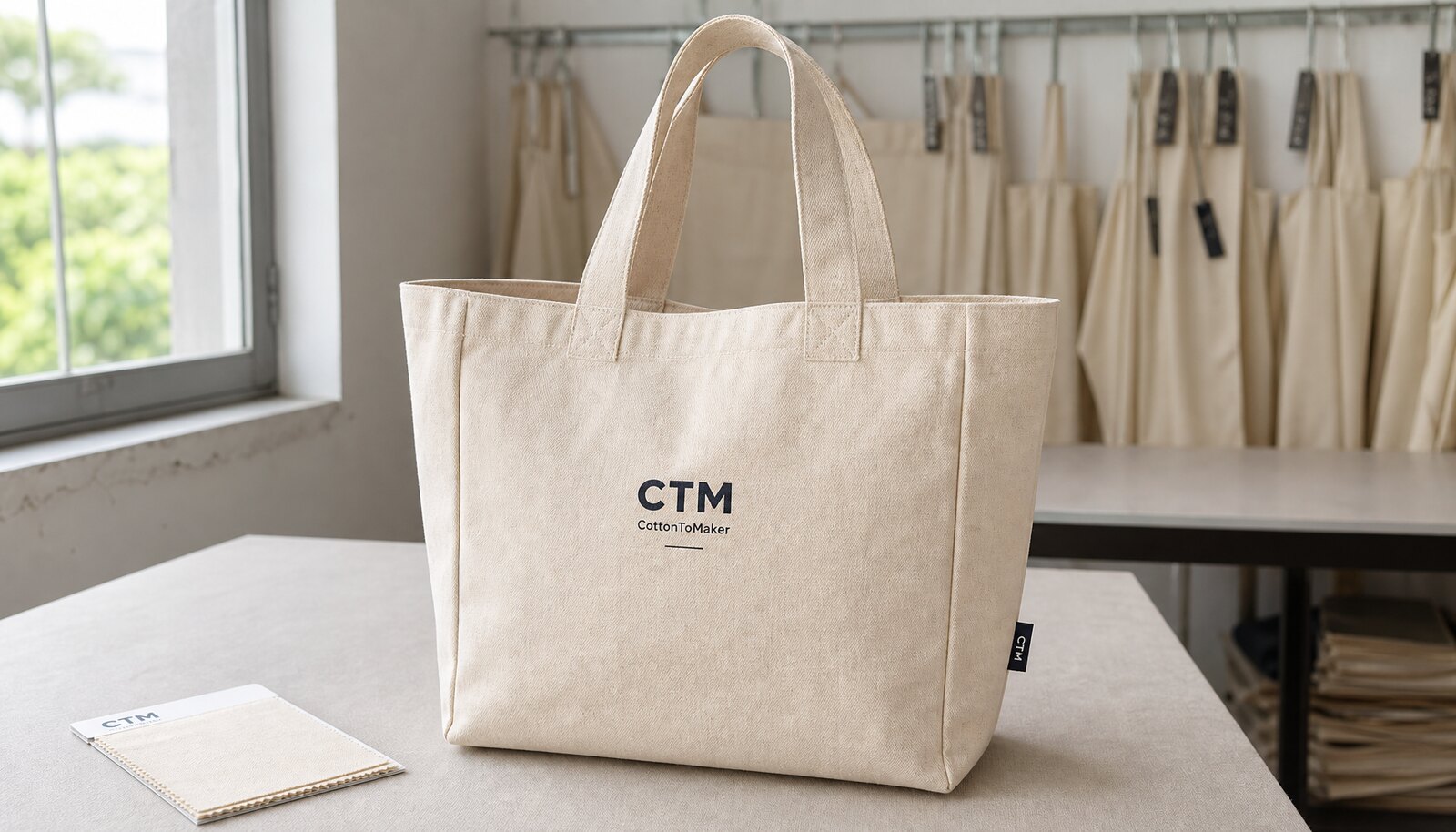
What a Retail Chain Is Actually Buying
A chain order is not a simple logo job on a blank bag. It is a repeatable retail SKU that has to survive store handling, distribution-center intake, shelf display, and later reorders without drifting away from the approved standard. The product is judged by consistency as much as by appearance. If the first sample looks good but the next shipment changes in fabric shade, print placement, or fold size, the buyer ends up managing exceptions instead of selling a controlled item.
That is why custom canvas tote bags for retail chains need to be scoped as a program, not a one-off decoration order. The bag has to look the same in every branch, pack the same way in every carton, and reorder without a fresh debate over what was approved last time. If the buying brief does not define the retail use case, suppliers will fill the gaps with their own assumptions, and the lowest-cost quote will often be the one that optimized the wrong thing.
The cleanest way to avoid that problem is to specify the bag as a retail object: construction, decoration, packing, and replenishment all in one brief. Once that is done, the print method becomes a commercial decision instead of a guess.
- Treat the tote as a retail SKU, not a promo throwaway.
- Write for store handling, DC intake, and reorder continuity at the same time.
- Do not compare suppliers until the use case is fixed.
Lock the Bag Spec Before You Price Decoration
Fabric weight drives almost everything that follows. For most retail chain programs, 10-12 oz canvas, or about 340-410 GSM, is a practical starting point because it gives the bag enough body to carry a clean logo without becoming awkward to fold or expensive to move. The real control point is not just the target weight but the tolerance around it. Buyers should ask for a narrow GSM window, confirm weave density, and understand whether the fabric has been prewashed or will shrink after finishing.
The finished dimensions matter just as much as the cloth itself. Handle width, handle length, seam construction, top hem, gusset, and reinforcement all affect how the tote carries and where the artwork can sit without distortion. If the logo is too close to a seam, fold line, or handle attachment, both screen print and transfer become harder to control. A good default is to keep the main artwork at least 15-20 mm away from any seam or fold line unless the supplier has already proven that placement on a sample.
It also helps to decide early how the bag will be presented in-store. A tote sold near the checkout lane may need a compact fold and a clean front panel. A gift-shop style tote can tolerate a looser presentation if the packaging carries the presentation load. Those are different products even when the artwork is the same, so the spec needs to reflect the selling environment, not just the art file.
- Fix GSM, weave, finished size, and shrinkage behavior before quoting.
- Keep the logo clear of seams, folds, and handle attachment points.
- Decide whether the bag must fold flat, stand in a tray, or hang on peg hook.
Screen Print, Heat Transfer, and Embroidery Are Different Commercial Products
Screen print is the default for a reason. It handles one or two spot colors well, gives a solid hand on canvas, and becomes very efficient once the artwork and cure process are approved. For chain programs with stable branding and real reorder volume, it is usually the strongest mix of cost and repeatability. The tradeoff is setup discipline. Screens, registration, ink laydown, and cure conditions need to be controlled, or the same design can come back with slightly different edges or color density.
Transfer print needs more precision in the buying language. On cotton canvas, the question is usually heat-applied transfer, not a generic transfer label. That can mean DTF, PU film, or screen transfer, and the differences matter. DTF is the most flexible for fine detail, small text, gradients, and artwork that may change seasonally, but it can feel thicker on the fabric. PU film is flatter and cleaner on simple graphics, with a softer visual edge. Screen transfer sits in the middle, but it still depends on heat and pressure. Sublimation is not the default for cotton canvas and should only be considered if the substrate is polyester-rich or coated for that process.
Embroidery has a different value proposition. It gives a premium texture and can elevate a tote that is meant to feel more giftable or higher-end, but the cost is higher and the process is less forgiving. Lighter canvas can pucker around the stitch field, while heavier canvas can support the look well if the backing is controlled. The buyer should not ask whether embroidery is 'better.' The question is whether the texture, labor, and price point fit the retail role of the bag.
- Use screen print for fixed logos, simple spot colors, and repeat orders.
- Use heat-applied transfer only when the exact transfer type is named in the spec.
- Use embroidery when the retail price point can absorb the added labor and texture.
Price the Whole Program, Not the Unit
A tote quote only becomes useful when the assumptions are visible. If the supplier gives a single price without separating fabric, sewing, decoration, packing, and freight, the quote is not really comparable. Two vendors can look close on unit cost and still land very differently once setup, carton work, barcode labels, and export handling are added. That is why the first buying question should be what exactly is included, not what the headline price is.
Setup cost deserves special attention because it behaves differently by method. Screen print may look cheap at scale, but the screen and registration cost has to be spread across the run. Heat-applied transfer can avoid screen charges but add per-piece labor or film cost. Embroidery may add digitizing, thread changes, and machine time. The practical way to compare suppliers is to ask for the same quote at several volume bands, such as 500, 1,000, 3,000, and 5,000 units, then compare the pricing curve instead of one number.
The buyer also needs the exclusions in writing. Freight, duties, inland trucking, third-party inspection, palletization, special retail packaging, and even artwork cleanup can all change the landed cost. On chain programs, those hidden items often matter more than a small factory price gap.
- Break the quote into fabric, sewing, decoration, packing, and freight.
- Ask for pricing at realistic chain volumes, not just the MOQ.
- Compare landed cost, not just factory price.
Audit the Factory and the Process Owner Before Award
The supplier route changes the risk profile. A direct factory is usually the better choice when the tote needs repeat control, the chain expects reorders, and the buyer wants a stable production route. Direct control makes it easier to keep the same fabric source, the same print method, and the same packing standard across later runs. The downside is simple: the buyer has to be specific, because the factory will not guess its way into a retail-ready brief.
A trading company or sourcing agent can make sense when the order needs consolidation, multiple product coordination, or help managing communication. That can reduce friction, but it can also hide who is actually making the bag. The important question is not whether an intermediary exists. It is whether the supplier can name the actual production site, the line owner for printing, the line owner for sewing, and the line owner for packing. If those answers are vague, the commercial control is weak.
Verification should be practical, not theatrical. Ask for the business name and address of the production site, current photos of the relevant line, and evidence that the same process is used on a comparable order. A live video walk-through, a date-stamped job ticket, or a current sample photo tied to a real batch is more useful than a polished factory brochure. If the supplier says it can do screen print, heat transfer, or embroidery, ask to see the equipment actually used for that method, not a stock image.
- Identify the actual factory, not just the sales company.
- Ask who owns printing, sewing, and packing on the line.
- Verify claims with current production evidence, not brochure photos.
Approve a Sample That Mirrors Production
A sample only protects the buyer if it matches the bulk route. That means the final fabric, the final decoration method, the final thread or ink or film, and the final packing format. A paper proof does not tell you how a screen print will sit on canvas, and a stitched sample on the wrong GSM does not tell you whether the production bag will pucker at the handle. The approved sample should be treated as the golden reference for the order and, ideally, retained in both sealed and open form.
The review itself should be method-specific. Screen print should be checked for coverage, edge sharpness, registration, and cure quality. Heat-applied transfer should be checked for bond strength, edge lift, and hand feel after the bag is folded. Embroidery should be checked for puckering, backing visibility, stitch density, and how the raised surface reads against the canvas texture. The sample needs to be judged under the light conditions used for approval, not casually under warehouse lighting.
Chain buyers should also ask for a retained sample from the approved bulk run. That gives the team a reference for reorders, claims, and future seasonal variants. Without that baseline, every later run becomes a memory contest instead of a controlled comparison.
- Approve the exact fabric and decoration method that will be used in bulk.
- Keep one sealed master sample and one working reference sample.
- Judge the sample under D65 light and against the signed master.
Set Numeric QC Limits for the Lot
Retail chain orders need numbers, not just good-bad language. Common sense is not enough when the product has to pass through purchasing, quality, and operations. The useful approach is to define tolerances before production starts, then inspect against those limits when the lot is ready. Common standards can be used as a reference point: ASTM D4966 or ISO 12947 for abrasion, AATCC 8 or ISO 105-X12 for crocking, and AATCC 61 or ISO 105-C06 for wash fastness if the tote is expected to survive laundering.
For color, a Delta E00 target against the approved master under D65 is more useful than a vague 'match the sample' instruction. For most retail chain programs, Delta E00 <= 2.0 is a reasonable default, with tighter control for core brand colors if the brand demands it. Placement should also be numeric. A practical default is +/-3 mm on artwork position and no seam or fold intrusion unless it was signed off in the spec.
Physical durability needs the same treatment. A 10 kg static handle load for 60 seconds is a reasonable default for standard canvas totes, with a higher target if the bag is heavier or intended for stronger carry loads. Fold performance matters too: after repeated folding, the printed area should not crack wider than 1 mm at the main fold line, and heat-applied transfer should not show edge lift greater than 1 mm. The point is not to create paperwork. The point is to make failure visible before the chain takes delivery.
- Canvas GSM within +/-5% of spec; body dimensions within +/-5 mm and handle length within +/-10 mm.
- Artwork placement within +/-3 mm and no seam or fold intrusion unless approved.
- Color target Delta E00 <= 2.0 under D65, or tighter for core brand colors.
- After 5,000 Martindale cycles, the decorated area shows no visible base fabric show-through or logo failure.
- If washability is required, pass 5 cycles per AATCC 61 or ISO 105-C06 equivalent with no peeling or flaking.
- Dry crocking is grade 4 or better and wet crocking is grade 3 or better per AATCC 8 / ISO 105-X12.
- Handle attachment survives a 10 kg static load for 60 seconds with no seam opening or stitch burst.
- Defects follow AQL 0 for criticals, 1.0 for majors, and 2.5 for minors, with no stains larger than 3 mm, no broken stitches, and no missing labels.
- Packed cartons are dry, intact, and labeled with SKU, quantity, case pack, and destination exactly as approved.
Write the Packing Spec for DC Intake and Shelf Display
A tote can pass decoration QC and still fail at the distribution center if the pack-out is sloppy. Buyers need to define folded dimensions, case pack, carton dimensions, barcode placement, pallet pattern, and whether an inner polybag is actually required. If the bag is going into a shelf tray, the fold size matters more than a perfect carton count. If it is moving through central replenishment, scanning and stackability matter more than presentation.
It helps to think of the pack spec as a labor-saving device for the retailer. A carton that is easy to count but awkward to stack costs time at the DC. A package that protects the print surface but obscures the barcode creates friction downstream. The best answer is the one that matches the retailer's receiving flow without adding unnecessary packaging material.
For store-facing programs, the fold should be mocked up before production. If the tote needs to sit face-up, the front panel should stay centered when folded. If it hangs, the handles need to fall in a clean line. Those details are minor at the factory and visible on shelf.
- Define folded size, case pack, and barcode placement before production starts.
- Match the pack style to the retailer's shelf, tray, peg, or DC flow.
- Do not add packing layers unless they solve a real handling problem.
Protect Reorders With Version Control
The first order is only part of the program. The real savings come from reorders that look like the approved sample without forcing the buyer to requalify the product every time. That requires version control. The supplier should keep the artwork file, screen record, transfer spec, thread code, fabric reference, and retained sample tied to the order number. If any of those inputs change, the reorder should be treated as a new approval, not a silent substitution.
Reorder timing should also be written down. The lead time for a first run is not the same as the lead time for a repeat run, and the supplier should state both. A retailer launching a seasonal tote or replenishing a store network needs a clear answer on how long it takes to restart the exact same bag. If the supplier cannot commit to a reorder lead time, the apparent unit price has less value than it looks like on paper.
The safest commercial rule is simple: no change in fabric source, decoration method, or packing format without written approval. That protects the chain from small process swaps that are invisible in a quote but visible once the goods are in the network.
- Keep versioned records for artwork, screens, transfer specs, thread codes, and fabric lots.
- Quote reorder lead time separately from first-run lead time.
- Treat any material or process substitution as a new approval.
Specification comparison for buyers
| Decision area | Best-fit choice | Procurement spec or acceptance criterion | Failure mode / buyer risk |
|---|---|---|---|
| Fabric weight | 10-12 oz canvas, about 340-410 GSM | Target GSM within +/-5% and confirm weave, shrinkage, and finished size before quoting | Too-light canvas distorts artwork and feels cheap; too-heavy canvas raises cost, packing time, and freight |
| Screen print | 1-2 spot colors with stable artwork | Require placement within +/-3 mm, Delta E00 <= 2.0 to the approved master, and no cracking after 5,000 Martindale cycles or 5 wash cycles if washability is required | Registration drift, uneven ink laydown, or color drift on reorder |
| Heat-applied transfer | Detailed art, gradients, small text, or short seasonal runs | Name the transfer type - DTF, PU film, or screen transfer - and reject sublimation on cotton canvas unless the substrate is polyester-coated; require edge lift no greater than 1 mm after fold and abrasion checks | Plastic hand feel, edge peeling, or a supplier swapping to a different transfer system later |
| Embroidery | Premium branding on heavier canvas | Keep stitch density at 7-9 stitches per inch on the logo area, limit puckering to 2 mm or less, and require no backing show-through on the face | Higher labor cost, panel distortion, and visible thread shade variation |
| Setup cost | Repeat volume favors screen print; short runs can favor transfer | Quote screens, digitizing, film, plates, and art prep as separate line items | A low unit price can hide a large startup charge |
| Lead time | Stable reorders versus frequent artwork changes | Quote sample-to-bulk and reorder lead times separately, with the approved production route named in writing | Delays appear when screens, files, or transfer plates are not retained |
| Color control | Core brand colors and chain-wide consistency | Match to a signed master under D65 lighting and keep brand colors within Delta E00 <= 2.0, or tighter if the brand requires it | Store-to-store drift and arguments over whether the shade is acceptable |
| Shelf presentation | Checkout, peg, tray, or gift display | Define folded size, front-panel orientation, and barcode clear zone before sewing starts | Bad fold geometry or off-center branding weakens shelf appeal |
| Supplier route | Direct factory for repeat control; trading company when coordination is the real value | Name the actual production site, decoration line owner, and packing line owner before award | Hidden outsourcing and weaker process control on reorders |
Buyer checklist before sampling
- Lock GSM, weave, finished size, handle length, handle width, seam type, and print zone in millimeters before asking for price.
- Provide one vector artwork file with Pantone references and state whether the design will be screen print, heat transfer, or embroidery.
- Ask for separate quotes for fabric, decoration, sewing, packing, and freight so the landed cost is visible.
- Require the supplier to identify the exact transfer type or embroidery process, not just print.
- Ask for a sample on the final fabric, using the exact production line and thread, ink, or film.
- Set numeric tolerances for placement, color, defects, and folded pack size.
- Ask for cartoning, palletization, barcode label format, and case pack before approval.
- Confirm who owns screens, artwork files, digitizing, retained samples, and reorder records.
- Ask the factory how it handles process changes, subcontracting, and substitute materials.
- Define overrun, underrun, and replacement policy in writing for launch-sensitive programs.
Factory quote questions to send
- What exact fabric weight, weave, and shrinkage are you quoting, and what tolerance do you allow?
- Which decoration process is included, down to transfer type or embroidery density?
- What is the target Delta E and placement tolerance against the approved sample?
- Can you show a sample made on the final fabric, not a substitute cloth?
- What are the MOQ and price breaks at 500, 1,000, 3,000, and 5,000 units?
- What setup charges are separate from unit cost?
- What is the reorder lead time versus the first-run lead time?
- What is the inspection plan and what AQL do you ship against?
- What is excluded from the quote: freight, duties, inland trucking, inspection, palletization, and labels?
- Who actually prints, sews, and packs this order?
Quality-control points to confirm
- Canvas GSM is within +/-5% of the approved spec; finished size is within +/-5 mm on body dimensions and +/-10 mm on handle length.
- Artwork placement is within +/-3 mm of the approved position, with no seam or fold intrusion unless signed off.
- Screen print color is within Delta E00 <= 2.0 under D65; core brand colors should aim for <= 1.5.
- Ink or transfer surface is fully bonded, with no edge lift greater than 1 mm after 25 fold/unfold cycles.
- If the tote is meant to be washable, it survives 5 cycles per AATCC 61 or ISO 105-C06 equivalent with no peeling, flaking, or crack wider than 1 mm at the main fold line.
- Abrasion resistance is tested to ASTM D4966 / ISO 12947 at 5,000 Martindale cycles with no visible base fabric show-through or logo failure in the decorated area.
- Dry crocking is grade 4 or better and wet crocking is grade 3 or better per AATCC 8 / ISO 105-X12.
- Handle attachment survives a 10 kg static load for 60 seconds with no seam opening, stitch burst, or distortion that changes the bag shape.
- Defect plan uses AQL 0 for criticals, 1.0 for majors, and 2.5 for minors, with no stains larger than 3 mm, no broken stitches, and no missing labels.
- Packed cartons are dry, intact, and labeled with SKU, quantity, case pack, and destination exactly as approved.