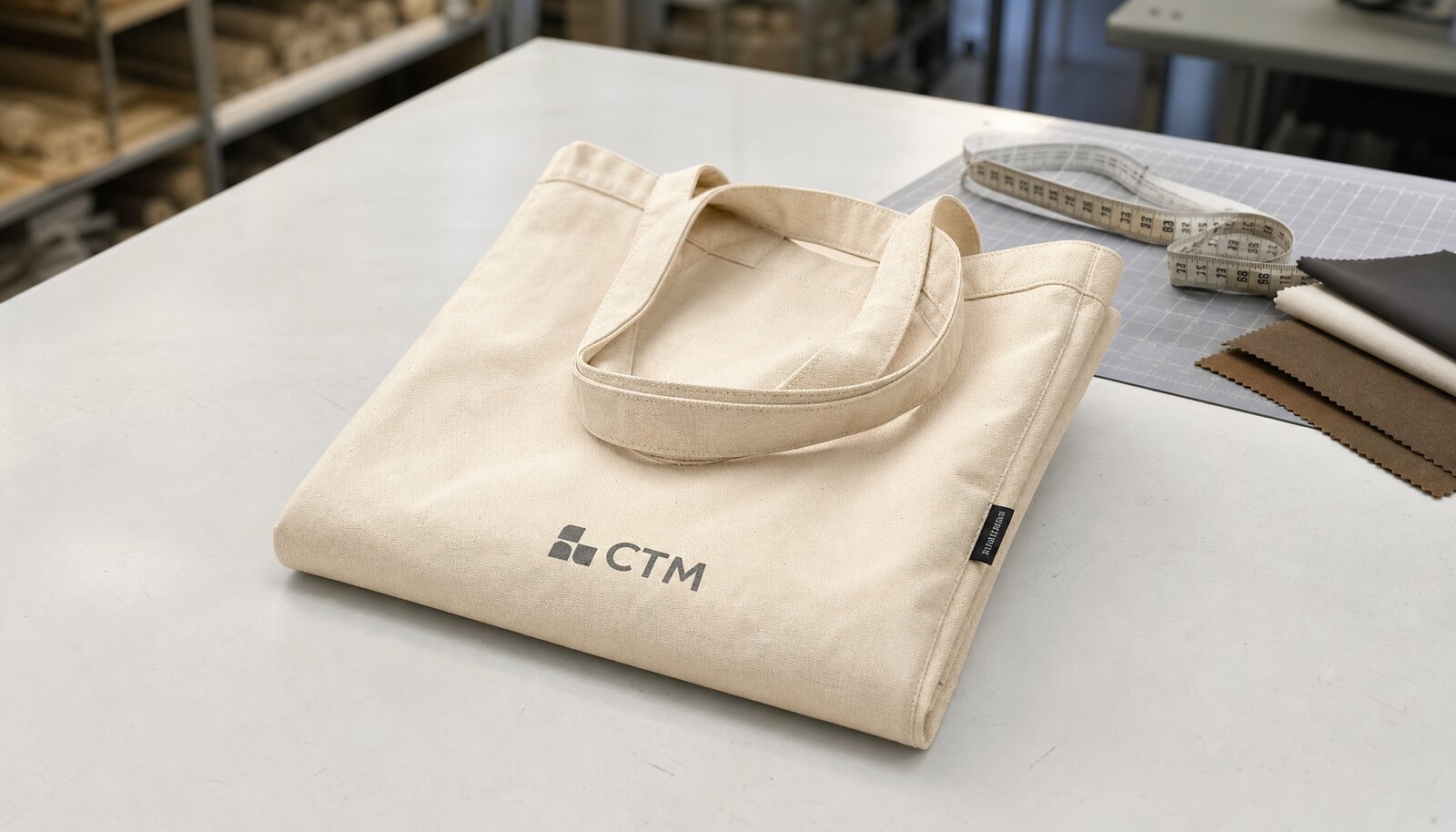
Why retail chains need a tighter tote bag spec than normal promo buying
A retail chain tote is not just a giveaway bag. It sits in a supply chain that needs predictable carton counts, stable print output, store-friendly handling, and low claims. That means the spec has to cover not only the bag itself, but also how it ships, how it is packed, and how it is approved before mass production. If you leave those details open, suppliers will fill the gaps with their own assumptions, and those assumptions rarely match a chain buyer’s requirements.
The right spec also protects margin. A tote that looks cheap on paper can become expensive when the fabric is too light, the print needs extra passes, or the cartons are packed inefficiently. For retail programs, procurement should treat canvas totes as a finished commercial item, not as a simple sew-and-print product. The quote should let you compare factories on the same basis: cloth weight, construction, print method, pack format, and final landed cost logic.
- State the retail use case: checkout carry, shelf impulse item, gift-with-purchase, or branded resale bag.
- Define whether the bag must look premium in-store or only perform as a transit package.
- Treat packing efficiency and barcode labeling as part of the product, not an afterthought.
Start with the bag structure: size, canvas weight, and carry behavior
For most retail chain programs, the most practical base construction is a 12 oz or 14 oz cotton canvas tote with reinforced handles and a flat bottom or light gusset. That range gives the bag enough body to hold shape without becoming unnecessarily heavy or costly. An 8 oz canvas can work for light promotional use, but it usually feels too soft for store retail and can wrinkle badly in packing. On the other end, very heavy canvas may add cost and reduce carton efficiency without bringing a real sales benefit.
The finished size should be driven by what the customer will actually carry. If the tote is meant for apparel or books, a medium format with a moderate gusset is usually better than a large, floppy shopper bag. Ask the factory to quote by finished dimensions, not only by flat fabric cut size, because some suppliers calculate dimensions before seam allowance and others after. That is a common source of quote comparison errors.
- Typical retail-friendly canvas range: 12 oz to 14 oz finished canvas.
- Use a gusset when the bag needs to stand on shelf or carry boxed goods.
- Keep the handle drop realistic for shoulder or hand carry; too-short handles reduce repeat use.
Print method decisions that affect cost, speed, and appearance
For custom canvas tote bags for retail chains packaging specification guide work, screen printing is still the default for most buyers. It gives stable cost on repeat orders, handles bold logos well, and is easier to control across bulk runs than decorative methods. If your artwork is simple and your brand color is fixed, screen print usually gives the cleanest balance of cost and durability. For one- or two-color graphics, it is usually the most straightforward route for both procurement and production.
Heat transfer, digital print, and embroidery each have a place, but they should be chosen for a reason. Heat transfer can suit small runs with detailed art, but it may create a less natural hand feel and can be sensitive to folding at the pack stage. Embroidery adds premium value but raises sewing cost and can distort on thin canvas. If the bag is retail-packaged and intended to sit on shelf, the print should survive repeated handling and not crack at fold lines.
- Screen print: best for simple logos, larger orders, and repeat programs.
- Heat transfer: useful for short runs or detailed artwork, but test fold resistance.
- Embroidery: premium appearance, but only if the canvas weight supports the stitch density.
How MOQ really works on retail chain programs
MOQ on tote bags is often misunderstood because the factory may quote one number, but the real limitation sits inside fabric color, print color, and packing variant. A buyer may see a “5,000 pcs MOQ” and assume that covers all versions, while the factory is actually building a minimum per style, per color, or per artwork. If your chain rollout uses multiple stores, regions, or seasonal graphics, break the order into the exact combinations before asking for pricing.
The cleanest RFQ format is to request base MOQ by finished size and fabric color, then ask for the surcharge of each artwork variant. This makes it easier to see whether a low MOQ quote is truly competitive or simply hiding setup fees. It also helps the supplier decide whether your order should run in one production lane or multiple lanes, which matters for lead time and consistency.
- Separate base bag MOQ from print-variant MOQ.
- Ask whether natural canvas and dyed canvas share the same sewing schedule.
- Clarify whether one artwork change triggers a new sampling fee or a full production reset.
Landed-cost comparison: direct factory vs trading route
Retail buyers often compare only unit price, but tote bags with packaging specifications can shift cost materially depending on sourcing route. A direct factory quote may look higher at first glance if it includes proper packing, carton labeling, and consistent print control. A trading route can appear easier to buy, especially if the supplier bundles different products, but the underlying factory may still be the same type of sewing operation with less transparency. The real issue is not who replies fastest; it is who can prove the spec will be followed run after run.
For chain programs, direct sourcing usually gives better control over fabric, sewing, and packing, especially when the same tote will be reordered. Trading companies can add value if you need mixed-category consolidation or if your internal team wants one buying contact for multiple packaging items. But if you choose a trading route, require written disclosure of the actual manufacturer, the sample origin, and who owns final QC before shipment.
- Direct factory: better for stable specs, lower hidden markup, clearer QC ownership.
- Trading route: useful for bundled sourcing, but verify actual production site and packing owner.
- Do not compare quotes without including carton packing, labels, and variant setup fees.
Product-specific comparison table: choosing the right sourcing route
The best sourcing route depends on how standardized your retail rollout is. A regional chain with one logo and one carton plan should not buy the same way as a multi-brand distributor that needs mixed packaging and last-minute changes. This table compares practical sourcing options rather than generic spec items, so procurement can see where each route creates savings or risk.
Use this comparison before you issue the RFQ. It will help you decide whether to prioritize price, flexibility, or packing control, and it will show which supplier type can actually support the spec you want without hidden revisions later.
- Write decisions in measurable language, not only descriptive wording.
- Ask for sample photos plus one physical approval sample for important orders.
- Keep quotation, sample approval, and inspection notes tied to the same spec version.
Sample approval: what the first sample must prove before bulk order
A tote bag sample is only useful if it proves the exact features that can fail in production. The sample should show final fabric weight, seam construction, print placement, handle length, and the intended pack method. If the factory sends a loose proto that is not close to the bulk spec, it may look acceptable but still fail in production because the fabric or sewing settings were changed later. For chain buyers, that is a costly mistake because the issue often appears only after the first cartons reach the distribution center.
The most practical approval process is to request a pre-production sample made from the intended fabric and print method, then review a packed sample if retail labeling is part of the order. Measure the bag, load it with a realistic item weight, fold it to the intended pack format, and inspect the print after handling. If the tote will be sold in stores, also check whether the bag stands neatly when folded or if the seams twist under pressure.
- Approve the sample as a final-reference sample, not a generic prototype.
- Test load and fold behavior with a realistic product weight.
- Confirm that any labels, barcodes, or hangtags match the store requirement.
Packing specification: where many retail programs lose money
Packing is one of the easiest places to lose margin because it sounds minor until it affects carton count, labor, and damage rates. If the bags are retail-ready, you may need individual polybags, barcode stickers, or insert cards. If the bags are only for internal store distribution, bulk packing with inner bundles is often more efficient. The wrong pack method can inflate cartons, increase freight volume, and add handling steps at both factory and distribution center.
Write the pack spec in practical terms. State how many bags per inner bundle, how many bundles per master carton, whether cartons can be mixed by color, and whether each carton needs SKU labeling on two sides. If your retailer uses warehouse scanning, ask for barcode format and label placement. A supplier should not guess this. The packaging plan should be part of the quote and part of the approval sample.
- Bulk pack reduces freight and carton cost when the bag is not shelf-presented individually.
- Individual polybags add labor and volume; only use them when the chain requires retail presentation or hygiene control.
- Carton labels should identify SKU, color, size, and quantity clearly enough for DC receiving.
QC thresholds that matter for canvas totes in retail programs
Quality control for canvas totes should focus on the failures that create store claims: wrong size, weak handles, crooked print, poor seam finish, and inconsistent packing. Buyers often spend too much time reviewing cosmetic perfection and too little time defining measurable acceptance criteria. The factory needs clear thresholds for fabric tolerance, stitch quality, and print placement so inspection is objective and repeatable.
A practical standard is to define the allowable deviation for finished size, stitch quality, and print position before production begins. Then review first-batch cartons against the signed sample. If the factory does not maintain those limits, it should sort or rework before shipment. For a chain program, it is far cheaper to reject a batch at source than to deal with store-level returns or repacking.
- Set acceptable measurement tolerance for width, height, gusset, and handle drop.
- Require clean seam finishes with no loose threads at visible touch points.
- Verify print alignment against the signed sample under normal viewing distance, not only under close inspection.
Lead time planning and the schedule risks buyers underestimate
Lead time for custom canvas totes is rarely just sewing time. Material booking, dyeing if needed, print setup, sample approval, carton production, and packing all add time. When a chain buyer gives a launch date without a frozen spec, the supplier often has to hold fabric or wait for revised artwork, which stretches the schedule. If the order is seasonal, a few days lost in sampling can become a missed store window.
Build the schedule backward from the in-store date. Ask the factory to separate sample timing from bulk timing, and separate production time from packing and carton loading. That way you can see where the real risk sits. For higher-volume chain rollouts, the safest approach is to approve the sample early, lock the artwork, and avoid last-minute changes to packing format or barcode language.
- Material lead time and print setup often drive the earliest delays.
- Artwork changes after sample approval usually reset part of the schedule.
- Packing requirements can add more time than sewing if labels or retail inserts are involved.
Specification comparison for buyers
| Spec decision | Recommended option | When it fits | Buyer risk to check |
|---|---|---|---|
| Fabric weight | 12 oz or 14 oz canvas for store carry bags; 8 oz only for light promotional use | Retail chains need a bag that feels substantial, holds shape on shelf, and survives repeated customer use | If GSM is not stated, suppliers may quote different cloths under the same “canvas” name; compare actual weave density and finished weight |
| Print method | 1–2 color screen print for most chain programs; heat transfer only for small, detailed graphics | Best when the artwork is simple, repeat orders are likely, and you need a stable unit cost | Multi-color prints can hide registration problems; approve actual print placement and ink coverage on a pre-production sample |
| Handle construction | Cross-stitch or reinforced box stitch at stress points with 25–30 cm handle drop | Suitable for retail bags that carry catalogs, apparel, or medium-weight goods | Short handles may look neat but cause customer complaints; weak bar-tacks fail first at busy store checkouts |
| Bottom structure | Flat-bottom with sewn gusset for better shelf presentation and pack efficiency | Useful for chains that want a bag to stand up in-store and during carrier packing | Gusset width changes both carton count and print panel layout; lock the finished size before artwork finalization |
| Lining and closure | Unlined open top for simple retail gifting; zip-top or snap closure for premium reuse or security | Use closure only when the retailer needs higher perceived value or reduced spillage | Extra components add sewing time, QC points, and failure risk; confirm zipper pull style and smoothness in sample approval |
| Supplier route | Direct factory for chain rollouts; trading company for mixed-category bundles or consolidated sourcing | Direct sourcing works best when volume is stable and packaging is standardized across stores | Trading quotes can look easier to buy but hide factory spec drift; identify the actual mill, printer, and packing line in writing |
| MOQ logic | Plan MOQ by fabric color + print color + size combination, not just by style | Fits retail programs that use one base bag with multiple seasonal prints or regional SKUs | A low total MOQ may still force high per-SKU quantities; separate sample MOQ from production MOQ in the RFQ |
| Packing format | Bulk packed in master cartons with labeled inner bundles; retail-ready polybag only if store handling requires it | Best for importers aiming to reduce packing labor and carton volume | Retail-ready packaging raises unit cost and carton counts; confirm whether hangtags, barcodes, and warning labels are applied at factory or in distribution center |
Buyer checklist before sampling
- Lock the finished size, fabric weight, handle length, and gusset depth before requesting quotes.
- State whether the bag is for shelf display, checkout carry, gifting, or resale packaging.
- Specify print method, number of ink colors, and exact print location with measured artwork area.
- Define carton pack, inner bundle count, and whether retail labels or barcodes are needed.
- Request a pre-production sample, a bulk shade band reference, and a sewn-sample approval photo before mass production.
- Separate sample cost, unit price, and outer carton cost in the quote sheet.
- Ask for the actual lead time by step: material booking, sample approval, production, and packing.
Factory quote questions to send
- What exact canvas weight in oz or GSM will you use, and what is the finished fabric tolerance?
- Which print method is included in the unit price, and what is the cost impact of each extra color?
- What is the MOQ by size, color, and print variant, and can mixed artwork share the same fabric run?
- Can you confirm the sewing construction at handle joints, seam allowance, and bottom reinforcement?
- What packing method is included: bulk pack, inner bundle, individual polybag, barcode sticker, or retail hangtag?
- What sample stage will you provide before production, and what does the approval sample represent: fabric, print, or final packed unit?
- What is your production lead time after sample approval, and what factors normally extend it?
- Which parts of the quote are excluded, such as freight, import carton labels, testing, or local compliance documents?
Quality-control points to confirm
- Fabric weight matches the agreed spec within the factory’s stated tolerance and does not feel thin or see-through at the seams.
- Handle stitching is even, with no skipped stitches, loose threads, or pulled tension at the stress points.
- Print registration sits within the approved artwork placement and does not bleed, crack, or ghost on folded panels.
- Finished size stays within the agreed measurement range for width, height, gusset, and handle drop.
- Cartons match the pack plan and show the correct SKU, quantity, and lot identification on the outer case.
- Sample-approved color should remain consistent across the first production cartons; do not accept random shade variation without a documented tolerance.
- Edges, binding, and seam turns must remain flat with no puckering that will affect shelf display or folding.