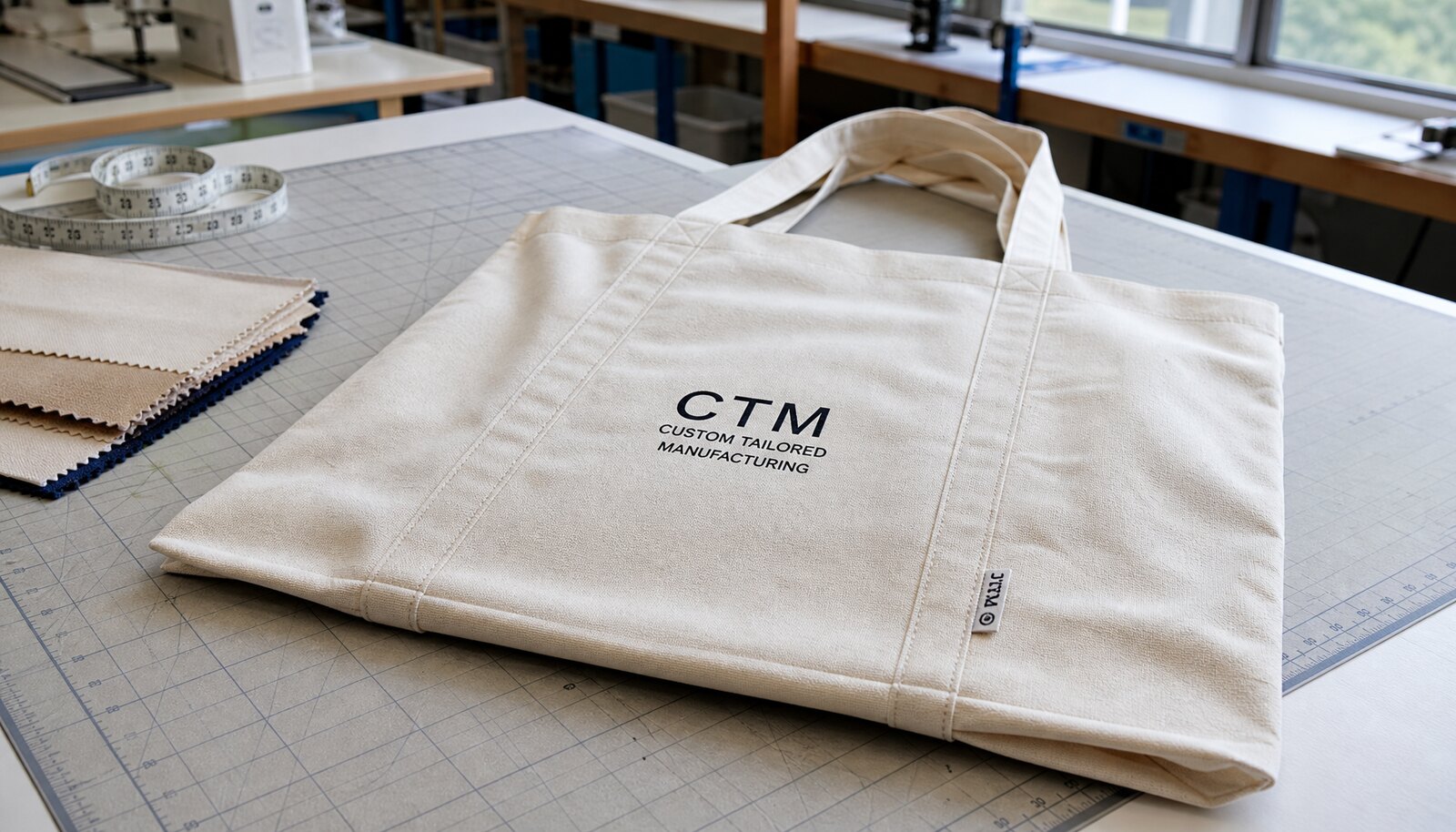
Start With the Museum Job, Not the Bag
Museum buyers often receive broad requests like "custom tote for the shop" and then get quotes that cannot be compared. The first step is to define the actual job the bag has to do. A retail tote for the gift shop, a membership welcome gift, and an exhibit opener giveaway all push the specification in different directions. Retail bags need better hand feel and print fidelity. Giveaway bags can tolerate a simpler build if the program needs volume and a sharp price point.
Write the RFQ around the use case, then tie every spec back to that use case. If the tote will carry catalogs or hardback books, the canvas needs more body and stronger handles than a light visitor bag. If the tote is meant to sit on a shop shelf, the bag must look structured even before it is filled. That context helps suppliers quote the right cloth, stitching, and decoration method instead of guessing at a generic promotional bag.
- State whether the bag is for resale, gifting, or visitor use.
- Include target retail price or target landed cost if the tote will be sold in the museum shop.
- Describe the heaviest item the tote should carry without distortion.
Lock the Canvas Spec Before You Compare Prices
Canvas pricing changes quickly when the fabric weight is vague. For museum programs, 10 oz to 12 oz canvas is usually the practical range for standard retail totes, while 16 oz canvas is a better fit for premium programs where the bag must feel substantial on the shelf. In GSM terms, that is roughly 340 to 410 GSM for standard weight and around 540 to 560 GSM for heavy canvas. Do not rely on the term "heavy canvas" without a number. Two suppliers can use the same words and still ship very different cloth.
Put the fabric definition in writing with the finish and color. Natural canvas, bleached canvas, dyed canvas, and recycled canvas each carry different visual risk and price logic. Ask whether the quote is based on pre-shrunk fabric, whether the cloth is bleached or optical-whitened, and whether the supplier will allow shade variation within a batch. Museum buyers should also call out if the bag must look clean and neutral for gallery retail, because visible slubs and speckling can be acceptable on one program and rejected on another.
- Use both oz and GSM if the supplier works across markets.
- State whether the canvas should be bleached, natural, dyed, or recycled.
- Add a tolerance note for color variation and shrinkage so the sample sets the benchmark.
Choose the Print Method for Wear, Not Just for the Art File
Museum artwork often starts as a logo, exhibit identity, or illustration with fine detail. The print method should follow the artwork and the bag's retail life. Screen print is usually the first choice for simple logos, strong color blocks, and repeat programs because it stays economical at volume and gives a solid retail appearance. If the design uses gradients, small type, or more than two colors, the quote should also cover heat transfer or digital print as a separate option so the buyer can compare true tradeoffs instead of guessing.
The sample has to prove more than image quality. It should show how the print sits on the canvas after curing, whether the edges crack when the bag is folded, and whether the ink feel is too heavy for a shop item. If the museum wants a soft, natural surface, a thick print can look overbuilt. If the bag will be sold as a durable souvenir, a slightly heavier hand on the ink may be acceptable. The right answer depends on the audience and the bag's shelf life, not on the decorator's default process.
- For one- to two-color logos, screen print is usually the most stable quote basis.
- For complex art or short runs, ask for a separate heat transfer or digital print price.
- Require rub resistance and fold-line durability on the physical sample, not only an image proof.
Compare Supplier Routes Before You Compare Unit Price
A low unit price can hide a weak sourcing route. Direct factories are usually the best fit when the museum wants control over canvas weight, stitch quality, and packaging, especially for repeat shop programs. Trading companies can be useful when the buyer needs a fast combined source or has no time to manage multiple vendors, but the buyer should expect less visibility into the real factory and more room for quote drift. Local decorators that print on imported blanks can work for small runs, but the total landed cost often rises once blank quality, decorating charges, and domestic freight are added together.
The practical test is simple: who owns the cloth, who owns the sewing, who owns the print, and who is responsible if the sample and bulk run diverge? If those answers are unclear, the quote is not ready for comparison. Museums with recurring season launches should favor routes that can hold fabric consistency across reorders. A one-off campaign can tolerate more flexibility, but only if the buyer knows where the risk sits.
- Direct factory: best for repeat orders and controlled specs.
- Trading company: useful for broader sourcing support, but verify QC ownership.
- Local blank decorator: suitable for small tests, but compare landed cost rather than unit print price alone.
Build a Quote That Can Be Audited
Many tote quotes are impossible to compare because they mix setup charges, blank bag cost, decoration cost, and packaging into one number. Split the request into line items. Ask for blank bag price, print setup or plate charge, label cost, hangtag cost, packing cost, and carton charge separately. If the supplier only gives one blended number, the buyer cannot tell whether the low price depends on a cheap fabric, a loose packing spec, or a hidden setup fee that will reappear on reorder.
For museum procurement, the quote also needs commercial details. State the target quantity, ship terms, currency, and destination port or warehouse. Ask for EXW, FOB, and if needed DDP so finance can compare options on the same basis. MOQ should be broken out by color, print method, and carton pack, because a supplier may accept 1,000 pieces overall but require 500 pieces per print color or per fabric dye lot. That distinction affects the actual order plan and the launch date.
- Separate blank cost, decoration cost, labeling, and packing in the quote.
- Request EXW, FOB, and DDP when you need landed-cost comparison.
- Break MOQ down by fabric color, print color count, and packing style.
Use the First Sample to Expose Real Production Risk
A museum tote sample should not be treated as a presentation piece only. It is the production standard. The first sample needs to prove that the canvas weight is right, the handles sit evenly, the print registers correctly, and the bag can carry the intended load without twisting or opening at the seams. If the sample is weak at the mouth, too narrow at the gusset, or too floppy on the shelf, those problems usually become more visible in bulk production, not less.
Set sample approval criteria in plain language before the factory makes it. For example, the buyer can require the exact artwork placement, a clean top edge, no loose threads, and no visible glue or stain on the bag. For premium retail, the buyer may also want a neat inside seam finish or a better fold line. Once the sample is approved, any change to cloth weight, print method, strap length, or lining should trigger a revised sample or written approval, because those changes alter cost and quality.
- Test the sample with the heaviest intended load.
- Review print placement, color match, stitch density, and handle symmetry.
- Treat any spec change after approval as a controlled revision, not a verbal note.
Plan Packing Like a Retail Buyer, Not a Sewing Buyer
Packing affects both cost and receiving speed. Museums that stock shelves, gift shop back rooms, or warehouse inventory should specify how the totes are folded, packed, and labeled. Bulk cartons are usually the most efficient route for wholesale, but the fold direction and compression level matter because canvas can crease deeply if packed too tightly. If the bag is going straight to retail shelves, inner polybags may protect the print and keep dust off, but they also add cost and disposal volume.
The quote should define carton count, inner pack count, carton dimensions, gross weight, and palletization if relevant. If the museum buyer uses barcode systems or SKU-based replenishment, the supplier should print the SKU and quantity on each carton. That small detail often removes receiving errors and reduces back-end labor. For premium museum shops, a simple side label or woven label can also help the bag feel finished without turning the program into a custom packaging project.
- State whether bags are bulk packed, polybagged, or retail-ready.
- Include carton pack count, carton size, and gross weight in the RFQ.
- Ask for SKU labels and carton marks that match warehouse intake rules.
Schedule Around Exhibit Dates, Not Factory Optimism
Lead time is where museum tote programs slip. A supplier may quote a short production window, but the buyer still needs sample time, revision time, fabric booking, print setup, and outbound freight. For a simple canvas tote, a realistic plan often starts with several days for sample approval, then moves into production once the cloth and trims are confirmed. If the order uses custom-dyed canvas, specialty labels, or multiple print colors, buffer time becomes more important because each step adds a failure point.
The buyer should ask for the critical path, not only the total lead time. Which items are long lead: fabric procurement, print setup, label sourcing, or carton allocation? That answer shows where schedule risk actually lives. When the launch date is fixed, the safe play is to reduce variables. Keep the bag structure simple, avoid late artwork changes, and choose a packing spec the factory already runs well. Complexity is what pushes a tote from a normal order into a missed window.
- Separate sample lead time from bulk production lead time.
- Ask which materials are already in stock and which must be sourced.
- Build buffer for shipping, customs, and warehouse receiving if the tote supports a fixed launch date.
Compare Landed Cost, Then Avoid the Usual Mistakes
The cheapest quote is often the most expensive program after freight, defects, and rework are added. For museum tote bags, landed cost should include unit price, decoration setup, packaging, inland freight, international freight, duty, and the labor cost of any repacking. If the quote looks attractive only because the packing is loose or the fabric is light, the museum may pay later in damaged goods, poor shelf appeal, or a reorder that does not match the first run.
The most common mistake is under-specifying the bag and over-specifying the artwork. Buyers spend time on logo placement but leave the fabric, handle reinforcement, and packing standard open. That usually creates quote noise and sample conflict. A better RFQ is balanced: clear cloth spec, clear construction spec, clear packing spec, and artwork that is detailed enough to be useful but not so complex that production control gets lost.
- Compare quotes on landed cost, not only on factory unit price.
- Do not leave fabric weight, handle construction, and packing open-ended.
- Reject quotes that do not state what is included and what is extra.
Specification comparison for buyers
| Spec decision | Recommended option | When it fits | Buyer risk to check |
|---|---|---|---|
| Supplier route | Direct factory with in-house sewing and printing | Best for repeat museum programs, custom sizing, and tighter cost control | Confirm the factory really owns the sewing line and decoration process, not only the quotation |
| Supplier route | Trading company with multiple factory sources | Useful when you need faster sourcing support or mixed product categories | Watch for hidden markups, inconsistent fabric lots, and vague QC responsibility |
| Supplier route | Local decorator using imported blank totes | Fits small runs, urgent exhibit launches, or test programs below factory MOQ | Blank quality, print durability, and landed cost can be worse than they look |
| Fabric weight | 10 oz to 12 oz canvas, roughly 340 to 410 GSM | Works for museum shops, gift sales, and standard literature carry bags | Light fabric can lose shape and feel cheap; ask for finished bag weight and shrinkage behavior |
| Fabric weight | 16 oz canvas, roughly 540 to 560 GSM | Fits premium memberships, limited editions, or higher-ticket retail | Heavier cloth increases unit cost, sewing difficulty, and shipping weight |
| Print method | 1 to 2 color screen print | Best for bold museum logos, exhibit marks, and large print runs | Registration, curing, and wash/rub durability need proof on the sample |
| Print method | Heat transfer or digital print for short runs | Useful for complex artwork, gradients, or seasonal exhibit graphics | Check cracking, edge lift, and whether the look still feels retail-ready after handling |
| Packing route | Bulk packed with carton labels and inner poly by size | Best for wholesale, warehouse intake, or retail back-of-house handling | Loose packing can scuff prints and slow receiving if carton counts are unclear |
Buyer checklist before sampling
- Define the exact tote use case: retail sale, membership gift, exhibit promo, or visitor welcome bag.
- State fabric weight in oz and GSM, plus whether the quote is for bleached, natural, dyed, or recycled canvas.
- Lock finished size, gusset depth, handle length, handle width, and seam reinforcement points.
- Specify print locations, number of colors, Pantone references, and whether both sides are decorated.
- Require a sample fee, sample timeline, and the sample revision limit in the first quote.
- Ask for MOQ by fabric color, print color count, and packaging style, not only by total pieces.
- Request carton pack count, carton dimensions, gross weight, and retail labeling method.
- Confirm production lead time after sample approval, not from the date of inquiry.
- Ask for overrun and underrun policy, plus whether spare pieces can be supplied at the same price.
- Require photos or a short video of the actual production line and finished bag details before PO release.
Factory quote questions to send
- What exact canvas weight, weave, and finishing treatment are you quoting, and what is the finished bag weight?
- Is the bag sewn and printed in the same factory, or are you outsourcing decoration?
- What is the MOQ for this fabric color, print method, and packing format?
- What are the sample cost, sample lead time, and the number of free revisions included?
- Does the unit price include screen setup, plate charge, label, hangtag, and carton packing?
- What is the production lead time after sample approval, and what is the earliest ship window?
- What overrun percentage do you allow, and how do you handle short shipment or defects?
- Can you quote EXW, FOB, and DDP so we can compare landed cost accurately?
Quality-control points to confirm
- Fabric weight tolerance should be controlled against the approved swatch, not only against the supplier's nominal oz claim.
- Seam stitch density, strap box-stitching, and stress points must match the approved sample and not drift in bulk production.
- Print registration should stay within an agreed tolerance, with no blur, pinholes, misalignment, or visible color shift.
- Handle length on both sides should be consistent within a narrow tolerance so the bag hangs evenly.
- Finished size, gusset depth, and opening width should be checked on random cartons against the approved spec sheet.
- Cartons should show clear SKU, quantity, and packing count so warehouse intake does not require repacking.
- Any smell, heavy lint, excessive loose threads, or stain on natural canvas should be rejected before packing.
- The final shipment should match the approved sample in color, hand feel, and overall structure before release.