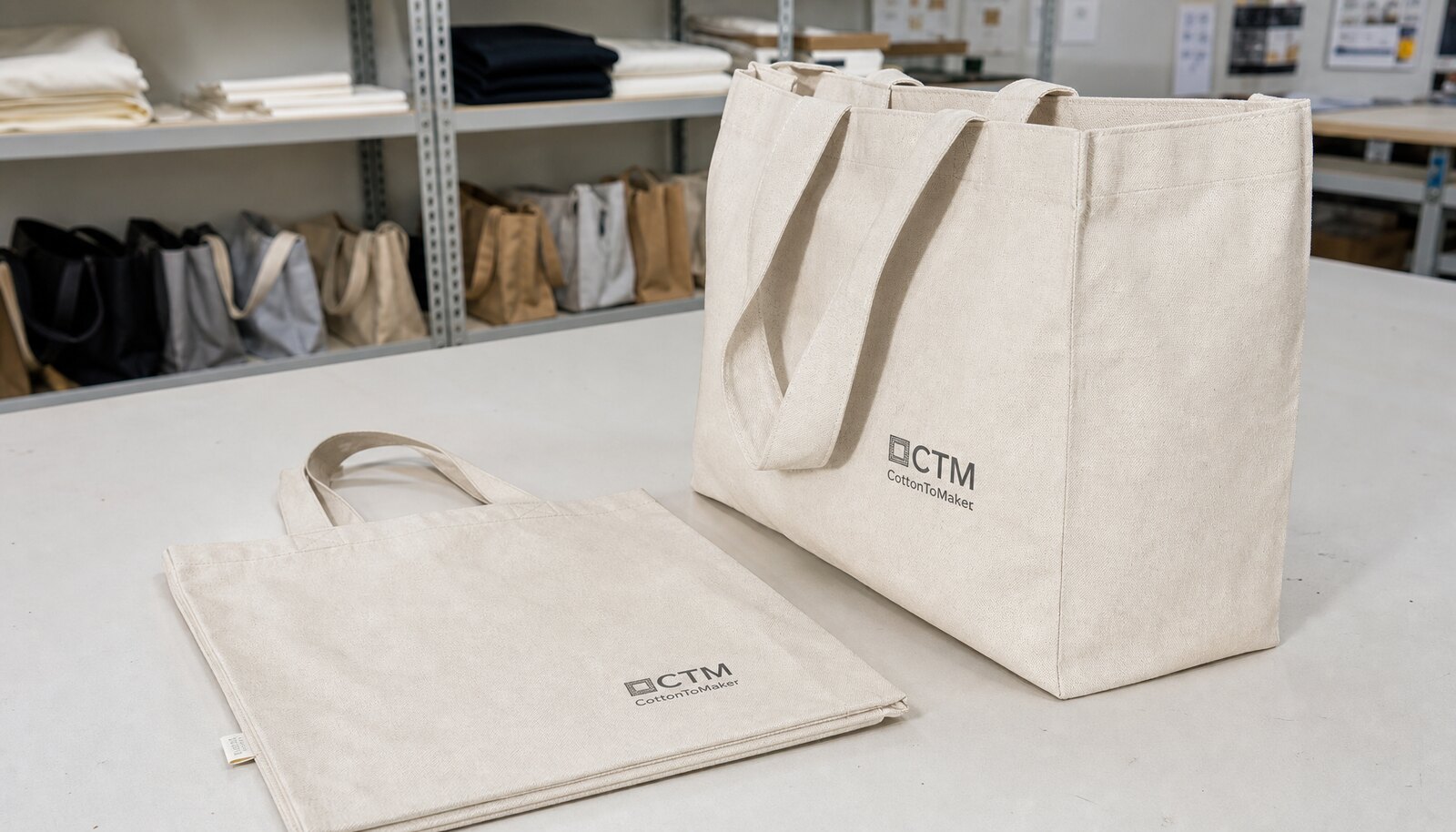
Start With the Event Use Case, Not the Bag Type
Museum giveaway planning fails when the bag is specified like a generic tote. A member night bag, an opening reception bag, and a retail cross-sell bag all behave differently. If the bag needs to carry a brochure, a notebook, a catalog, and a water bottle, the gusset, handle length, and fabric weight matter more than the logo treatment. If the bag is only meant to hold a postcard and a coupon, the same spec would waste money and freight. Before you request quotes, define the actual handoff moment: visitor checkout, ticket desk giveaway, donor gift, school group kit, or sponsor insert pack. That use case drives the structure, not the other way around.
Buyers often overfocus on print and underdefine performance. For museum events, the bag must look good at the door, survive a day of handling, and still be usable later so the brand impression lasts. A tote that collapses under moderate load or stretches out of shape after the first use gives the museum a cheap impression, even if the print quality is fine. Set the functional target first. Then work backward into canvas weight, handle construction, and finishing. That sequence keeps the RFQ practical and makes supplier quotes easier to compare.
- Define the bag's real payload in kilograms or pounds, not just the item list.
- Decide whether the bag is a disposable event handout or a reusable museum merchandise item.
- Separate visitor-giveaway requirements from retail-store requirements before you source.
Choose the Canvas Weight That Matches the Buying Goal
For most museum event giveaway programs, 8 oz to 10 oz canvas is the sensible starting range. It gives enough body to stand up in hand, takes print well, and keeps freight under control. If the bag is intended to be reused many times or sold in the shop, 12 oz to 14 oz canvas gives a better perceived value and reduces the chance of seam distortion. Lighter fabrics may reduce unit price, but they also make the bag feel like a throw-in rather than a kept item. That matters for member events and sponsorship gifts, where the bag itself reinforces the institution's positioning.
Ask the supplier to quote in grams per square meter or ounces per square yard, then make sure the same fabric basis is used across all samples and production. In this category, buyers get burned by vague language like 'heavy canvas' or 'good quality cotton.' Those phrases do not control material substitution. Specify whether you want natural unbleached canvas, bleached white, dyed stock, or a recycled blend. If color consistency matters across multiple event dates, approve a fabric lot or at least a color range before production starts. Canvas can vary more than buyers expect in shade, slub, and surface texture.
- 8 oz to 10 oz: best balance for event giveaways and moderate use.
- 12 oz to 14 oz: better for premium retail or repeat-use museum bags.
- Request the basis weight, weave density, and shrink treatment in the quote.
Decide the Print Method Before You Compare Prices
For simple museum marks, screen print is still the most useful commercial option. It is stable on canvas, cost-effective at scale, and usually the cleanest choice for one to three colors. When the artwork includes gradients, fine illustration, or a multicolor exhibition image, digital transfer or heat transfer may fit better, but the buyer should not assume it is automatically superior. Some transfers sit more like a film than a textile print, and the look can be less suitable for a heritage institution or a design-focused brand. If the logo is understated and the budget is tight, a woven side label or a single-color front print may be the smarter route.
The right question is not which method is 'best' in general, but which one fits the artwork, order quantity, and expected wear. Screen print requires clean separations and a realistic color count, but it rewards you with lower unit cost as volume rises. Heat transfer can reduce setup cost, but it can also raise rejection risk if the fabric texture is rough or the artwork needs repeated flexing. For museum giveaways, the print area should be large enough to be visible in photographs and at the event table, but not so large that it makes the bag look like a promotional banner. Keep the artwork simple and leave room for the canvas texture to do part of the work.
- Use screen print for flat logos, bold icons, and repeat programs.
- Use transfer methods only when the artwork genuinely needs more detail or color.
- Approve a strike-off on the exact canvas, not on a smoother substitute.
Compare Supplier Routes by Risk, Not Only by Unit Price
A low quote means little if the supplier route creates extra coordination work. A direct factory is usually best when the buyer has a stable spec, decent volume, and enough lead time to manage sampling. A trading company can help when the order needs mix-and-match products, but the extra layer can blur accountability on print quality or fabric substitution. A local printer using imported blanks can be fast, yet it may leave the buyer with weak visibility into sewing standards. For museum programs, the best route is the one that keeps the same person accountable for material, decoration, packing, and shipping terms.
Use the comparison below to benchmark suppliers before you commit to sample development. The goal is not to find the cheapest bid. The goal is to find the route that matches your event calendar, internal sourcing capacity, and tolerance for production risk. If the event has a fixed opening date, the supplier's control over the critical path matters more than a small savings on the tote itself.
- Direct factory: best visibility, fewer handoffs, stronger cost control.
- Trading company: useful for mixed categories but requires tighter document review.
- Local printer with blanks: speed advantage, but inspect blank quality before print approval.
Use the Quote Structure to Expose Hidden Cost Drivers
Museum buyers often compare prices without breaking out what actually moves the number. The quote should separate fabric, sewing, print setup, print run, packaging, and freight terms. Handle length, gusset depth, zipper pockets, inner labels, and custom hangtags all change labor time. The same tote can swing materially in price depending on whether the supplier packs flat, inserts tissue, or polybags each unit. Even carton size matters because a small dimensional change can shift ocean freight and warehouse receiving cost. If the supplier only sends one total price, ask for a structured breakdown so you can compare like with like.
MOQ logic is another source of confusion. A supplier may quote a low total MOQ but require a higher MOQ per color or per print version. If the museum wants one bag design for several events, that is workable. If the team wants different museum wings or exhibition names on separate runs, the per-design MOQ can make the project expensive quickly. Ask for the minimum by fabric color, artwork version, packing format, and carton allocation. That lets procurement decide whether to consolidate versions or standardize one base bag with variable inserts.
- Request separate line items for fabric, sewing, printing, packing, and freight basis.
- Check MOQ by design version, not just total units.
- Treat packaging and carton size as cost drivers, not afterthoughts.
Approve Samples Like a Production Buyer, Not a Brand Presentation
A museum tote sample is not approved because it looks nice on a desk. It is approved when it matches the production spec and survives basic handling. Start with a pre-production sample that reflects the exact canvas weight, handle material, seam structure, and print method. Then inspect the details that actually fail in production: top-stitch consistency, handle symmetry, logo placement, color density, and whether the bag sits flat when folded. If the design includes a pocket or lining, check internal stitch finish and whether the seam allowance creates bulk that affects folding or carton count.
If possible, request three checkpoints: fabric swatch approval, print strike-off approval, and sewn sample approval. That sequence catches mistakes earlier than waiting for a full sample. Acceptance should be based on measurable criteria, not vague preference. For example, allow small natural shade variation in unbleached canvas, but reject severe streaking, print bleed, or distorted handles. If the museum has a strict brand standard, compare the sample under the same lighting used in the event space or retail area. That helps avoid surprises caused by warm indoor light or stage lighting.
- Check stitch density, handle symmetry, and seam reinforcement.
- Review the sample under the lighting where the bag will be seen.
- Set objective reject reasons for print blur, shade variation, and size drift.
Set QC Thresholds That Prevent Event-Day Failures
The most expensive tote defects are the ones the event team discovers on the day of handout. Broken handle stitches, off-center prints, and smudged ink are obvious failures, but smaller issues also matter. Bags that smell strongly of finishing chemicals, pack inconsistently, or arrive with lint and loose threads create extra labor at receiving and can delay the handoff. For an event giveaway, the bag should be ready to use immediately when cartons are opened. That means the QC target should include visual appearance, measurement, odor, carton integrity, and count accuracy.
Build the inspection threshold around use, not just manufacturing standards. If the bag will be handed to donors, the finish should be cleaner than a back-of-house utility bag. If it will be sold in the gift shop, the print and sewing tolerance should be tighter still. Ask the supplier whether they inspect in-line, final-inspect, or both. A supplier with documented in-line checks is easier to manage than one that only inspects finished cartons. For larger orders, require photo evidence from production and carton staging before shipment. It is easier to stop a problem before freight leaves the factory than after it lands.
- Set measurement tolerance for body size, handle drop, and gusset depth.
- Require no major print defects, oil marks, or broken stitches.
- Ask for carton count verification and pre-shipment photos.
Plan Packing for Both Warehouse Efficiency and Event Use
Packing is often treated as a logistics detail, but it affects cost, damage rate, and receiving labor. Bulk-packed totes are cheaper and usually suitable when the museum team will distribute them directly from cartons. Individual polybags may be necessary if the bags will be sold retail or stored for a long period, but they add material cost and increase cube. Tissue insert, barcode label, and hangtag options can also change the unit economics. If the bags are for a one-day event, elaborate retail packing is usually unnecessary unless presentation is part of the donor experience.
The carton plan should reflect how the bags will be stored and moved after arrival. If the museum warehouse receives mixed SKUs, standard carton counts and clear outer labels reduce handling mistakes. If the bags are shipping to multiple sites, ask for pack-by-venue cartons or outer markings that make distribution simple. A small change in packing spec can save real labor at the receiving dock. The buyer should know the carton dimensions, gross weight, carton count, and palletization plan before approving production, because these factors drive both freight and warehouse efficiency.
- Bulk pack for direct giveaway programs when presentation is simple.
- Use individual packaging only when retail handling or protection requires it.
- Lock carton count and outer marking before production starts.
Work Backward From the Event Date to Protect Lead Time
The safest schedule starts from the event deadline and subtracts sample approval, material procurement, sewing, printing, packing, and transit. Museum teams often lose time at the sample stage because artwork is still being finalized by marketing, development, or the exhibition team. Once the design is late, the factory cannot compress all other steps indefinitely. Even when the bag is simple, canvas sourcing and print setup can add several days, especially if the supplier is waiting on fabric matching or approval signatures. Build a buffer into the schedule and make it visible to every stakeholder who can delay sign-off.
For a standard canvas tote, a realistic production window after final approval is often two to five weeks depending on order size, decoration complexity, and factory load, with freight added separately. That is not a promise; it is the range buyers should use when planning. If the event date is fixed, the buyer should ask the supplier to identify the critical path items: fabric arrival, print plate or screen preparation, sewing line capacity, and carton completion. Any one of those can become the bottleneck. Once you know the bottleneck, you can decide whether to simplify artwork, switch packing, or consolidate colors to protect delivery.
- Work backward from event handout date, not purchase order date.
- Treat artwork approval as a schedule gate, not a loose milestone.
- Ask the supplier which step is most likely to delay shipment.
Use a Simple Landed-Cost Comparison Before You Release the PO
The tote's factory price is only one part of the buying decision. A museum event program should compare landed cost, not just ex-works price, because freight, packing, customs handling, and storage can move the real number significantly. A heavier canvas tote with a lower defect rate may cost more at source but less in rework and replacement. A cheaper quote with oversized cartons can lose its edge once shipping is added. Procurement should compare the cost per usable bag at the venue, not just the cost per sewn unit.
A practical landed-cost review should include four lines: unit price, packaging cost, freight basis, and expected loss or rework rate. That last item is often ignored, but it matters when the event team has zero flexibility. If the supplier sends 3 percent of bags with cosmetic defects, the true cost is higher than the invoice shows. For a museum giveaway, the bag is part of the visitor experience, so the acceptable defect rate should be very low. Keep the math simple enough that non-sourcing stakeholders can understand it, then use that model to defend the spec choice internally.
- Compare cost per usable bag, not just invoice price.
- Include freight cube and carton count in the estimate.
- Reserve a small allowance for replacement or inspection fallout.
Specification comparison for buyers
| Spec decision | Recommended option | When it fits | Buyer risk to check |
|---|---|---|---|
| Direct factory order | Best for 5,000+ units with artwork locked | Museum programs with repeated events, multiple venues, or a long sales calendar | Lead time can stretch if artwork is revised after sampling or if trim stock is not reserved |
| Trading company or sourcing agent | Useful when the buyer needs mixed factory capabilities or low internal sourcing bandwidth | Teams handling several SKUs, mixed materials, or multi-country consolidation | Margin layers can hide true factory cost and make quote comparison harder |
| Local printer with imported blanks | Works for fast-turn events and smaller runs | Short event windows, one-off openings, or last-minute donor nights | Blank quality and seam strength may be unverified; ask for fabric weight and stitch spec, not only decoration price |
| Factory with in-house printing | Preferred for repeat orders and stable logo placement | Brand teams that need consistent color, placement, and production control | Check whether print and sewing are on the same site or transferred between plants |
| Heavy canvas 12 oz to 14 oz | Choose for premium retail feel and reusable museum merch | Gift shop tie-ins, member campaigns, and higher perceived value items | Higher fabric cost, more sewing load, and bulkier packing can affect freight |
| Midweight canvas 8 oz to 10 oz | Best balance for event giveaway bags | Visitor giveaways where bag cost must stay controlled but the bag must still feel substantial | Thin walls can show dark logos through the front or distort under load |
| Cotton twill or light canvas substitute | Only when the budget is tight and load requirements are light | Very large conference-style giveaways with short use cycles | It may not hold catalog brochures, water bottles, or museum-shop purchases without sagging |
| Screen print | Best for simple logos, one to three colors, and large volume | High-repeat museum identity marks and clean event branding | Need clear artwork, Pantone targets, and print adhesion testing on washed or abraded fabric |
| Digital transfer or heat transfer | Useful for gradients, complex illustration, or low minimums | Short runs, seasonal artwork, or multicolor exhibition graphics | Heat sensitivity, cracking over time, and a less textile-like finish than direct print |
Buyer checklist before sampling
- Confirm the event use case: brochure carry, retail purchase bag, donor gift, or member giveaway.
- Set the canvas weight target in GSM or oz and define whether you want unbleached, bleached, or dyed fabric.
- Lock finished size, handle drop, bottom gusset depth, and maximum load expectation.
- Approve the print method before quoting, including number of colors, print size, and front/back placement.
- Request fabric swatch, sewn sample, and print strike-off if the artwork is sensitive to color or registration.
- State the packing standard: bulk packed, folded with inserts, barcoded, or individually bagged.
- Ask for MOQ by color, print version, and carton configuration, not just total order quantity.
- Define inspection criteria for stitches, print opacity, odor, stains, and measurement tolerance.
- Confirm freight mode and carton count so landed cost is not distorted by oversized packaging.
Factory quote questions to send
- What canvas weight, yarn count, and weave density are you quoting, and is the fabric pre-shrunk?
- Is the bag sewn and printed in the same facility, or will it move between factories?
- What is the MOQ by design, color, and print method, and what happens if I split the order by venue?
- Can you quote the same bag with screen print, heat transfer, and woven label so I can compare landed cost?
- What are the sample charges, sample lead time, and whether the sample fee is refundable after order placement?
- What seam construction do you use on the handle attachment and side gusset, and how many stitches per inch?
- How do you pack each carton, what is the carton size and gross weight, and can you optimize for sea freight?
- What is the standard production lead time after approval, and where are the bottlenecks if the artwork is late?
- What inspection report, photos, or inline QC records can you provide before shipment?
Quality-control points to confirm
- Canvas weight matches the approved spec within an agreed tolerance, and the hand-feel is consistent across the lot.
- Panel dimensions, gusset depth, and handle drop stay within a practical tolerance after sewing and pressing.
- Handle stitching is reinforced at the stress points and does not skew after a weighted pull test.
- Print color matches the approved strike-off closely enough for event use, with no major off-register or pinholing.
- Logo placement is centered and consistent from bag to bag, especially on front panels with pockets or seams.
- No visible stains, oil marks, needle damage, broken threads, or loose lint remain in the packed goods.
- Cartons are strong enough for stacking and freight handling, and bag counts per carton are correct.
- The odor level is acceptable on unpacking, especially if the bags will be handed out immediately at the venue.