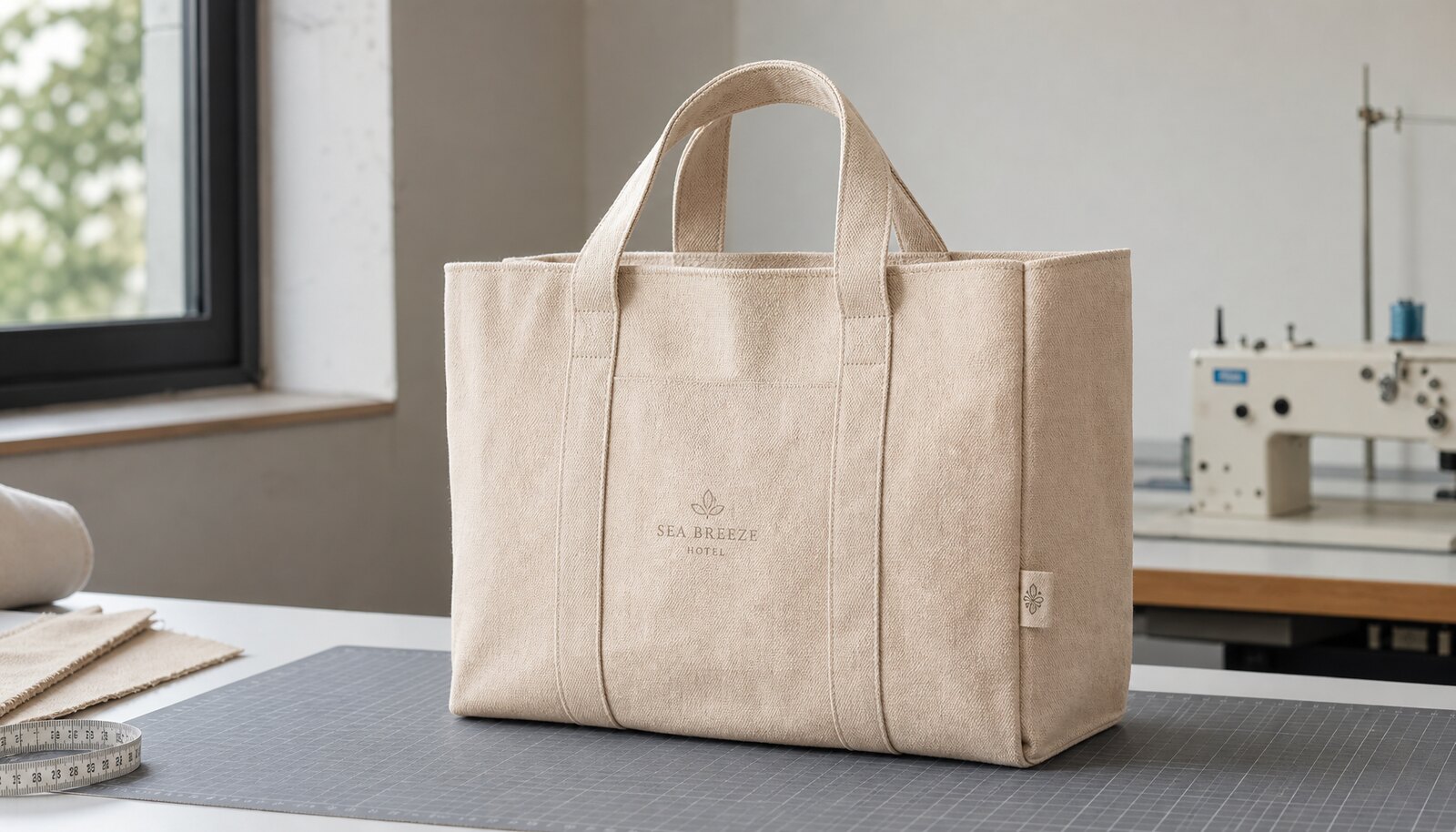
Why hotel retail totes need a different spec
A hotel retail tote is not a generic giveaway bag. It has to sell as part of a merchandised assortment, sit neatly on a shelf, and survive enough guest use that the brand still looks credible after the first carry. That changes the buying logic. Procurement should treat the tote as a retail item first and a branded item second. If the base bag feels thin, poorly stitched, or inconsistent in a stack, no logo treatment will rescue it next to robes, books, or local gifts in the store.
For custom canvas tote bags for hotels, the first decision is usually not the artwork. It is the construction standard. The bag needs enough body to stand up, enough seam strength to support a real load, and enough finishing consistency that the launch inventory looks intentional, not promotional. A slightly better base bag is often cheaper than a premium decoration method applied to a weak structure, because the weak structure creates returns, complaints, and a poor shelf impression. The right spec is the one that matches the way the tote will actually be sold and carried, not the one that looks best in a mockup.
- Treat the tote as shelf inventory, not event swag.
- Define the use case before the artwork: shopping, beach carry, amenity bundle, or gift packaging.
- Choose a spec that looks consistent in a stack and under store lighting, not only in a sample photo.
Start from the retail tier and the guest use case
The right tote depends on where it sits in the hotel's retail mix. A boutique property selling smaller lifestyle gifts can usually stay in a lighter, simpler spec. A resort shop with bottled items, beach goods, and bundled purchases needs more structure. A city hotel gift store often sits in the middle, where the bag must look polished enough for front-of-house retail but still be affordable enough for travelers who are already spending on luggage, transport, and room charges.
A useful procurement shortcut is to map the tote to a shelf-price band before sourcing. As a working model, low-ticket programs usually cannot absorb heavy embroidery or very dense fabric, mid-tier programs often work well with 10 oz to 12 oz canvas and one- or two-color print, and premium programs can justify heavier cloth, cleaner edge finishing, and more careful packing. The point is not to force every hotel into the same spec. The point is to make sure the product, the retail price, and the guest use case all point in the same direction.
- Boutique or lifestyle hotel: lighter spec, simpler artwork, smaller opening quantities.
- Beach or resort hotel: gusseted body, stronger handles, and better load handling.
- Urban or business hotel gift shop: clean branding, moderate weight, and a price point that supports repeat sales.
Fabric, size, and structure choices that affect resale
Canvas weight is the easiest spec to compare, but it is not the only one that matters. Two bags with the same nominal weight can still feel different if one uses a tighter weave, a cleaner finish, or a more consistent yarn structure. For most hotel retail launches, 10 oz to 12 oz is the practical core range. It gives enough body for shelf presence, print clarity, and daily use without making the bag so heavy that freight and sewing costs rise faster than the retail value justifies.
Size should follow the product plan, not the other way around. A flat tote works for brochures, books, and light accessories. A gusseted tote is better if the hotel shop sells boxed amenities, bottles, or mixed purchases. Handle design matters just as much. Ask the supplier to confirm handle width, total loop length, finished drop, and stitch reinforcement in the quote. If those details are left vague, buyers often discover too late that the bag is uncomfortable to carry or too weak at the point where the handle meets the body. One more practical point: if the bag uses unbleached natural canvas, decide whether your size tolerance applies before or after any expected shrinkage, because that affects both approval and receiving.
- Use 10 oz to 12 oz canvas as the default launch band unless the retail tier clearly supports more.
- Use a gusset when the tote must carry rectangular items, bottles, or bundled merchandise.
- Lock finished dimensions, not cut dimensions, because seam allowance and shrinkage change usable volume.
- Ask for handle width and handle drop in the spec sheet, not only in the sample photo.
Decoration rules that prevent rework
Canvas is forgiving for bold graphics and less forgiving for fine detail. Screen printing is usually the cleanest option for one or two solid colors because it gives predictable coverage, repeatable setup, and manageable cost. Embroidery can look more premium, but it adds stitch density, fabric distortion risk, and a higher unit cost. Transfer methods can help with artwork that is too detailed for screen printing, but the buyer should test the final appearance on actual canvas because weave texture changes the way edges and small text read.
The artwork file should be prepared for the bag, not adapted from a web asset at the last minute. Thin strokes, tiny type, and gradients are where tote programs often fail. A practical rule is to avoid relying on delicate details under about 1.5 mm on textured canvas unless the supplier can prove the result on the approved fabric. Ask for a strike-off or print proof on the actual cloth, not just on paper. Then check it in the same light the tote will see on the shelf. If the hotel wants a woven side label or a small sewn badge, that can sometimes carry brand identity more reliably than a crowded front print.
- Use screen print for bold logos and predictable repeatability.
- Use embroidery only when the retail price can absorb the extra cost and the fabric can support the stitch density.
- Avoid fine text, thin lines, and gradients unless the supplier proves them on the real canvas.
- Approve decoration under daylight and store lighting, not only on a monitor or paper proof.
How to qualify suppliers without relying on paperwork alone
Sourcing guidance gets weak when it stops at document requests. The buyer needs evidence of actual capability. Ask the supplier to identify the production site, not just the sales office, and request recent proof that the same kind of work is happening there: current line photos or a live video walk-through, comparable tote samples, a process flow, and recent inspection records if they are available. If the supplier claims certifications, ask for the certificate number, issue date, expiry date, and the legal entity name, then verify that the documents match the quote.
A trading layer is not automatically a problem. It becomes one when responsibility is blurred. If the supplier cannot name the factory, will not show the inspection point, or cannot explain who owns correction if the bulk batch differs from the sample, you do not have enough control for a retail launch. In contrast, a reliable factory or transparent trading partner should be able to explain the fabric source, the sewing flow, the print process, the packing sequence, and the inspection checkpoint without changing the story from message to message. If you can, ask for a short pilot run of 20 to 50 pieces before committing to the full buy; that exposes problems in stitch balance, packing, and color control faster than another round of slides.
- Ask for the actual factory name and production site address.
- Request a live line walk-through or current production photos that match the quoted spec.
- Check whether sample photos, bulk photos, and quote details all describe the same stitch pattern and packing standard.
- Treat vague answers about correction ownership, fabric source, or inspection timing as a risk signal.
Region-specific sourcing tradeoffs buyers should actually compare
If your supplier base spans China, India, Vietnam, or nearshore options, compare them on operational variables rather than slogans. East Asian suppliers often have strong process discipline, fast sampling, and good control over print and packing consistency, but the total landed cost can be higher on some lanes. South Asian suppliers can be attractive when cotton sourcing and fabric economics matter, but buyers should pay closer attention to shrinkage control, shade variation, and finish consistency. Southeast Asian options can be a solid middle ground when you need a balance of manufacturing maturity, transit time, and commercial flexibility. Nearshore production can reduce communication friction and inventory risk, but the piece price is often higher.
The useful question is not which region is best. It is which region fits the launch risk. If the hotel opening date is fixed and the assortment is small, shorter transit and faster sample loops may be worth more than a lower ex-factory price. If the launch is a longer seasonal program with a stable forecast, a longer lane can make sense if the supplier proves carton control, sample fidelity, and correction speed. Use the same scorecard for every region: fabric consistency, line visibility, artwork control, pack accuracy, and how quickly the supplier fixes a miss when the first sample is wrong.
- Compare sample speed, fabric consistency, carton control, and transit time before comparing unit price.
- Use shorter lanes when the opening date is fixed and the assortment is small.
- Use longer lanes only when the supplier can prove repeatability and you have schedule buffer.
How to structure the RFQ so quotes are comparable
MOQ is a cost structure, not a negotiation style. Screen setup, cutting efficiency, stitching time, and packing labor all sit under fixed cost that has to be recovered somewhere. If you reduce quantity, the unit price usually rises because the fixed cost is spread across fewer pieces. The right move is to define the launch quantity, the reorder scenario, and the acceptable simplifications separately. One logo position and one colorway are usually much easier to launch than multiple versions of the same tote across several hotel outlets.
The RFQ should force line-item visibility for the pieces that move cost: fabric, labor, decoration, packing, sample work, labels, carton marks, and any special finishing. Ask for a price ladder at 300, 500, and 1,000 pcs, and ask which charges change at each break point. That makes hidden setup costs visible and gives procurement a way to compare one supplier's low headline price against another supplier's more complete quote. If the supplier will not state what is included, treat the quote as incomplete and calculate a landed-cost estimate yourself before you compare it to the retail margin target.
- Compare only like-for-like specs: same weight, same handle construction, same print method, same packing format.
- Ask for prices at 300, 500, and 1,000 pcs so setup costs and quantity break points are visible.
- Separate the bag price from sample cost, freight assumptions, and packing upgrades.
- Reject quotes that do not state whether the sample is production-accurate or hand-finished.
Sampling and approval should be a controlled process
Sampling needs its own schedule and approval logic. A useful buying guide should tell the supplier how many days are allowed for a strike-off, how many for the pre-production sample, and how revision requests are handled if the first sample misses the target. The sample should match the actual fabric, actual decoration method, actual thread, and actual packing. If the supplier substitutes materials for the sample, the approval is not trustworthy. For a hotel retail launch, the signed sample should be treated as the reference standard for bulk production, not as a loose example.
It helps to split approval into two steps. First, approve the visual and structural spec: size, logo placement, handle drop, color, and pack format. Second, approve the production sample: the exact unit that will be used as the bulk reference. Keep the signed sample, the strike-off, the carton mock-up, and the final artwork in one approval pack so the operations team can compare bulk output against one clean reference set. If any material, print process, or pack method changes after approval, require a new sample rather than assuming the old approval still applies.
- Name the sample SLA in days for strike-off, PP sample, and revision sample.
- Require a production-accurate sample, not a nicer hand-finished version.
- Keep the approved sample set with the PO so there is no dispute about the reference standard.
- Reject sample approval if dimensions, logo placement, or handle drop differ from the spec sheet.
QC standards, inspection points, and the tests that matter
QC coverage needs to go beyond a defect list. A procurement-ready tote spec should define what counts as a critical defect, a major defect, and a minor defect, then tie those categories to an inspection level. For most retail programs, critical defects should be zero tolerance, and AQL 2.5 for major defects and AQL 4.0 for minor defects is a sensible starting point. Tighten those thresholds if the tote is premium, white, very light in color, or being sold as a signature item rather than a utility bag. Do not apply one tolerance set blindly to every launch.
The tests should be simple enough to repeat and specific enough to be meaningful. Dimensions should be checked against the approved sample, not just the target size. Handles should be checked for attachment integrity and carry comfort. Decoration should be inspected in normal light, not only under ideal studio conditions. For print durability, a basic dry-rub and damp-rub check catches a surprising amount of weak ink or poor curing. If the tote is intended for heavier use, add a load test that matches the real use case and keep the target written into the purchase order. The goal is not to over-engineer the bag. The goal is to catch the failures that damage the retail program: crooked print, weak handles, dimensional drift, and poor packing.
- Use zero tolerance for critical defects such as holes, contamination, and mixed SKUs.
- Check dimensions against the approved sample and the tolerance sheet, not just the nominal size.
- Use a simple load test, seam check, and rub test on pre-production and random bulk samples.
- Inspect carton marks, barcodes, and unit counts before shipment, not after arrival.
- Reject any batch where the bulk finish clearly diverges from the approved sample.
Packing, logistics, and landed cost
Packing is where many tote orders lose time and money. If the bags are loosely packed, they arrive dusty or scuffed. If the count per carton is not clearly defined, the receiving team wastes time recounting. If the carton is too heavy, freight cost goes up and warehouse handling gets harder. For hotel retail, the pack plan should be explicit: folded or flat, tissue or insert board, polybagged or not, barcode or hangtag requirements, master carton count, carton dimensions, and carton marks. Those are not minor details. They affect receiving speed, shelf readiness, and shrink risk.
Landed cost should be calculated as a full program cost, not as ex-factory price alone. A simple framework is ex-factory unit price plus sample amortization plus packing upgrades plus freight plus duties or brokerage plus local delivery. If a tote is quoted at $2.30 ex-factory, packing adds $0.12, freight allocation adds $0.55, and clearance or delivery adds $0.18, the landed cost is about $3.15 before internal handling. That is the number procurement should compare against the target retail price band and expected margin, not the base factory quote. For a launch tied to a hotel opening or seasonal refresh, a low quote that misses the delivery window is not low-cost at all. Longer transit lanes also need stronger carton spec and moisture control, especially if the bags will sit in storage before merchandising.
- Write the packing standard into the RFQ and into the PO.
- Set a reasonable carton count so the boxes are manageable for receiving teams.
- Use the same label logic the hotel store or warehouse system will actually scan.
- Compare landed cost, not just ex-factory price.
Specification comparison for buyers
| Spec decision | Recommended option | When it fits | Buyer risk to check |
|---|---|---|---|
| Fabric weight | 10 oz to 12 oz canvas for most hotel retail launches | When the tote needs shelf presence and a solid hand feel without becoming overly heavy | Below 8 oz usually reads as promo; above 14 oz can add freight and sewing cost without improving sell-through |
| Bag structure | Gusseted body with reinforced base and side seams | When the bag must carry bottles, boxed amenities, books, or mixed guest purchases | Flat bags look cleaner and cost less, but they lose usable volume and can stress the side seams when overfilled |
| Handle build | Cotton webbing or self-fabric handles with reinforced attachment | When guests may carry the tote through a resort, airport, or day trip | Short or thin handles feel awkward and can twist or cut into the shoulder under load |
| Decoration method | One-color or two-color screen print for launch | When artwork is bold and brand readability matters more than special effects | Fine text, thin lines, and gradients often print poorly on textured canvas |
| MOQ strategy | Price at 300, 500, and 1,000 pcs per style | When you need to see both launch economics and reorder economics | Very low MOQ can hide setup fees, fabric substitutions, or higher packing charges |
| Sample path | One production-accurate pre-production sample plus bulk carton photos | When brand standards are strict or the opening date is fixed | A hand-finished sample or substitute fabric does not prove the bulk process |
| Packing format | Folded with tissue or insert board, then polybagged if retail presentation requires it | When the hotel store needs shelf-ready inventory | Loose packing creates dust, scuffing, and count errors during inbound QC |
| Supplier route | Direct factory or transparent trading partner with named production site | When repeat orders, traceability, or spec control matter | If the actual factory and inspection point are unclear, correction responsibility becomes hard to enforce |
| Lead time plan | Quote sample lead time, bulk lead time, and shipping days separately | When the product is tied to an opening, campaign, or seasonal refresh | A single total lead time often hides risk in artwork approvals and packing changes |
Buyer checklist before sampling
- Lock the finished size, gusset depth, handle drop, and target load before asking for price.
- Specify fabric weight, weave density, shade tolerance, and any pre-shrink allowance in writing.
- Send vector artwork, logo placement, size, and Pantone or equivalent color references with the RFQ.
- Request a sample SLA that names strike-off timing, pre-production sample timing, and revision turnaround.
- Ask for quoted prices at 300, 500, and 1,000 pcs so launch economics and reorder economics are visible.
- Confirm carton count, carton dimensions, gross weight target, barcode or hangtag needs, and shipping marks before production.
- Set an inspection standard with AQL targets, major and minor defect definitions, and test methods.
- Confirm the incoterm, delivery date, and the action plan if artwork approval slips or sample revision is required.
Factory quote questions to send
- What exact canvas construction are you quoting, including GSM or ounce weight, weave density, and any pre-shrink allowance?
- Is this quote from the production factory or from a trading layer, and can you identify the actual production site?
- Can you show recent QC evidence such as inline checks, final inspection reports, or third-party audit summaries for similar tote programs?
- What is the unit price at 300, 500, and 1,000 pcs, and which setup charges, color charges, or packing charges change at each break point?
- How long do you need for strike-off, pre-production sample, revision sample, and bulk production after approval?
- What inspection standard do you use, and can the buyer appoint a third-party inspector before shipment?
- What is the packing specification, including fold method, polybag thickness, carton count, carton dimensions, and gross weight target?
- What is your correction policy if the bulk shipment does not match the approved sample on fabric, print, size, or packing?
Quality-control points to confirm
- Treat holes, contamination, wrong SKU, wrong logo, and broken handle seams as critical defects with zero tolerance.
- Use AQL 2.5 for major defects and AQL 4.0 for minor defects as a starting point for a standard retail launch; tighten to 1.5 on premium or light-color programs if the brand risk justifies it.
- Check finished dimensions after final pressing and folding, not cut size; as a practical default, allow plus or minus 1 cm for bags under 40 cm on the long side and plus or minus 1.5 cm above that, with handle drop within plus or minus 1 cm.
- Require even stitching, no skipped stitches on visible seams, no open gaps at the handle join, and no loose thread tails longer than 1 cm.
- Use a load test that matches the intended use, not a universal weight; 5 kg is a reasonable starting point for general retail totes, while resort or beach programs may need a higher verified load if the structure supports it.
- For screen print, check registration, coverage, and cure with a simple rub test such as 20 dry rubs and 10 damp rubs with a white cloth, then define the acceptable transfer limit in the PO.
- For natural canvas, define the acceptable shade range before bulk starts, because unbleached fabric can vary more than buyers expect from roll to roll.
- Inspect packing against the retail plan: correct fold, correct tissue or insert board, correct polybag or no-bag decision, correct barcode or label, exact carton count, and clean carton marks.
- Reject cartons with stains, oil marks, broken stitches, needle holes, damaged corners, mixed SKUs, or unclear receiving labels before shipment.
- Keep the approved sample, strike-off, carton mock-up, and inspection report together as the reference set for bulk acceptance.