Why Hotel Reorders Fail After the First Approval
Hotel tote bag reorders fail for a simple reason: the first order was approved as a sample, but the repeat order is treated as if the sample will police itself. In practice, hotels use these bags in different ways. A lobby gift shop needs a more presentable bag than housekeeping does. A conference property may want a sturdy carry bag for brochures and amenities, while a resort may need a retail-ready bag that can sit on a shelf and still look clean after a guest uses it once.
A reorder planning memo solves that problem by turning the first approved bag into a controlled spec, not a memory. The memo should say which details are fixed and which are flexible. If the canvas weight, print placement, handle construction, and packing method are not locked, the supplier can legally quote a different bag that still sounds close enough on paper. For hotel buyers, that is how a repeat order becomes a new quality issue.
- Freeze the items that affect feel, function, and guest presentation.
- Leave only low-risk items flexible, such as carton artwork or internal shipping marks.
Lock the Canvas Spec Before You Chase Price
For custom canvas tote bags for hotels, the fabric choice drives most of the real-world quality difference. A light 8 oz or roughly 280 gsm canvas can work for simple welcome bags or short-use event bags, but it often feels too soft for retail or repeated guest use. A 10 oz to 12 oz canvas, roughly 340 to 400 gsm, is usually the safer band when the bag has to look substantial and survive more than one stay. The important point is not the number alone. It is whether the factory can hold the same weave density, shade, and stiffness across reorders.
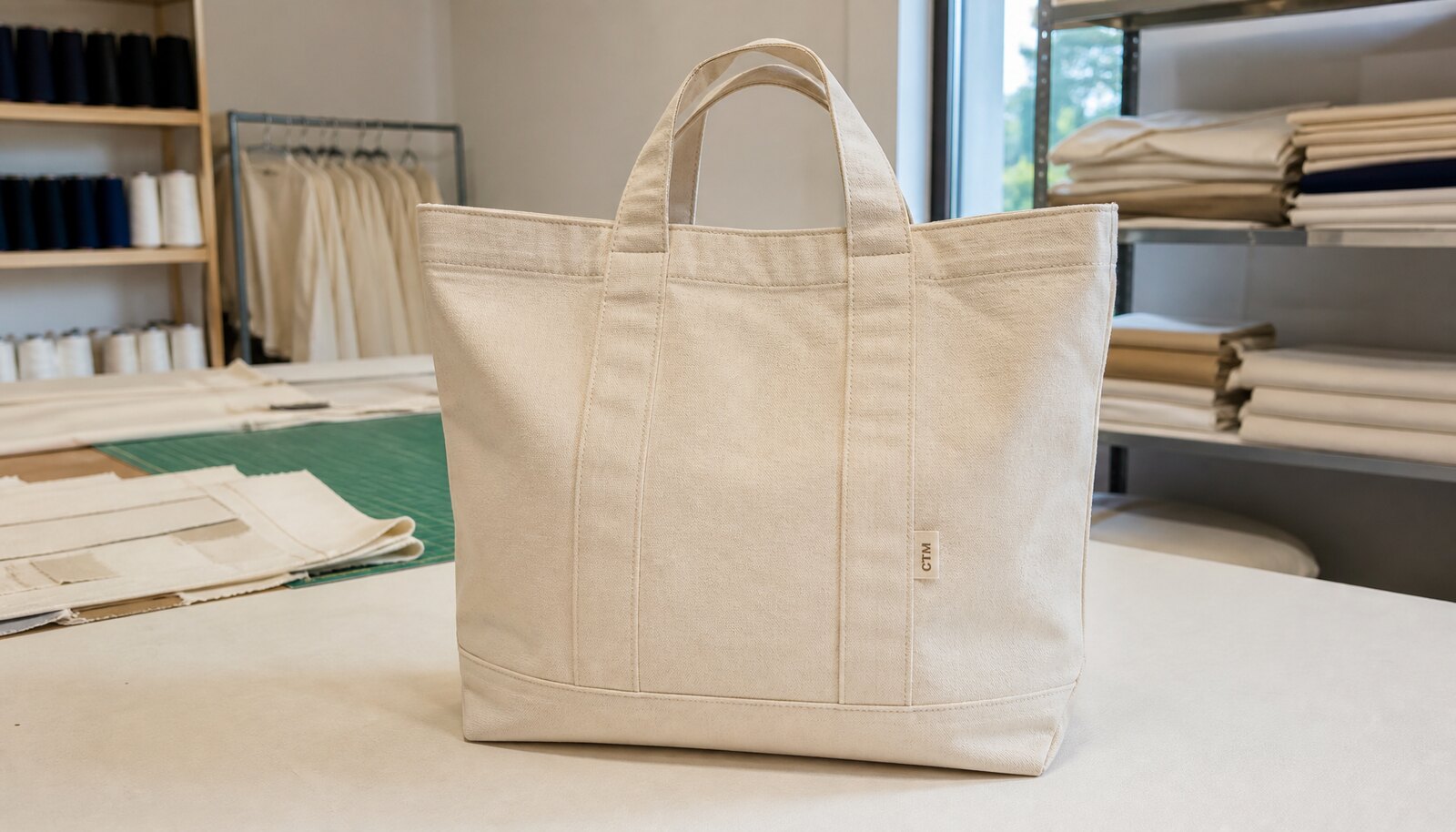
Construction matters just as much as fabric. Hotels usually want a bag that keeps its shape on a counter, carries flat items without twisting, and does not rip at the handle after a few heavier fills. Self-fabric handles with bartacks at the stress points are the common baseline. If the bag needs a cleaner retail look, a woven side label or a small stitched patch can be better than a large print, especially when the logo is simple. Screen print works well for one- and two-color artwork, but it should be matched to the canvas surface and ink coverage expected on the sealed sample.
- 8 oz / 280 gsm: lighter programs, event handouts, lower carry weight.
- 10 oz / 340 gsm: most hotel welcome bags and gift shop carry bags.
- 12 oz / 400 gsm: stronger retail feel, heavier contents, or repeated guest use.
- Bar-tack every handle end and confirm seam allowance before approving mass production.
Compare Sourcing Routes Before You Price the Reorder
The cheapest quote is not always the cheapest sourcing route. A direct factory quote usually gives better control over fabric lot, print setup, and packing details, which matters when the same hotel program will reorder again next quarter or next season. Trading companies can be useful when the buyer needs faster coordination or a mixed bag program, but the price may hide less visible control points, such as material swaps, subcontracted print work, or weak carton supervision. Local stock can solve an emergency gap, but it rarely supports a controlled brand program if the logo, shade, or bag structure must stay stable.
For hotel buyers, the right route depends on the reorder cadence. If the property opens once and then reorders from actual consumption, a direct factory relationship gives the strongest control. If the buyer needs a short-term bridge while the long-term program is being developed, a hybrid route can work: one factory for the base bag, another source for a temporary fill-in lot. The comparison table in this memo is meant to expose those tradeoffs early, before a quote is mistaken for a controlled supply plan.
- Use direct factory sourcing when consistency matters more than speed.
- Use local stock only for bridge supply or urgent replenishment.
- Use a trading route only if the quote clearly states who controls fabric, print, and packing.
Build MOQ Around Fabric Rolls, Print Setup, and Carton Logic
MOQ for canvas totes is rarely an arbitrary number. It usually comes from how the factory purchases fabric, how many screens or plates the artwork needs, and how efficiently the bags fit into cartons. If one logo color needs one screen and the next reorder keeps the same artwork, the second order should not carry the same setup penalty as the first. If the bag size uses a full fabric roll width efficiently, the MOQ can often be lower than a size that wastes material. Buyers who understand this logic can challenge a quote that looks inflated without guessing at the factory's cost structure.
The reorder plan should also reflect usage, not just launch enthusiasm. A hotel program that consumes 300 bags per month does not need a six-month replenishment sitting in the warehouse unless freight is unstable. A smarter plan is to cover the next buying cycle plus a safety buffer for damage, giveaway volume, and seasonal spikes. That buffer is usually small, but it should be deliberate. The risk is not only stockout. It is also overbuying a bag that may later need a logo update, a property name change, or a revised packing format.
- Set reorder quantity from actual monthly usage, then add a controlled buffer for extras and loss.
- Tie MOQ to print setup and fabric efficiency, not to a generic factory minimum alone.
- If the artwork changes, treat it as a new SKU and expect a different MOQ.
Use Sample Approval to Freeze the Repeat Order
A hotel tote bag should move through at least two control stages before mass production: a sample that proves the concept, and a pre-production sample that matches the final order conditions. The first sample can be rough if it helps the buyer settle the bag size, handle drop, and logo position. The pre-production sample is the one that should be treated as the control reference. It should use the final fabric, final print method, final trim, and final packing style. If the factory changes any of those items after approval, the buyer is no longer buying the same bag.
The approval record should be objective. Measure the body size, handle length, gusset depth, and placement of the logo. Photograph the front, back, seam inside, and carton pack. Then write down what is acceptable and what is not. For example, a logo can be slightly smaller if the position stays consistent and the print remains sharp, but a different ink color, a looser weave, or a visibly thinner handle should fail the approval. That standard matters more on a reorder than on a first order because the buyer already has a reference in hand.
- Measure actual bag dimensions against the approved sample, not against the artwork file alone.
- Check logo placement from the same points each time so repeat orders stay comparable.
- Keep the signed sample, dated photos, and the final PO together as one control set.
Set QC Thresholds That Match Hotel Use
Hotel use is harsher than a showroom display but lighter than industrial carry use, so the QC standard should reflect that middle ground. The goal is not to build an overengineered tote. It is to make sure the bag survives repeated handling, looks clean in guest-facing areas, and does not create complaints when the property starts using it in volume. A good QC plan will test seam strength, print rub resistance, stitch quality, and packing accuracy before the goods leave the factory. A weak QC plan only counts bags and hopes the rest matches the sample.
A useful acceptance standard is practical and visible. The seams should be neat, the bartacks should be dense enough to hold the handle load, and the print should not crack or smear when folded and handled. If the hotel uses the tote for light retail, the bag should also keep a presentable shape after being filled and set upright. For larger orders, consider an inspection standard that separates critical defects from minor ones. A missing handle or wrong logo color is a critical failure. A loose thread that can be trimmed is not the same problem.
- Test seams and handles under the expected carry load plus a reasonable margin.
- Reject obvious print misregistration, weak coverage, or wrong ink color.
- Separate critical defects from minor cosmetic issues so the factory knows what must be fixed before shipment.
Choose Packing That Fits the Property Workflow
Packing is often treated as an afterthought, but for hotel buyers it changes how the product is received, stored, and issued. A back-of-house operation usually wants flat-packed bags in clean cartons with clear counts so the team can move them quickly to departments or guest touchpoints. A gift shop program may need individual polybags, barcodes, or hangtags because the bag has to be displayed or scanned like retail stock. The wrong packing method can create extra handling work even when the bag itself is correct.
The quote should spell out the exact pack method, carton dimensions, outer marks, and any inner pack structure. If the buyer needs 25 pieces per inner polybag and 100 pieces per carton, the factory should say that before production starts. If the hotel chain uses property codes, the carton label should include them. This seems minor, but packing mistakes are expensive because they are hard to fix after export. The right packing standard also helps with reorder planning because the warehouse can forecast storage space instead of discovering it at receiving time.
- Specify flat pack, retail pack, or mixed pack by department or property.
- Confirm carton counts and carton dimensions before booking freight.
- Add barcode, property code, or SKU label requirements directly to the PO.
Schedule Lead Time Around Occupancy Peaks and Freight Risk
Lead time on a hotel bag reorder is not just the sewing time. It includes fabric booking, sample approval, screen setup, cutting, sewing, finishing, packing, inspection, and freight. If the order must arrive before a holiday season, opening date, or group event, the buyer should work backward from the in-room or launch date rather than from the deposit date. This matters because canvas is not a commodity that can always be pulled from stock in the exact weight and shade you want. If the factory has to source fresh cloth or rematch a print color, the schedule can move quickly.
The most common scheduling mistake is assuming a repeat order is automatically fast. A reorder can be faster than the first order, but only if the earlier spec was truly frozen and the factory still has the same material path available. If the artwork changed, the packing changed, or the factory moved the production window, the reorder behaves like a new project. Build enough buffer to absorb a sample correction, a fabric delay, or a freight booking issue. For seasonal hotel programs, a small delay can become a stockout at exactly the time the property needs the bags most.
- Count backward from the required delivery date, not from the order date.
- Reserve time for sample sign-off and freight booking, especially before peak season.
- Treat artwork changes as schedule changes, not minor admin edits.
Compare Quote Data on a Landed-Cost Basis
A unit price only tells part of the story. For custom canvas tote bags for hotels, the real buying decision is the landed cost: fabric, print, trim, packing, inner cartons, outer cartons, sample fees, inland freight, export documents, and the shipping mode. A quote can look attractive if it excludes one or two of those items. That is why buyers should standardize the quote request before comparing suppliers. The factory that lists every charge may appear more expensive at first glance, but it can be cheaper once the hidden items are added back in.
The best comparison uses identical assumptions across suppliers. Same fabric weight, same print method, same dimensions, same packing, same inspection point, and same delivery term. If one supplier quotes bulk pack and another quotes retail pack, the numbers are not comparable. If one supplier prices from a sample photo and another prices from a sealed sample, the risk is not comparable either. The buyer should force a like-for-like comparison first, then judge which route gives the best control over repeatability, not just the lowest line item.
- Request one quote format for all suppliers so hidden costs are visible.
- Compare the same packing method and delivery term across every offer.
- Include sample fees, carton work, and freight assumptions in the total cost view.
Turn the Memo Into a Reorder Rule Book
The most useful reorder memo is short enough to be used and detailed enough to prevent drift. It should name the approved sample, list the frozen dimensions, define the print method, state the MOQ logic, and show the packing and inspection requirements. It should also say who can approve a deviation. Without that rule, every reorder becomes a negotiation, and every negotiation creates room for a different bag to sneak in under the same PO number.
For hotels and multi-property buyers, the memo should live with the spec file, not in a one-off email chain. When the property manager, procurement lead, or distributor asks for a reorder, the buyer should be able to point to a single reference document and say what is allowed. If the tote needs a new logo version, a heavier canvas, or a different pack format, the memo should force a new sign-off. That is how you protect repeat quality without making the process slow.
- Name the control sample and store the matching photos with the memo.
- State who can approve a deviation and what requires a new SKU.
- Review reorder trigger points after each shipment so the next buy is based on consumption, not habit.
Specification comparison for buyers
| Spec decision | Recommended option | When it fits | Buyer risk to check |
|---|---|---|---|
| Fabric weight and weave | 10 oz to 12 oz canvas, ideally from the same mill lot across reorders | Hotel welcome bags, gift shop resale, and repeat guest use where the bag must feel substantial | A lower quote may switch to a lighter cloth or looser weave that changes handfeel and durability |
| Print method | 1 to 2 color screen print or a sewn woven label for the cleanest repeat order control | Simple hotel logos, property marks, and brand marks that need stable placement | Small text, gradients, and fine lines can blur on canvas if the print method is not matched to artwork |
| Handle construction | Self-fabric handles with bar-tack reinforcement at all load points | Bags that carry brochures, toiletries, retail items, or room-service inserts | Handles sewn too close to the edge or without reinforcement can fail after repeated guest handling |
| Reorder sourcing route | Direct factory with in-house print and packing control | Annual or seasonal hotel programs where repeatability matters more than the lowest first-order price | A trading or middleman quote can hide weak change control and inconsistent material sourcing |
| Sample control | A sealed golden sample plus a pre-production sample signed off before mass production | Multi-property programs and chain reorders where one reference sample must govern every future lot | If the factory builds from an old email photo instead of a controlled sample, spec drift is likely |
| Packing format | Flat-packed bulk cartons with clear count labels unless retail presentation requires individual packing | Back-of-house storage, housekeeping distribution, and fast property-level issue | Retail-only items may need polybags, barcode stickers, or hangtags that bulk packing would miss |
| Inspection method | Final inspection to an agreed AQL standard, with count verification before carton sealing | Larger orders, split shipments, or dates tied to a hotel opening or event calendar | Inspection only after packing can hide count errors, mixed sizes, and carton mark mistakes |
| Freight plan | Sea freight with a reorder buffer, or air only for urgent gap fills | Planned hotel programs with steady demand and enough calendar time to absorb transit risk | A late freight booking can erase the savings from a cheap unit price and create stockouts at peak season |
Buyer checklist before sampling
- Final logo artwork is in vector format, with one approved placement drawing showing size, position, and color reference.
- Canvas weight is fixed in GSM or ounces, and the seller has confirmed whether the cloth is greige, dyed, or washed after sewing.
- Bag dimensions, gusset depth, handle drop, and seam allowance are listed on the PO, not only in a sample photo.
- The print method is locked to the artwork complexity, with a signed sample showing actual ink coverage and edge sharpness.
- Reinforcement points are specified for handles, bottom seams, and stress areas that will see repeated guest use.
- Packing style is defined by property need: flat bulk pack, retail-ready polybag, or mixed inner pack by department.
- Carton count, carton size, label format, and barcode content are written into the quote before production starts.
- MOQ, lead time, and reorder trigger point are tied to the real consumption rate, not a one-time launch estimate.
- Acceptance criteria cover dimensions, print placement, stitch quality, shade variation, and carton count accuracy.
- The approved sample is signed, dated, and stored as the control reference for the next reorder.
Factory quote questions to send
- What exact canvas weight, weave type, and finishing method are included in this price, and can you name the mill or material spec used for the reorder?
- Is the quoted print method screen print, heat transfer, embroidery, woven label, or sewn patch, and what setup cost or screen charge is included?
- What is the MOQ per color, per artwork, and per packing format, and does a reorder use the same MOQ as the first order?
- What dimensions are you pricing against, including handle length, handle drop, gusset width, seam allowance, and any pocket or lining detail?
- What sample stages are included before mass production, and who pays for revision samples if the first sample does not match the approved reference?
- What packing, carton marking, and barcode work is included in the unit price, and what is charged separately?
- What is the production lead time from approval of the pre-production sample, not from the first inquiry or deposit date?
- What inspection standard do you follow, and will you provide photos or reports for fabric weight, print placement, and packed carton counts?
Quality-control points to confirm
- Canvas weight matches the approved spec and does not feel noticeably lighter, thinner, or more open-weave than the sealed sample.
- Finished dimensions are within the agreed tolerance for body width, height, gusset, and handle drop.
- Print placement is centered or positioned exactly as approved, with no visible distortion, banding, or weak ink coverage.
- Stitching is straight and consistent, with no loose threads, skipped stitches, broken seams, or weak bartacks at load points.
- Handle length is symmetric, attached cleanly, and reinforced well enough to carry the expected hotel-use load.
- Shade variation between panels, handles, and repeat lots stays within the approved lot standard and does not look mismatched in daylight.
- Inner packing count, carton count, and carton labels match the PO exactly, including property codes or size labels if used.
- Fold style, polybag use, barcode placement, and outer carton marks are correct before the cartons are sealed for shipment.