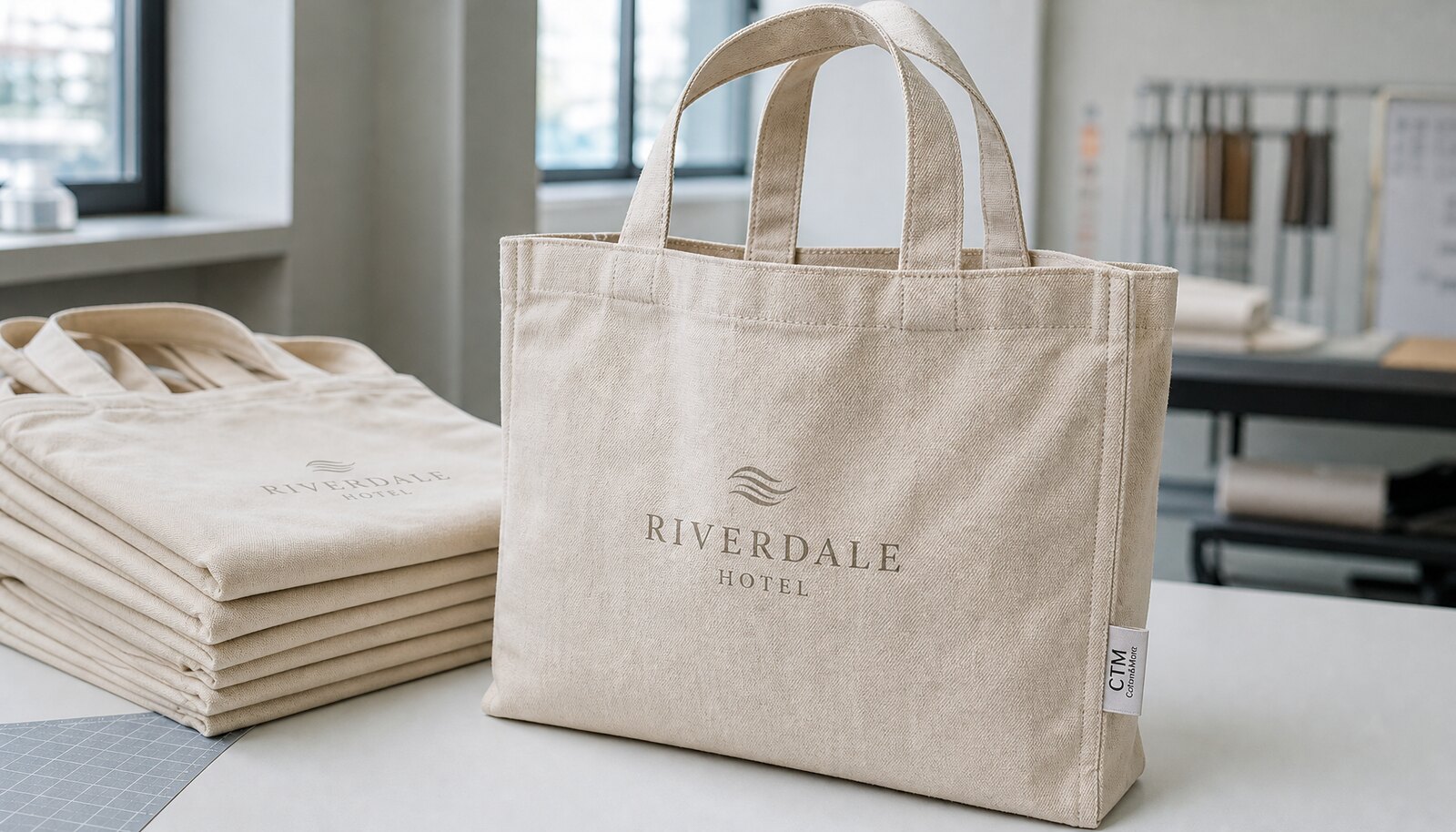
What hotel buyers are really solving with a private label tote
For hotels, a custom canvas tote is not just a giveaway bag. It is usually a retail item, guest amenity, event resale piece, or branded carrier that has to look consistent across multiple properties. That means the bag has to survive daily handling, hold its shape on a shelf, and carry the hotel brand without looking like a promotional throwaway.
A private label sourcing plan matters because many tote quotes look similar at first glance. The real difference is in fabric weight, print method, finishing, and packing discipline. If those are not defined early, one supplier may quote a thin body with a weak handle, while another prices a more structured bag that lands at a completely different cost.
- Decide whether the tote is for retail, in-room resale, conference merchandising, or spa use.
- Keep the bag style simple if the hotel needs repeat replenishment across seasons or properties.
- Treat branding as part of construction, not as a late-stage decoration.
Start with the right canvas weight and bag construction
Most hotel programs land well in the 10–12 oz canvas range. At that level, the bag feels structured enough for retail use, yet it is still economical to print and ship. A lighter 8 oz bag can be acceptable for soft amenity use, but it tends to wrinkle, collapse in display, and show the internal contents more easily. Once the bag moves above 12 oz, freight cost and sewing labor rise, so the buyer should make that jump only when a more premium feel is truly needed.
Construction details matter as much as fabric weight. Self-fabric handles are common for a clean look, but the handle length, stitching path, and reinforcement point determine whether the tote will survive repeated loading. A box stitch or reinforced cross-stitch at the handle top is usually safer than a simple straight seam. If the hotel plans to pack the tote with a water bottle, brochures, or boxed amenities, the bottom seam should also be reinforced.
- 10 oz: lighter retail tote, lower cost, softer structure.
- 12 oz: standard hospitality retail balance, good print surface, stronger hand feel.
- 14 oz+: premium look, better structure, higher material and freight cost.
- Use a gusset only when the bag needs boxier capacity; it increases fabric use and sewing time.
Choose the print method before you compare supplier prices
Print choice is one of the biggest hidden cost drivers in a custom canvas tote program. For simple hotel logos, screen print is usually the most practical route because it gives a clean result on natural canvas and keeps setup cost predictable. One to three spot colors is the sweet spot. Once the design moves into fine gradients, photo effects, or very small lettering, the risk of fill-in, blur, or weak registration rises quickly.
Embroidery can work for a premium property or a limited retail line, but it is not always the best choice on canvas because it adds density and can distort lighter fabric panels. Woven labels, sewn patches, and side labels are often better for subtle private label placement. If the hotel wants the bag to feel more like a retail product than a promo item, the best answer may be a combination: printed logo on the face, woven CTM or CottonToMaker side label, and a branded hangtag for shelf presentation.
- Use screen print for simple logos, monograms, and short hotel names.
- Use woven label or side label when the branding should be understated and durable.
- Use embroidery only when the artwork is simple and the bag weight can support the needle density.
- Avoid tiny text near seam lines; sewing shrinkage can pull the artwork off center.
Build the private label spec so suppliers quote the same thing
The fastest way to get misleading quotes is to request 'custom hotel tote bags' without defining the private label package. A buyer should state whether the supplier needs to apply a sewn brand label, an inner woven label, a printed care label, or a separate hangtag. Each item changes labor, material, and packing time. If the hotel is buying through a distributor, this also affects whether the factory can print the hotel name directly or whether branding must remain neutral for later localization.
For repeat programs, the smartest route is usually a standard base bag with custom branding added in one or two controlled locations. That keeps MOQ lower and reduces the chance that a future reorder becomes a full re-development project. If the hotel group needs multi-property use, define one master spec and then lock the label location, label size, and logo placement so each facility receives the same product.
- Define label type, size, and placement in millimeters, not only in words.
- State whether the bag needs retail-ready presentation or only warehouse bulk packing.
- Keep one version as the master spec and avoid last-minute property-by-property changes.
Use MOQ logic to decide between stock base, custom size, or custom fabric
MOQ should not be treated as a random supplier number. It reflects fabric loss, cutting layout, print setup, labeling time, and carton packing efficiency. A stock-pattern canvas tote with standard natural fabric often gives the lowest MOQ because the factory can cut from existing rolls and use familiar sewing lines. A custom size or custom dyed fabric usually pushes MOQ up because the factory must allocate special material and may need a dedicated production slot.
For hotel buyers, a practical sourcing route is to begin with a stock base bag, then customize the branding and packing. If the item proves successful in guest shops or amenity kits, a larger repeat order can justify custom size or dyed canvas later. That sequence lowers development risk and gives the procurement team a cleaner basis for comparing supplier reliability and true unit cost.
- Lower MOQ: stock fabric, standard size, one-color print, simple label.
- Medium MOQ: custom print placement, branded woven label, custom hangtag.
- Higher MOQ: custom dyed fabric, special wash effect, custom hardware, or unique shape.
- If a factory gives a very low MOQ, compare whether the quote excludes labels, packing, or print setup.
What a usable supplier quote should show line by line
A quote for custom canvas tote bags for hotels should separate material, sewing, decoration, and packing instead of burying everything in one number. That is the only way to compare factories on equal terms. A buyer should be able to see the fabric weight, bag size, handle construction, print method, label application, and carton pack count. If the supplier only writes 'custom tote bag' with a price, the quote is not yet usable for procurement.
Good quote structure also makes landed-cost planning easier. For example, a bag that looks inexpensive at ex-works pricing can become costly if the carton count is inefficient or if the bag is folded in a way that increases carton volume. Freight, storage, and distribution often move the total cost more than a small difference in sewing labor. Ask for the bag's packed dimensions, gross weight, and the number of bags per carton so the logistics team can model the shipment before approval.
- Request a breakdown for material, labor, decoration, packing, and tooling if applicable.
- Compare unit price only after checking carton count and gross weight.
- Make sure sample fees and bulk fees are not mixed into the same line item without explanation.
Use this product comparison to choose the right sourcing route
Not every hotel program should follow the same sourcing route. A luxury property with a small seasonal buy may need a sample-driven direct factory order. A multi-property chain may need a stable supplier with repeat QC and consistent packing. A distributor serving several hotels may prefer a stock-base route with branding applied locally. The comparison below shows how the main sourcing paths differ in real buying terms.
The most common mistake is choosing the cheapest-looking route before checking whether it can repeat the same bag next season. For private label programs, repeatability is part of the product. A slightly higher quote from a direct factory with clear material control can be the better buy if the hotel plans reorders, property expansion, or retail restocking.
Sample approval should test the parts that often fail in bulk
A pre-production sample should be made with the actual canvas, actual print, actual label, and actual folding method. A paper drawing or digital artwork proof is not enough because canvas can shift the way print sits after sewing and pressing. For hotel buyers, the sample must also be judged by presentation: does it look like something a guest would keep, buy, or carry into a lobby without damaging the brand image?
The sample should be rejected or revised if the logo is too close to a seam, if the handles twist, if the bag does not stand well on a shelf, or if the folded pack does not match the planned carton count. Make sure the sample approval record includes photo evidence and specific correction notes. That prevents later arguments about what was agreed before bulk production started.
- Verify size, handle drop, print position, and label placement on the sample.
- Test stitching by loading the bag with actual hotel-use items, not only by hand.
- Approve the final fold and carton pack pattern before the bulk run begins.
Packing and carton rules that protect the tote in transit
Packing is often ignored until the first shipment arrives with wrinkled print, dusty fabric, or missing pieces. For custom canvas tote bags for hotels, bulk polybag packing is usually enough if the bags go to a warehouse or fulfillment center. If the product is retail-ready, the supplier may need individual polybags, insert cards, barcode stickers, and clean carton markings. Those choices change packing labor and carton volume, so they should be part of the quote from the start.
The buyer should also decide whether each carton contains a single size and color or a mixed lot. Mixed cartons can help with small rollouts, but they complicate inventory control and can create counting problems. Standardizing one carton count per SKU makes receiving easier and reduces the chance of a property receiving the wrong assortment.
- Specify folded dimensions before shipping.
- Confirm whether polybags are required for dust protection or retail presentation.
- Set carton labeling standards: SKU, size, color, quantity, country of origin, and PO number.
Lead time and landed-cost planning for a hotel rollout
A realistic lead time for a standard canvas tote program is often 30–45 days after sample approval, but that is only the production window. The full schedule also includes artwork finalization, sample creation, approval rounds, and shipping. If the order lands near a factory peak season or requires custom dyeing, the timeline expands quickly. Procurement teams should build in buffer time because hotel launch dates usually move less than factory schedules do.
Landed cost should be reviewed with freight in mind, not only with ex-works pricing. Canvas totes are not extremely heavy, but they are bulky. A thicker fabric, large gusset, or retail packing can increase carton volume enough to change freight cost materially. For small and medium hotel programs, the cheapest unit price may lose once carton size, pallet space, and destination handling are added.
- Model cost by carton volume as well as per-piece price.
- Include sample charges, print setup, and label costs in the comparison.
- Add a schedule buffer if the order depends on seasonal retail opening or event timing.
Specification comparison for buyers
| Supplier option | What to verify | Commercial advantage | Buyer risk to control |
|---|---|---|---|
| Direct sewing factory | fabric swatch, approved sample, seam close-ups, logo test photos, packing pilot, and final inspection evidence | Better sample-to-bulk control and faster production feedback | May be weaker on export paperwork or branded packing unless checked early |
| Trading company | Factory name, production photos, trim-source proof, and who owns QC decisions | Can coordinate small mixed orders and extra services | Markup can hide real factory capability and slow defect decisions |
| Specialized bag workshop | bag size, gusset, handle drop, seam allowance, stitch density, reinforcement patch, and loading expectation | More practical for detailed construction, trims, and repeat programs | Capacity may be limited during peak seasons |
| Low-price general supplier | 8-12 oz cotton canvas, 120-220 gsm cotton, recycled cotton, or blended fabric selected by use case and target price | Useful for simple promotional runs with loose specs | Material downgrades, weak packing, and vague inspection scope can erase savings |
| Retail-ready supplier | fold method, inner bundle, carton count, carton mark, moisture protection, SKU separation, and warehouse receiving needs | Can handle labels, SKU separation, carton marks, and receiving rules | Higher unit cost must be compared against reduced warehouse work |
| Compliance-focused supplier | Fabric records, labeling review, test plan, and production traceability | Safer for retail programs and repeat brand orders | Documentation claims need evidence, not only sales language |
| Local sample room plus bulk factory | Signed sample, bulk factory handoff, first-piece photos, and deviation owner | Good for complex branding before large production | Sample room quality may not match bulk line unless handoff is controlled |
Buyer checklist before sampling
- Final bag size, seam allowance, and handle drop are locked before RFQ.
- Canvas weight is specified in oz or GSM, not described only as 'heavy duty' or 'premium'.
- Branding method, logo size, and print placement are shown on a flat artwork file.
- Private label requirement is defined: woven label, sewn patch, inner print, hangtag, or all of the above.
- Packing method is stated for each bag: folded size, polybag yes/no, carton count, and carton marking.
- Target order quantity is given by size/color so the supplier can calculate fabric loss and setup cost.
- Destination country and required carton dimensions are included for freight planning.
- Sample approval steps are defined, including what must be corrected before bulk approval.
- QC tolerance for measurements, print position, and stitching defects is documented.
- Lead-time expectation includes artwork approval, sample lead time, bulk production, and shipping buffer.
Factory quote questions to send
- What is your actual fabric construction, finished GSM or oz weight, and is the canvas bleached, natural, dyed, or washed?
- Is your quote based on stock pattern or a custom pattern, and what exact MOQ applies to each route?
- Which branding method is included in the price: screen print, embroidery, woven label, sewn patch, or inner label?
- What is the size tolerance after sewing, and what seam allowance do you use on this tote style?
- Can you provide a pre-production sample with real fabric, real print, and final packing before bulk approval?
- How many print colors are included in the quoted price, and what is the charge for extra colors or repeat setups?
- What is your standard carton pack count, carton size, and gross weight for this bag?
- What is the normal bulk lead time after sample sign-off, and what parts of the schedule can delay shipment?
- Which defects do you treat as rejectable in final inspection: broken stitches, crooked labels, ink smudges, size deviation, or stain marks?
- Can you share photos or a spec sheet from a recent similar tote order so we can compare construction and packing logic?
Quality-control points to confirm
- Measure finished size at three points on a production sample and confirm it stays within the agreed tolerance.
- Pull the handles and inspect the stitch density, bartacks, and seam security at the stress points.
- Rub the printed area after curing to see whether the ink cracks, transfers, or becomes tacky.
- Check whether the woven label, printed label, or side tag sits level and does not distort the seam line.
- Open and re-fold several cartons to verify pack count, dust protection, and whether the fold creates permanent creases.
- Inspect the canvas for slubs, visible stains, broken threads, and shade variation between panels.
- Confirm that print position is centered on the panel and not drifting due to sewing shrinkage.
- Review carton markings, barcode labels, and inner packing slip details against the PO before shipment release.