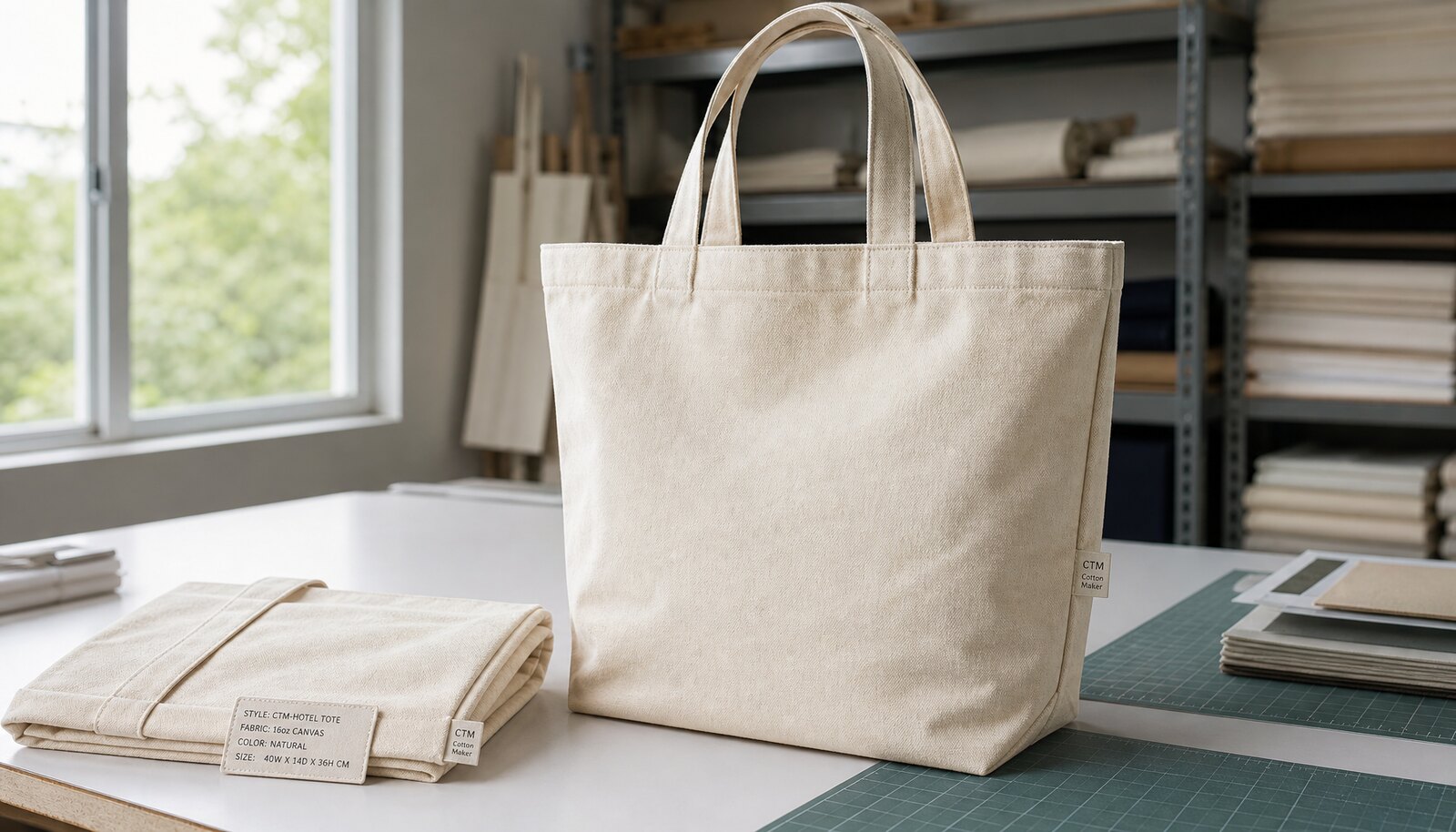
1) Start With the Hotel Use Case, Not the Bag
A hotel tote is not a generic canvas bag with a logo added at the end. It is a working item that may be used for a welcome kit, spa retail, gift shop purchase, conference handout, loyalty giveaway, or upsell package. Each use case changes the ideal fabric weight, print area, packing method, and carton configuration. Procurement teams get better quotes when they define how the tote is handled after it leaves the factory, not only how it looks in a mockup.
For a room-drop or amenity program, the bag often needs to arrive flat, clean, and easy for staff to open and fill. For a retail shelf, the tote has to present consistently from bag to bag, with the logo facing the same direction and the fold line not collapsing the front panel. For a guest purchase item, a more structured body, stronger handles, and a cleaner pack presentation matter because the tote becomes part of the brand experience. The commercial decision starts with use, then moves to construction, then to packaging.
Procurement should also identify who touches the bag after delivery. If housekeepers, concierge staff, or shop assistants will distribute it, the packaging needs to support quick handling and accurate counting. If the hotel wants the tote to sit on a shelf or display table, the pack format must protect the face of the bag and reduce wrinkling. That operational detail often explains why two suppliers with the same sewing cost can produce very different landed costs once packing and freight are included.
- Define the use case: room kit, retail shelf, event handout, or guest purchase.
- State whether the bag must arrive flat-folded, individually packed, bulk packed, or shelf-ready.
- List who handles the tote after receipt so packing can be matched to actual workflow.
2) Choose Fabric Weight and Finish With a Realistic Service Level in Mind
Canvas weight is one of the easiest ways for a supplier to make a quote sound better than it is. A light 8 oz canvas may be acceptable for a short-run handout or a simple promotional item, but it can feel soft, wrinkle easily, and lose shape when filled with brochures, slippers, or a water bottle. A 10 oz canvas is usually the best balanced starting point for hotel tote programs because it gives better body, better print support, and still keeps cost and carton weight under control. A 12 oz canvas feels more substantial and can suit premium retail positioning, but it will increase material cost, sewing effort, and shipping weight.
It helps to specify both ounces and gsm because suppliers and buyers often quote in different systems. More important than the number itself is whether the weight is finished fabric weight or only the base cloth before finishing. Ask the factory to state if the canvas is raw, bleached, washed, dyed, or pre-shrunk, because those choices affect shade, handfeel, odor, and consistency across lots. Hotels usually care less about the textile terminology and more about whether the bag looks clean on day one and still looks controlled after storage in a back-of-house room.
If the program includes long storage cycles or mixed delivery conditions, ask about shrinkage and odor control. A tote packed tightly in a carton for weeks can pick up a compressed smell if the fabric or packing environment is not controlled. That is not a theoretical textile issue; it becomes a guest-facing quality issue when the bag is opened in a room or shop. For that reason, the spec should mention acceptable shade range, any washed look, and whether minor tonal variation is acceptable between lots.
- 8 oz / about 270 gsm: workable for lightweight giveaways and conference use.
- 10 oz / about 340 gsm: strongest all-round option for hotel retail, welcome kits, and repeat handling.
- 12 oz / about 410 gsm: best for premium handfeel and heavier contents, but expect higher cost and freight impact.
3) Set Dimensions, Gusset Depth, and Handle Geometry Before Quoting
The best tote size depends on what the hotel expects the bag to carry. A welcome kit may only need room for stationery, slippers, a letter, and a small bottle. A retail or spa shop bag may need enough width and gusset depth to hold boxed items without looking overstuffed. The common mistake is to approve a sample by eye and then ask the factory to “make it similar” without giving a finished dimension or tolerance. That is how suppliers end up making slightly different bags from one order to the next.
Buyers should lock the finished width, height, and gusset separately. The gusset matters because it changes usable capacity, panel shape, and shipping volume. A deeper gusset makes the bag easier to fill but also makes the folded bag thicker in carton. For hotel procurement, this directly affects carton count, CBM, and the amount of shelf space the tote occupies once distributed. If the tote is meant to fit inside another pack or amenity box, the external dimensions must also be checked against the kit it will support.
Handle geometry deserves the same discipline. Ask for handle length, handle width, and handle drop, not just “long handles” or “short handles.” If the tote is hand-carry only, a long shoulder strap may add cost without adding value. If guests are expected to use the bag on the shoulder, the drop must be tested on the sample with the actual intended contents inside. Handle reinforcement also matters; a nicely printed bag is not useful if the handle seam loosens after a few uses.
If the hotel wants the bag to stand up on a counter or retail shelf, structure should be part of the spec. This does not always require a rigid base board, but it may require heavier fabric, tighter seam control, or a more controlled gusset seam. The right structure should be selected for presentation and use, not for appearance alone.
- State finished width, height, and gusset in writing, with a tolerance band.
- Specify handle length and handle drop separately so shoulder carry is measurable.
- Define whether the bag must stand upright, fold flat, or fit inside a secondary kit.
4) Compare Construction Options That Affect Strength, Presentation, and Cost
Construction choices change both product performance and quote structure. A plain open-top tote is usually the simplest and cheapest route, while a zip-top, snap closure, or drawstring adds hardware, sewing steps, and inspection points. That can be worthwhile if the bag will carry travel items, cosmetics, or a welcome set that needs to stay closed in transit. If the tote is mainly a room-drop or shop bag, a simple open top usually keeps costs lower and production cleaner.
The seam architecture also matters. A bag with side and bottom seams, reinforced handle joins, and a clean top hem will generally present better than a loosely finished tote even if both are technically made from the same canvas. Buyers should ask whether the factory uses a self-fabric top hem, binding, or turned-edge construction. Each option changes appearance, strength, and sewing time. The same is true for internal seams: a neat internal seam may not be visible to the guest, but it can affect durability and the chance of loose threads during use.
Lining and pockets should be treated as functional features, not decorative extras. A lined tote can feel more premium and protect print on the inside, but it also adds more panels, more sewing, and more opportunities for misalignment. An internal pocket can be useful for key cards, spa vouchers, or small retail items, but only if the hotel has a clear reason to use it. The sourcing question is simple: does this feature reduce operational friction, or does it only add cost?
- Ask the supplier to name the exact seam type, top finish, and reinforcement method.
- Use closures only when the hotel use case needs containment or presentation control.
- Treat pockets and lining as added labor, not free upgrades.
5) Select Branding That Fits the Fabric and Survives Handling
The best decoration method for a hotel tote is the one that stays readable after folding, storage, transport, and guest handling. For most hotel logos, screen printing remains the most practical choice because it is clear, repeatable, and usually the most economical at scale. It works especially well for simple lettering, flat icon marks, and one- or two-color artwork. If the hotel wants a quieter or more premium look, a woven label, sewn patch, or restrained side label can be more appropriate than a large front print.
Embroidery can look upscale on heavier canvas, but it is not a free premium upgrade. Dense stitching can pull on lighter canvas, distort the panel, or make the logo appear too heavy relative to the bag body. It also adds setup complexity and can increase rejection if thread density is not managed well. Heat transfer may be useful for small runs or detailed graphics, but procurement should ask for rub testing, wash resistance if relevant, and a clear view of how the decoration ages after repeated handling.
The procurement brief should define the logo size, exact placement, and the number of decoration positions. A supplier cannot reliably quote “front logo” if the artwork might be centered, offset, upper chest, side seam, or both sides. Buyers should also define color references. If the brand uses Pantone standards, ask the factory how they handle matching on natural or bleached canvas, because the background color affects perceived ink tone. A white logo on cream canvas will read differently than the same white on a cooler bleached cloth.
For hotel use, consistency matters more than artistic variety. If the same tote will ship to multiple properties, the brand team should agree on one approved graphic size and one approved placement. If the hotel wants different versions for a resort, city hotel, and spa, separate those as distinct SKUs so production, packing, and reorder control do not become messy.
- Fix the print area in millimeters or inches, not in general terms.
- Approve Pantone references against actual fabric swatches, not only on screen.
- Ask for a print strike-off or pre-production decoration sample before mass production.
6) Specify Packaging, Fold Method, and Cartonization as Part of the Product
Packaging is not just logistics; it is part of the delivered product. A tote that is sewn correctly but folded inconsistently can look messy in a hotel room kit or retail display. For some programs, a flat-folded bag is enough. For others, the bag needs to open with the logo facing outward and the handle lay controlled so staff can insert items quickly. This is why the pack spec should be written with the same discipline as the sewing spec.
If the tote will be used in room kits or guest-facing retail, individual polybags are often worth considering because they protect against dust, abrasion, and warehouse handling marks. If the bags are replenishment stock for back-of-house use, bulk folding may be more economical. There is no universal answer. The right choice depends on who opens the carton, how quickly the bags are issued, and whether the hotel wants presentation quality or replenishment efficiency.
Cartonization has a direct effect on landed cost. The same tote can ship very differently depending on fold style, pack count, and carton dimensions. A tight, efficient carton can reduce CBM and sometimes cut freight materially. A loose or oversized carton can make a cheap factory quote expensive once shipping and storage are included. Buyers should request master carton dimensions, gross weight, and exact pack count before comparing suppliers. If a supplier only gives unit price without carton detail, the quote is incomplete for procurement decisions.
For warehouse control, ask for SKU labeling that matches how the hotel or distributor receives stock. That may mean barcode labels on each unit, carton marks on all four sides, or a specific destination code. If the tote is part of a multi-item gift set, the carton spec should also confirm orientation, insertion order, and whether the bag arrives pre-packed inside another box or as a standalone item. Small packing choices can save more handling time than a small price reduction ever will.
- Write the fold method, face orientation, and pack order into the spec sheet.
- Ask for carton dimensions and gross weight, not only total quantity.
- Confirm whether each unit needs a polybag, insert card, barcode, or none.
7) Build a Quote That Can Actually Be Compared Across Suppliers
Hotel procurement often receives quotes that look comparable but are built on different assumptions. One supplier may quote a simple bag only, another may include individual polybags, and a third may have hidden setup or carton charges. That is why the RFQ should ask for a line-by-line quotation structure. The more controlled the pack format, artwork, and carton requirements, the easier it is to identify which factory is actually cheaper and which one is only quoting a narrower scope.
The right comparison is landed cost, not factory price in isolation. Landed cost includes the bag, print or decoration setup, packing materials, carton printing, inland freight to port or warehouse, export handling, ocean or air freight, duty, and final delivery. A factory with a slightly higher manufacturing price can still win if its cartonization is tighter, its packing is more efficient, and its lead time avoids expensive air freight. Procurement teams should compare suppliers using the same Incoterm so freight and risk are not hidden in different places.
It also helps to separate one-time and recurring costs. Screen setup, embroidery digitizing, label plates, and carton print setup may only apply to the first order. If the hotel expects reorders, the first order should not be evaluated only on total invoice price. Ask suppliers to show what drops out on repeat runs so the team can forecast the true program cost over time. That approach is much more useful than a one-off cheap quote that cannot be repeated at the same price.
If multiple properties or seasonal launches are involved, the quote should clearly state what changes constitute a new SKU. Different print colors, different handle lengths, different pack counts, or different labels can all create additional setup. Keeping the shell bag consistent while changing only the label or insert is often the cleanest way to manage cost and SKU complexity.
- Use the same Incoterm across all quotes.
- Compare like-for-like packing, not just like-for-like bags.
- Ask suppliers to split one-time setup from recurring unit cost.
8) Approve Samples, Sealed References, and Change Control Before Bulk Production
A sample should prove more than visual resemblance. For a hotel tote, the pre-production sample must confirm size, handle geometry, print position, fold method, and packaging. If the sample is approved without the correct pack format, the bulk order can drift even if the bag itself is correct. Many procurement problems start because the buyer approved a beautiful loose sample and then discovered that the real shipment would be polybagged, folded differently, or carton-packed in a way that changed the appearance and handling quality.
The most practical approach is to retain one sealed reference sample with the approved fabric, decoration, and pack format. That reference becomes the comparison point for bulk goods, and it is especially useful when there is a dispute on shade, print placement, or handle length. Ask the factory to keep their own reference as well, so both sides are comparing against the same approval point. If the order involves several property versions, label the approved sample by SKU and keep that record with the PO file.
Change control matters because tote orders often evolve after first sampling. A hotel may decide to change artwork placement, switch from bulk pack to individual polybag, or ask for a deeper gusset after seeing the sample. Those changes are not a problem if they are documented. They become a problem when the factory is asked to “adjust slightly” without a revised spec and price confirmation. Every change that affects sewing, printing, packing, or carton size should trigger a new written approval.
For first orders, procurement teams should also request photo proof from the factory before bulk packing begins. That is not a replacement for a physical sample; it is a control step to catch obvious drift before a full run is completed. A simple photo set that shows front, back, handle, stitching, fold, and carton label can prevent costly rework if the wrong version has started on the line.
- Approve the bag and the pack together, not separately.
- Keep one sealed reference sample tied to the purchase order.
- Treat any change to artwork, size, pack format, or carton count as a documented revision.
9) Set QC Thresholds, Inspection Methods, and Acceptance Criteria the Factory Can Follow
Good QC for canvas totes is specific, measurable, and focused on defects that matter in hotel use. If the bag is going into guest-facing service, a crooked logo, uneven handle, or dirty mark is not a minor issue. If the tote is a back-of-house replenishment item, some cosmetic variation may be acceptable, but wrong count, wrong size, and weak seams are never acceptable. The important step is to separate cosmetic defects from functional defects and give the factory a clear basis for sorting, rework, and rejection.
Many procurement teams use AQL for incoming inspection. If you use AQL, state the plan on the PO or quality agreement before production starts. A common approach is a tighter review on first orders and a standard incoming check on repeat orders, but the exact level should depend on the program’s risk. The factory should know what sample size will be checked, what defects are classed as critical, major, or minor, and what happens if a lot fails. Without that clarity, inspection becomes subjective and expensive.
A useful tote QC plan should name measurement methods. For example, finished width, height, and gusset can be measured on a flat surface with a steel ruler or calibrated tape measure after the bag is fully relaxed. Handle length should be checked from stitch point to stitch point, not from the outer fabric edge. Print placement should be measured from a fixed seam reference rather than estimated by eye. These small details matter because a supplier and a buyer can disagree even when both think they are measuring the same thing.
The QC list should also cover packaging integrity. A bag that passes sewing inspection but arrives with a crushed carton, damp packaging, or mixed SKU counts still creates warehouse work. For hotel programs, the standard should include carton dryness, packing count, barcode correctness, and orientation consistency. If the shipment will go directly to multiple properties, carton labeling and count accuracy are part of the product, not just the transport method.
- Define critical, major, and minor defects in writing.
- Measure size and handle length with a consistent method.
- Inspect the first production output before the full lot is sealed.
10) Use a Buyer’s Spec Sheet to Prevent Rework, Delays, and Quote Drift
The easiest way to improve procurement outcomes is to send one complete spec sheet instead of scattered emails. For custom canvas tote bags for hotels packaging specification guide projects, the sheet should bring together product dimensions, fabric weight, finish, decoration, packaging, cartonization, sample rules, QC thresholds, and delivery terms. When that document is clear, factories spend less time guessing and more time pricing accurately. The buyer also gets fewer surprises once the order enters production.
A strong spec sheet does not need to be complicated, but it should be complete. It should answer what the tote is, how it is built, how it is decorated, how it is packed, how it is inspected, and where it is delivered. It should also identify what is fixed and what can be proposed by the supplier. For example, the buyer may fix the bag size and logo size but allow the factory to propose the most efficient carton count within a defined CBM target. That is a useful way to invite cost-saving ideas without letting the spec drift.
Here is a practical structure procurement teams can use: product description, finished size, fabric weight and finish, color, handle spec, decoration method, pack format, carton details, sample approval flow, QC standard, order quantity, MOQ, lead time, delivery term, and destination. Add artwork files and any hotel brand rules as attachments. If the tote is going to multiple properties, include a SKU matrix so the supplier can separate variants cleanly and avoid mix-ups. The more the order is documented up front, the less the factory has to assume later.
A final buyer habit that pays off is asking one simple clarifying question in every RFQ: what could make this quote change after we place the order? That question surfaces hidden assumptions around artwork revisions, fabric availability, packaging changes, and freight volatility. In hotel procurement, the goal is not only to find the lowest quote. It is to buy a tote program that arrives on time, presents well, and can be reordered without renegotiating everything from scratch.
- Use one spec sheet for product, print, pack, carton, QC, and delivery.
- Separate fixed requirements from supplier proposals so pricing is comparable.
- Ask every supplier what conditions could change the quote after award.
Specification comparison for buyers
| Decision area | Option A / lower-cost route | Option B / balanced hotel route | Option C / premium route | Procurement trade-off to verify |
|---|---|---|---|---|
| Canvas weight | 8 oz / about 270 gsm | 10 oz / about 340 gsm | 12 oz / about 410 gsm | Heavier fabric improves body and perceived quality, but also raises material cost, sewing resistance, and carton weight. Ask for finished fabric weight, not yarn count. |
| Fabric finish | Raw or lightly treated natural canvas | Bleached or washed canvas with controlled shade | Dyed or specialty-finish canvas | Natural fabric is easiest to source, but shade variation and odor control matter. Bleached or washed options usually look more consistent for guest-facing use. |
| Print method | One-color screen print | One- to two-color screen print with controlled Pantone match | Multi-pass print, embroidery, or patch applications | Screen print usually gives the best unit economics for hotel logos. Embroidery or patchwork can improve presentation but may add cost and risk fabric distortion on lighter canvas. |
| Branding format | Large front logo only | Small front logo plus woven side label | Front print, side label, and custom hangtag | More branding points can improve shelf appeal, but they also add setup, packing labor, and rejection points if placement is not controlled. |
| Closure style | Open top | Open top with gusset or simple top hem | Zip top, snap, or drawstring closure | Closures add hardware and sewing complexity. They are only worth the cost if the bag must protect contents, travel, or present as a gift set. |
| Lining and pockets | Unlined, no pocket | Unlined with one simple internal pocket or divider | Lined body with pocket, card slot, or bottle holder | Every added panel increases sewing time and inspection points. Use only when the hotel use case truly needs organization or product separation. |
| Handle build | Basic self-fabric handle | Reinforced self-fabric or webbing handle | Thicker webbing, cross-box stitch, or extended shoulder drop | Handle comfort and stitch strength matter more than visual thickness. Ask for handle width, drop, and bartack pattern in writing. |
| Packaging format | Bulk fold in master carton | Flat-fold, individual polybag, carton by SKU | Retail-ready fold with insert card, barcode, and controlled face orientation | Bulk packing lowers cost, but retail or room-service programs often need a consistent first impression and faster warehouse handling. |
| Cartonization | Standard export carton only | Carton with SKU marks, count labels, and moisture control | Retail master carton with precise pack count, barcode, and shelf-ready orientation | Carton size drives CBM and freight. A cheaper unit price can be erased by oversized cartons or poorly optimized packing. |
Buyer checklist before sampling
- Finished dimensions: width, height, gusset, and handle drop, with explicit tolerance limits on the spec sheet.
- Fabric spec: canvas weight in oz and gsm, finish type, color, and whether shade variation is acceptable.
- Construction: seam allowance, stitch density, bartack locations, handle reinforcement, and any base or side panel structure.
- Branding spec: print method, Pantone references, logo size, placement coordinates, and whether artwork appears on one side or both.
- Packaging spec: fold method, individual polybag or bulk pack, insert card, barcode label, and face orientation in the pack.
- Carton spec: pack quantity per inner or master carton, carton dimensions, gross weight target, and shipping mark text.
- Inspection plan: AQL level or equivalent defect limits, measurement method, sampling point, and approval responsibility.
- Sample plan: photo proof, pre-production sample, sealed reference sample, and who signs off before bulk cutting begins.
- Commercial terms: MOQ by color and print version, setup charges, lead time by stage, Incoterm, destination, and freight responsibility.
Factory quote questions to send
- What is the finished fabric weight you are quoting, in both oz and gsm, and is that weight measured after finishing or before finishing?
- Are you controlling sewing, printing, and packing in-house, or are any steps outsourced to a subcontractor?
- What are the MOQ and price breakpoints by color, print version, closure option, and packing format?
- Can you quote the same tote in bulk-packed and individually polybagged formats so we can compare true packaging cost impact?
- What are the exact handle width, handle drop, seam allowance, and bartack pattern you will use?
- What tolerances do you normally work to for finished size, print placement, and carton count accuracy?
- What is included in the unit price, and what is separate: setup, print screens, labels, inserts, carton printing, and special folding?
- What sample stages are included before production, and will you retain a sealed reference sample against the bulk order?
- How many days are required for material sourcing, sampling, production, packing, and final shipping preparation?
- Can you provide carton dimensions, gross weight per carton, and an estimated CBM so we can estimate freight and warehouse space?
Quality-control points to confirm
- Measure finished width, height, and gusset on a defined sample size and compare against the approved tolerance range before packing starts.
- Check fabric weight using the supplier's declared GSM and, where possible, cross-check with incoming fabric records or cut-piece weight samples.
- Inspect handle symmetry, handle length, and handle attachment placement; variance should not affect bag balance or wear comfort.
- Look for skipped stitches, loose threads, broken seams, and weak bartacks, especially at handle joins and gusset corners where stress is highest.
- Review print alignment, color match, opacity, and edge definition under daylight or standardized white light against the sealed reference sample.
- Confirm there are no oil stains, needle holes, broken yarns, shade patches, or fabric distortion in the front-facing areas of the tote.
- Verify fold method and orientation in the polybag or bulk carton so the logo face, handle lay, and opening direction are consistent across units.
- Count bags per carton and per inner pack; treat short count, mixed SKU, or damaged carton as a packing defect, not a minor issue.
- Check cartons for dryness, crushing, and clear shipping marks, including PO number, SKU, carton count, destination, and country-of-origin text.