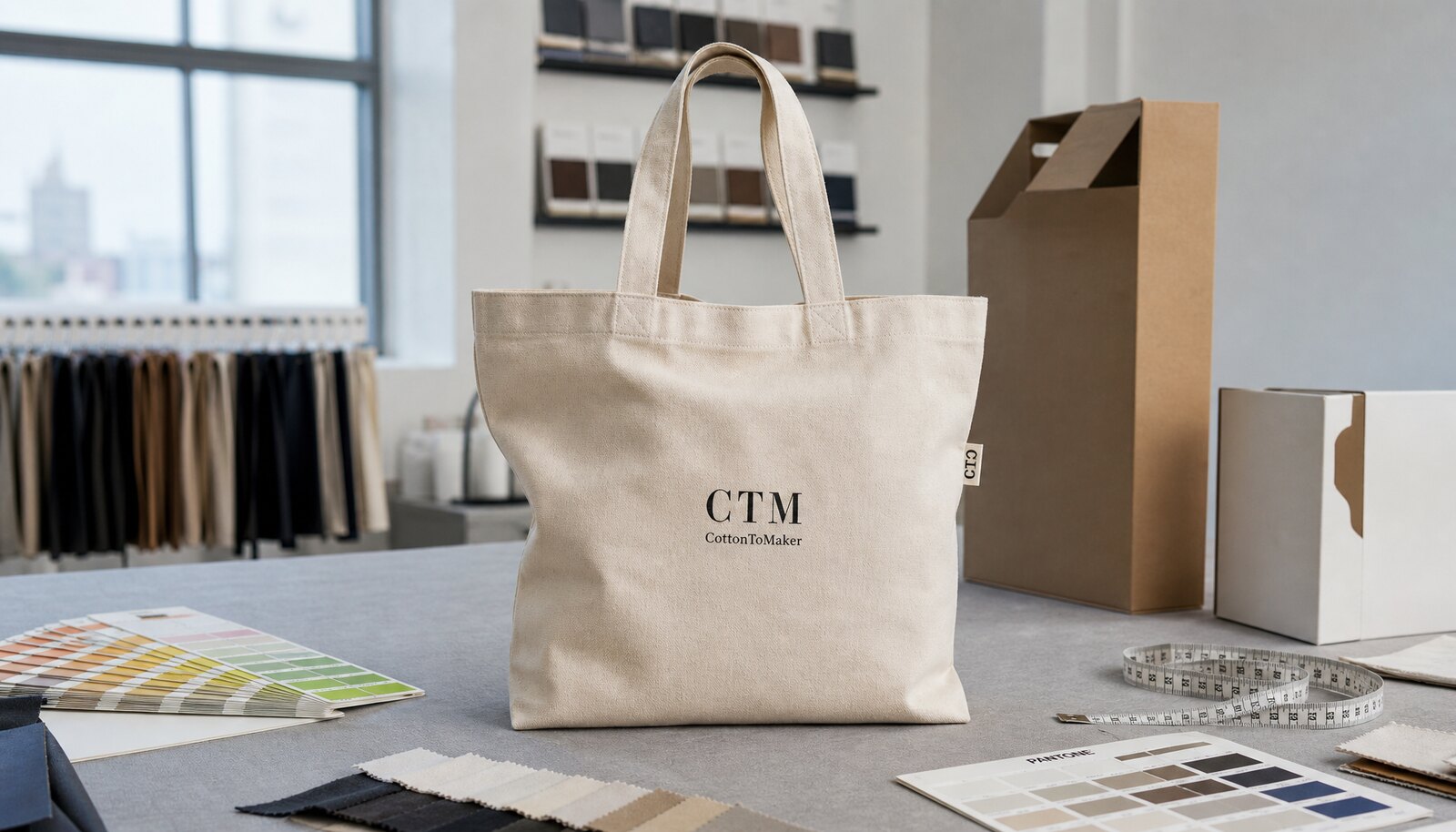
Why gift shops need a different tote spec
Gift-shop totes are not the same buying job as a trade-show giveaway. They need to sell from a shelf, look good in a hand photo, and survive being stuffed with books, candles, mugs, or other impulse purchases. For private label sourcing, that means the bag has to feel like part of the store assortment, not a generic promotional item. The sourcing plan starts with how the bag will be presented and used, not with the lowest quote on paper.
The wrong canvas weight creates a retail problem fast. Too light and the bag feels cheap or shows through at the print. Too heavy and it becomes stiff, expensive to ship, and less attractive as an add-on purchase. For most gift-shop programs, the useful middle ground is a 12 oz bag for general retail, with lighter 8 to 10 oz options for souvenir-style items and 14 to 16 oz options for premium or higher-load use.
- Define whether the tote is a checkout add-on, a premium gift item, or a permanent private-label SKU.
- Set a realistic retail price band before you ask for quotes, because the spec needs to fit the shelf price.
- Decide early whether the bag should look soft and casual or structured and premium.
Choose the fabric weight and construction first
For canvas totes, fabric weight is the first control point. In practical sourcing terms, 12 oz or roughly 340 to 400 GSM is a strong midpoint for a gift-shop bag that needs body without becoming overly stiff. If the tote will carry boxed gifts, catalogs, or heavier impulse items, move toward 14 to 16 oz, or roughly 420 to 520 GSM, and add stronger reinforcement at the handle points. Buyers should always ask whether the quoted weight refers to finished fabric or grey fabric, because those numbers are not interchangeable.
Construction choices matter just as much as weight. Handle width, handle drop, bottom reinforcement, seam allowance, and whether the bag uses a gusset all change the look and the load performance. A narrow handle can be acceptable for a light souvenir bag, but it will look weak and feel uncomfortable on a premium retail tote. If the bag must sit neatly on a hook or fold flat for display, avoid a bulky gusset or an overly stiff wash finish that makes the bag hard to present.
- Specify handle width and handle drop in the RFQ instead of leaving them open.
- State whether the bag must stand upright, fold flat, or both.
- Define acceptable shrinkage or washing behavior if the tote will be sold as a reusable item.
Pick the print and branding method for shelf life
Screen print remains the default choice for most canvas tote private-label programs because it is durable, easy to reproduce, and cost-effective at moderate volume. One-color artwork usually gives the cleanest result on natural canvas, especially when the store wants a classic, handmade, or heritage look. If the artwork uses multiple colors or fine detail, direct-to-film transfer, heat transfer, or digital print can work, but the buyer should test edge sharpness, hand feel, and rub resistance before approving the method for bulk production.
Branding placement should support the retail story. A front-center logo is easy to approve, but a woven side label, small seam tab, or understated bottom mark often feels more private label and less promotional. For gift shops, the bag should look designed rather than merely printed. Lock the artwork size, Pantone references, and logo position before sampling, and do not accept a faster substitute unless the supplier shows a real sample against the approved art and not a generic demonstration piece.
- Use screen print for simple logos and durable retail carry bags.
- Use transfer or digital print only when artwork detail justifies the added risk and cost.
- Treat woven labels and side tabs as part of the brand, not an afterthought.
Compare supplier routes before you request quotes
Supplier route changes the economics and the risk profile. A direct factory gives the most control over fabric, sewing, print, and packing, but it also demands a tighter RFQ and stronger discipline on sample approvals. A trading company or sourcing agent can simplify communication across multiple factories, yet the buyer must push for transparency on who actually makes the goods and where each process happens. Local decorators can be valuable for rush orders, but they may not control the blank bag quality or the long-term repeatability of the spec.
The cheapest ex-factory quote is rarely the lowest real cost. A bag can look inexpensive until you add woven labels, hangtags, packing labor, carton marks, or relabeling at the warehouse. For a one-off seasonal gift-shop test, a stock blank plus local print may be a rational choice. For a permanent private-label line, a factory that can cut, sew, print, and pack under one quality system is usually the cleaner route because it reduces handoffs and makes the reorder easier to control.
- Choose the route that matches the order purpose: test order, seasonal launch, or ongoing private-label line.
- Ask every supplier who owns the sewing, printing, labeling, and packing steps.
- Compare landed cost and defect risk, not just the initial unit price.
Build an RFQ that produces comparable pricing
Most quote spread comes from missing data, not from suppliers using different math. A useful RFQ for custom canvas tote bags for gift shops private label sourcing plan should include exact dimensions, fabric weight, weave type, handle length, print area, number of colors, label plan, carton pack, and the incoterm you want quoted. If the supplier has to guess at reinforcement, packaging, or label placement, the quote will not be comparable and the cheapest number will usually hide an omitted process.
Force the supplier to break out the price by component. Ask for the bag body, print setup, labels, hangtags, packing, cartons, and freight terms as separate lines. That structure makes it much easier to spot where one quote is genuinely efficient and another has simply excluded part of the job. A buyer who compares only unit price often discovers too late that the cheaper quote did not include woven labels, carton marks, or retail folding.
- Request pricing at several quantity breaks, such as 500, 1,000, 3,000, and 5,000 units.
- Ask for a quote format that separates recurring cost from one-time setup cost.
- Make the supplier confirm whether the quoted MOQ applies per color, per size, or per artwork.
Use MOQ logic instead of chasing the lowest minimum
MOQ should reflect real production constraints, not just sales positioning. Screen setup, custom woven labels, special thread colors, and retail packing all push the minimum upward. A simple stock-bag program with one print color may be workable at 300 to 500 units, but a fully custom cut-and-sew tote with woven label and branded hangtag often needs 1,000 to 3,000 units before the price becomes practical. If a supplier offers a very low minimum, the buyer should ask what was removed from the spec to make that number possible.
The right MOQ is the one that matches sell-through and replenishment. Gift shops often do better with a first order that covers launch plus a small reorder buffer than with a large one-time buy that ties up cash. If the tote is seasonal, size the order around the selling window and the expected store count. If the tote is a permanent item, use the first run to validate quality and then build the reorder point from actual weekly movement instead of from a guess.
- Use MOQ to test whether the supplier understands setup cost, not just whether they can say yes.
- If the MOQ seems unusually low, inspect the spec for missing labels, simpler packing, or reduced print complexity.
- For gift-shop assortments, a smaller launch order can be smarter than a full-season buy.
Approve the sample as a production tool, not a display piece
A pre-production sample should prove the tote can be repeated, not just that it photographs well. Check fabric hand feel, print density, label placement, seam finish, and how the bag folds or hangs when empty. If you cannot inspect it in person, ask for detailed photos under consistent lighting because natural canvas shifts tone depending on the light source. The point of sample approval is to match the written spec, not to treat a nice-looking sample as a blank canvas for later interpretation.
Your approval note needs to be precise enough that the factory can build from it. State whether the logo is centered within the agreed tolerance, whether the handle length is correct, whether thread tails are trimmed, and whether the color is acceptable against the approved swatch. If the sample is wrong, revise the spec before bulk production starts. Once the factory treats the wrong sample as the standard, the bulk order will reproduce the mistake efficiently.
- Verify size, handle drop, label placement, print registration, and seam quality on the sample.
- Review the sample under the same lighting you expect in the receiving room or QC station.
- Do not approve a sample until the factory has confirmed the exact materials and production route behind it.
Pack the bag for retail handling and warehouse receiving
Packaging is part of the product in gift retail. Some stores want a tote that can go straight onto a shelf or hook; others need a bag that arrives clean, folded, and easy to receive in back stock. Decide early whether each bag will ship in a polybag, a paper band, or only in the carton. A polybag protects print and keeps dust off the product, but it adds cost and creates plastic handling on the receiving side. For a more premium look, a neat fold with a simple belly band and barcode label often works better.
Carton planning deserves the same attention as the bag itself. Ask for carton dimensions, gross weight, and carton count before confirming the order, because those details affect freight, warehouse labor, and damage risk. Make sure the carton marks include the SKU, color, quantity, and country of origin in the format your retailer, distributor, or 3PL requires. A perfect tote becomes a receiving problem if the carton is mislabelled or packed in a way that slows putaway.
- Confirm barcode format and location before the supplier prints the labels.
- State whether bags should be folded to a fixed retail size or packed loose in cartons.
- Ask for carton test data or at least a practical carton spec if the totes are heavy or overpacked.
Protect lead time and landed cost before award
Lead time for a custom canvas tote is usually a chain of small delays rather than one long manufacturing step. Fabric booking, print setup, label approval, sample correction, sewing, packing, and final inspection all take time, and a first order often needs one correction loop. A realistic plan leaves room for that loop. When a supplier promises a very short timeline, verify whether the clock starts at artwork approval, deposit receipt, or factory slot confirmation, because those are different milestones and they do not mean the order is actually in production.
Landed cost should decide the award, not the lowest FOB number. Add inland freight, export documents, packing extras, import duty, and warehouse handling where relevant. A slightly higher factory price can still win if it saves relabeling, reduces carton damage, or gives you a more reliable reorder path. For private label gift-shop programs, margin is not just the purchase price; it is also the time and labor needed to receive, sort, and sell the tote without creating a problem for the store team.
- Build your award decision around landed cost, sample quality, and schedule confidence together.
- Ask the supplier to confirm what starts the lead-time clock and what can stop it.
- Treat freight, carton quality, and packing efficiency as part of the buying decision.
Specification comparison for buyers
| Supplier option | What to verify | Commercial advantage | Buyer risk to control |
|---|---|---|---|
| Direct sewing factory | fabric swatch, approved sample, seam close-ups, logo test photos, packing pilot, and final inspection evidence | Better sample-to-bulk control and faster production feedback | May be weaker on export paperwork or branded packing unless checked early |
| Trading company | Factory name, production photos, trim-source proof, and who owns QC decisions | Can coordinate small mixed orders and extra services | Markup can hide real factory capability and slow defect decisions |
| Specialized bag workshop | bag size, gusset, handle drop, seam allowance, stitch density, reinforcement patch, and loading expectation | More practical for detailed construction, trims, and repeat programs | Capacity may be limited during peak seasons |
| Low-price general supplier | 8-12 oz cotton canvas, 120-220 gsm cotton, recycled cotton, or blended fabric selected by use case and target price | Useful for simple promotional runs with loose specs | Material downgrades, weak packing, and vague inspection scope can erase savings |
| Retail-ready supplier | fold method, inner bundle, carton count, carton mark, moisture protection, SKU separation, and warehouse receiving needs | Can handle labels, SKU separation, carton marks, and receiving rules | Higher unit cost must be compared against reduced warehouse work |
| Compliance-focused supplier | Fabric records, labeling review, test plan, and production traceability | Safer for retail programs and repeat brand orders | Documentation claims need evidence, not only sales language |
| Local sample room plus bulk factory | Signed sample, bulk factory handoff, first-piece photos, and deviation owner | Good for complex branding before large production | Sample room quality may not match bulk line unless handoff is controlled |
Buyer checklist before sampling
- State the exact bag size, handle drop, gusset depth, and target fabric weight in oz and GSM.
- Define the print method, artwork size, Pantone references, and logo placement on the bag.
- Specify label plan, barcode format, country-of-origin marking, and whether hangtags are included.
- Request MOQ by color, print color count, and size, not just one global minimum.
- Ask for line-item pricing for bag body, print, labels, packing, cartons, and any setup fees.
- Confirm the sample approval rule: pre-production sample, size tolerance, stitch quality, and print match.
- Lock packing details: fold method, polybag or paper band, carton count, and carton markings.
- Clarify incoterm, lead time start point, overrun or underrun tolerance, and payment milestones.
Factory quote questions to send
- What is the exact fabric weight in oz and GSM, and is that finished fabric weight or raw fabric weight?
- Does your quote include print setup, label sewing, hangtags, packing labor, and carton marking?
- What is the MOQ by size, color, and print method, and what changes if we add a woven label?
- What is the true production lead time after sample approval and deposit, not just the sample lead time?
- Can you provide a pre-production sample and list the size tolerance, seam allowance, and stitching spec?
- What overrun or underrun range do you allow on the final shipment quantity?
- Which steps are done in-house, and which steps are subcontracted or outsourced?
- What packaging options and carton dimensions do you recommend for retail receiving and storage?
Quality-control points to confirm
- Fabric weight should match the approved swatch and quote, with no weak spots, streaks, or visible thin areas in the body panels.
- Finished dimensions, handle drop, and gusset depth should stay within the agreed tolerance after pressing and folding.
- Print registration should be centered and clean, with no bleed, cracking, ghosting, or color shift outside the approved sample.
- Stitching should be straight and even, with bar tacks or reinforcement at handle stress points and no loose thread tails longer than the agreed limit.
- Seams should close flat without puckering, twisting, or uneven seam allowance, especially at the bottom corners and gusset joins.
- Labels, side tabs, and hangtags should sit at the agreed location and remain readable, straight, and securely attached.
- Carton pack count should be exact, with the correct fold direction, barcode placement, carton marks, and country-of-origin text.
- Random pull samples should pass handle-strength and print-rub checks before the shipment is released.