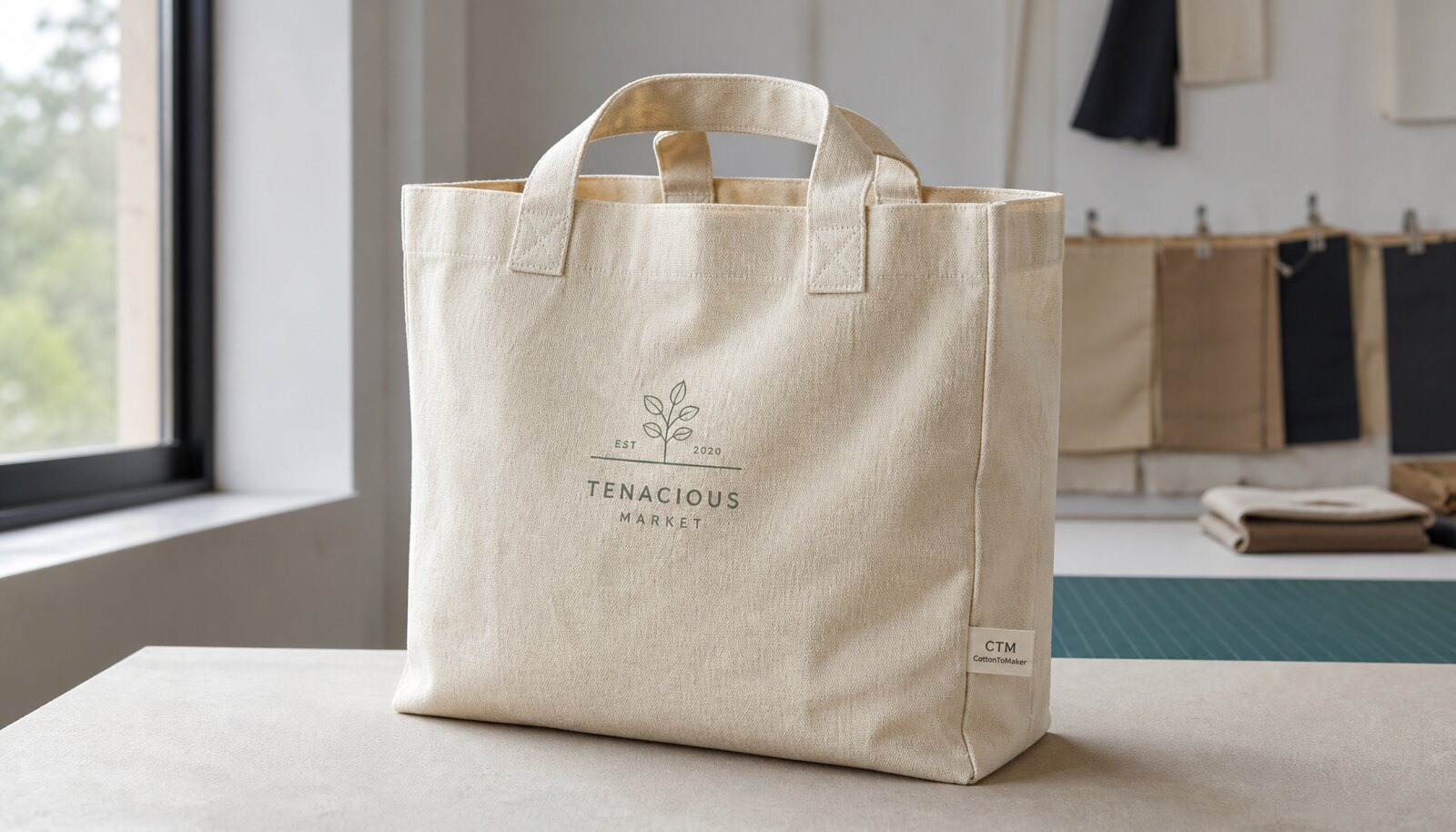
Why farmers market totes need a different sourcing spec
A tote for a farmers market is not just a branded shopper bag. It has to carry mixed produce, survive repeated weekly use, and communicate sustainability without looking flimsy. Procurement teams usually evaluate it on four fronts at once: material story, durability, print quality, and landed cost. That is why custom canvas tote bags for farmers markets need a more detailed spec than a simple promo giveaway.
The common mistake is to buy from a marketing brief instead of a use-case brief. A lightweight tote may look eco-friendly in a flat lay, but if it collapses under apples, bread, and jars, the customer sees disposable packaging rather than reusable packaging. For a B2B buyer, the real question is not whether the bag appears sustainable in a catalog. It is whether the bag is durable enough to create repeat use, low complaint risk, and a credible brand impression.
For farmers market programs, the bag must also work operationally. It needs a size that can hold a realistic shopping load, handles that do not cut into the hand, and packing that moves efficiently through a warehouse or fulfillment center. If the tote is sold at retail, it also has to sit well on shelf and survive consumer handling before purchase. If it is included as a promotional item, it needs to be costed like packaging, not like merchandise.
Useful buyer lens: compare not only the tote itself but the full system around it. Material, decoration, supply route, packing, and freight all affect whether the program is genuinely sustainable and commercially workable.
- Best-fit use cases: produce carry, market shopping, membership gifts, checkout promotions, and retail resale.
- Procurement goal: minimize cost per use, not just cost per piece.
- Commercial risk: a bag that looks sustainable but fails on strength or consistency damages both brand and program economics.
Canvas weight, fabric finish, and the spec ranges that actually matter
For most farmers market tote programs, the practical canvas range sits around 340-450 GSM, or roughly 10-12 oz depending on the supplier's terminology. That range is broad enough to cover value programs and premium retail, but the final choice should depend on load, reuse expectation, and shipping budget. A 10 oz bag usually gives the best balance of price and usefulness for everyday market shopping. A 12 oz bag feels more substantial and can support a stronger retail price, but it adds cost in fabric, sewing, and freight.
Do not compare quoted fabric weight without asking whether the supplier is referencing greige fabric, finished fabric, or the full finished bag weight. Those are different things. A factory can quote a canvas gsm number and still deliver a bag whose final packed weight and carton density change the landed cost more than expected. Ask for both fabric spec and finished bag weight so you can compare like for like.
Material finish matters too. Natural cotton canvas is generally the most straightforward option for sustainable packaging comparison because it is easy to position, easy to decorate, and usually less process-heavy than specialty finishes. Dyed or washed canvas can add visual differentiation, but it can also add shrinkage risk, shade variation, and extra process cost. If the bag is intended to feel premium, you may accept that complexity. If the program is a seasonal farm market promotion, the simplest finish often buys the best value.
For procurement, the key is to tie weight to function. A tote that carries light produce once a week can often stay in the 10 oz range. A tote expected to carry bottles, heavier vegetables, or frequent retail use should move up in strength and handle reinforcement. In other words, the right spec is not the thickest one available; it is the one that performs reliably at the target use level.
- 10 oz canvas: cost-conscious, good for moderate loads, and usually enough for general farmers market use.
- 12 oz canvas: better for premium retail, heavier contents, and longer perceived life.
- Natural cotton: usually the simplest sustainable-looking base with fewer process steps than dyed or washed alternatives.
- Always ask for finished bag weight, not just fabric GSM, when comparing quotes.
Comparing custom tote sourcing routes: factory, trading company, and mixed supply chains
The supplier route changes more than price. It changes visibility, defect ownership, communication speed, and how easy it is to manage repeat orders. A direct factory source is usually the cleanest option when you need stable specs, repeatability, and direct control over sewing and print. If the supplier operates with in-house cutting, sewing, printing, and packing, it is easier to keep process responsibility in one place and reduce the chances of an undocumented handoff.
A trading company or sourcing agent can still be valuable, especially if your team needs help lining up multiple factories or comparing different construction options quickly. The downside is that procurement teams sometimes receive a blended quote that hides the real production route. When that happens, the buyer cannot tell whether the price difference comes from fabric, print quality, sub-sourcing, or service markup. If you use an intermediary, ask for the actual plant name, the production location, and the step where quality responsibility is transferred.
There is also a mixed-route scenario worth watching. Some suppliers sew in one location and outsource print or labels to another. That is not automatically bad, but it does create more schedule and QC risk. If print is subcontracted, curing, shade matching, and defect attribution get harder to manage. For private label farmers market bags, that matters because the final product usually has one chance to make the brand look organized and trustworthy.
The right route depends on program maturity. For a first launch or seasonal test, a sourcing partner may help you move faster. For replenishment, private label retail, or multi-market rollouts, a direct factory relationship usually gives better control over unit economics and consistency.
- Direct factory: best for repeat programs and tighter spec control.
- Trading company: useful for factory comparison and communication support, but verify the real production route.
- Mixed supply chains: acceptable only when the buyer understands who controls sewing, print, labels, and packing.
Sustainable packaging comparison: canvas tote bags versus paper, compostable, and reusable alternatives
If the keyword is sustainable packaging comparison, buyers should compare canvas totes against the actual packaging alternatives they are replacing, not against a vague idea of 'eco-friendly' materials. In a farmers market setting, the real comparisons are usually between reusable canvas, paper shopping bags, reusable nonwoven bags, and compostable or fiber-based packs. Each option has a different cost structure, reuse pattern, and end-of-life story.
Canvas is strong when the program values repeated use and brand visibility. A well-made tote can be reused many times, which makes the initial cost more acceptable if the customer actually keeps using it. The tradeoff is that canvas has a higher upfront cost and higher material weight than single-use packaging. That means the buyer needs to think in cost per use, not just cost per unit. The bag only becomes sustainable if the reuse rate is credible.
Paper bags are usually simpler and cheaper at the start, but they are generally limited to one or a few uses and can be less suitable for wet produce, heavy loads, or premium branding. Compostable or fiber-based options can fit certain waste systems, but end-of-life is only meaningful if the local disposal route exists and the packaging is actually handled correctly after use. Reusable nonwoven bags can be cost-effective, but their look and hand feel may differ from cotton canvas and some buyers prefer the natural fiber story of canvas for retail branding.
The practical procurement takeaway is this: canvas tote bags are often the better fit when durability, shopper reuse, and visible branding matter more than ultra-low first cost. Paper or compostable options can still make sense for short-use packaging or moisture-sensitive processes. For farmers markets, however, the reusable canvas route often works best when the brand wants a stronger, longer-life packaging statement rather than a one-time carry solution.
- Compare options by reuse rate, load capacity, and disposal route, not only by 'green' perception.
- Ask whether your packaging system needs one-time carry or repeat carry.
- Do not assume compostable packaging is better if the local end-of-life infrastructure is weak or unclear.
Print methods, decoration options, and what each one does to cost and durability
Most farmers market totes use simple artwork: a logo, market name, seasonal message, or a small brand mark. For that kind of decoration, screen printing is usually the most commercial choice when volume is sufficient. It works well on natural canvas, gives strong opacity, and is easier to inspect against a physical sample. The main control point is ink cure. If the print is under-cured, it can crack, rub off, or transfer during packing and use.
Digital print and heat transfer can help with lower MOQs or more complex art. They are worth comparing when the design includes multiple colors, gradients, or fine type that would be expensive to separate into screens. But these methods need a real production sample on the actual canvas, because texture changes how the art appears. A graphic that looks crisp on a screen can soften on coarse canvas or lose small details once the fabric weave is involved.
Decoration also affects sustainability comparisons. More ink, more transfer film, or more process steps can mean more material input and more risk of rework if the artwork is not approved carefully. For that reason, a simpler print spec often outperforms a more elaborate one on both cost and operational reliability. Many procurement teams find that one strong logo in one or two colors is enough for market use and gives a better total-cost result than a complex, highly decorated tote.
If the brand wants a quieter look, stitched side labels, woven labels, or a small hem tab can reduce ink usage while still giving a custom identity. That approach can work well, but the label itself becomes a QC item. Placement, fraying, and stitch bite should be checked just as carefully as print alignment.
- Screen print: best for simple logos, better opacity, and scalable unit economics.
- Digital or heat transfer: useful for small launches or complex art, but validate on actual fabric.
- Side labels reduce print coverage, but they add stitch and placement QC requirements.
- Require a rub test and a fold test on printed samples before bulk approval.
How to build a quote that procurement can actually compare
A usable quote should look more like a production spec sheet than a sales note. If a supplier only gives a unit price and a product image, there is not enough information to compare vendors. The quote should name the fabric weight, dimensions, handle size, print method, color count, label type, fold method, carton count, and lead time. Without those details, you cannot separate a real price difference from a missing process step.
This is where many buyers underestimate landed cost. A quote can be cheaper because it excludes a sewn label, uses a lighter actual fabric, or packs fewer units per carton with more air. When freight, customs handling, and warehouse labor are included, the low quote may not be the low cost. For custom canvas tote bags for farmers markets, the right comparison is ex-factory plus all the steps required to get the bag usable in your channel.
A good RFQ should also ask the factory to show what is included and excluded. For example, if one quote includes one-side print, polybag, and master carton marks, while another excludes folding and labels, the numbers are not directly comparable. Ask for a line-item breakdown so the decision maker can compare supplier A versus supplier B on the same assumptions. If the supplier cannot separate those items, treat that as a sourcing warning, not a minor formatting issue.
Practical quote structure: base bag cost, decoration cost, packing cost, sample cost, and any setup cost. Once those pieces are visible, procurement can compare supplier routes, explain the premium for quality, and defend the final award internally.
- Ask for separate pricing for base bag, print setup, labels, packing, and samples.
- Require carton dimensions and packed quantity so freight can be estimated accurately.
- Compare landed cost, not just ex-factory unit price.
What to specify in size, handles, seams, and load performance
Farmers market totes fail most often at the same points: handles, side seams, and bottom seams. That is why the product spec needs to cover more than a bag silhouette. Start with the use scenario. If shoppers will carry produce, jars, and bottles, the bag needs a width and depth that keep the contents stable, plus a handle long enough to stay comfortable over the shoulder or in hand. If the tote is mainly a giveaway, a simpler size can work, but the customer should still be able to reuse it without frustration.
Handle construction is one of the biggest cost-performance indicators. The buyer should ask how the handle is attached, how many stitch rows are used, whether bartacks or box-X reinforcement are standard, and what seam allowance the factory uses. A handle that looks fine in a photo can still fail early if it is sewn too narrowly or with too few reinforcement stitches. For market use, that failure is not just a warranty issue; it is a brand trust issue.
Seam layout matters as well. A flat tote with a clean side seam may be enough for light use, but if the bag is expected to carry heavier produce, ask whether the bottom seam or gusset area can be reinforced. A simple way to control this is to specify a load target during sample approval. You do not need to publish a lab claim to the factory, but you do need a realistic benchmark so the sewing line understands what the bag must withstand.
If the tote includes a lining, pocket, or gusset, each added feature raises sewing time and can affect the minimum order quantity. Those features are not wrong, but they should be justified by the channel. For a farmers market shopper bag, fewer features often mean better durability, lower unit cost, and easier inspection.
- Define the intended load before finalizing size and seam design.
- Ask for handle attachment details: stitch rows, bartacks, and reinforcement pattern.
- Use load-driven spec decisions rather than feature-driven decisions.
- Keep the structure simple unless the retail channel truly needs extra pockets or lining.
MOQ, lead time, and the real cost drivers behind each quote
MOQ is rarely just a factory policy. It is usually a reflection of setup cost, cutting efficiency, print screens, label application, and packing labor. A simple natural tote with one-color print can often be produced at a lower MOQ than a tote with a woven label, special fold, and multiple print positions. This is why two suppliers can quote very different minimums for what looks like the same product.
Lead time should be read in stages: sample time, bulk time, packing time, and booking time. A supplier may quote a short bulk lead time, but if artwork confirmation or carton approval is delayed, the calendar slips anyway. That is why buyers should freeze artwork and packaging details before the production slot is booked. For seasonal farmers market campaigns, the approval cycle is often the hidden risk, not the sewing line.
Cost drivers are usually predictable. Heavier fabric raises material cost and freight. More colors raise print setup and inspection burden. Special labels and retail folding raise labor cost. Better carton density improves shipping efficiency. If you want to reduce price without lowering perceived quality, the first places to look are artwork simplification, standard fold method, and carton optimization rather than simply reducing fabric weight.
A practical procurement rule: use lower MOQ and more customization for test launches, then move to a simpler, repeatable spec once you know what the market buys. That gives the brand room to learn without locking the program into expensive complexity.
- Separate MOQ for the base bag from MOQ for each decoration or packing step.
- Freeze artwork early to avoid print and sample delays.
- Use simpler specs to keep MOQ manageable, especially for first orders.
- Consider running a test launch before committing to a large replenishment program.
QC plan: the inspection points that should be in the PO or approval file
Quality control for canvas totes should be specific enough that a third party could inspect the order without guessing. Start with an AQL framework and tie it to the approved sample. The buyer should define what counts as a major defect, a minor defect, and a critical defect. If the order is important to retail or seasonal sales, it is worth stating how many units will be inspected, what sampling plan applies, and which defects trigger rework or rejection.
Measurement points should be standardized. For a tote, that usually means body width at top and bottom, height, handle length, handle drop, gusset depth if any, and print position relative to seam or hem. Measure from the same points on every sample so the factory and buyer are comparing the same thing. Variation is normal in sewn goods, but it should stay inside the agreed tolerance.
The seam check deserves more detail than a quick visual scan. Inspect the handle attachment area for skipped stitches, loose thread ends, needle holes, crooked reinforcement, and unequal stitch count between left and right handles. Check the side seam for puckering and the bottom seam for tension marks. If the tote is meant for heavy produce, ask whether the manufacturer can run a pull test or load simulation on the handle attachment before bulk release.
Print QC should be equally practical. Check registration, edge sharpness, ink opacity, and cure. Then perform a simple rub test: dry rub, and if relevant, a light wet rub. If the bag will be folded for packing, fold a sample several times and inspect whether the ink cracks on stress lines. Finally, inspect cartons as part of the product. A packed tote that looks fine in-process can still arrive damaged if the carton count, carton strength, or pack method is weak.
For export shipments, a carton drop test or basic transit simulation can be worth adding, especially when the shipment is high value or destined for retail distribution. That is a low-cost way to catch packing weakness before the shipment leaves the factory.
- Use an AQL-based inspection plan with defined major, minor, and critical defects.
- Measure the same points every time: width, height, handle length, handle drop, and print location.
- Check handle reinforcement, seam quality, print cure, and carton integrity as separate QC items.
- Ask for dry rub, wet rub, and fold stress checks on printed samples.
Landed-cost comparison: how to compare suppliers without being fooled by unit price
A meaningful sustainable packaging comparison needs a landed-cost view. The ex-factory unit price matters, but it is only one part of the final number. Fabric weight changes freight. Packing density changes carton count. Decoration changes labor and rejection risk. And if the supplier route is unclear, a low unit price may hide a second layer of service or a subcontracted process that changes accountability.
For example, a lighter canvas tote may quote lower at the factory but require more cartons for the same order quantity, which raises ocean or air freight. A heavier tote may cost more per piece but pack more predictably and look premium enough to support retail pricing. Likewise, a simple one-color screen print may be cheaper and more durable than a more complex decoration that needs extra setup or has a higher defect risk. Procurement should compare the cost of getting the bag into use, not just getting it out of the factory.
It is also useful to think in cost per use. Farmers market tote programs often rely on reuse to justify the sustainability story. A bag that is a little more expensive but lasts longer and gets reused more often may be the better commercial choice. That does not mean every buyer should choose the thickest canvas available. It means the cheapest piece is not always the cheapest program.
If you need a quick internal comparison, model three things side by side: factory price, freight impact from packed weight and carton volume, and expected life in use. That framework usually exposes which option is truly economical and which one only looks cheaper on paper.
- Compare ex-factory price, freight impact, and expected life together.
- Watch how fabric weight changes carton density and shipping cost.
- Use cost per use as the internal decision metric whenever the tote is positioned as reusable packaging.
Specification comparison for buyers
| Buying route / material option | Best fit for procurement | Commercial tradeoffs | Sustainability and QC watchouts |
|---|---|---|---|
| Direct factory source with in-house sewing and print | Repeat programs, private label, tighter spec control, and season-to-season replenishment | Usually strongest on unit cost at volume and easiest to lock to one approved spec; quoting is clearer when cutting, sewing, printing, and packing are all in one facility | Ask who owns each step. If print is outsourced, lead time, shade control, and defect accountability become harder to manage. Request in-house process photos and one QC owner for the full order |
| Trading company or sourcing agent | Teams that need help comparing multiple factories or have limited Asia sourcing capacity | Can speed up factory matching and communication, but price transparency depends on whether they disclose the actual production route and service fee | Check whether the quote is a true factory price plus service fee or a blended quote. Ask for factory name, production location, and whether samples will be approved at the actual plant |
| 10 oz canvas tote, about 340-380 GSM | General farmers market use, giveaways, mid-tier retail, and moderate produce loads | Lower fabric cost and lighter freight than heavier canvas; usually a better launch spec when the brand wants an accessible price point | Confirm handle reinforcement and stitch density. If the tote will carry jars, potatoes, or multiple items weekly, 10 oz may need a reinforced bottom seam and wider handle attachment |
| 12 oz canvas tote, about 400-450 GSM | Premium resale, longer reuse cycles, and heavier contents | Higher material and sewing cost, more freight weight, and often a firmer hand feel that can support retail value | Heavier fabric can reduce print sharpness on coarse weave. Ask for actual finished weight, not only fabric GSM, and compare carton density before awarding |
| Natural cotton canvas | Brands that want a clean, organic-looking base and straightforward decoration | Usually the most cost-effective look for sustainable packaging programs and easier to source than specialty finishes | Natural shade varies by lot. Build a color tolerance method into sample approval because cream tone, flecks, and yarn irregularity can vary within acceptable production ranges |
| Dyed or garment-washed canvas | Fashion-forward retail programs or seasonal branded collections | Stronger visual differentiation but more process steps and typically more cost | Color consistency, shrinkage, and wash effect need tighter control. Confirm whether the finish is pre-washed or garment-washed and how that affects dimensional tolerances |
| Screen print, 1-2 colors | Simple logos, market messaging, and higher-volume programs | Best cost-performance for large runs and strongest opacity on natural canvas | Cure quality matters. Require rub testing, print registration checks, and a sample from the actual production screen, not only a digital proof |
| Digital or heat transfer print | Short runs, multi-color graphics, or launches with uncertain demand | Lower setup burden than screens, but the finished look can be softer and sometimes less durable on textured canvas | Request abrasion and fold testing. Fine type can break up on coarse canvas, and color on fabric may differ from the on-screen design |
| Reusable canvas tote vs. single-use paper or compostable pack | Programs where buyers are comparing sustainable packaging choices, not just tote suppliers | Canvas can outperform one-time packaging when reuse is realistic, but it requires a higher initial cost and better durability spec | Do not assume sustainability from material alone. End-of-life, washability, replacement rate, and actual reuse behavior matter more than a simple green label |
Buyer checklist before sampling
- Define the use case before requesting quotes: farmers market shopping, produce carry, promotional giveaway, or retail resale. The bag size, fabric weight, handle length, and reinforcement level should change with the use case.
- Request GSM or oz, weave type, and finished bag weight in the RFQ. Do not accept vague language such as 'thick canvas' or 'heavy duty' without measurable specs.
- Set the target load clearly. If the tote will carry bottles, boxed produce, or jars, ask for bottom seam reinforcement and a stronger handle attachment pattern.
- Choose the print method based on artwork complexity and order volume. Simple one- or two-color graphics usually fit screen printing best; short runs and complex art may justify digital or heat transfer.
- Ask for a pre-production sample in final fabric, final color, final print method, and final packing style before bulk approval. A paper mockup is not enough.
- Confirm carton count, carton dimensions, gross weight, and fold method before production starts so freight planning and warehouse receiving are accurate.
- Build in a tolerance method for natural canvas shade, bag dimensions, handle length, and print placement. Keep a signed sample and photos from multiple angles.
- Request a QC plan that includes AQL level, measurement points, seam checks, print durability checks, and carton drop or handling tests if the shipment is export-critical.
- Ask the supplier to quote all cost components separately: unit price, print setup, sample fee, label fee, packing fee, and any surcharge for rush production or special folding.
Factory quote questions to send
- What is the exact fabric construction, yarn count, weave, and GSM or oz? Please also state whether the canvas is natural, bleached, dyed, or washed before sewing.
- Is printing done in-house? If not, who performs it, and how does that affect lead time, color control, and defect responsibility?
- What is the exact bag size, handle length, handle width, seam allowance, and reinforcement pattern? Can you share a spec sheet with measurement points?
- What is the MOQ by size, print color, and label type? Please separate MOQ for the base bag from MOQ for each decoration step.
- What is included in the quoted unit price: fabric, sewing, print, labels, folding, polybag, carton marks, and export packing?
- Can you provide a pre-production sample, a production sample, and a carton-packed sample photo with the final fold and count method?
- What tolerances do you apply for dimensions, print placement, color shade, and stitch alignment? Please state the acceptable range in millimeters or percentage where possible.
- What QC standard do you use for inspection, and what AQL level do you propose for major, minor, and critical defects?
- How do you inspect handles, seams, and print durability? Please describe the seam test, rub test, and any pull or load test you use.
- What carton size, packed quantity, and gross weight do you recommend for sea freight efficiency and warehouse handling?
Quality-control points to confirm
- Use an AQL-based inspection plan rather than a generic visual check. For a standard tote program, many buyers set separate acceptance criteria for major, minor, and critical defects and inspect against the approved sample and spec sheet.
- Measure the bag at consistent points: body width at top, body width at bottom, body height, gusset depth if any, handle drop, and handle length. Measure at least the left, center, and right if the pattern is prone to variation.
- Inspect stitch quality at handle attachment, side seams, bottom seams, and any stress points. Look for skipped stitches, loose thread tails, needle damage, uneven seam allowance, and puckering.
- For handle strength, check both symmetry and reinforcement. Confirm that the number of rows, box-X pattern, bartacks, or equivalent reinforcement matches the approved sample and is placed evenly on both sides.
- For print quality, verify placement, registration, edge sharpness, ink opacity, and cure. A useful screen-print check includes dry rub and wet rub, plus a simple fold test to see whether the ink cracks at stress points.
- For color tolerance, compare against a signed reference sample under consistent lighting, ideally daylight-equivalent light. Do not judge shade only from a phone photo; natural canvas absorbs and reflects color unevenly.
- Check the canvas itself for broken yarns, oil stains, fiber contamination, slubs beyond the agreed tolerance, and panel shade variation. Natural fabric often has visible character, but buyers still need a threshold for defect acceptability.
- If the tote includes a side label, woven label, or printed neck tab, inspect placement and finish separately. Look for curling, fraying, skew, and stitch bite into the label edge.
- Confirm carton build quality and packing count. Check carton dimension, compression strength if the shipment will be stacked, and whether the pack count matches the label and packing list exactly.
- Perform a carton drop test or handling simulation when the order is high value or export-sensitive. At minimum, test the packed carton for corner damage, flap opening, and item movement after a short transit simulation.