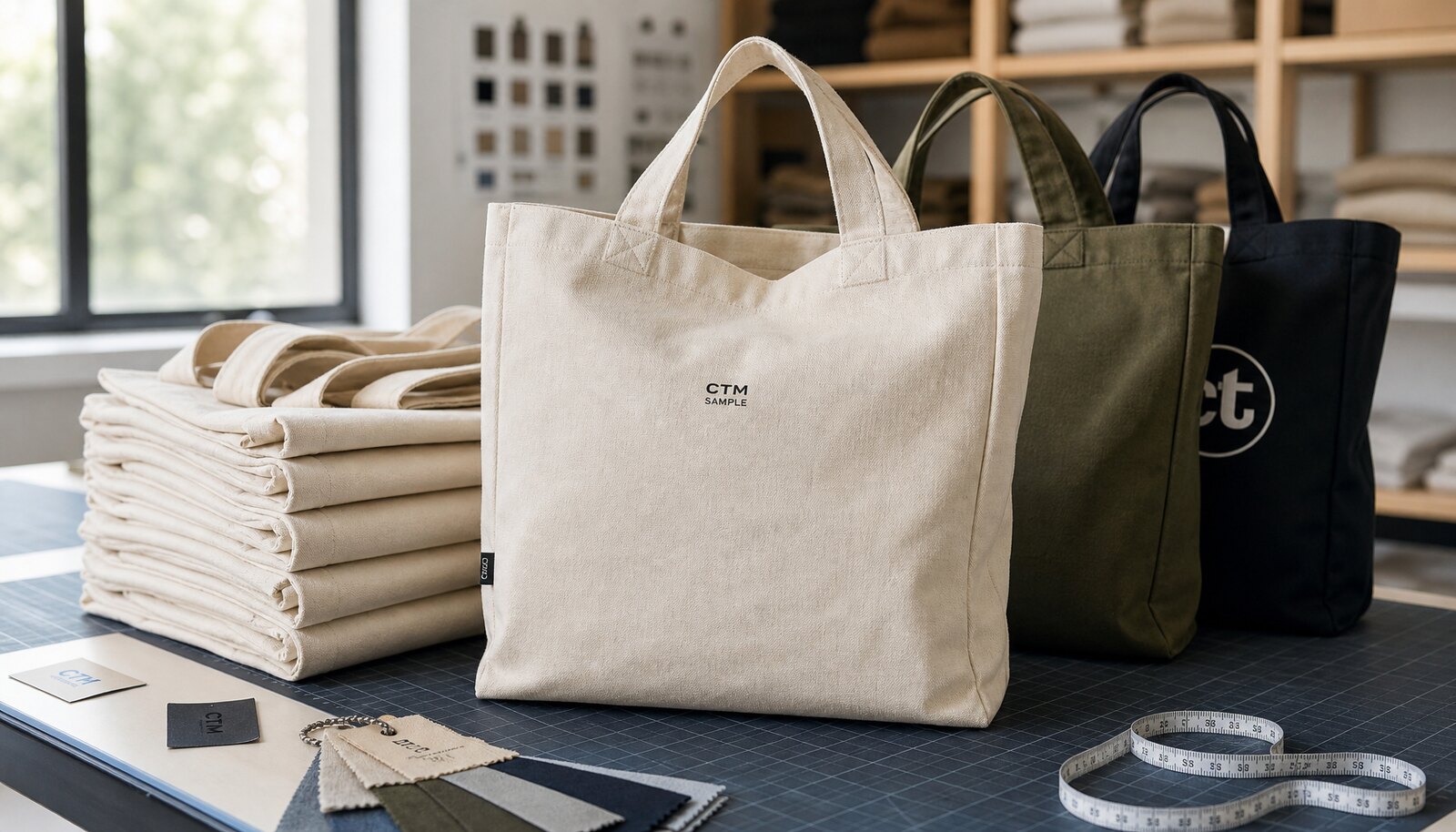
1) Start with the market use case, not the artwork
A farmers market tote is not judged like a simple promo bag. Buyers are usually trying to solve a practical retail or distribution problem: shoppers need a bag that can hold produce, bread, jars, flowers, and seasonal goods without sagging, tearing, or looking disposable after one trip. The bag also carries brand value, because a tote that gets reused after the market becomes a moving advertisement for the store, co-op, farm, or event sponsor.
That is why the first procurement decision should be use case, not artwork. A simple logo can work on many bag constructions, but the right spec depends on whether the tote will be sold at retail, given away at a weekend event, used in a CSA membership pack, or handed out by vendors as a co-branded premium. If you define the channel first, the rest of the RFQ becomes easier to compare and far less likely to drift into quote-by-guesswork.
For procurement teams, the most useful question is: what does success look like after first use, third use, and first wash or wipe-down? If the answer is “bag still stands, handle still feels secure, print still looks clean,” the specification needs enough structure to support repeated handling. If the answer is “low-cost giveaway for a single event,” you can relax some requirements, but you should not skip the basic checks on seams, dimensions, and print clarity.
- Define the use case: retail, giveaway, CSA pack-in, vendor co-brand, or wholesale program.
- Decide whether repeat use is expected; that changes fabric weight, reinforcement, and print durability.
- Treat appearance, load behavior, and packaging as one commercial specification, not separate tasks.
2) Choose the canvas weight that fits the tote’s job
For most custom canvas tote bags for farmers markets custom logo order guide projects, 10 oz to 12 oz canvas is the most practical starting point. That range typically gives enough body for a tote to stand up on a table or in a cart, while still accepting common print methods without becoming too expensive to sew, pack, and ship. In GSM terms, many buyers will see this roughly in the 340 to 420 GSM band, though suppliers do not always describe canvas the same way, so the raw spec should be written in both systems if possible.
There are good reasons to move lighter or heavier. A lighter 8 oz bag may work for a short-term promo, especially when the order is large and the budget is tight. But lighter fabric usually makes the tote collapse more readily under produce or bottled goods, and the bag can look less valuable when it is empty. Heavier 12 oz to 14 oz canvas improves structure and perceived quality, but it adds unit cost, can increase sewing difficulty, and may require stronger handles and more careful print curing.
A procurement buyer should ask for the exact fabric construction, not only the marketing label. “Canvas” can mean different weave densities, finishes, and caliper. A quote that says only “cotton canvas bag” is not enough for a serious order. Ask whether the fabric is bleached or natural, whether it is pre-shrunk, whether there is any coating or wash effect, and whether the sample came from the same mill batch as intended for production.
- 8 oz: best for low-cost events or short-use programs; higher risk of floppy structure.
- 10–12 oz: usually the best balance for farmers market retail and repeat use.
- 12–14 oz: stronger feel and better shape retention, but higher cost and more sewing stress.
3) Lock the bag size and handle geometry before asking for prices
Size affects both sell-through and packaging efficiency. A common working format for market use is 12 x 13 x 6 in for compact daily shopping, or 15 x 15 x 7 in for more general produce and mixed vendors. The gusset matters because it gives the tote depth for apples, greens, flowers, loaves, jars, and boxed items. A flat tote may look neat in a mockup, but in actual market use it behaves like a poster board sleeve: fine for papers, not ideal for produce.
Handle geometry matters just as much. Buyers should specify handle length, finished drop, width, and construction method. A handle that is too short forces a hand-carry only posture and becomes annoying when the tote is full. For many farmers market programs, a total handle length around 22 to 26 in supports both hand carry and shoulder carry, but the useful number is the finished drop, not only the cut length. Ask the factory to state both in the quotation.
The attachment method should reflect expected load. Self-fabric handles are aesthetically cohesive and often suit retail branding, while webbing handles can improve load confidence and wear resistance. If the tote will carry jars or heavier produce, require bartacks or reinforced joins at the handle seam. A simple note like “reinforced handles” is too vague; write the reinforcement type and exact location so the supplier cannot substitute a lighter method without notice.
- Specify finished size and gusset depth; do not rely on artwork mockups to imply capacity.
- State handle drop, not only total handle length.
- Require reinforcement at stress points if the bag will be loaded with produce or bottles.
4) Select the print method based on artwork, not habit
For simple logos and repeat bulk orders, screen printing remains the most dependable route. It usually gives good opacity on natural canvas, and it is well suited to one- or two-color branding where the buyer wants a clean logo, not a photographic effect. On textured canvas, though, the weave can affect edge sharpness and ink laydown, so the approved sample matters more than the digital proof.
Heat transfer and DTF have a place, but they should be chosen intentionally. If the artwork has fine lines, many colors, or variable placement, these methods can solve detail problems that screen print cannot handle economically. The tradeoff is that the print may feel less integrated with the fabric, and buyers need to confirm rub resistance, fold behavior, and long-term appearance under repeated handling. A tote for farmers market use gets folded, set down, picked up, and stuffed into cars, so a decoration method that looks great on day one but wears badly after use creates avoidable complaints.
A good RFQ should include the exact artwork file type, print locations, color count, and acceptable variation. For natural canvas, buyers should also ask how the factory manages white underbase, color density, and print registration on rough weave. This is especially important when the logo sits close to a seam, gusset, or handle attachment point. If your design is small, keep the type size generous; tiny letters often fill in once printed on coarse canvas.
- Use screen print for simple 1–2 color logos and repeat runs.
- Use transfer methods only when art detail or small quantity justifies the tradeoff.
- Approve on the actual canvas color and weight, not on a paper proof alone.
- Avoid tiny text and hairline rules on heavily textured fabric.
5) Use supplier route and MOQ together, not as separate decisions
The right supplier route depends on how tightly you need to control material and process. A direct factory is usually the strongest option for buyers who want more predictable fabric sourcing, stitch construction, and production visibility. It also makes it easier to manage sample approval, because you are closer to the line that actually sews and packs the bags. A trading company may help when you need a broader product bundle, when the order is urgent, or when your internal team prefers one point of contact. The drawback is that traceability and change control can be weaker if the trading layer is not disciplined.
MOQ should be interpreted in layers: fabric, print, and packing. A supplier might say the total MOQ is low, but still require minimums by color, artwork, or carton configuration. For farmers market totes, a practical production range is often 1,000 to 3,000 pcs for a standard style with a simple logo, though some factories can go lower if the buyer accepts higher unit cost or fewer customization choices. Very low MOQ can work for pilots or event trials, but if the tote is a repeat SKU, buyers should compare landed cost, not just the starting quote.
One useful procurement test is to ask the supplier how the unit price changes across volume tiers and across print changes. Compare one color versus two colors, one artwork versus a second print location, or bulk pack versus retail pack. Those deltas show whether the quote is built on real manufacturing logic or just a placeholder number. If the supplier avoids specific answers, that is a red flag: it often means hidden setup charges will appear after sample approval.
- Direct factory: best for repeatability, spec control, and clearer QC evidence.
- Trading company: useful for mixed programs, but confirm who owns sample and production accountability.
- Low MOQ is not a bargain if it comes with limited print options, poor packing flexibility, or weak traceability.
6) Compare quote structures before you choose a supplier
A useful supplier comparison should show more than unit price. Procurement teams need to see how each option performs on material control, decoration quality, packing, and lead time. Two quotes can differ by only a few cents and still carry very different risk profiles if one includes pre-production approval, in-process photo evidence, and stronger carton packing while the other leaves those items vague.
The table below is more useful than a generic “best choice” label because it shows what the supplier route means operationally. Buyers can use it to decide whether the lowest quote is really the lowest landed cost, or whether it simply hides risk in the sample stage, packing stage, or final inspection stage.
This comparison is especially important when the tote is tied to a seasonal sales window. A slightly higher quote from a factory that can hold spec discipline may be cheaper than a lower quote from a supplier that needs repeated corrections. In other words, quote comparison should include the cost of delay and the cost of rework, even if those costs are not line-itemed in the first offer.
7) Build the sample and approval process like a production gate
A sample should prove production reality, not only visual intent. For a canvas tote, the pre-production sample or strike-off should be made on the actual fabric weight and color intended for bulk production whenever possible. That sample should confirm print position, logo size, handle balance, seam appearance, and how the bag behaves when loaded. A digital render is not enough, because canvas texture, ink density, and sewing tension all change the final result.
The approval process should be written as a gate. First, verify the artwork file and placement dimensions. Second, check the physical sample for size, handle drop, seam balance, and print quality. Third, test the sample with real contents: produce weight, bottled goods, or whatever your buyers actually carry. Fourth, record what was approved so later production changes can be compared against a fixed reference. This is the simplest way to prevent silent spec drift.
If the tote is going into a retail or distribution channel, ask for at least one approval sample retained by your team. That retained sample becomes the benchmark for future reorders. It also helps when a supplier changes fabric source, print shop, or sewing line. Buyers often lose time because the “same” tote is revised over time without a formal version record. Treat version control as part of procurement, not an admin afterthought.
- Approve the sample using the actual canvas weight, not just a visual mockup.
- Test the sample with real load, not empty-bag inspection only.
- Keep one reference sample and a dated spec sheet for reorders.
- Record any approved deviations so future production does not silently drift.
8) Quality control for tote bags needs measurable checks, not vague approval
For a buyer order guide to be commercially useful, QC needs more specificity than “check stitching and print.” A serious tote program should define what good looks like before the order starts. That usually means tolerances on finished dimensions, a visible standard for stitch density, a method for checking handle strength, a print adhesion check, and packing verification that matches the warehouse or receiving process. Without those rules, the factory may still ship a bag that technically looks acceptable but fails in daily use or creates receiving disputes.
Start with the sewing. Ask the supplier to state seam construction and stitch density, and then verify that the approved sample is consistent with bulk production. Many buyers use a practical benchmark expressed as stitches per inch or an equivalent sewing standard, because that is easier to audit than “strong stitching.” Reinforced handles should show bartacks or equivalent reinforcement where stress is highest, and the top seam should not twist when the bag is loaded.
Next, check print performance. On canvas, ink should sit cleanly on the weave without major patchiness, bleeding, or undercured tackiness. A simple cloth rub test after curing can reveal whether ink transfers too easily. If the design includes fine text or registration across panels, inspect alignment against an agreed tolerance rather than relying on eye-balling from a distance. Small shifts matter when the logo is centered on a bag that will be displayed in retail.
Finally, verify packaging as part of QC. Count accuracy is critical, but so is physical protection. Check carton size, inner pack count, carton strength, and whether bags are folded in a way that creates hard creases or crushes printed areas. If the shipment is palletized, make sure the pallet pattern and wrap are stable enough for transit. For long shipping lanes or humid storage, ask whether the carton board and packing method are appropriate for moisture exposure. A clean tote can still arrive looking low quality if the carton tears or the bags are packed too tightly.
- Ask for stitching standards in measurable terms, not only visual approval.
- Check handle reinforcement and top seam behavior under load.
- Use a rub test for ink adhesion on the actual canvas.
- Verify carton count, carton dimensions, and packing orientation before shipment.
9) Packing, labeling, and receiving rules should match your channel
Packing decisions affect freight cost, warehouse handling, and retail presentation. For bulk wholesale, flat packing in master cartons is usually the most efficient approach because it keeps the tote compact and reduces shipping waste. If the bags are going straight to stores or need to be scanned into a warehouse, then individual polybags, insert cards, barcode labels, or shelf-ready packing may be necessary. Those choices should be defined before quoting because they change labor time, carton dimensions, and total landed cost.
Labeling needs to align with the buyer’s receiving workflow. If your warehouse expects UPC labels or carton marks, the supplier should know the exact format, placement, and content. If your team does not use barcodes, do not pay for them. A common mistake is ordering retail-ready extras that do not fit the actual distribution process, which adds cost without helping the buyer move inventory.
Carton verification matters because tote programs often create disputes over count and color split. Define inner pack count, outer carton count, net and gross weight, and whether mixed-color cartons are allowed. If mixed cartons are permitted, specify the ratio and the marking method. If they are not allowed, say so clearly. The fewer assumptions left to the supplier, the less likely the receiving team will face surprises at destination.
- Bulk pack for wholesale efficiency; retail pack only when the channel requires it.
- Specify barcode, insert card, and carton marks only if your process actually uses them.
- Define inner pack count and carton split rules to prevent receiving disputes.
10) Lead time planning should include sample, revision, and peak-season risk
Lead time is rarely just sewing time. For a first order, the schedule should include RFQ review, sample creation, sample approval, any artwork edits, production, packing, final inspection, and shipping. For repeat orders, production may be faster, but seasonal demand still creates pressure. Farmers market buyers often need totes before spring openings, summer events, harvest weekends, or holiday gifting. If the order lands late, the bag may miss the selling window even if the product itself is acceptable.
A practical lead-time target for a repeat spec after sample approval is often in the 35 to 50 day range, but that should be treated as a planning baseline, not a promise. New fabric sourcing, additional decoration methods, or retail-ready packing can extend the schedule. Buyers should build internal deadlines with buffer time, especially if they expect artwork revisions or want a third-party inspection before dispatch. The simplest way to protect the calendar is to freeze the spec before the factory starts cutting.
When comparing suppliers, ask where schedule risk usually appears. A strong factory can explain whether delays are more likely in fabric procurement, print setup, sewing capacity, or carton packing. That answer is more useful than a generic “fast delivery” claim. If a supplier cannot identify the critical path, they may not have enough control over the order to support a seasonal launch.
- Use a schedule with time for sample approval and any rework.
- Treat packaging changes as schedule changes, not minor edits.
- Freeze the spec before cutting to reduce the risk of late-stage surprises.
- Ask the supplier to name the bottleneck that most often affects delivery.
Specification comparison for buyers
| Procurement decision | Option A | Option B | Tradeoff / implication |
|---|---|---|---|
| Fabric weight | 8 oz / lightweight canvas | 10–12 oz / standard market canvas | 8 oz lowers cost and shipping weight, but bags lose structure and may feel promotional rather than retail-ready; 10–12 oz is usually the safest balance for repeated market use. |
| Bag build | Flat tote without gusset | Gusseted tote with 3–7 in depth | Flat bags are simpler to make and cheaper to ship, but they hold less produce and collapse at the stall; gussets improve capacity and shelf appeal, but raise sewing complexity and carton bulk. |
| Handle construction | Self-fabric handles | Webbing handles or reinforced self-fabric handles | Self-fabric handles look cohesive and are common for retail branding; webbing handles often improve load confidence, while reinforced self-fabric handles need good bartacks and seam control to avoid failures under heavy produce. |
| Print method | 1–2 color screen print | DTF / heat transfer / multi-color print | Screen print is usually best for repeat bulk orders with simple logos; transfer methods can support detail or small runs, but buyers should verify feel, wash/rub resistance, and placement on real canvas. |
| Supplier route | Direct factory | Trading company or local decorator | Direct factories usually give better control over stitching, material sourcing, and QC evidence; trading companies can be faster for mixed programs, while local decorators are often easier for very small quantities but can be less competitive on unit cost. |
| MOQ | 1,000–3,000 pcs per style | 300–999 pcs with narrower options | Higher MOQ often supports better pricing and more stable production; lower MOQ may be workable for pilots, but usually adds cost, reduces customization options, or increases the chance of manual handling errors. |
| Packing style | Bulk pack in master cartons | Retail-ready polybag, insert card, barcode label | Bulk packing is more freight-efficient and common for wholesale; retail-ready packing improves sell-through and warehouse intake, but it adds labor, carton volume, and verification steps. |
| Quality control level | Basic final inspection | Pre-production sample + in-process checks + final AQL-style inspection | Basic inspection may be enough for simple giveaways; a retail program should include measurable QC checkpoints because defects in handle strength, print position, or count accuracy are expensive to correct after shipment. |
| Lead-time approach | Single production run close to launch | Buffer schedule with sample approval and contingency time | Tight schedules can work for repeats, but first orders and seasonal launches need buffer for artwork corrections, sample sign-off, and carton verification before dispatch. |
Buyer checklist before sampling
- Define the end use first: resale at market, vendor giveaway, CSA membership kit, co-branded promotion, or retail wholesale.
- Confirm fabric weight in oz or GSM, and state whether the canvas is natural, bleached, dyed, or garment-washed.
- Lock finished size, gusset depth, handle length, handle drop, and handle attachment method before requesting quotations.
- Provide vector artwork and specify print colors, Pantone targets if needed, print placement, and acceptable logo tolerance on textured canvas.
- Request a pre-production sample or strike-off made on the actual fabric weight and color, not only a digital mockup.
- Ask the supplier to confirm stitch construction, bartack placement, and seam allowance in the sample stage.
- State packing requirements clearly: bulk pack, individual polybag, insert card, barcode label, carton marking, or shelf-ready pack.
- Ask for in-process production photos covering cutting, printing, sewing, finishing, and carton packing.
- Request carton count, inner pack count, net/gross weight, carton dimensions, and palletization rules before shipment.
- Specify whether the order must pass internal warehouse receiving rules, retail compliance rules, or third-party inspection.
Factory quote questions to send
- What exact canvas weight, weave style, and finish are included in the quote?
- Is the quoted price for self-fabric handles, webbing handles, or reinforced handles with bartacks?
- What is the finished bag size after sewing, including gusset depth and handle drop?
- How many print colors, print positions, and setup fees are included?
- What is the surcharge for a second logo location, a larger print area, or a change in print method?
- What is the MOQ per style, per color, and per artwork version?
- If we request multiple colorways or pack formats, how does that affect price and lead time?
- What sample fee applies, and is it credited back after bulk order confirmation?
- What quality checks are performed before packing, and can you share actual production photos?
- What carton size, pack count, and outer carton strength do you recommend for this order?
Quality-control points to confirm
- Fabric weight should be measured against the approved spec, not estimated by feel; ask the supplier to confirm GSM or oz with the production batch.
- Finished dimensions should include a tolerance range in writing, such as a practical ±0.5 in on body width/height and a clear limit on gusset variation, because small changes affect retail presentation and carton fit.
- Seam construction should be checked at corners, side seams, and bottom joins; look for consistent seam allowance and no skipped stitches or loose thread ends.
- Handle strength should be verified with a pull test or load simulation; buyers often use a practical internal benchmark such as lifting a weighted sample repeatedly without stitch separation, bartack failure, or seam distortion.
- Stitch density should be visible and consistent along the load-bearing seams; ask the factory to state stitches per inch or an equivalent sewing standard for the approved sample.
- Bartacks should be present at stress points if the bag is intended for heavy produce or repeat use; weak or missing reinforcement is a common failure mode.
- Print quality should be checked for registration, opacity, edge sharpness, and cure; rub with a white cloth after curing to look for ink transfer or tackiness, especially on dark or heavily textured canvas.
- Ink adhesion should be checked on the actual canvas finish; screen print, heat transfer, and DTF can all behave differently once folded, handled, or exposed to friction.
- Carton packing should be verified by count and by physical fit; bags should not be crushed, overfolded, or packed so tightly that seams crease permanently.
- Carton drop and transit readiness should be checked at the packing stage; a simple internal test is to confirm cartons remain intact after handling simulation and that handles, corners, and printed surfaces do not deform or rub against rough board edges.