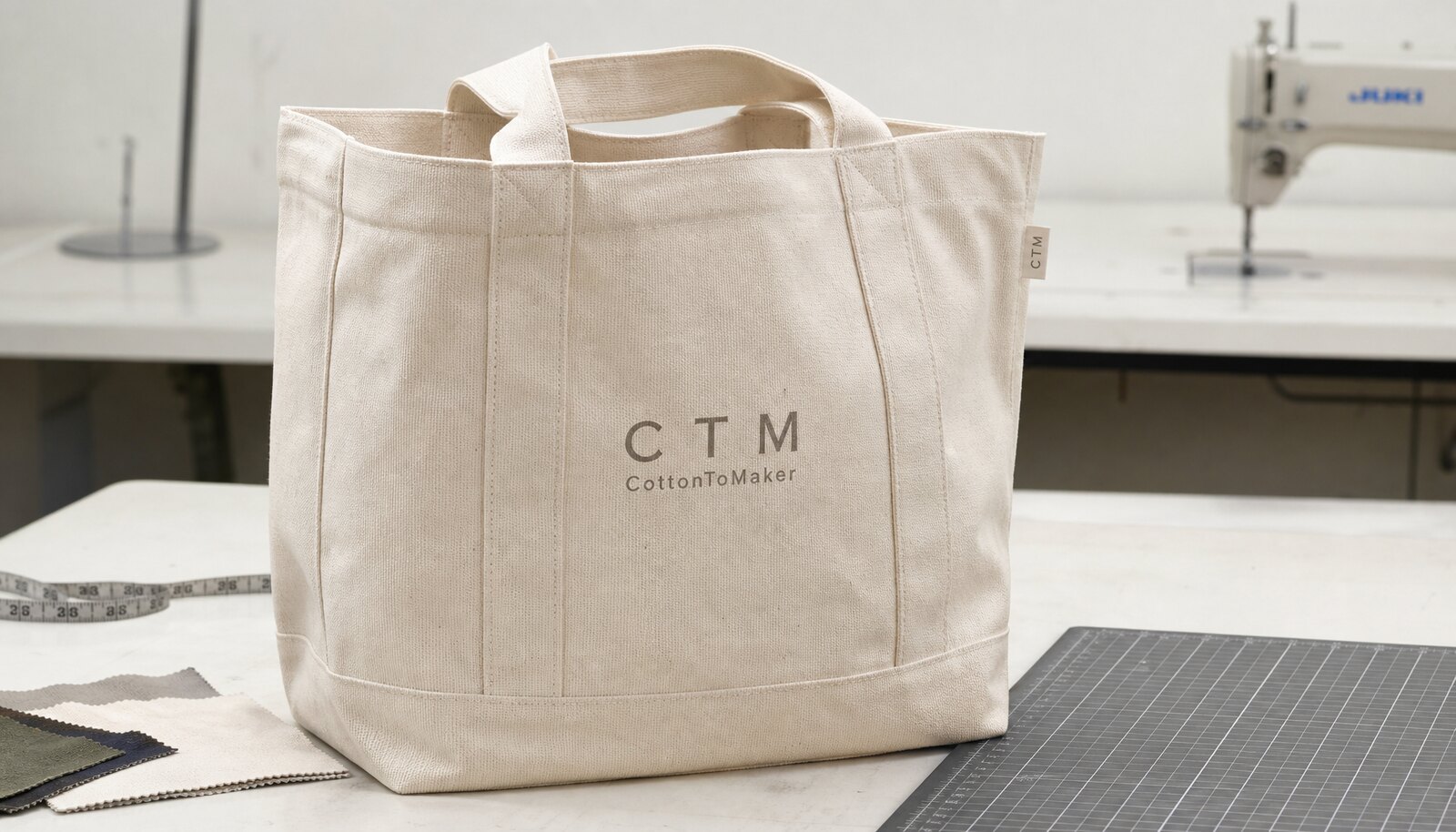
Why sample approval matters more than the quote
For custom canvas tote bags for ecommerce brands sample approval checklist work, the sample is not a formality. It is the point where artwork, fabric, stitching, and packing stop being abstract and become a real production reference. Many buyers lose money by approving a clean rendering, then discovering the bulk bags feel thinner, print darker, or pack differently than expected.
The best way to use a sample is to treat it like a contract draft. A good sample tells you what the factory understood; a bad sample tells you where the RFQ was too loose. Before you compare prices, make sure the sample represents the actual materials, the actual print method, and the actual packing route you want in bulk.
- Use the sample to lock the final spec, not just the look.
- Do not approve artwork without seeing print on the real canvas weight.
- Keep one sealed approved sample for production comparison.
Choose the right canvas weight before you approve anything
Canvas tote buyers usually choose between 10 oz, 12 oz, 14 oz, and 16 oz fabric, with some factory catalogs showing ounce weight and others showing GSM. A practical ecommerce tote often lands in the 12–16 oz range, depending on whether you want a lightweight mailer-style tote or a sturdier reusable bag that feels closer to retail quality. If your bag carries apparel, books, or bundled sets, low-weight canvas can disappoint even if the print looks good.
Ask the supplier to state whether the quoted weight is raw fabric or finished fabric. Washing, dyeing, and shrinkage can change the hand feel and dimensions. If the sample feels soft but too thin, that may be a process issue rather than a color issue. For private label orders, the fabric choice also affects carton count, freight volume, and customer perception when the tote arrives in a DTC box.
- 10 oz: lower cost, lighter feel, suitable for giveaways or low-load ecommerce inserts.
- 12 oz: balanced choice for standard branded ecommerce totes.
- 14–16 oz: better for premium positioning, heavier products, and retail resale.
Match the print method to the artwork and order size
For canvas totes, the print method should be chosen from the artwork backward, not from price alone. Screen print is usually the most economical for simple logos and 1–3 solid colors, especially on repeat orders. Heat transfer can work for short-run launches or complex graphics, but it is more sensitive to heat, press consistency, and edge lifting. Embroidery or a woven patch can lift perceived value, but it adds cost, lead time, and placement risk.
During sample approval, inspect print opacity, registration, ink hand feel, and whether the print cracks when the fabric is folded. If the logo uses small type or thin lines, move the design larger or simplify it. A design that looks good on a monitor may disappear on textured canvas, and once bulk starts, that problem becomes expensive to correct.
- Screen print: best for clean logo branding and stable repeat runs.
- Heat transfer: useful for detail-heavy art, but test wash and rub durability.
- Woven patch or embroidery: premium finish, but verify placement and stitch density.
Use a supplier comparison table before you lock the route
Different sourcing routes for custom canvas totes create different approval risks. A factory that produces fabric and prints in-house may quote faster and control color better. A trading company may offer flexibility across trims and packaging but can hide sub-supplier details. A low-cost printer may be fine for simple artwork, but can struggle when you need custom labels, retail folds, and carton marking consistency.
Comparing routes helps you see what is included in the sample and what is only assumed. If your ecommerce brand needs consistent replenishment, the cheapest quote is not always the safest one. The better question is which supplier can repeat the approved sample with the fewest hidden changes.
Read the sample like a production engineer
When the sample arrives, do not start with the logo. Start with the structure. Measure body width, height, and gusset depth; compare them against your tech pack; and record the handle drop from top edge to handle apex. Then inspect seam lines, corner shape, and stitch finish. If the tote cannot stand square, folds poorly, or twists under its own weight, that is usually a pattern or sewing issue, not just a cosmetic one.
For ecommerce brands, the sample also needs to reflect how the bag will move through fulfillment. A tote that looks great on a desk may be awkward in polybag, too thick for a mailer, or too bulky for carton packing. If your warehouse or 3PL will apply barcodes, inserts, or retail stickers, test those steps on the sample before approving bulk.
- Measure the physical sample with a ruler, not only by eye.
- Check symmetry between left and right handles.
- Open and refold the tote to see how the fabric creases and stacks.
Sample approval checklist that actually prevents bulk mistakes
A useful sample approval checklist should combine appearance, function, and packaging. The goal is not to make the sample perfect in theory; the goal is to prove the production version is repeatable. If the factory sends a revised sample, compare it against the first one and note exactly what changed. Even small changes in thread color, fabric shade, or print position can affect retail consistency and downstream replenishment.
Treat every approval decision as a gate. If the print is right but the handles are wrong, the sample is not approved. If the bag size is right but the packing is wrong, the sample is not approved. This sounds strict, but it is cheaper than discovering the issue after thousands of units are packed and loaded for export.
- Fabric: approved weight, finish, and color against reference.
- Artwork: position, size, opacity, edge quality, and color match.
- Construction: stitching, reinforcement, symmetry, and load feel.
- Packing: fold direction, insert, barcode, carton count, and carton marks.
- Documentation: final spec sheet, approved sample photos, and revision notes.
MOQ logic and quote structure are part of sample approval
MOQ should be reviewed by component, not only by bag count. A supplier may quote a low bag MOQ but require higher MOQ for print screens, woven labels, or carton printing. If you miss that detail, you may approve a sample that cannot be reproduced economically. For ecommerce brands with multiple colorways or seasonal artwork, the real cost driver is often setup complexity, not just fabric.
Ask the factory to separate unit price from setup fees, sample fees, and packing extras. A clear quote should tell you whether the price includes the bag body, printing, label application, folding, inner packing, and export cartons. That way, you can compare apples to apples across suppliers and avoid a low headline price that becomes expensive once packaging is added.
- Bag MOQ may differ from print color MOQ and packaging MOQ.
- Low MOQ often means higher unit cost or limited finishing options.
- Separate one-time setup charges from repeat-order unit pricing.
Packing spec matters for ecommerce, not just for shipping
For ecommerce brands, packing is part of the product. Flat folding affects warehouse speed, shelf presentation, and shipping cost. A tote packed in a loose polybag may look untidy or absorb wrinkles, while a neatly folded bag with a belly band or insert card can support retail resale and DTC unboxing. The sample should show the final packing format, not a temporary factory packing method.
If you use Amazon FBA, retail distribution, or a 3PL, confirm carton quantity, carton dimensions, and gross weight early. Overpacked cartons can crush bags and increase labor at inbound receiving. Underpacked cartons raise freight cost. The sample should let your team test barcode placement, SKU labels, and carton marks before bulk production starts.
- Confirm whether each bag is individually packed or bulk packed.
- Specify fold size so the tote fits your chosen shipper carton.
- Require carton marks that match your warehouse receiving process.
Lead time risk usually hides in the sample stage
The lead time you need for a launch is not just the bulk sewing window. It includes artwork adjustment, sample revision, material sourcing, print plate preparation, packing material sourcing, and final pre-production approval. If your first sample looks right but the factory needs a revision for size or print placement, your calendar may move by days or even weeks. That is why sample approval should be tied to a real schedule, not an optimistic promise.
A realistic buying plan separates sample lead time from bulk lead time. The factory should tell you when sample approval will unlock production, and what will restart the clock if you change the spec. Brands that launch seasonal collections or campaign bundles should build in revision time before they commit to a marketing date.
- Track time for artwork submission, sample making, and revision round.
- Ask what happens if a trim or label must be re-sourced.
- Do not commit a campaign launch until the pre-production sample is sealed.
Specification comparison for buyers
| Spec decision | Recommended option | When it fits | Buyer risk to check |
|---|---|---|---|
| Fabric route | 12–16 oz unbleached or dyed cotton canvas | Ecommerce brands that want a durable tote with a premium hand feel and repeat use | Low-GSM fabric can look flat, wrinkle badly, or fail handle pull tests after packing heavy items |
| Print method | Screen print for 1–3 colors; heat transfer only for short-run art; embroidery or woven patch for premium branding | Screen print works best for clean logos and repeat orders; patches suit higher perceived value | Fine text, gradients, and over-registration become approval problems if the method does not match the artwork |
| Handle construction | Cross-stitch or box-X reinforcement with matching canvas or cotton webbing handles | Brands shipping heavier SKUs, kits, or promo bundles | Weak bar-tacks and short stitch length cause handle failures in transit or customer use |
| Sample approval route | Pre-production sample with full final materials, then gold seal or approved reference sample | When the order has custom print, custom label, or retail packing requirements | A mockup-only approval misses shrinkage, color shift, and seam appearance |
| MOQ strategy | Start with a usable production MOQ, not an artificially low sample batch | Brands testing a new tote design before scaling across ecommerce channels | Very low MOQ can hide setup costs, inconsistent print calibration, or unstable trim sourcing |
| Packing format | Flat-packed with size-stable polybag or kraft belly band, carton pack by SKU | DTC fulfillment, FBA prep, or distributor reallocation | Loose folding, mixed sizes, and carton overfill increase damage, warehouse labor, and chargebacks |
| Lead time route | Quote separately for sample lead time and bulk production lead time | When launch dates, campaign calendars, or replenishment windows are fixed | Factories often quote one timeline that ignores art approval, trim sourcing, or packing assembly time |
| Cost model | Evaluate fabric, print, sewing, trim, packing, and inland carton loading as separate lines | When comparing suppliers from different regions or with different service scope | A low unit price can hide expensive packing, higher damage rates, or added revisions |
Buyer checklist before sampling
- Confirm the exact tote size, measured seam to seam, and include tolerance limits for body width, gusset depth, and handle drop.
- Lock the fabric weight in GSM or oz, plus whether the canvas is bleached, unbleached, enzyme-washed, or pre-shrunk.
- Approve the print file, print size, ink color references, and whether the factory will match Pantone, a visual standard, or a lab dip.
- Inspect handle width, stitch density, reinforcement pattern, and load expectation before bulk approval.
- Review the sample for seam alignment, thread trimming, corner shape, and whether the tote stands or collapses as intended.
- Approve packaging: fold method, insert card, barcode label, inner polybag or paper wrap, master carton mark, and carton quantity.
- Separate sample approval from bulk quote acceptance so price changes are tied to real spec changes, not assumptions.
- Capture photo evidence of the approved sample from all sides and retain it as the production reference.
Factory quote questions to send
- What exact fabric weight are you quoting, and is that finished GSM after washing or raw fabric weight before finishing?
- Which print method is included in the quote, how many colors are covered, and what setup charge applies for each artwork version?
- What handle construction and stitch pattern will you use, and do you have a pull-test target for the finished bag?
- Does the quoted price include woven label, care label, hangtag, barcode label, polybag or paper wrap, and master carton packing?
- What are the sample lead time, bulk lead time, and the earliest date you can ship after final sample approval?
- What MOQ applies to the bag body, print color, and packaging components separately?
- How many sample revisions are included before you charge again, and what is the cost per revision?
- Can you provide carton dimensions, gross weight, and estimated cube so we can compare freight and warehouse cost?
Quality-control points to confirm
- Fabric is within the approved GSM/oz range and matches the sealed reference sample.
- Print is sharp, centered, and consistent, with no visible misregistration or ink loss.
- Handles and seams are reinforced, even, and free of skipped stitches or loose ends.
- Measurements fall within agreed tolerance for body size and handle drop.
- Packing format matches the approved fold, insert, label, and carton count.
- Cartons are intact, clean, and marked clearly for warehouse handling.