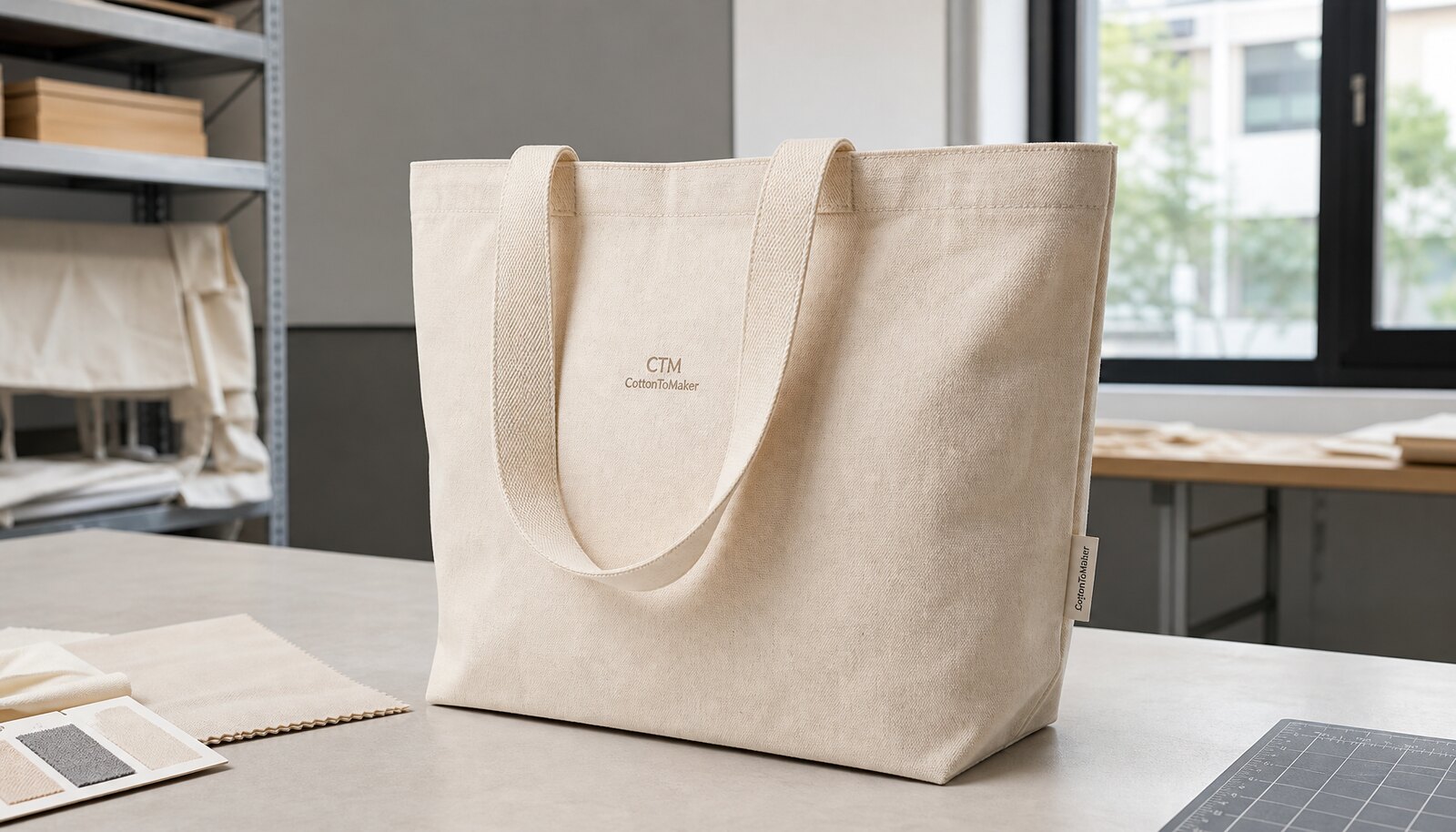
Start With the Retail Use Case, Not the Tote Size
Custom canvas tote bags for ecommerce brands work best when the sourcing brief starts with the sales job, not with a generic bag size. A tote used as a subscription insert has different requirements from a tote sold as a standalone private-label item, and both differ again from a tote packed inside a gift kit. If the bag is only holding a lightweight accessory, a 10-12 oz canvas can be a sensible cost target. If the bag is expected to carry apparel, books, or bundled products, a heavier body and stronger handle build are worth the added cost because they reduce customer complaints and return risk.
Buyers often lose time by asking factories to quote a loose idea instead of a defined use case. The supplier then fills the gaps with its own assumptions, which is how quotes become impossible to compare. Put the expected load, shelf role, folding behavior, and brand position into the brief before asking for a price. If the tote has to look premium on arrival, the bag needs clean folds, stable seams, and a print that reads well on the chosen canvas texture. If it ships as an insert inside another SKU, freight cube and pack efficiency may matter more than the bag's visual volume.
- Single-SKU ecommerce insert
- Retail-ready private-label tote
- Bundle or gift-kit component
- Repeat reorder with the same art and pack format
Build a Quote-Ready Spec Sheet
A useful RFQ for canvas totes needs more than artwork and quantity. State the finished dimensions, gusset, handle length, handle drop, fabric weight, color reference, print area, and packing format. Include whether the bag needs self-fabric handles, webbing handles, or a reinforced cross-stitch at the stress points. Add the target quantity per color and the destination so the factory understands the commercial structure of the order. Without that detail, one supplier may quote a stripped-down version while another includes extra steps that the buyer did not ask for.
The fastest way to get an apples-to-apples comparison is to send one spec sheet with a sketch, a product reference photo, and any non-negotiables called out in plain language. If the logo needs exact placement, define the tolerance in millimeters. If the tote must fit a 3PL shelf or mailer, define the folded size as well as the finished bag size. A factory can usually work from a concise one-pager if the buyer is specific about what cannot change.
- Body width, height, and gusset
- Fabric weight in oz and gsm
- Handle type, length, and drop
- Print method, color count, and artwork file format
- Packing format, carton count, and label requirements
- Destination, incoterm, and target ship window
Choose Fabric Weight and Construction by Load
Fabric weight is one of the first decisions that changes both the feel of the bag and the factory quote. In practical private-label sourcing, 10-12 oz canvas, roughly 340-400 gsm depending on weave and finish, is usually suited to light ecommerce use, promo inserts, and lower-cost brand programs. 12-14 oz canvas works well for general retail and branded merch because it balances stiffness, print clarity, and manageable production cost. Once you move into 14-16 oz canvas, roughly 470-550 gsm, the bag starts to feel more substantial and premium, but the sewing operation becomes slower and the carton volume increases.
Heavier is not automatically better. A dense canvas can hide print slightly better and hold shape on a shelf, but it also requires stronger handle attachment, tighter seam control, and a packing plan that does not crush the finished shape. Buyers should look at the entire performance chain: fabric body, seam strength, handle reinforcement, and how the tote will be folded and packed. If the end customer will carry only lightweight goods, paying for a much heavier canvas may not create extra value. If the tote is part of a retail assortment, the heavier hand feel can support the brand story and reduce the chance that the bag looks flimsy at first touch.
- 10-12 oz / about 340-400 gsm: insert programs and light merch
- 12-14 oz / about 400-470 gsm: mainstream private label and ecommerce retail
- 14-16 oz / about 470-550 gsm: premium retail or heavier contents
- Use reinforced seams, bar tacks, or X-box stitching at the handle anchor points
Compare Sourcing Routes Before You Compare Prices
A low unit price does not mean the quote is stronger. For canvas totes, the sourcing route changes what is hidden inside the number. A direct factory usually gives the cleanest control over fabric, sewing, and decoration, which matters when you want repeat private-label consistency. A trading company can be useful when you need a broader basket of products or a smaller first order, but the buyer should know where the bags are actually made and who owns the QC responsibility. A domestic converter with imported blanks may deliver faster replenishment, though the unit cost and landing cost can climb quickly once you add inventory carrying cost and freight volume.
The right route depends on order frequency, artwork complexity, and how much process control your team wants. If the tote is a core SKU that will be reordered, a specialized bag factory is usually worth the added setup effort. If the order is a one-time campaign or a mixed kit, the speed of a converter or trading partner can outweigh the cost premium. Use the same specification, sample path, and inspection standard across all options so the decision is based on evidence rather than on whichever supplier wrote the most polished email.
- Direct factory: better control, better for repeat runs
- Trading company: easier for mixed programs and lower admin load
- Domestic converter: faster replenishment, higher unit cost
- Stock blanks with private label: fastest path when time matters most
Break the Quote Into Real Cost Drivers
A quote for custom canvas tote bags should be broken down by fabric, cutting, sewing, decoration, labels, packing, and carton work. If the supplier only gives one unit price, you cannot see whether the bag includes screen setup, woven labels, polybags, or extra reinforcement. That matters because a quote that looks cheaper on paper can become more expensive once you add the omitted steps back in. A buyer should ask each supplier to state exactly what is excluded, because exclusions are where sourcing surprises tend to hide.
For ecommerce brands, the bigger cost swing is often not the fabric itself but the finished packing volume and freight impact. A tote that folds thickly or ships in a bulky carton can consume more cubic space in the ocean container or air shipment, which changes the landed cost more than a small difference in sewing labor. Request carton dimensions, gross weight, and packed quantity with every quote. Then compare the price on the same incoterm and the same delivery point, otherwise you are comparing different logistics assumptions rather than different factory efficiency.
- Fabric and dye or greige base
- Printing screens, plates, or strike-off work
- Handle reinforcement and seam upgrades
- Labels, inserts, polybags, and carton marks
- Carton size, gross weight, and cube
- Freight term and destination port or warehouse
Use Samples to Prove the Factory Understood the Brief
Sampling is where most tote bag sourcing mistakes become visible before the order is committed. A practical sequence is blank sample first, then print strike-off, then a pre-production sample built to the final spec. If the print is simple and the factory already has the right fabric, a buyer may combine the stages, but the approval logic should still be the same: dimensions, fabric hand, seam quality, and artwork placement all need signoff. Once mass production starts, a color issue or a handle-length error costs time and money that are harder to recover than a sample revision.
Do not approve a sample by general impression alone. Measure the finished bag after pressing and folding, inspect the handle symmetry, and test the tote with the real product weight or a close substitute. Check whether the print sits straight on the panel and whether the ink sits cleanly on the weave rather than bleeding into it. If the sample is close but not exact, write the deviation into the approval record so the production team knows what has been accepted and what still must be corrected. That is the difference between a controlled concession and an undocumented defect.
- Measure finished size, not cut size
- Inspect seam allowance and corner reinforcement
- Verify print opacity, placement, and edge sharpness
- Load test with the intended product weight
- Confirm fold pattern and retail presentation
Pick the Decoration Method That Matches the Artwork
Screen printing is still the default choice for many custom canvas tote bags because it handles bold logos, simple artwork, and repeat orders efficiently. On canvas, it usually gives the strongest color density and the best price point when the design uses one to three solid colors. The buyer still needs to control the print area and the weave of the fabric, because a coarse canvas can make fine details look soft if the artwork was not prepared for the material. Request a strike-off before the full run so the factory can prove the ink color, registration, and coverage on the actual cloth.
Other decoration methods solve different problems. A woven label or sewn patch can look more premium and reduce the risk of print misalignment, especially on smaller logos. Heat transfer can be useful for more complex art, but the buyer should test rub resistance and wash performance if the tote is likely to be handled frequently. Embroidery can work on heavier canvas, but it adds needle holes, may pucker lighter fabrics, and can change how the bag folds in packing. The right method depends on brand position, artwork complexity, and how the tote will be used after delivery.
- Screen print: best for simple logos and repeat volume
- Heat transfer: useful for gradients or short runs, with durability testing
- Woven label or sewn patch: good for premium branding and lower ink risk
- Embroidery: only when fabric weight and artwork size can support it cleanly
Design Packing for Ecommerce Fulfillment
Packing should be set around the warehouse flow, not treated as an afterthought. If the tote is going to a 3PL and later kitted with other SKUs, bulk folding may be the cheapest and cleanest route. If the bag goes directly to retail shelves or ships to consumers in a branded parcel, an individual polybag or protective wrap may be justified to keep the surface clean and the folds uniform. Every packing choice changes labor, carton size, and cube, so the best option is the one that matches your actual fulfillment process rather than the one that looks neat in a sample room.
A good packing brief tells the factory exactly how the bag should be folded, where the sticker goes, whether a size label or barcode is needed, and how many units belong in each carton. If the warehouse receives by carton scan, carton marks must show style, color, quantity, and PO clearly. If the tote is sold retail-ready, the front of the bag should not be creased by an over-tight fold or crushed by an under-sized carton. The goal is to keep the product presentable without paying for unnecessary packaging complexity.
- Bulk pack for lower inbound cost and later kitting
- Polybag with the required market label if protection is needed
- Belly band or header card for shelf presentation
- Carton marks with SKU, color, quantity, and PO
Plan Lead Time and Reorder Risk
Lead time for canvas totes is easy to underestimate because the sewing operation is only one part of the schedule. The full timeline may include fabric reservation, dyeing or color matching, cutting, printing, drying, stitching, finishing, inspection, packing, and export documentation. If the supplier quotes a short lead time without saying whether the fabric is already in stock, the number is not yet usable for procurement. Ask for the timing after sample approval, not just a vague calendar estimate, because sample signoff is usually where real production timing begins.
For ecommerce brands, reorder planning should be separated into launch stock, safety stock, and replenishment logic. The first order may need extra time for artwork approval and packaging setup, while later reorders may move faster if the same fabric and print screens are already in place. If the bag is tied to a seasonal campaign, add a buffer for strike-off corrections, carton relabeling, or transit delays. A tote program that looks easy on paper can still miss the sell window if the buyer treats production and logistics as one undifferentiated block of time.
- Ask for confirmed ex-factory days after sample approval
- Separate material lead time from sewing lead time
- Add buffer time for custom dye or new artwork
- Plan reorder triggers in weeks of cover, not only in units
Verify Supplier Evidence and QC Before You Release PO
Canvas tote QC usually fails in the same places: loose stitches, off-center prints, weak handle anchors, uneven folds, and carton packs that do not match the instruction. That is why supplier evidence matters. A capable factory should be able to show a sewn sample with dimensions, a print reference, and a clear process for in-line and final inspection. If the supplier cannot explain how defects are caught before packing, the unit price is not the real cost of the order because the buyer will absorb the downstream risk.
Make the QC requirement part of the quote comparison rather than a separate afterthought. Ask every supplier for the same photos, the same measurement method, and the same defect handling rule so the review is consistent. A supplier that can describe how it handles rework, replacement, or credit before shipment is usually more reliable than one that only promises a low price. The goal is not to over-specify a simple tote. The goal is to remove ambiguity in the few places where simple totes most often fail.
- Photo of sewn sample with measurements and front and back views
- Fabric weight or reference swatch confirmation
- In-line and final inspection method
- Carton drop or compression test if retail packed
- Clear defect handling rule before shipment
Specification comparison for buyers
| Supplier option | What to verify | Commercial advantage | Buyer risk to control |
|---|---|---|---|
| Direct sewing factory | fabric swatch, approved sample, seam close-ups, logo test photos, packing pilot, and final inspection evidence | Better sample-to-bulk control and faster production feedback | May be weaker on export paperwork or branded packing unless checked early |
| Trading company | Factory name, production photos, trim-source proof, and who owns QC decisions | Can coordinate small mixed orders and extra services | Markup can hide real factory capability and slow defect decisions |
| Specialized bag workshop | bag size, gusset, handle drop, seam allowance, stitch density, reinforcement patch, and loading expectation | More practical for detailed construction, trims, and repeat programs | Capacity may be limited during peak seasons |
| Low-price general supplier | 8-12 oz cotton canvas, 120-220 gsm cotton, recycled cotton, or blended fabric selected by use case and target price | Useful for simple promotional runs with loose specs | Material downgrades, weak packing, and vague inspection scope can erase savings |
| Retail-ready supplier | fold method, inner bundle, carton count, carton mark, moisture protection, SKU separation, and warehouse receiving needs | Can handle labels, SKU separation, carton marks, and receiving rules | Higher unit cost must be compared against reduced warehouse work |
| Compliance-focused supplier | Fabric records, labeling review, test plan, and production traceability | Safer for retail programs and repeat brand orders | Documentation claims need evidence, not only sales language |
| Local sample room plus bulk factory | Signed sample, bulk factory handoff, first-piece photos, and deviation owner | Good for complex branding before large production | Sample room quality may not match bulk line unless handoff is controlled |
Buyer checklist before sampling
- Final bag size, gusset, handle length, and tolerance written in the RFQ
- Fabric weight stated in oz and gsm, with the weave or finish noted
- Decoration method fixed, including artwork colors, placement, and print area
- Sample path defined: blank sample, strike-off, and pre-production sample
- Packing spec set: fold size, polybag or bulk pack, labels, and carton count
- MOQ and price breaks requested by color, artwork, and packing option
- Lead time stated separately for sample approval, production, and transit
- Incoterm, destination, and inspection requirements included on the quote
Factory quote questions to send
- Are you quoting direct factory production, or is any part of this order traded through another supplier?
- What fabric weight, weave type, and shrinkage assumption are you using for this quote?
- What is the MOQ per color and per artwork, and does MOQ change if packaging or labels change?
- What exactly is included in the unit price: fabric, cutting, sewing, print, labels, polybags, cartons, and export packing?
- Are screen charges, plate charges, woven labels, and sample fees separate or included?
- What sample stages do you provide, and how many days are needed for each stage?
- What is the confirmed ex-factory lead time after sample approval, and what material status supports that timeline?
- What inspection standard, AQL level, carton size, gross weight, and carton count per SKU should we expect?
Quality-control points to confirm
- Finished size must stay within the agreed tolerance after pressing and folding
- Fabric weight, shade, and hand feel must match the approved reference sample or sealed swatch
- Handle length and placement must be symmetric, with reinforced stress points at the top seam
- Stitch density must be even, with no skipped stitches, loose threads, or seam puckering
- Print registration, opacity, and edge sharpness must match the approved strike-off
- Artwork placement must stay within the agreed location tolerance on every panel
- Fold pattern, carton count, and inner packing must match the packing instruction exactly
- Carton labels, SKU codes, and barcodes must match the PO and warehouse receiving sheet