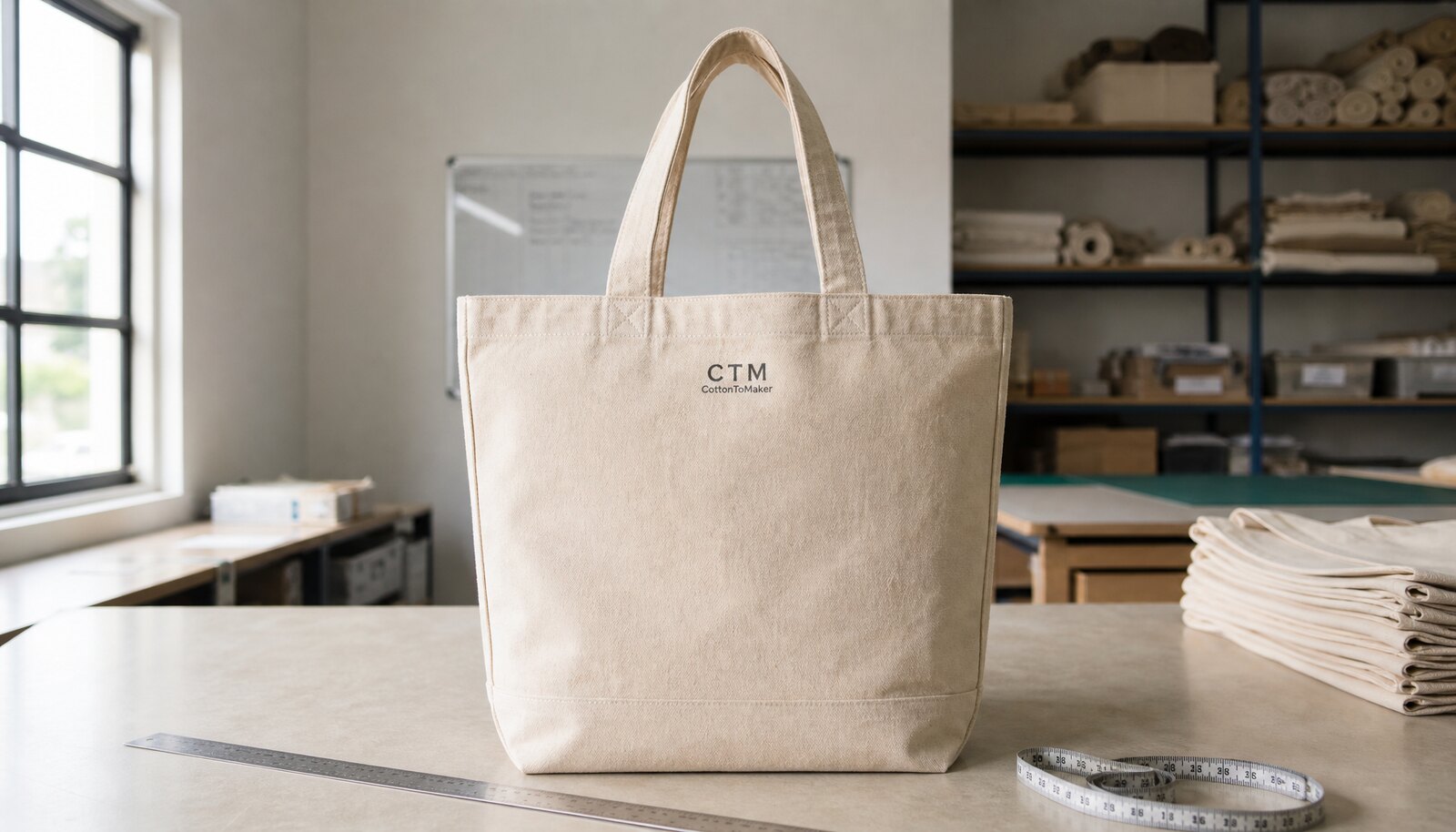
Start With the Use Case, Not the Aesthetic
For custom canvas tote bags for ecommerce brands, the first procurement decision is not the logo or the color. It is the job the bag has to do. A tote sold as a merch item, used as a gift-with-purchase insert, or shipped as part of a boxed bundle has different requirements for structure, print durability, and packing density. If the bag only carries lightweight apparel, a softer canvas can be enough. If it needs to hold books, bottles, or a curated kit, the same fabric may feel flimsy and invite returns or customer complaints.
Treat the tote like a functional component in the fulfillment chain. The bag has to survive warehouse handling, folding, transit, shelf display, and the customer's first use. That means the spec needs to connect material choice to the actual load case, the sales channel, and the brand promise. A premium DTC unboxing program can justify heavier canvas and cleaner finishing. A high-volume promotional program may need a flatter-folding tote with lower cost and simpler print requirements.
- Define the carry load before you define the fabric.
- Separate retail presentation needs from freight and storage needs.
- Use the tote's job to decide structure, reinforcement, and packing.
- Ask the factory to quote the same design in a standard and upgraded build.
Convert Oz to GSM and Pick the Real Fabric Weight
Canvas weight is often quoted in ounces, but procurement teams need the number in a form that can be compared across suppliers. One ounce per square yard is roughly 33.9 GSM, so 8 oz canvas is about 271 GSM, 10 oz is about 339 GSM, 12 oz is about 407 GSM, and 14 oz is about 474 GSM. Use both units in the RFQ. If a factory only writes "10 oz" without a GSM reference, you may still be comparing very different cloth constructions.
Weight alone does not tell the full story. Two fabrics at the same nominal GSM can feel different if one uses a tighter weave, thicker yarns, or a heavier finish. A looser weave may look casual and cost less, but it can show more irregularity and print less cleanly. A tighter weave usually gives better print sharpness and a more retail-ready surface. For procurement, the right spec is not just a number on paper. It is a weight, weave, and finish combination that repeats consistently from sample to bulk and from first order to reorder.
- Write both oz/yd2 and GSM in the RFQ.
- Ask whether the quoted weight is finished weight or raw cloth weight.
- Compare not only mass but weave density and surface consistency.
- Reserve heavier canvas for loads, structure, or premium shelf presentation.
Compare the Material Options by Hand Feel, Print, and Risk
The strongest comparison is not between factories. It is between material choices. Natural cotton canvas is the most common starting point because it is familiar, printable, and easy to source. Pre-shrunk or controlled-finish canvas is a better fit if dimensions must stay stable after steam, humidity, or light washing. Organic cotton canvas is useful when the buying brief includes environmental claims, but the buyer has to verify the documentation chain, not just the fiber description on the invoice.
Recycled cotton canvas can support a circularity story, but lot variability matters more than with standard cotton. The surface may be less uniform, which can affect print clarity and visual consistency across reorders. Dyed canvas is a good option when brand color matters more than natural fiber appearance, but it increases MOQ and shade management complexity. If you are deciding between materials, compare hand feel, print compatibility, shrinkage tolerance, reorder continuity, and cost per finished unit, not just the first sample impression.
- Natural cotton canvas is usually the lowest-risk default for ecommerce merch.
- Pre-shrunk canvas is worth the premium when final dimensions matter.
- Organic and recycled claims need certificate scope, not just verbal assurance.
- Dyed canvas can improve brand fit but usually raises MOQ and shade variation risk.
Match Print Method to the Cloth and the Sales Channel
Printing should be chosen for the canvas, not only for the artwork file. Screen printing remains the best value for many tote programs because it gives strong opacity, durable coverage, and repeatable unit cost for simple logos. It usually performs best on natural canvas with one to three colors. Digital printing or heat transfer can handle more detailed art, but the supplier should prove that the print survives folding, warehouse friction, and customer handling. If the tote is going into a premium kit, the print has to look good after transit, not only on day one.
For buyer approval, the relevant test is whether the graphic survives real use. Ask the factory how the print behaves after abrasion and whether any cure or drying step changes the handle or hand feel of the bag. If the tote is printed on both sides, or if the design wraps around a gusset, the registration tolerance needs to be written into the spec. Keep a physical approved sample with the exact color reference and placement. A PDF is not enough for reorder continuity.
- Screen print for simple logos, stable repeat orders, and strong opacity.
- Digital or transfer print for complex art, but test abrasion and fold behavior.
- Double-sided or wraparound printing increases defect risk and should be quoted separately.
- Lock a physical approved sample for color, placement, and edge clarity.
Write the Construction Spec So the Factory Cannot Guess
Many tote orders fail because the spec is incomplete, not because the supplier is careless. The bag needs a finished width, height, gusset depth, handle width, handle drop, seam allowance, reinforcement method, and any lining or board requirement. If the handles are cut too long or the seam reinforcement is weak, the bag can look fine in a photo but fail in use. Procurement teams should not rely on a generic product description when the tote will be sold at volume. The spec needs to control the details that affect function and resale value.
The most useful RFQ language is restrictive where it matters. State which fabric, print method, handle length, seam construction, carton count, and packaging format cannot change without written approval. If the factory wants to propose an equivalent, ask for a revised sample and a clear cost delta. This is how you prevent hidden substitutions. A cheaper stitch count or thinner handle tape can make a quote look good while pushing quality risk onto the buyer.
- Specify finished measurements, not only flat fabric dimensions.
- Call out handle reinforcement, seam construction, and any optional lining.
- Require written approval for any change to fabric, print, or pack format.
- Ask for a revised sample when the factory proposes an alternative build.
Treat Sustainability as a Documentation Problem
Sustainability claims are only useful when the paperwork matches the product lot. If the tote is sold as organic cotton, the buyer needs to confirm which certificate applies, whether the supplier entity is within scope, and whether transaction documents are available if the retailer asks for them. GOTS is stronger when the product needs a full organic textile claim and chemical processing control. OCS is a content standard and can support organic fiber content claims, but it does not do the same job as GOTS. For recycled content, RCS or GRS can be relevant, depending on whether the buyer needs chain-of-custody and processing claims.
The same discipline applies to country-of-origin and import paperwork. A serious RFQ should ask for the commercial invoice, packing list, certificate of origin if required, and any test report or certificate the channel requires. If the tote will move through a retailer compliance program, ask the supplier who owns the documentation, who issues transaction certificates, and whether the source factory and finishing site are both in scope. Buyers should avoid generic sustainability language. The claim must be defensible at the lot level, not just at the product category level.
- Verify certificate scope for the actual factory and, if relevant, the trader.
- Use the right claim type: organic content, organic processing, or recycled content.
- Ask for transaction or chain-of-custody documents when the sales channel requires them.
- Keep origin and compliance paperwork tied to the lot, not just the SKU.
Compare Quotes on Landed Cost, Not Factory Price
A one-line tote price hides too much. Break the quote into fabric, cutting, stitching, print, reinforcement, packing, cartonization, and export handling. If one factory gives a lower number without detailing the build, it may simply be using lighter canvas, fewer stitches, simpler packing, or a different print method. That is not a real comparison. For ecommerce brands, the landed cost matters more than the ex-factory price because freight, handling, and rework can erase a small quote advantage very quickly.
The best quote is also the one that makes reorder planning easier. Ask for pricing at two or three quantity levels so you can see the breakpoints for setup costs, fabric utilization, and packing efficiency. If a supplier cannot explain where the price drops come from, they probably do not understand their own process well enough for a repeat program. You want a supplier who can tell you which part of the cost is fixed, which part moves with volume, and which part becomes more expensive if the spec changes.
- Require line items for material, labor, print, packing, and export handling.
- Ask for tiered pricing to reveal setup and volume breakpoints.
- Compare landed cost and reorder continuity, not only factory price.
- Make the supplier state which spec changes would trigger a re-quote.
Set Sample Gates Before Bulk Material Is Cut
Sampling should prove the material and build, not just the artwork placement. A useful approval path starts with a fabric swatch, moves to a print proof or strike-off, then a sewn pre-production sample, and finally a top-of-production reference for larger programs. Each gate should answer a different question. The fabric swatch confirms hand feel and surface behavior. The sewn sample confirms dimensions, reinforcement, and folding. The print proof confirms registration and color. If any of those steps are skipped, the factory has room to interpret the order in its own way.
The sample approval sheet should include measurements and tolerance, not a vague sign-off note. Record the finished width, height, gusset, handle drop, and placement of the logo or graphic. If the tote will carry weight, test it with a realistic load and inspect for handle stretch, seam distortion, and corner stress. This is also the point to confirm carton fit and fold pattern. A sample that looks fine on a table can still fail in packing if the fold direction creates ugly creases in the printed area.
- Approve fabric before bulk cutting begins.
- Use a print proof or strike-off for artwork-heavy programs.
- Measure the sewn sample, not the fabric swatch, for final sign-off.
- Test the tote under realistic load before releasing bulk production.
Control Packing, Cartons, and Warehouse Behavior
Packing is part of the product spec for canvas totes. Bulk packing is the lowest-cost option and can work when the tote goes straight into a distribution center that will repack it later. Polybagging protects the fabric and print better, but it adds labor, plastic, and carton volume. If the bag is sold as retail-ready, a simple insert card, barcode label, or folding instruction may be enough without overbuilding the pack. The right answer depends on the sales channel, not just the lowest packing line item.
You should request carton dimensions and gross weight early because they affect freight and warehouse handling. A tote that looks inexpensive at unit level can become costly when carton size expands and pallet density falls. For Amazon, wholesale, or store replenishment, carton count and label placement should be stable from the first shipment. If the bag is folded one way for one market and another way for another market, write those variants into the spec. Otherwise, the factory will choose the easiest pack-out, not the one your warehouse needs.
- Choose bulk pack, polybag, or retail-ready pack based on the channel.
- Confirm fold direction, logo orientation, and label placement in writing.
- Review carton dimensions and gross weight before price approval.
- Check pallet fit and warehouse handling, not just the factory carton count.
Build a Reorder System, Not a One-Off Purchase
If the tote may be reordered, continuity matters as much as the first shipment. Ask the supplier how they retain the fabric lot record, approved sample, print screen or digital file, and final pack spec. If the program uses a stock fabric, can the factory reserve the same lot or a closely matched lot? If the tote uses dyed cloth, how will shade variation be controlled across seasons? These are the questions that separate one-time sourcing from a repeatable supply program.
A good procurement process also assigns ownership. Someone should be responsible for the master spec, someone for quality approval, and someone for change control. If you do not define that responsibility, the factory will fill the gap with its own defaults. For ecommerce brands, the cost of a bad reorder is not just rework. It can be a mismatch between listing photos and delivered goods, which creates returns, customer service burden, and channel complaints. The reorder system should prevent that drift before it starts.
- Retain the approved sample, spec sheet, and lot record for every program.
- Reserve fabric or confirm substitution rules before the first production run closes.
- Assign ownership for spec control, sample approval, and change management.
- Write reorder continuity into the contract if the tote is a recurring SKU.
Specification comparison for buyers
| Material spec | Typical weight and hand feel | Print compatibility | Buyer controls to lock | Cost impact by spec |
|---|---|---|---|---|
| Natural cotton canvas 8 to 10 oz, about 271 to 339 GSM | Light to medium structure, softer hand, folds flat for fulfillment | Good for 1 to 3 color screen print and simple logos | Confirm finished GSM, weave density, and shrinkage after wash or steam | Lowest base cost, but may need extra reinforcement if the tote carries heavier inserts |
| Natural cotton canvas 10 to 12 oz, about 339 to 407 GSM | Balanced structure with better body and less show-through | Best all-around option for screen print and many transfer applications | Set a tolerance for finished weight and approve a sewn sample, not just fabric | Moderate unit cost increase, usually the strongest value point for ecommerce merch |
| Heavy canvas 12 to 14 oz, about 407 to 474 GSM | Stiffer, more premium, stands up better in product photos and retail use | Excellent for opaque prints, but some digital methods need testing on the actual cloth | Lock handle reinforcement, seam construction, and carton weight because freight rises faster | Higher fabric and sewing cost, plus higher freight and warehouse handling cost |
| Pre-shrunk or controlled-finish canvas | More predictable after steam, washing, or warehouse humidity changes | Improves print registration stability and reduces size drift | Ask for shrinkage test results and define acceptable warp and weft movement | Small premium on fabric, often worth it if exact dimensions matter to your pack-out |
| Organic cotton canvas | Comparable hand feel to standard cotton, depending on yarn and finishing | Works well if the surface is consistent and the print method is matched to the weave | Verify certificate scope, chain of custody, and whether the factory can issue transaction documents | Usually higher cost and tighter documentation burden, especially for retailer programs |
| Recycled cotton canvas | Can feel slightly more variable lot to lot, depending on fiber source and blend ratio | Can print well, but color consistency and surface irregularity need sample confirmation | Check recycled content wording, certificate type, and whether the lot itself is covered | Cost may be competitive, but QC and documentation often add administrative effort |
| Dyed canvas in a brand color | Visual fit is stronger, but shade variation is the main risk | Good for tonal branding if the dye lot is consistent and print contrast is tested | Approve a lab dip or strike-off, then define shade tolerance and reorder reserve rules | Higher MOQ and higher risk of lot drift, especially on repeat programs |
Buyer checklist before sampling
- Final tote size with finished tolerance for width, height, gusset depth, handle length, and handle drop
- Fabric spec in both oz/yd2 and GSM, plus fiber content, weave density, finish, and shrinkage tolerance
- Expected load case, including what the tote will carry, approximate weight, and whether it must stand upright
- Print method, number of colors, placement, Pantone targets, and whether the art must survive folding and abrasion
- Reinforcement requirements for handles, seams, corner boxing, bindings, lining, or bottom board
- Compliance requirements, including certificate type, scope holder, chain-of-custody needs, and country-of-origin paperwork
- Packaging spec: bulk packed or retail packed, polybag rules, insert card, barcode label, carton pack count, and master carton dimensions
- Sampling path: fabric swatch, strike-off or print proof, pre-production sample, and top-of-production approval
- Incoterm, destination port or warehouse, freight method, and whether the quote includes export docs, inspection, or test reports
- Reorder plan, forecast range, and whether the factory must reserve fabric lots or print screens for continuity
Factory quote questions to send
- What is the actual fabric weight in oz/yd2 and GSM, and is that finished weight or raw cloth weight?
- What is the weave density, and can you share a mill spec or sample ticket that proves the lot you are quoting?
- What shrinkage should I expect after steam or wash, and what test method did you use to measure it?
- Is this stock canvas, custom woven canvas, or dyed-to-order fabric, and what changes in MOQ or lead time if I reorder?
- Which print method will you use for this art, what is the maximum color count without price change, and what is the registration tolerance?
- What is the sewing construction at the handles and side seams, and how many reinforcement stitches or bar tacks are included?
- Which steps are included in the unit price: cutting, stitching, printing, trimming, labeling, packing, and cartonization?
- What sample stages are included before bulk production, and what exact sign-off point locks the bulk spec?
- What is your acceptable QC standard, and can you share AQL levels, defect categories, and the inspection checklist before production starts?
- If sustainability claims are required, which certificate covers this lot, what is the scope number, and can you provide transaction or chain-of-custody documents?
Quality-control points to confirm
- Fabric weight must match the approved spec within an agreed tolerance, commonly plus or minus 5 percent on the lot average, measured from multiple random cuts
- Finished width, height, gusset, and handle drop must stay within the approved dimensional tolerance, commonly plus or minus 6 mm for body measurements and plus or minus 10 to 12 mm for handle-related dimensions
- Shrinkage after the agreed wash or steam test should stay within the written limit, commonly 3 percent or less in warp and weft for standard consumer totes
- Handle stitching and seam construction must show no skipped stitches, open seams, loose thread bundles, or weak backtacks at stress points
- A static load test should be run on sampled units, such as 5 kg for 30 minutes or the agreed real-use load, with no seam opening, handle tear, or stitch failure
- Print registration should stay within the agreed tolerance, commonly 1 to 1.5 mm for multi-color artwork, with no visible misalignment on key logo edges
- If the artwork uses solid fills, inspect for pinholes, patchiness, or uneven opacity under normal retail lighting before approval
- If color is critical, use a spectrophotometer and set a written Delta E limit, commonly 2.0 or tighter under D65 lighting for brand-controlled colors
- Dry rub or crocking resistance should be checked on printed areas using the agreed lab method, such as AATCC 8 or ISO 105-X12, with no visible transfer outside the target threshold
- Cartons must match the approved pack count, SKU label, and barcode placement, with no mixed lots unless the order explicitly allows it