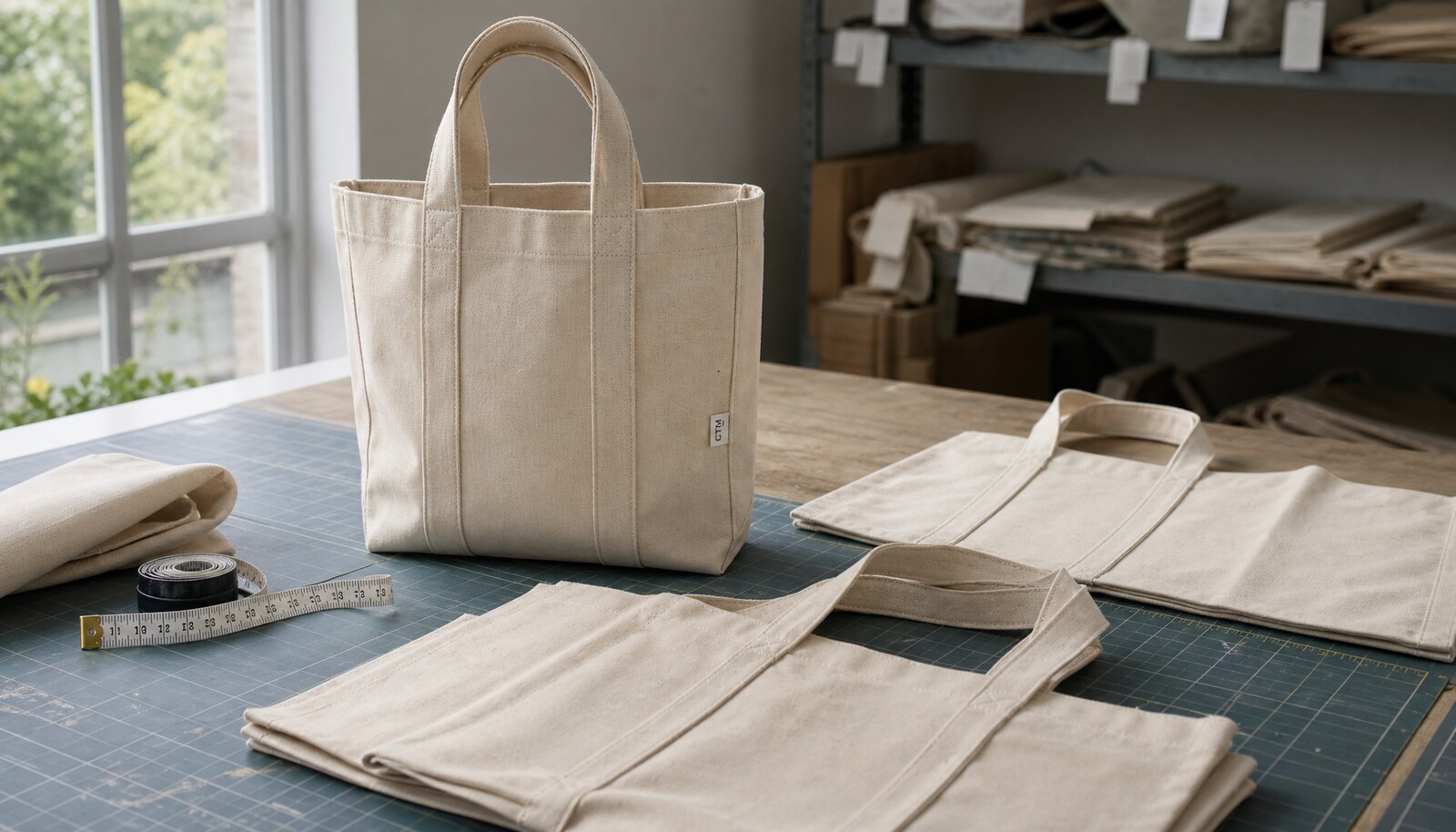
1. Start with the event job, not the artwork
For ecommerce brands, the tote is rarely the real product decision. The actual sourcing question is what job the bag has to do at the event and how that job changes fabric weight, construction, print, packing, and freight. A tote that only hands out a brochure at a trade show is not the same item as a tote that ships inside a customer gift box or carries product samples for a launch event. If you start with artwork and treat the bag as an afterthought, you usually end up with a quote that looks fine on paper but fails when the bag is filled, folded, stacked, or distributed.
A useful procurement brief names four things before any supplier is contacted: the load, the channel, the reuse expectation, and the presentation standard. The load tells the factory whether the tote needs lighter promotional construction or a more durable build. The channel tells you whether the bag will move through warehouse receiving, direct mail, event staff handout, or retail-style presentation. The reuse expectation tells you whether the tote can be purely functional or should feel like a product customers will keep using after the event. The presentation standard tells you whether the print needs to read from across a booth, survive customer handling, or look polished enough to sit on a desk or retail shelf.
This framing also keeps the quote honest. A supplier can make a cheap tote if the job is simply to carry a folded leaflet from point A to point B. The same supplier may need heavier fabric, cleaner stitching, stronger handles, or better packing once the tote becomes part of a customer-facing giveaway. Buyers get better results when they treat the bag as a small piece of operating equipment for the campaign rather than as a promotional accessory.
- Handout only: prioritize compact folding, simpler printing, and lower cost.
- Sample-kit insert: prioritize stronger seams, better print opacity, and a gusset that holds bottles, boxes, or brochures.
- Premium gift bag: prioritize cleaner stitching, heavier canvas, and packaging that protects the print from scuffing.
- If the tote is part of a customer shipment, test how it folds inside the outer carton before you approve the spec.
2. Choose canvas weight by real load and print behavior
Canvas weight is the first spec most buyers should lock because it changes hand feel, print appearance, and cost at the same time. For event giveaways, 10 oz / 340 GSM is usually the practical floor if the bag needs to look intentional rather than flimsy. For bags that carry sample products, catalogs, or a bottle, 12 oz / 407 GSM usually gives a better body and makes the tote feel more stable in the hand. Heavier fabric can be justified when the tote is part of the gift itself, but every step up in weight adds material cost, sew time, and freight cost.
The detail many procurement teams miss is that a supplier can quote the same words while using a different fabric construction. Ask whether the weight is measured before or after finishing, whether the canvas is natural, bleached, dyed, or washed, and whether the yarn count or weave density changes by lot. Two bags can both be called canvas and still behave very differently under print. If the weave is loose, small logo text can look broken or uneven. If the fabric is too soft, the tote can collapse when displayed or wrinkle badly in the carton. If the bag is too stiff, it may look more premium but create packing inefficiency and higher cube.
A good sourcing note links weight to the actual use case, not to a generic promotional standard. A bag that holds only a shirt and a flyer can stay at a lighter spec. A bag that carries a boxed product, water bottle, and printed collateral should be specified with stronger fabric and a construction that resists twist at the handles. That is a better conversation with a factory than asking for the cheapest canvas tote available.
- 10 oz / 340 GSM: workable for standard event handouts and lightweight inserts.
- 12 oz / 407 GSM: better for reusable brand bags and product samples.
- 14 oz / 475 GSM and above: consider only when the tote needs a longer-life consumer feel or heavier carrier function.
- Ask the supplier to send a swatch photo plus one physical sample so you can judge weave density and hand feel together.
3. Lock dimensions, handles, and construction details early
A tote quote is not comparable until the dimensions and construction details are fixed. Common event sizes often sit around 14 to 16 in wide and 15 to 18 in tall, with a 3 to 5 in gusset, but the right size depends on what goes inside and how the bag should look when carried. A tall, narrow bag can work for flat collateral or apparel. A wider gusseted bag is better for boxes, bottles, or a mixed sample set. If the bag is going into shipping, the folded size also matters because a bulky tote can inflate carton volume and change freight cost.
Handle geometry matters more than many teams expect. Handle length and handle drop affect whether the bag is carried by hand or over the shoulder, and the difference changes the user experience immediately. For a carry-on style event bag, buyers often want a longer drop so the tote rides comfortably on the shoulder. For a smaller giveaway bag, a shorter drop is fine and can make the bag feel tighter and more finished. Construction should also be explicit: ask for the seam allowance, whether the edges are turned or bound, what reinforcement is used at the handle join, and whether the bottom is single-layer or double-layer.
Do not assume the factory will choose the right geometry on its own. A good supplier can build almost any tote shape, but they will build to the exact spec you approve. If the bag will carry samples, specify the target load rather than just saying "strong enough." That single change lets the factory choose the seam structure and reinforcement pattern with less room for interpretation.
- Shoulder carry: usually needs a longer handle drop and stronger reinforcement at the stress point.
- Hand carry: can use shorter handles and a simpler build if the load is light.
- Reinforcement: bar tacks or a box-X at the handle attachment are worth specifying for any bag that will carry product samples.
- Gusset: a flat bag is cheaper, but a bottom or side gusset can materially improve usability and perceived value.
- If the tote must sit upright in a retail display or gift kit, ask for a boxed bottom and sample it under load.
4. Pick the decoration method for the artwork, not the other way around
Print method should follow artwork complexity and event intent. Screen print is still the most common choice for promotional canvas because it is stable, repeatable, and economical at volume. It works best for bold logos, limited colors, and clear shapes that need to read from a few feet away. If the artwork has thin lines, small text, gradients, or layered color transitions, the factory may be forcing the design into a process that is not well suited to it. In those cases, a woven label, sewn patch, embroidery, or a different transfer method can be a better answer.
The buyer should also think about what the tote will look like after handling, folding, and reuse. A print that looks good on a digital proof but cracks, rubs, or becomes faint after light abrasion does not support the brand. For event giveaways, the safest route is usually one or two colors with clear placement, a print box that avoids seams, and a minimum text size that the factory can hold consistently. On textured canvas, very fine details often disappear because the weave breaks the image. If your logo depends on hairline strokes or tiny type, the process should be chosen around that constraint instead of trying to push the same art into every supplier.
A useful buyer question is whether the art is designed for a tote or merely copied from a digital ad. Totes are tactile and low-resolution compared with screens. They reward simplified marks, strong contrast, and deliberate spacing. If the event asks for a premium feel, the branding cue can come from the label, thread color, or patch texture instead of from a crowded print area. That makes the bag easier to manufacture and often better looking in real use.
- Screen print: best for volume, strong logo visibility, and simple artwork.
- Embroidery: good for premium positioning, but can pucker on thinner canvas if not tested.
- Woven label or sewn patch: useful when the brand wants a cleaner premium cue without pushing the print process.
- Heat transfer or similar methods: consider for small runs or multi-color artwork, but confirm rub resistance before approval.
- For small text, ask the supplier for the minimum practical type size before approving artwork.
5. Compare supplier routes with a real sourcing matrix
This is where procurement teams often lose time: they compare quote totals before they compare the route that produced the quote. A direct factory, a local decorator, and a trading company can all quote the same tote, but they do not expose the same risk. If you want repeatable output for a recurring event calendar, the factory route usually gives the best control over fabric, sewing, and packing. If you need a domestic rush order or a very small run, a local decorator may win on speed even if the unit price is higher. If you are bundling bags with inserts, labels, or other products, a trading company can simplify coordination, but you should ask more questions about who is actually making the bag.
Use the same comparison frame across all bids so you are not comparing different scopes. Ask each supplier to quote the same fabric weight, finished dimensions, print method, packing format, and carton assumptions. Then read the response for what is missing. Missing details are usually a bigger risk than a slightly higher unit price. A quote that does not name the seam style, sample stage, carton size, or defect standard is not a complete offer; it is a starting point for assumptions.
Regional sourcing tradeoffs matter here. As a planning benchmark, Asia often gives the lowest unit cost and the widest factory selection, especially when you need repeat production or custom sewing details. Domestic or nearshore sourcing often carries a much higher bag-only price, but it can cut transit time dramatically and reduce the cost of last-minute artwork changes. Trading companies can sit in the middle on price while adding coordination value, but they may also add 5% to 12% to the bag price if they are managing communication, kitting, or multi-supplier packaging. Those are not fixed rules; they are the kind of deltas a buyer should expect to see when the scope is otherwise comparable.
- Write the same spec to every bidder so the quote is genuinely comparable.
- Ask for sample photos plus one physical approval sample when the bag will be seen by customers or press.
- Keep the approved spec, quote, and inspection notes tied to one version number so changes do not get lost.
- If the order is time-critical, compare quote price against total schedule risk, not against unit price alone.
6. Use region, compliance, and supplier type to narrow the field
A supplier is not just a price point. It is a combination of region, category focus, document discipline, and production visibility. For a US- or EU-facing campaign, a factory that regularly exports to those markets can save time because the documentation workflow is usually better understood. For a domestic event with a short runway, a local decorator can be enough if the spec is simple and the volume is low. For mixed promotional kits, a trading company may be useful because it can coordinate inserts, labels, and packaging across multiple factories, but the buyer should still ask who controls the sewing and who signs off on the final goods.
Compliance risk should be handled as a normal sourcing question, not as a special request at the end of the process. If the totes are being resold, distributed through retail channels, or shipped into a market with specific requirements, confirm what documentation the supplier can provide and how fast they can provide it. The right question is not just whether they have a test report. It is whether they have the right test report for the market you are actually selling into, plus a process to repeat it if the fabric or decoration changes. If labeling, country of origin, fiber content, or restricted substance documentation matters, include it in the RFQ instead of negotiating it after the sample has already been approved.
Procurement teams should also be alert to capability gaps that show up only after the quote is accepted. A supplier may be able to sew a nice tote but not maintain color consistency across lots. Another may be able to meet a price but struggle with carton discipline or export paperwork. The best way to separate these is to ask for recent photos of similar work, a sample policy, and the specific name of the factory or subcontractor if the bidder is not the manufacturer.
- Direct factory: best when the spec is stable and you want clearer control of production.
- Local decorator: best for rush timelines, domestic delivery, and small event quantities.
- Trading company: best when the order includes mixed products or you need one commercial contact, but require factory transparency.
- Compliance check: confirm document support before award, especially for market-specific labeling or chemical requirements.
- Ask who owns the final QC signoff if the bidder is not the factory.
7. Build the RFQ around cost drivers, not generic quote language
A good RFQ makes the cost structure visible. A weak RFQ produces a low unit price that later grows with setup fees, packing changes, or freight surprises. The most useful version of the request is itemized: fabric weight, finished dimensions, print area, decoration method, handle style, packing format, and delivery region. If those are fixed, suppliers can quote more honestly and you can compare them on equal terms. If those are loose, the lowest bid is often just the one that assumed the lightest fabric or the simplest packing.
The biggest cost drivers are not mysterious. Fabric weight, print color count, setup charges, packing labor, carton volume, and freight density account for most of the difference between quotes. A bag with a simple logo can still be expensive if the packing is labor-intensive or the carton is inefficient. Likewise, a bag that looks cheap on paper can become costly if the supplier has to do multiple proof rounds, add labels one by one, or rework the packaging for every event location. That is why buyers should ask for line-item pricing wherever the supplier can separate recurring and one-time costs.
Use the RFQ to surface hidden scope before the supplier starts sewing. If you need custom inserts, barcode labels, retail hanging tags, or multi-language packing notes, say so early. If you need multiple event versions, ask for base bag pricing plus variable print or label pricing. If you are shipping internationally, ask for the shipping terms, carton counts, and whether the supplier expects to load by pallet, master carton, or loose carton. Those details often decide whether a quote is actually affordable.
- Ask for a line item if a charge is one-time, per color, per size, or per carton.
- Request carton dimensions and carton weight before you compare freight.
- Ask whether the quote includes sample making, print screens, barcode labels, inserts, and customs-ready packing lists.
- If you need multiple event versions, ask for base bag pricing plus variable print or label pricing.
- If the supplier will not separate bag cost from packing cost, treat that as a sourcing risk, not a convenience.
8. Set QC standards before the first sample is approved
Quality control for canvas totes should not be limited to a visual check of the logo. The sample needs to prove the bag can be used the way the event team expects. That means checking the finished size, the handle length, the balance of the bag when loaded, the seam quality, the appearance of the print, and the packing format. For important campaigns, define the defect categories before production starts. Many buyers use an AQL-style approach with separate thresholds for major and minor defects, then tighten the standard when the tote is highly visible or will be touched by customers before the event.
The best sample process includes physical handling, not just approval by email. Hang the bag with the intended contents, look at the print from normal viewing distance, and inspect whether the body twists or the handle load feels uneven. Run a dry rub check on the print, inspect for thread tails, and check that the bag folds as expected for carton packing. If the event requires tight consistency, ask the supplier to show top, middle, and bottom carton units during pre-shipment review rather than only the best sample from the top layer.
A more useful QC checklist is concrete. For canvas work, buyers can set a stitch-density target of about 7 to 9 stitches per inch on visible seams, specify that handle reinforcements must be intact with no skipped stitches, and require print registration to stay within 1.5 mm to 2 mm on simple logo work. That is specific enough to remove ambiguity without turning the inspection into a subjective style review. If your tote is retail-facing or appears in press photos, tighten the tolerances and make the supplier sign the standard before production.
- Use a load test that reflects the actual contents, then add a margin if the bag will be reused.
- Define major defects before production, such as open seams, wrong size beyond tolerance, missing reinforcement, or print shifted into the seam.
- Define minor defects too, such as loose thread tails, small ink specks, or slight shade variation within an agreed range.
- Request pre-shipment photos that show the bag, the packed carton, and the carton label together.
- If the order is visible to customers, tighten the acceptance standard rather than relying on a generic factory default.
9. Treat packing, freight, and the event calendar as part of the product
Packing is not a finishing detail. It changes receiving labor, print protection, carton count accuracy, and total freight cost. Bulk packing is usually the cheapest option and works well when the bags will be redistributed from a warehouse or repacked into event kits. Individual polybags add cost, but they protect the print and simplify handout logistics when bags go direct to event locations or into customer shipments. If the tote is part of a multi-item kit, a kitted approach may be worth the labor because it reduces setup work at the destination.
The freight issue is often volume, not weight. A light tote in an oversized carton can cost more to ship than a denser pack in a better-sized master carton. Ask the supplier for carton dimensions, units per carton, and estimated cubic volume before the order is placed. If you plan air freight for speed, remember that dimensional weight can erase savings from a low unit price. If you plan ocean freight, make sure the cartons stack cleanly and the packing method does not create unnecessary voids. A lower bag price does not matter if the packaging doubles the cube.
The event calendar should run backward from delivery, not forward from production start. Build time for sample approval, bulk production, inspection, transit, and internal receiving. If the order includes custom packaging or multiple artwork versions, add time because every change multiplies the chance of rework. For fixed launch dates, a slightly more expensive supplier that can commit to the full schedule is often the better commercial decision than a cheaper quote that needs heroics to hit the date.
- Bulk pack: lowest material cost, best for warehouse redistribution.
- Individual polybag: better print protection and easier direct-to-event handling.
- Kitted pack: best when the tote is one item in a larger branded set.
- Carton design: ask for a box size that protects the handles and reduces unused volume.
- Do not let the event date become the production finish date; leave margin for inspection and transit.
Specification comparison for buyers
| Spec decision | Recommended option | When it fits | Buyer risk to check |
|---|---|---|---|
| Canvas weight | 10 oz / 340 GSM for standard giveaway bags; 12 oz / 407 GSM when the tote carries samples or keeps a premium feel | Trade shows, ecommerce inserts, launch events, and retail-adjacent giveaways | Confirm whether the quote is based on finished fabric weight or greige fabric weight, and ask for lot tolerance |
| Bag structure | Turned seams, reinforced handle joins, and a flat or boxed gusset if the tote must hold product or sit upright | Most branded event programs and reusable customer-facing totes | Weak bar tacks, thin seam allowance, or a shallow gusset can fail once the bag is loaded |
| Decoration method | 1-color or 2-color screen print for volume; woven label, sewn patch, or embroidery for premium positioning | Simple logos, campaign marks, or higher-perceived-value kits | Thin type, gradients, and small text may not survive canvas texture or print registration limits |
| Supplier route | Direct factory for repeat orders; local decorator for rush or low-volume domestic runs; trading company for mixed kits and multi-item coordination | Stable specs, recurring event calendars, or cross-category bundles | Middleman quotes can hide who is actually sewing the bag and which factory owns the production risk |
| Regional sourcing | Asia for lower unit cost and broader factory selection; domestic or nearshore for shorter transit and smaller runs | Longer lead times, compliance-driven programs, or time-sensitive launches | Freight, customs, and rework risk can erase a low bag-only price if the schedule is tight |
| Compliance/documents | Ask for the exact documents needed for the target market before award | US, EU, UK, or retail-facing programs | Do not assume the supplier can produce origin statements, test reports, or fiber/labeling documentation on short notice |
| Packing format | Bulk packed for warehouse redistribution; individual polybag or kitted pack when presentation matters | Fulfillment, multi-location events, or direct mailer inserts | Loose bulk packing can scuff print, complicate counts, and increase receiving labor |
| Sample path | Artwork proof plus physical pre-production sample; strike-off when print placement is critical | Any order where brand color, logo size, or placement must be exact | Approving only a digital proof misses seam interference, size drift, and ink opacity |
| Landed cost | Compare ex-works, packaging, freight density, and clearance as a single case cost | Budgeting for margin, event ROI, or multi-region distribution | A low unit price can disappear once carton size, volume weight, and last-mile handling are added |
Buyer checklist before sampling
- Define the job first: handout only, sample-kit insert, on-site carry bag, or premium reusable gift.
- Lock the target load and event contents before asking for quotes so fabric weight and construction match real use.
- Specify finished bag size, gusset depth, handle length, handle drop, and whether the tote must sit flat or stand upright.
- State the print method, print size, number of colors, placement, and any minimum line thickness or text-size limits.
- Choose the packing format by distribution channel: bulk carton, individual polybag, master carton with inner packs, or fully kitted sets.
- Request a physical pre-production sample for the approved spec, not just a digital artwork proof.
- Ask for carton dimensions, carton count, gross weight, and cubic volume so freight can be planned before approval.
- Write down your quality threshold for dimensions, stitch quality, print coverage, and acceptable defect levels before production starts.
Factory quote questions to send
- What exact canvas construction and finished GSM or oz are you quoting, and what tolerance do you allow across the fabric lot?
- Is the quote based on screen print, heat transfer, embroidery, woven label, or patch application, and what setup charges are separate from unit price?
- What is the MOQ by bag color, print color, size, and packaging variant, and what changes if we revise artwork or insert requirements?
- Can you confirm the finished size, gusset depth, handle length, seam type, and reinforcement method in writing on the quote?
- What packing format is included in the unit price, and what is charged separately for polybags, tissue, inserts, barcodes, or custom cartons?
- What is your sample timeline from artwork approval to physical sample, and how long does bulk production take after sample sign-off?
- What are the carton dimensions, carton weight, units per carton, and estimated loading quantity for the shipment mode we will use?
- Which inspection standard do you use before shipment, and can you share the defect rules for print misalignment, loose stitching, size variance, stains, and damage?
Quality-control points to confirm
- Canvas weight matches the approved spec within the buyer-agreed tolerance, and the fabric does not feel noticeably thinner on the body panel than the approved sample.
- Finished dimensions stay within the agreed tolerance, typically plus or minus 1 cm or 0.5 in for a standard event tote unless a tighter control is needed.
- Handle length and handle drop match the approved sample so the tote carries correctly in hand or on shoulder.
- Handle joins include reinforcement at the stress point, such as bar tacks or a box-X, with no skipped stitches, loose ends, or open seam starts.
- Stitch density on visible seams should be consistent, with a typical target of 7 to 9 stitches per inch on canvas unless the construction requires a different standard.
- Print placement stays within the approved placement box and does not drift into seams, folds, or the gusset edge; for simple logo work, many buyers set a 2 mm to 3 mm placement tolerance.
- Ink coverage is opaque enough that the canvas texture is visible but the logo does not look washed out, broken, or under-cured from normal viewing distance.
- For one-color or two-color screen print, registration should stay within about 1.5 mm to 2 mm on normal giveaway work; if the art is small or text-heavy, tighten that tolerance before sample approval.
- No visible stains, holes, oil marks, crushed corners, or heavy shade variation appear in the carton or on the bag face.
- Carton counts are exact, carton labels match the PO, barcode labels scan cleanly if used, and a load test or hang test passes at the agreed target load.