Why procurement buyers compare canvas totes as packaging, not merchandise
For cosmetic brands, a canvas tote is rarely a standalone accessory. It is usually a packaging component that supports a launch kit, gift-with-purchase, retail carry program, PR send, or refill campaign. That changes the procurement lens. The question is not only whether the bag looks good in a mockup; it is whether the bag fits the product set, ships efficiently, survives handling, and supports the customer experience the brand is trying to build.
A good sourcing brief starts with the use case. A tote for a checkout counter does not need the same structure as a tote that carries glass jars, boxed serums, or a curated holiday set. A bag intended for repeated use also deserves a different spec than one meant to leave the store once and never come back. If the use case is unclear, suppliers will fill the gap with assumptions, and the quote will be too loose to compare.
This is where cosmetic procurement can drift into generic accessory buying. If a tote is sourced as a “nice branded bag,” it often ends up overbuilt or underperforming. If it is sourced as packaging, the team can define load weight, opening size, print area, carton efficiency, and acceptable reuse expectations. That gives the buyer a cleaner basis for award decisions and a more defensible sustainability story.
The right comparison is not just canvas tote versus canvas tote. It is canvas tote versus paper shopping bag, nonwoven polypropylene bag, cotton pouch, or no secondary package at all. Each route solves a different problem. The best one depends on whether the brand needs premium presentation, lower freight, better shelf presence, or lower material use. The answer should come from the product and the channel, not from a trend.
A short decision memo is usually enough to keep the RFQ focused: what the bag must carry, how it will be distributed, whether it is intended to be kept, and whether the order is a pilot or a replenishment item. That one page does more for quote quality than a long list of mood-board references.
- Primary use cases to define: retail carry, gift-with-purchase, PR kits, refill programs, event handouts, or e-commerce inserts.
- Functional target to confirm: product fit, loading weight, carry comfort, and whether the bag needs to stand upright.
- Brand target to confirm: match the material and finish to the product tier, not just to the logo artwork.
How to compare canvas totes against paper, nonwoven, pouch, or no secondary pack
A useful sustainable packaging comparison should include more than unit cost. It should compare material weight, expected reuse, freight volume, production complexity, and customer-facing value. Canvas totes can be the best option when the brand wants a durable, reusable item that extends brand visibility. Paper bags are often the better answer for short-use retail carry because they are lighter and usually easier to source in a flat-pack format. Nonwoven polypropylene can be acceptable for high-volume promotions where premium tactility is not a priority. Cotton pouches work well for small items, samples, and accessories that need enclosure rather than open carry.
The most common buyer mistake is treating canvas as automatically greener. Sustainability only improves if the item is actually reused enough times to offset the extra material and freight. If a tote is handed out once and discarded, the environmental case is much weaker than a paper carrier or even a smaller pouch. Procurement should therefore ask a practical question: what reuse rate is the business expecting, and is that expectation realistic for the distribution channel?
The comparison becomes more useful when you score each route on the same five dimensions: material efficiency, perceived value, carry strength, print durability, and freight efficiency. Canvas typically performs well on the first four and less well on the fifth because it is bulkier. That is not a problem if the business case depends on keeping the bag in circulation. It is a problem if the bag is mainly there to fill space in a launch kit.
If your team is debating between a tote and another route, request a packed sample of each option with the same product set. A paper bag that looks acceptable on a deck may fail in real warehouse conditions. A canvas tote may justify its higher freight cost if it replaces a secondary box, improves shelf presentation, or becomes a retained brand asset after the purchase. The comparison should be built around the actual pack-out, not around a generic sustainability claim.
For some programs, the best answer is no extra bag at all. If the primary carton already provides protection and branding, adding a tote can be unnecessary. Procurement should be willing to test that option, especially when freight, carton count, and warehouse labor are under pressure.
- Compare at least four routes: canvas tote, paper shopping bag, nonwoven PP bag, and cotton pouch.
- Use the same packed product set in each sample test so the comparison is meaningful.
- Judge the total package on reuse rate, freight volume, and customer experience, not on one-unit cost alone.
Fabric weight, weave, and finish: what procurement buyers should really ask for
For custom canvas tote bags for cosmetic brands, fabric weight is only the starting point. A quote that says “12 oz canvas” can still hide important differences in weave density, yarn quality, finishing, and shrinkage. Two bags with the same nominal weight may feel completely different in hand. One may hang soft and casual; another may feel dense and structured. That is why buyers should ask whether the quoted number refers to finished fabric weight or raw fabric weight, and whether the cloth is pre-shrunk or washed before sewing.
In many beauty applications, 12 oz is the most practical baseline. It usually provides enough body for a clean print, reasonable shelf presence, and acceptable carrying strength without pushing freight cost too high. Ten oz can work for light promotional use, but it may wrinkle more easily and look less premium when filled. Fourteen oz or 16 oz can support heavier gift sets and feel more substantial, but the bag becomes more expensive to sew, more costly to carton-pack, and heavier to ship. If the program is regional or replenishment-based, that freight penalty can matter as much as the unit price.
Weave density affects appearance and decoration quality. Coarse weave can create a natural, rustic look, but it also makes small typography and thin line art less reliable. Fine logos may disappear into the texture unless the print method is selected carefully. Ask the supplier to show the same logo on different cloth weights or finishes so the team can judge edge sharpness, opacity, and overall clarity. Do not rely on artwork proofs alone; a screen image does not show how the weave will interact with the ink.
Finish also matters. Some cosmetic brands want an uncoated, matte surface because it signals simplicity and natural positioning. Others need a smoother surface because the tote sits beside higher-value skincare or premium sets. Bleaching, dyeing, washing, and calendaring all change the hand feel and print behavior. If the factory offers multiple finishes, request side-by-side swatches using the same logo method. That makes comparison easier and gives procurement a cleaner basis for award.
The most useful question is not “What oz do you recommend?” It is “What fabric specification best supports the product weight, the print method, and the expected reuse rate while staying within freight and budget targets?” That forces the supplier to solve the real business problem rather than quoting the heaviest option available.
- Ask for finished fabric weight, weave type, and whether the cloth is pre-shrunk or washed.
- Use 12 oz as the baseline comparison point, then test 10 oz and 14 oz if cost or feel may change the award decision.
- Check how the weave affects logo clarity, especially for small type and thin line art.
A more realistic packaging comparison: what to benchmark before you award a tote
A procurement-ready comparison should read like a decision tool, not a marketing claim. Before you choose a canvas tote, compare it against the other packaging routes using the same product set, the same distribution channel, and the same brand goal. For example, a tote for a retail campaign should be judged differently from a tote for an e-commerce insert or a PR mailer. The best route is the one that fits the channel with the fewest downstream compromises.
The first benchmark is pack efficiency. How much space does each option take in the carton, and how many units fit per master carton or pallet? Canvas often looks modest on screen but can become bulky once folded and packed. That creates freight implications and can change the economics of a larger order. If a supplier cannot provide carton dimensions, gross weight, and carton count, the buyer does not yet have a real comparison.
The second benchmark is reuse probability. A tote only earns its place in a sustainability discussion if the customer is likely to use it again. Ask the brand team what reuse behavior is realistic for the target audience. If the answer is vague, the packaging story is weak. In that case, a paper bag or smaller pouch may be the more responsible route. The buyer does not need a perfect lifecycle assessment to make this call; they need a believable use pattern.
The third benchmark is decoration durability. Paper bags can be cost-efficient and visually clean, but they do not usually survive repeated use. Nonwoven PP can be economical but may feel less premium. Cotton pouches are efficient for enclosed product sets, but they may not support boxed skincare or multi-item kits as well as an open tote. Canvas is strongest when the brand wants the item to stay visible after purchase.
The fourth benchmark is operational simplicity. If the tote needs lining, extra pockets, zippers, or multiple labels, the production line becomes more complex. That may be worth it for a premium gift program, but it is often too much for a volume-driven campaign. Procurement should keep the pack spec simple unless there is a clear user benefit.
- Benchmark pack efficiency, reuse probability, decoration durability, and operational simplicity on the same product set.
- Do not approve a tote without carton dimensions, gross weight, and pack count.
- If the brand cannot justify reuse, consider paper or no secondary pack instead.
Construction details that affect shelf presence and real-world durability
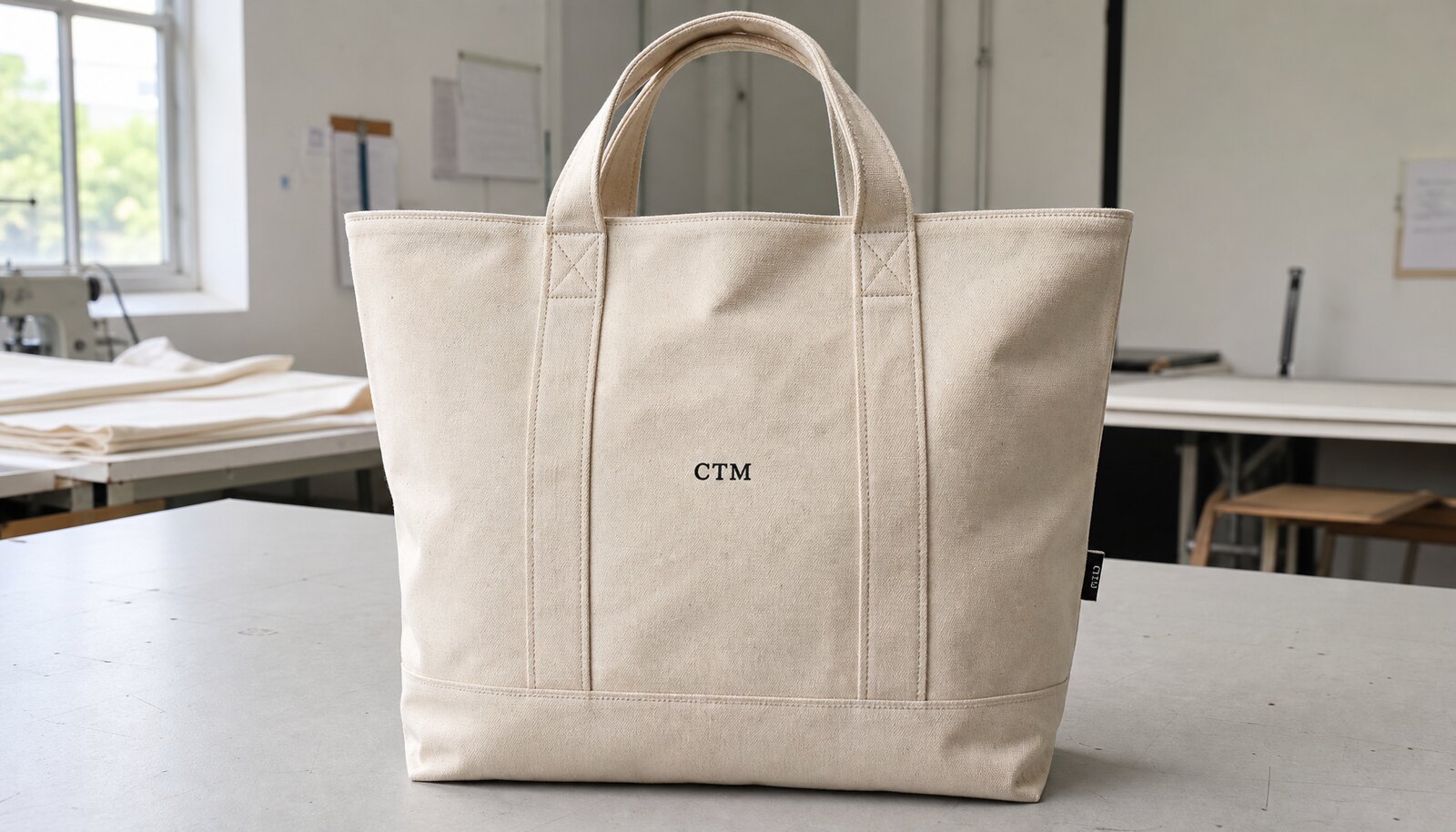
The construction spec often decides whether a tote feels premium or promotional. Buyers should pay close attention to seam finishing, handle attachment, bottom reinforcement, gusset width, and opening shape. A simple bag with clean turned seams and well-placed reinforcement can look more elevated than a complex design with weak stitching or crooked panels. In cosmetic packaging, visual symmetry matters because the bag is usually seen alongside cartons, inserts, and other branded materials.
Handle construction deserves special attention. The handle may be stitched into the seam, attached with a folded reinforcement patch, or supported by bar tacks. Each choice affects cost and durability. The buyer should specify handle drop and ask the factory to confirm tolerance for left-right symmetry. A few millimeters of mismatch may sound small, but it becomes visible in retail display, photography, and customer unboxing.
Bottom shape is equally important. A flat-bottom gusset helps the bag stand more cleanly and fit rigid cosmetics cartons. A soft, unstructured bottom may be acceptable for light event giveaways, but it can collapse under load and make the logo look distorted. If the tote is intended for boxed skincare or glass jars, request a packed sample using the actual product dimensions. That is the fastest way to see whether the opening is wide enough and whether the base seams can handle the load.
Extra features such as lining, inner pockets, zipper tops, and woven labels are useful only when they solve a defined problem. Every extra component adds sewing time, inspection complexity, and freight volume. For many cosmetic programs, a plain but well-built tote performs better than an over-accessorized one. If a supplier suggests upgrades, ask which business issue each feature solves and what cost or lead-time change it creates.
It also helps to ask where each production step happens. If cutting, sewing, printing, and packing happen in different places, the bag can still be acceptable, but the buyer should expect more quality variation and a higher coordination burden. Fewer handoffs usually mean fewer surprises.
- Check handle length symmetry, anchor reinforcement, and bar tack placement.
- Use a packed sample with actual cosmetic products to confirm opening width and base shape.
- Treat extras such as lining or zippers as separate commercial decisions, not default upgrades.
Print methods, artwork rules, and what to request in a strike-off
The print method should be selected after the fabric is chosen. Screen print is usually the best option for one- or two-color logos on canvas because it delivers durable coverage and predictable unit economics at scale. Heat transfer can work for short runs or multi-color graphics, but buyers should test whether it cracks, peels, or loses clarity after folding. Embroidery can create a premium feel for small marks, though it can distort lighter fabrics and add significant cost. Woven labels are helpful as a brand detail, but they are not always a substitute for clear logo decoration.
Artwork should be prepared in vector format with exact color calls, line thickness, and placement dimensions. Fine text can disappear on coarse weave, so logos may need thicker strokes or a simplified layout. If the brand uses Pantone references, ask whether the factory matches to coated or uncoated standards and how it handles ink on textured material. Many quote disputes begin because the buyer expects a digital file to print exactly as it appears on screen.
A proper strike-off should be produced on the final canvas using the intended print method and final color count. A paper proof is not enough. The buyer should check logo centering, print opacity, edge sharpness, and whether ink sits cleanly over the weave. If the design wraps near a seam or gusset, that area needs special review because distortion is common. The same artwork that looks clean on a flat mockup can shift once the bag is sewn.
To reduce disagreements later, ask the supplier for a reference set of acceptable and reject examples: acceptable color range, acceptable print shift, reject photos for smudge or incomplete coverage, and acceptable alignment around seams. That makes it easier for both sides to judge bulk output consistently.
If you want a premium appearance without a large decoration budget, a simple screen print with a woven side label often works well. It gives the bag a more finished look while keeping the quality check straightforward. Buyers can inspect the print and the label separately, which reduces ambiguity during approval.
- Use screen print for simple logos; use heat transfer only when the short-run tradeoff is acceptable.
- Approve artwork in vector format with real placement measurements and color references.
- Require a strike-off on final fabric before approving bulk production.
What a strong quote should include: unit price, hidden costs, and landed-cost tradeoffs
Many tote quotes are hard to compare because they mix production, packing, and logistics assumptions. A procurement-ready quote should separate the cost of fabric, sewing, printing, labels, hangtags, polybags, carton packing, and export-ready packaging. Without that breakdown, the buyer cannot tell whether a lower price reflects better efficiency or simply fewer inclusions. This matters especially when comparing a direct factory with a trading company or a converter that subcontracts sewing.
The landed-cost view should go beyond ex-works price. A tote made from heavier canvas may cost more per unit, but it can reduce perceived quality risk and lower the chance of a brand complaint. Conversely, a cheaper quote with weaker packing may create more damage in transit or more receiving discrepancies. Freight volume matters because canvas is bulky. Even a small change in folded thickness can alter carton count and shipping cost, especially for regional or replenishment programs.
A practical RFQ should ask suppliers to quote at least two packing formats. For example: flat packed in master cartons with outer labels only, and individual polybag plus barcode sticker plus master carton. That comparison shows whether the sustainability benefit is real and whether the freight savings from minimal pack outweigh the handling risk. It also gives finance a cleaner basis for total landed cost.
When comparing suppliers, ask for the details that reveal the true difference in price. A direct factory may show lower sewing cost and clearer material ownership, while a trading company may present a more bundled service price with less visibility into the production chain. Neither is automatically better. The decision should depend on transparency, responsiveness, and who can be held accountable if the order fails inspection.
When bids are close, the deciding factors are usually clarity of scope, packing accuracy, and whether the supplier quoted against a production-ready spec. If the offer was built from a vague “canvas tote” description, it is not yet a valid comparison.
- Request a line-item quote for fabric, sewing, print, labels, packing, and cartons.
- Compare ex-works price and freight impact together; canvas is bulky and can change shipping cost materially.
- Ask for at least two packing formats so you can compare sustainability and logistics on equal terms.
Supplier route comparison: direct factory, trading company, or mixed production chain
For procurement buyers, the question is not simply who is cheapest. It is who can deliver the bag spec with the least ambiguity. Direct factories are often the strongest route when the program requires controlled sewing quality, repeat orders, and visibility into how the bag is actually made. But not every factory is equally capable. Buyers still need to verify whether cutting, sewing, printing, and packing are truly in-house or split across subcontractors.
Trading companies can be useful when the order is small, the sourcing team lacks local infrastructure, or the buyer wants one party to coordinate multiple packaging items. The tradeoff is transparency. If the trading company cannot clearly identify the source factory or explain the production flow, the quote becomes harder to compare on a true apples-to-apples basis. It can also be harder to assign responsibility if the tote arrives with stitching variation or print defects.
A mixed chain is common in the market: one vendor handles sales and artwork, another handles sewing, and a third handles print or labels. That structure is not automatically bad, but it should trigger extra diligence. Ask who owns final QC, who signs off on the golden sample, and who is responsible if one step introduces a defect. If the answer is unclear, the landed-cost risk is higher than the quote suggests.
For repeat cosmetic programs, the best route often depends on order stability. If the bag will be reordered, kept in a seasonal line, or rolled into a retail replenishment program, direct factory sourcing usually becomes more attractive because it supports process control and price continuity. If the order is a one-off test with changing artwork and uncertain volume, a trading company may offer more flexibility, but the buyer should demand stronger documentation.
The most effective supplier comparison is one that asks each bidder to quote the same final spec, the same packing format, and the same inspection expectation. Without that discipline, the lowest number is often just the least complete offer.
- Direct factory: better for repeatability, visible process control, and accountable QC.
- Trading company: useful for smaller or mixed programs, but require stronger documentation and source transparency.
- Mixed chain: acceptable only if one party clearly owns final quality and shipment responsibility.
MOQ planning, pilot orders, and how to avoid accidental scope creep
MOQ issues are often really specification issues. A supplier may quote a manageable quantity for one size, one color, and one print location, but the order becomes expensive when the buyer adds alternate handles, different label placements, multiple print colors, or retail packaging requirements. In other words, the apparent MOQ problem may be a complexity problem. Buyers can usually reduce friction by simplifying the first order and proving demand before layering in extras.
For pilot orders, the goal should be to preserve the core tote experience while limiting setup costs. That usually means one size, one fabric color, one decoration method, and one packing spec. If the brand needs two sizes or two colors, ask the factory to show whether those options share the same fabric roll, the same print screen, or the same sewing pattern. If not, the program is effectively multiple SKUs and should be quoted that way.
When you request a pilot, do not ask only for total units. Ask for MOQ by SKU and by production step. A factory may be willing to cut 1,000 bags but require a much larger fabric minimum, or it may be comfortable with a small run only if the print screen can be reused later. That detail matters because procurement often compares offers that are not structured the same way.
Scope creep is another hidden issue. Buyers sometimes approve a sample and then ask for zipper pulls, a bigger logo, a second label, or a different carton style before bulk starts. Those changes can reset setup costs and push lead time out. The cleaner approach is to lock the golden sample, then manage any post-approval changes through a formal revision notice with cost and timing impact clearly stated.
If the tote is for a cosmetic brand launch, the safer path is often a modest first run on a stable spec and a second round for creative variation. That keeps the launch on schedule and gives procurement a cleaner baseline for supplier evaluation.
- Start with one size, one color, one logo location, and one pack format for the pilot order.
- Ask for MOQ by SKU and by production step, not only by total order quantity.
- Treat any post-sample change as a formal revision with cost and lead-time impact.
QC and inspection: specific acceptance criteria buyers can actually use
QC should be more specific than “good stitching” or “acceptable print.” For a canvas tote, define measurable checkpoints before production begins. The buyer should approve a reference sample, then inspect bulk output against that sample using an AQL-based final inspection plan. In practice, that means setting critical defects, major defects, and minor defects with different tolerances. A critical defect might be a torn seam or contamination that makes the bag unusable. A major defect might be a misprinted logo, skewed handle, or size error beyond tolerance. A minor defect might be a stray thread or a small aesthetic inconsistency that does not affect function.
A practical inspection process starts with a pre-production sample and then moves to in-line and final checks. During in-line inspection, the factory or third-party inspector should verify the first produced units for size, print position, and stitch consistency before the full batch runs. At final inspection, random cartons should be opened and measured. Buyers should not rely only on visual checks from outside the carton, because count errors and mixed lots can hide there.
Set tolerances before the order starts. Define acceptable variance for width, height, and handle drop, and add a rule for symmetry between left and right handles. Also define print standards: centered within a specific millimeter range, fully opaque without pinholes, and no severe cracking after a simple fold test. If the tote has a woven label, require the label to be level and securely stitched, not tilted because it “still looks fine in photos.”
Because cosmetic branding is visual, small defects matter more than they do in a generic utility bag. Stains, loose threads, or ink smudge can lower shelf appeal and trigger receiving complaints. Buyers should ask for an inspection photo set that distinguishes acceptable from reject conditions. That makes it easier for both sides to resolve disputes without guessing.
If the program is high visibility, consider a third-party inspection with a clear report format and carton-by-carton findings. At minimum, the report should state sample size, defect counts by category, key measurements, carton count verification, and whether the shipment passed, held, or failed. That is more useful than a simple “passed inspection” email.
- Use an AQL-based inspection plan with critical, major, and minor defect categories.
- Define tolerances for size, handle drop, print position, and stitch symmetry before production starts.
- Require carton count verification and photo evidence for visible defects and packing issues.
Specification comparison for buyers
| Option / decision | Best-fit use case | Procurement advantage | Buyer risk or watch-out |
|---|---|---|---|
| 10 oz canvas tote | Light promotional inserts, event handouts, or low-load beauty kits | Lower unit cost and lighter freight; easier to keep MOQ down | Less structure, easier print distortion, and weaker shelf presence; not ideal for glass jars or boxed skincare |
| 12 oz canvas tote | Most retail-ready cosmetic kits, GWP programs, and reusable shopping bags | Balanced cost, structure, and branding surface; often the best quote baseline | Nominal oz labels can vary by mill and finish; always verify actual fabric spec and shrinkage |
| 14 oz-16 oz canvas tote | Premium gifting, heavier skincare sets, and reusable carry programs | Better shape retention, stronger seams, and higher perceived value | Higher sewing cost, heavier cartons, and greater freight impact; may be over-spec if reuse rate is low |
| Canvas tote vs paper shopping bag | Reusable brand touchpoints where longevity matters more than first-use cost | Canvas usually wins on reusability, print durability, and repeated brand exposure | Paper is lighter and often cheaper per unit; canvas only wins if reuse is realistic and frequent |
| Canvas tote vs nonwoven polypropylene bag | Beauty promotions that need a more premium tactile look but still need price control | Canvas feels more elevated and is easier to position as a kept item | Nonwoven PP is often cheaper and faster; canvas may be over-specified for disposable campaigns |
| Canvas tote vs cotton pouch | Small-format kits, sample sets, or accessories where enclosure matters | Tote gives more usable branding surface and easier loading of boxed items | Pouches can be lower volume and more protective; totes are less efficient for tiny SKUs |
| Direct factory vs trading company | Repeat programs needing construction control and clearer accountability | Better visibility on fabric, sewing, print, and QC; often stronger landed-cost transparency | Trading companies may bundle margin and obscure the actual production source unless documentation is tight |
| Minimal-pack sustainable route vs retail-ready overpack | Brands trying to reduce packaging waste without sacrificing shipment control | Flat-packed cartons, paper inserts, and selective protection can reduce excess materials | Too little protection increases scuffs, count errors, and receiving claims |
Buyer checklist before sampling
- Define the exact tote use case: retail carry, gift-with-purchase, PR kit, refill program, e-commerce insert, or event distribution.
- Lock the finished bag size, gusset depth, handle drop, and target load weight before requesting quotes.
- Specify the canvas weight in oz or gsm, and state whether the supplier must quote finished fabric weight or raw fabric weight.
- Ask the supplier to confirm weave type, shrinkage behavior, and whether the cloth is pre-shrunk, washed, or calendared.
- Send vector artwork and confirm print area, logo size, color count, and Pantone references.
- Ask for a quoted BOM or line-item breakdown for fabric, sewing, print, labels, packing, and export carton work.
- Request a strike-off or print proof on the actual canvas, not just on paper or a swatch card.
- Approve a pre-production sample built with final fabric, final seam construction, final print method, and final packing format.
- Set inspection standards in the PO: size tolerance, stitch quality, print alignment, stain limit, and carton count accuracy.
- Confirm whether cartons are master packed, inner packed, or individually polybagged, and who pays for that packing labor.
Factory quote questions to send
- Is your unit price based on finished bag construction only, or does it also include raw fabric, sewing, print, labels, and carton packing?
- Please separate the quote into fabric cost, cut-and-sew labor, print setup, label attachment, packing, and export carton charges.
- What exact canvas weight, weave, and finishing are you using, and can you provide a mill spec or internal spec sheet?
- Can you quote the same tote in 10 oz, 12 oz, and 14 oz canvas so we can compare price, stiffness, and freight impact side by side?
- What is the MOQ per color, per size, and per print method, and does a second print location change the setup fee or MOQ?
- What sample stages do you provide before mass production, and which stage reflects the final fabric and final packing?
- How do you control stitching, print alignment, stains, and count accuracy during production, and what inspection method do you use?
- Can you share the AQL level you inspect to, the defect classification you apply, and sample photos of acceptable vs reject conditions?
- What is the carton count per master carton, the carton size, and the gross weight, and how does that affect freight quoting?
- If we compare you with a direct factory and a trading company, what elements of your quote are fixed, and what can change after sample approval?
Quality-control points to confirm
- Fabric verification: confirm actual fabric weight, weave density, and shrinkage behavior against the approved sample, not just the quoted oz label.
- Size verification: measure finished width, height, and gusset against the spec sheet; define acceptable tolerance before production starts.
- Handle reinforcement: inspect bar tacks, stitch density, stitch backtracking, and whether both handles sit at the same drop height.
- Load test: pack the tote with the intended cosmetic assortment and confirm opening width, carry comfort, and seam stress.
- Print control: verify color density, edge sharpness, registration, and rub resistance on the actual textured canvas surface.
- Stain and contamination control: inspect under bright white light for oil marks, dye spots, lint, thread ends, and packing debris.
- Packing count control: verify inner pack count, master carton count, carton labels, and lot traceability before release.
- Carton integrity: check compression resistance, tape closure, barcode placement, and moisture or crush damage risk during transit.
- AQL-based final inspection: set critical defects at zero tolerance, major defects tightly controlled, and minor defects limited by agreed sample size.
- Common reject triggers: broken stitches, distorted logo placement, uneven handles, severe print smudge, visible staining, mixed sizes in one carton, and short-shipped quantities.