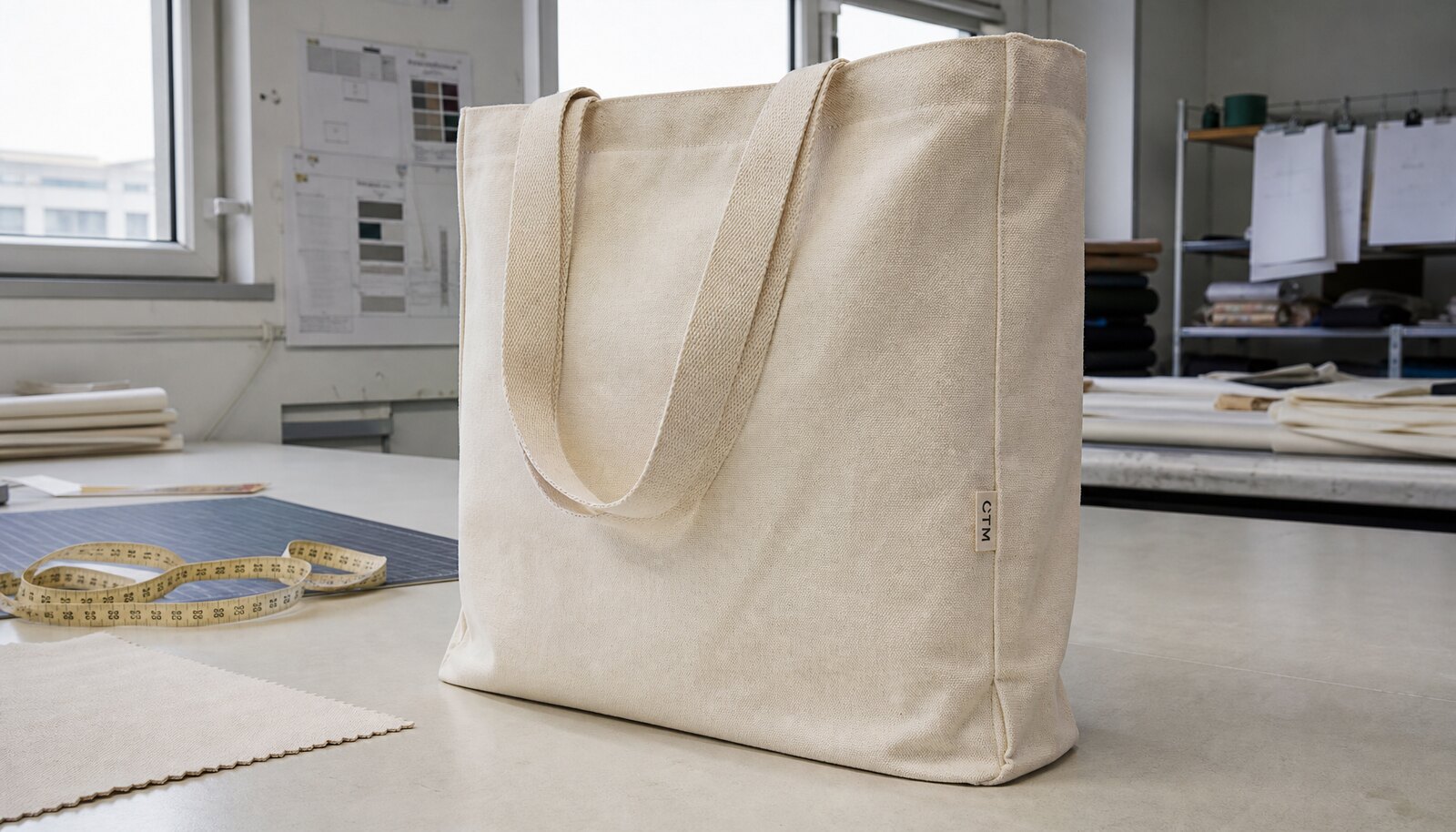
Start With the Use Case, Not the Bag
Custom canvas tote bags for cosmetic brands fail when the buyer starts with a vague idea of a nice bag instead of a clear use case. A tote for a retail counter, a gift-with-purchase program, a PR mailer, or an event giveaway does not need the same fabric weight, closure, or print format. Cosmetic buyers often want a premium feel, but premium is not the same as heavy. The right specification is the one that survives product insertion, shipping, shelf display, and repeated customer use without turning the bag into a cost problem.
The first sourcing decision is therefore not artwork or color. It is how the tote will move through the channel. If it is going into a lipstick or skincare set, the bag may need a tighter weave, a cleaner fold, and a more controlled print area. If it is a retail accessory, the brand may need a stronger handle, a nicer lining or inner trim, and a more polished label package. A bag that looks good in a sample photo can still be wrong if it collapses when filled, shows contents through the fabric, or stores badly in a carton.
- Retail tote: prioritize presentation, fold quality, and repeat use.
- Gift-with-purchase tote: prioritize speed, MOQ flexibility, and clean print.
- PR or influencer kit tote: prioritize weight control and carton efficiency.
- Bundle insert tote: prioritize size consistency and easy packing.
Set the Base Fabric Before You Compare Quotes
For cosmetic brands, the most practical canvas range is usually 10 to 12 oz for lighter retail or promotional use, and 12 to 14 oz when the bag needs a more premium hand feel or better structure. In GSM terms, that often lands roughly in the 340 to 475 GSM range, depending on weave density and finishing. The reason to specify both oz and GSM is simple: suppliers do not always describe canvas the same way, and one factory's 12 oz can feel noticeably different from another factory's 12 oz if the weave is loose or the finishing is soft. If the cloth is too light, the bag looks cheap and reveals the contents. If it is too heavy, the bag can become stiff, expensive, and awkward to pack.
Natural canvas, bleached canvas, and dyed canvas each carry different sourcing risks. Natural canvas can look authentic and eco-led, but buyers need to accept some slub, shade variation, and fiber flecking. Bleached or white canvas is cleaner for cosmetic branding, but it can show stitch marks, dirt, and print registration issues more clearly. Dyed canvas gives a sharper brand story, yet color matching and dye lot consistency become part of the order risk. The correct spec should include the acceptable range for slub, shade, and shrinkage, plus a clear stance on whether a softer washed finish is acceptable or whether the brand wants a crisp retail face.
- Write fabric weight in oz and approximate GSM so quotes are comparable.
- State whether the canvas is natural, bleached, or dyed.
- Include shrinkage allowance if the tote must keep a precise finished size.
- Specify seam allowance and reinforcement at the handle anchor points.
Choose the Supplier Route You Can Control
The supplier model matters as much as the bag spec. A direct factory is usually the cleanest route for private label control because the sewing, print, and packing assumptions can be aligned in one place. That said, a factory is only a good route if it actually runs canvas bag production regularly. If totes are a side product, communication can drift and the sample you approve may not match the bulk run. A trading company can reduce coordination friction when you need labels, cartons, and multiple SKUs handled together, but you should expect less visibility into the actual plant and some markup in exchange for project management.
Domestic decorators and print shops are useful when speed matters more than cost efficiency. They make sense for short launches, internal events, and urgent retail promotions, but they usually have fewer options for seam construction, label integration, and customized packing. A stock bag supplier with custom print is often the best route for pilots because it reduces lead time and MOQ pressure. The tradeoff is that you are buying into the supplier's existing fabric, handle, and folding assumptions. If the brand needs a very specific retail look, a fully custom route is more stable for the long term even if the first order is more work.
- Direct factory: best for repeat programs and tighter process control.
- Trading company: best when the project has many moving parts and one owner is needed.
- Domestic decorator: best for short lead time and smaller volumes.
- Stock plus custom print: best for pilot launches and market tests.
Write an RFQ That Forces Apples-to-Apples Quotes
Most tote quotes are hard to compare because the buyer gives a loose brief and the supplier fills in the blanks differently. If the RFQ does not lock the finished size, canvas weight, handle length, print method, and packing format, the lowest quote is often just the one that left out the most. For cosmetic brands, the quote should also state the brand use case, because a tote that sits beside a skincare gift box does not need the same construction as a fashion retail bag. The quote should separate the base bag from optional extras such as woven labels, hangtags, polybags, tissue, and insert cards.
A useful RFQ also asks for quote data that reveals cost drivers instead of hiding them. Finished dimensions, gusset depth, number of print colors, label type, carton count, carton size, and destination incoterm all affect landed cost. If a supplier can only quote after the artwork is simplified, that is a sign the artwork itself may be too expensive for the target price point. When two suppliers give different totals, look first at the assumptions. The correct response is rarely to negotiate blindly on unit price; it is to align the material, process, and packing spec before price comparison starts.
- Finished size in mm, not only in inches or a reference image.
- Fabric weight, color, and whether the cloth is stock or custom dyed.
- Print method, number of colors, and print area.
- Packing format, carton quantity, and destination incoterm.
Print and Branding Choices That Suit Cosmetic Use
For most cosmetic brands, screen print is still the best balance of cost, durability, and clarity on canvas. A one-color or two-color spot print gives the cleanest result when the logo needs to stay legible on a textured surface. It is also easier to keep consistent across reorders. Embroidery can look premium, but it adds thread cost, increases lead time, and may distort lighter canvas if the logo is large or dense. Heat transfer has its place for complex art or small-batch launches, but it needs tighter process control to avoid edge lift and wash wear.
Private label presentation usually works best when the decoration package is simple and disciplined. A front logo print plus a woven side label or sewn-in brand tab often looks more credible than multiple decorative treatments competing for attention. For cosmetic buyers, the risk is not too little branding; it is the wrong kind of branding. Fine lines, tiny type, gradients, and photo art can all look weak once they hit a woven surface. Ask for a strike-off or sample print on the actual cloth before you approve the artwork. A flat digital proof is not enough because canvas texture changes color density and sharpness.
- Use screen print for simple logos and repeat orders.
- Use embroidery only when the premium look justifies the added cost and thickness.
- Reserve heat transfer for short runs or complex artwork.
- Keep the logo large enough to remain clear on textured canvas.
Use Sample Approval to Catch Structural Problems Early
A sample is not approved because the logo looks acceptable in a photo. It is approved when the actual bag behaves correctly in use. That means the body should measure correctly after sewing, the handles should sit evenly, the print should be centered within the agreed tolerance, and the bag should fold the way the retail team expects. Cosmetic brands often underestimate how visible small defects become when a tote is paired with premium packaging. One crooked seam or a weak print cure can make the whole set look less controlled.
The pre-production sample should be made from the same bulk fabric, thread, and print method that will be used in production. A sales sample made from substitute cloth can hide problems with shrinkage, print spread, or handle softness. A practical approval routine includes a carry test with realistic fill weight, a look at stitch consistency on the handle anchors, a rub test on the print, and a review of the label placement after the bag is folded. If the sample is being approved for a retail launch, the buyer should also verify that the product still looks intentional after repeated unfolding and refolding.
- Measure critical dimensions after sewing, not before.
- Test print rub resistance and cure on the actual cloth.
- Load the bag with realistic product weight and inspect handle stress points.
- Reject samples that use substitute material or temporary finishing.
Packing Details That Affect Retail Readiness
Packing is often treated as a small detail, but for cosmetic totes it influences the perceived quality of the whole order. A flat-folded bag in a clean polybag or tissue wrap is usually the safest format for retail distribution and e-commerce inserts. If the tote is going into a beauty set, the fold direction should be fixed so the logo lands in the expected position when the carton is opened. If the bag is packed too tightly, the canvas picks up hard creases and the print can rub against the inner film. If it is packed too loosely, cartons lose efficiency and shipping cost rises.
The labeling package should be defined at the same time as the bag spec. That means country-of-origin marking, barcode placement, size sticker placement, and any retailer-specific carton marks. Cosmetic brands often have stricter packout rules than they expect, especially when the tote is bundled with skincare jars, glass bottles, or other items that can scuff the canvas. A good supplier will show a folded sample, the packed carton layout, and the outer carton count before bulk production starts. If the factory cannot explain how the tote will sit in a shipping carton, that usually means the packing line has not been planned properly.
- Fix the fold so the logo faces the right way on opening.
- Define whether tissue, polybag, or insert card is required.
- Lock carton quantity and master carton dimensions before production.
- Make sure barcode and country-of-origin labels are placed where the retailer expects them.
Lead Time and MOQ Logic for Private Label Programs
Canvas tote lead time is driven less by sewing alone and more by how many variables the supplier has to control. Stock fabric, one-color print, and simple packing can move faster than custom-dyed cloth, multiple decoration steps, and special inserts. If a supplier needs to source a new fabric lot, match a new print color, and add a woven label plus a hangtag, the schedule becomes more fragile. The safest plan is to split the project into sample approval, material booking, bulk production, and packing confirmation, each with its own signoff point.
MOQ is not just an arbitrary factory number. It is the point where cutting, printing, sewing, and packing become efficient enough to run without constant line changeovers. A brand that wants three tote colors, two print versions, and customized packing is effectively asking the factory to manage several small orders inside one order. That can be done, but the unit price and lead time will reflect the added setup. If the launch is still being tested, simplify the spec first and reserve the more complex version for the reorder. That is usually cheaper than pushing every detail into the first PO.
- Simplify the first order if the launch is still unproven.
- Use stock fabric when schedule risk matters more than perfect customization.
- Treat multiple colors and multiple print versions as separate production variables.
- Reserve custom dye, special packing, and extra trims for the reorder if the market response justifies it.
Compare Landed Cost, Not Just Factory Price
A tote quote that looks cheap at the factory gate can become expensive once freight, duty, carton volume, inland trucking, and rework are added. Canvas bags are not heavy in the way metal goods are heavy, but they can be bulky. That means carton dimensions and fold efficiency matter as much as fabric weight. If one supplier packs more bags per carton without crushing the fabric or print, the landed cost can improve even if the unit price is slightly higher. Buyers should compare total landed cost per sellable bag, not just the FOB line.
When comparing offers, separate what changes the bag itself from what changes only the shipment. Fabric weight, print colors, label count, and packing format affect product cost. Carton size, palletization, export paperwork, and freight mode affect logistics cost. If the supplier can show a clean cost breakdown, the buying team can decide where to spend and where to save. For cosmetic brands, the usual best tradeoff is simple decoration, controlled packing, and a slightly better fabric weight rather than a low-cost bag that looks thin in the hand. The right landed-cost choice is the one that protects the brand image without overspending on hidden extras.
- Compare unit price plus freight, duty, inland transport, and carton cost.
- Watch carton efficiency because canvas is bulky relative to its weight.
- Separate product cost from logistics cost before deciding the winner.
- Favor the quote that shows every assumption instead of hiding the setup.
Common Mistakes Cosmetic Buyers Make
The most expensive mistakes are usually simple ones. Buyers approve a mockup without testing the actual cloth, then discover the print reads too dark on natural canvas. They compare quotes that use different fabric weights and different packing methods, then assume the lowest number is the best deal. They also forget that cosmetic products often need a cleaner presentation than a generic promotional tote. A bag that is fine for a trade show can look underbuilt beside a premium cream jar or palette box.
Another common mistake is to treat the tote as a final add-on instead of part of the launch plan. If the bag is tied to a retail promotion, the supplier needs artwork, size, label, and packaging decisions early enough to book fabric and line time. Late changes create rush charges, rework, and quality drift. The better process is to decide the use case, write a clean RFQ, approve one production-real sample, and lock the packing spec before the bulk order starts. That sequence gives the buyer more control than chasing a low quote and trying to fix details later.
- Do not approve fabric from a photo alone.
- Do not compare quotes with different assumptions.
- Do not leave label and packing decisions until the last minute.
- Do not let the first order become a custom engineering project.
Specification comparison for buyers
| Supplier option | What to verify | Commercial advantage | Buyer risk to control |
|---|---|---|---|
| Direct sewing factory | fabric swatch, approved sample, seam close-ups, logo test photos, packing pilot, and final inspection evidence | Better sample-to-bulk control and faster production feedback | May be weaker on export paperwork or branded packing unless checked early |
| Trading company | Factory name, production photos, trim-source proof, and who owns QC decisions | Can coordinate small mixed orders and extra services | Markup can hide real factory capability and slow defect decisions |
| Specialized bag workshop | bag size, gusset, handle drop, seam allowance, stitch density, reinforcement patch, and loading expectation | More practical for detailed construction, trims, and repeat programs | Capacity may be limited during peak seasons |
| Low-price general supplier | 8-12 oz cotton canvas, 120-220 gsm cotton, recycled cotton, or blended fabric selected by use case and target price | Useful for simple promotional runs with loose specs | Material downgrades, weak packing, and vague inspection scope can erase savings |
| Retail-ready supplier | fold method, inner bundle, carton count, carton mark, moisture protection, SKU separation, and warehouse receiving needs | Can handle labels, SKU separation, carton marks, and receiving rules | Higher unit cost must be compared against reduced warehouse work |
| Compliance-focused supplier | Fabric records, labeling review, test plan, and production traceability | Safer for retail programs and repeat brand orders | Documentation claims need evidence, not only sales language |
| Local sample room plus bulk factory | Signed sample, bulk factory handoff, first-piece photos, and deviation owner | Good for complex branding before large production | Sample room quality may not match bulk line unless handoff is controlled |
Buyer checklist before sampling
- Finished size, gusset depth, and handle drop are written in millimeters, not only as a reference image.
- Canvas weight is stated in oz and the expected GSM range is noted on the RFQ.
- Fabric color is defined by a natural shade reference, Pantone target, or approved lab dip, with slub tolerance stated if relevant.
- Artwork files are final, and the print method, number of colors, and print area are fixed before quote comparison.
- Branding package is defined: woven label, printed logo, care label, hangtag, barcode, and country-of-origin marking.
- Packing format is fixed: flat fold, tissue wrap, polybag, insert card, carton count, and master carton marks.
- Sample approval includes size tolerance, stitch quality, print registration, color match, and a simple load or carry test.
- Incoterm, destination port or warehouse, and who pays inland freight are clear before the quote is accepted.
- The supplier has quoted the same fabric, same print process, same packaging, and same delivery assumption across all options.
- Reorder expectation is documented so the supplier knows whether this is a one-time launch or a repeat program.
Factory quote questions to send
- What exact canvas weight, weave style, and shrinkage allowance are included in the quote?
- Is the sample made from the same bulk fabric, thread, print screen, and finishing method as production?
- What is the MOQ per size, per color, and per print version, and does the MOQ change if packaging is simplified?
- What exactly is included in the unit price: fabric, sewing, print, woven label, hangtag, inner packing, and carton packing?
- What folding method and carton quantity are assumed, and what are the master carton dimensions and gross weight?
- What is the lead time for sample approval, bulk production, and repeat orders if the artwork stays unchanged?
- What tolerances do you allow for finished size, print placement, and stitching alignment?
- What inspection photos or report will you provide before shipment, and at what stage are defects removed or reworked?
- Which Incoterm are you quoting, and what inland trucking, export handling, or documentation charges are excluded?
- How do you handle reprints, needle damage, color drift, or delayed fabric arrival if the bulk order is already scheduled?
Quality-control points to confirm
- Fabric weight matches the approved spec and the cloth does not feel visibly thinner in stress areas.
- Finished dimensions stay within the agreed tolerance for body width, height, and gusset depth.
- Handle attachment is symmetrical, reinforced, and free from skipped stitches or loose thread ends.
- Print alignment, density, and cure are consistent, with no smearing, cracking, or wash-off risk in a simple rub test.
- Seams lie flat and the interior of the bag is clean, with no broken needles, holes, or oil spots.
- Color matches the approved sample under daylight and warm indoor light, not only in one inspection condition.
- Label placement is correct and does not interfere with the fold, handle stress point, or retail-facing side.
- Packing count, carton marks, and barcode placement match the purchase order exactly.
- No odor, mildew, or moisture is present after packing, especially if the order will sit in transit for several weeks.
- The sample and bulk production use the same trim, print method, and finishing sequence, not substitute materials.