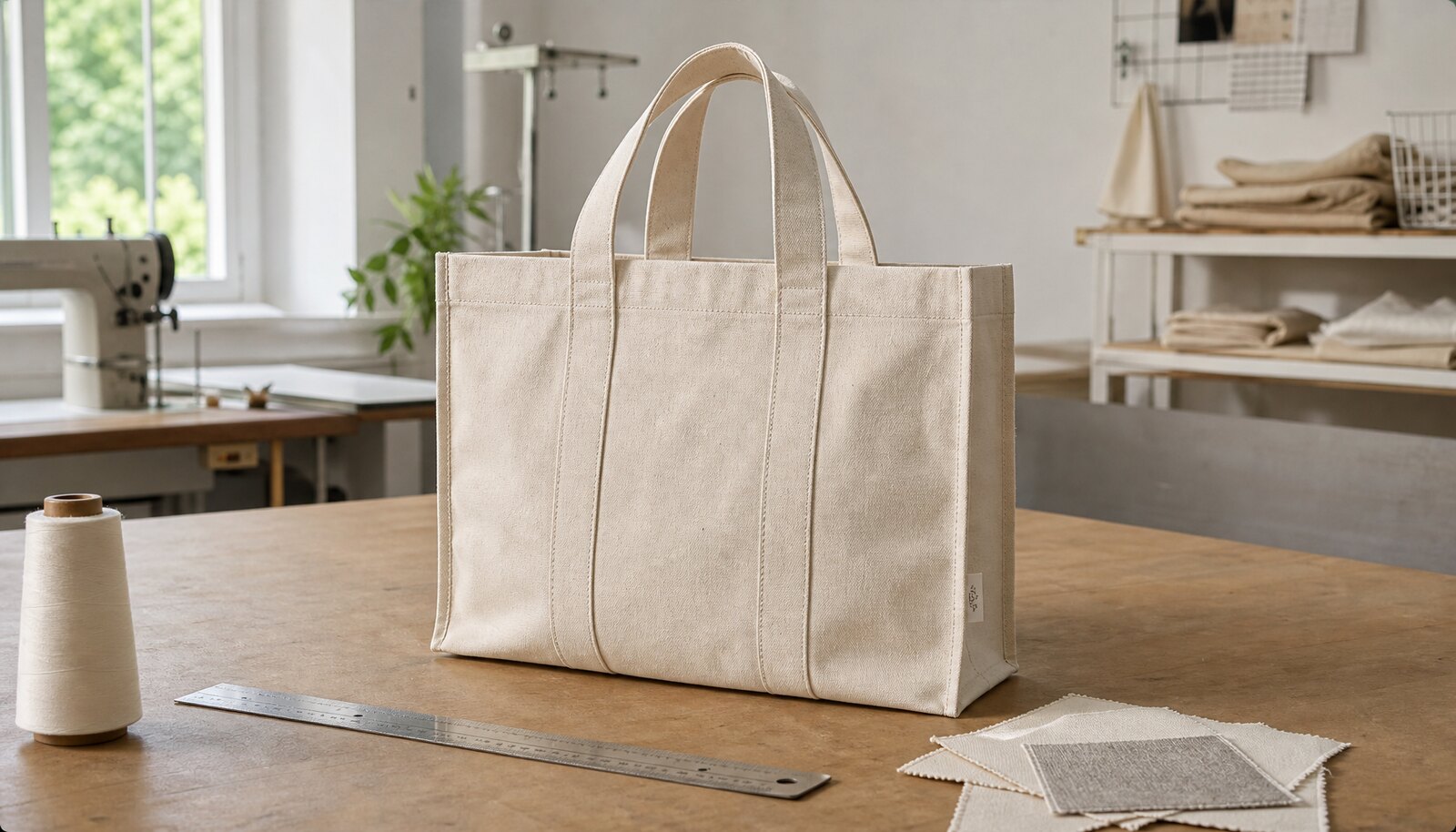
Start With the Packaging Job
Custom canvas tote bags for cosmetic brands are usually not generic merch. They are packaging components that also carry brand value, so the bag has to protect the product, look clean on shelf, and arrive in a condition the customer will reuse. That is a different job from a cheap promo tote. If the brief only says canvas bag, suppliers will fill in the blanks with their own default construction, and that is where most production mistakes start.
Before comparing quotes, define what the bag is doing in the buying flow. A tote used as a gift-with-purchase can be lighter and more decorative. A tote that carries boxed skincare needs better gusset control and stronger handles. A tote sold at retail needs a cleaner finish, tighter stitch work, and more disciplined packing. The use case determines fabric weight, print strategy, and how much time the factory should spend on finishing.
- Gift-with-purchase: lighter canvas, simple open top, fast branding.
- Retail carry bag: heavier canvas, reinforced handle points, cleaner seams.
- Beauty kit insert: size must fit cartons, sleeves, and bottle shapes without bulging.
- PR mailer: presentation matters, but packing and transit damage matter more.
Choose Size, Gusset, and Handle Drop
Cosmetic brands often get into trouble by choosing a size from a mood board instead of a carton plan. A tote that looks elegant on a sample table can fail once the brand inserts skincare boxes, fragrance cartons, or literature. Specify the finished dimensions, not just the image size, and include the gusset depth if the bag needs to sit upright or carry rigid items. For many beauty programs, the useful range is around 10 x 12 x 3 inches to 12 x 14 x 4 inches, but the right size depends on the actual inner pack or retail item.
Handle drop should be treated as a functional spec, not a style detail. A shorter drop suits a hand-carry beauty bag, while a longer drop is better for shoulder use in store or at events. If the bag will be packed into another carton or inserted into a gift box, the handle length also affects how cleanly the tote folds. Ask the factory to quote the finished size tolerance, not just nominal dimensions, because a loose tolerance can create carton fit problems later.
- State finished size, not cut size, in the RFQ.
- Define gusset depth if any boxed product must sit flat.
- Give a handle drop target if the bag will be carried on shoulder.
- If the tote must fit another carton, provide the inner carton dimensions first.
Choose Fabric Weight and Construction
For cosmetic packaging, fabric weight is a cost and presentation decision at the same time. A 10 oz canvas can work for lightweight campaigns and event bags, but it may feel too soft if the brand expects the tote to hold boxed skincare or be reused often. A 12 oz canvas is a safer default for most beauty buyers because it balances body, printability, and cost. A 14 oz canvas gives a more premium hand-feel and better structure, but it also increases material cost, sewing load, and carton weight.
Do not rely on weight alone. A well-cut 12 oz bag with reinforced handles and a folded top edge can outperform a loosely sewn heavier bag. For cosmetic use, look closely at the seam allowances, the bar tack or X-box reinforcement at the handle roots, and whether the bottom corners are cleanly turned. If the bag is unlined, the inside finish must still be tidy enough for a retail buyer to accept on opening.
- 10 oz: useful for lighter insert bags and short-run promotions.
- 12 oz: practical default for most cosmetic brand packaging programs.
- 14 oz: better for premium retail or heavier boxed sets.
- If the bag is unwashed cotton, expect some dimensional movement after production.
Match Print Method to the Artwork
Print method should follow the logo, not the other way around. Screen printing is usually the most reliable choice for simple brand marks, flat spot colors, and repeat orders. It gives good opacity on natural canvas and holds up better than many transfer options when the tote will be reused. If the artwork has gradients, fine photography, or more complex tonal detail, a transfer method may be more practical for short runs, but it must be tested on the actual canvas weight because thick fabric changes how the ink or transfer sits.
For premium cosmetic programs, some buyers move to woven labels, woven side tags, embroidery, or a mixed solution such as a small screen print plus a stitched brand label. That can look more elevated, but it also changes cost structure and lead time. Large ink coverage on canvas can make the fabric feel stiff, especially near fold lines, so request a sample with the actual print size and placement. The point is not to choose the fanciest method. It is to choose the method that matches the brand finish, the order quantity, and the number of color changes you can tolerate.
- Use screen print for one to three spot colors and repeatable brand marks.
- Use transfer methods only when the artwork needs tonal detail or short-run flexibility.
- If the bag is dark, confirm opacity and any underbase requirement.
- Test print placement on a full-size sample, not a small swatch.
Write the RFQ So Quotes Can Be Compared
A useful RFQ makes it possible to compare factories on the same basis. Without that, one supplier quotes a 12 oz bag with a simple one-color print and flat pack, while another quietly prices a lighter bag, a different print method, and a looser packing standard. The result is a false low quote. Ask for a line-item quote that shows fabric weight, finished size, handle spec, print method, color count, packing format, sample charge, and carton details.
If you are speaking to both direct factories and traders, give them the same brief and require the same response structure. Traders can be useful when you need mixed packaging SKUs, but they often bundle costs in ways that hide the actual production route. Direct factories are usually easier to audit when the tote must match a cosmetic launch plan exactly. Either way, make the supplier prove what is included, what is optional, and what would change the price.
- Ask for finished size, not only artwork dimensions.
- Separate fabric, sewing, print, packing, and tooling in the quote.
- Require a sample fee line if the supplier expects one.
- Ask whether carton dimensions are actual or estimated.
- Request the MOQ by colorway and by print version.
Use MOQ Logic Instead of Guessing
MOQ is not a random number. It usually comes from fabric roll usage, print setup, cutting efficiency, and labor time per bundle. A low MOQ can be legitimate if the supplier is using stock fabric and a simple print, but if the same factory quotes a very small run with multiple colors, closures, and packed inserts, something has to give. Either the price will climb later, or the factory will push back during sampling because the job is too fragmented for its process.
For cosmetic launches, think in terms of artwork versions and colorways rather than only total quantity. If you need natural canvas for the core range and black canvas for a premium line, treat them as different production plans. Likewise, if one tote uses a front logo only and another adds a side label or an inside print, those are not the same SKU. Buying this way keeps MOQ discussions honest and reduces the chance that a supplier confirms a number they cannot actually hold on schedule.
- MOQ rises when you add color changes, closures, pockets, or special packing.
- Stock fabric can reduce MOQ, but it may limit shade control and repeatability.
- Separate each artwork version into its own quote line.
- Do not assume the lowest MOQ is the safest choice for a launch.
Approve the Right Sample
For canvas tote bags, a blank sample proves very little. It can confirm rough size and basic structure, but it does not prove print placement, handle balance, packing accuracy, or how the bag behaves after finishing. A more useful process is to review a pre-production sample that includes final fabric, final artwork, final trim, and the actual packing method. If the sample does not include those elements, the bulk order is still exposed.
Set clear acceptance criteria before sample sign-off. Measure finished size, compare handle symmetry, inspect stitch density, and test the logo placement from the same viewing distance a retail buyer would use. If the bag is part of a cosmetics presentation set, open and repack it the same way the warehouse will. The sample should also show carton marks and SKU labels so the receiving team sees the same data the factory will print on the final shipment.
- Review at least one blank construction sample and one final pre-production sample.
- Measure size, handle drop, and gusset depth on the approved sample.
- Test print rub resistance and visual alignment on the actual canvas.
- Verify carton labels, quantity counts, and packing sequence before sign-off.
Specify Packing and Carton Handling
Packing choices affect damage risk, warehouse labor, and freight cost. For most cosmetic packaging programs, flat-packed totes in master cartons are the cleanest route because they reduce volume and keep the bags easy to count. If the tote will be sold at retail or hung in-store, you may need individual polybags, tissue, or a hangtag, but every extra packing step should be tied to a real selling requirement. Decorative packing that is not needed at receiving usually becomes avoidable labor and waste.
Carton specs matter more than many buyers expect. If the cartons are too full, canvas bags crease, corners crush, and quantities become hard to verify. If the cartons are too loose, the bags shift in transit and absorb moisture or odor. Give the factory a target carton count, carton dimensions, and a required marking format. That lets the freight forwarder and warehouse team compare what was quoted to what was actually packed.
- Use flat pack for most warehouse-bound cosmetic tote orders.
- Add individual packing only when retail display or hygiene requires it.
- State inner pack count and master carton count explicitly.
- Lock carton dimensions so freight estimates do not drift later.
Compare Landed Cost and Schedule Risk
The cheapest unit price is often not the cheapest landed cost. A supplier can quote a low bag price and still become expensive once you add sample rounds, artwork changes, extra packing, freight volume, and rework risk. For a cosmetic brand, a delayed tote can also hold up an entire launch because the bag is part of the gift set or shelf presentation. That means schedule risk has a real cost even when it is not visible on the PO.
Compare suppliers by the full path from approved sample to delivered carton. Direct factories usually make the most sense when the bag specification is stable and repeatable. Traders can be useful if you need mixed product sourcing or bundled procurement, but they should still show you the underlying production assumptions. Before award, convert each quote into the same baseline: fabric spec, print method, packing count, carton size, sampling path, and lead time after approval. That is the only way to see which supplier is actually cheaper.
- Compare sample fees, tooling, packing, freight volume, and rework exposure.
- Treat lead time after sample approval as a separate line from quote date.
- Use the same spec sheet across all suppliers to prevent false comparisons.
- Buffer the first order so art changes do not push the launch date.
Specification comparison for buyers
| Spec decision | Recommended option | When it fits | Buyer risk to check |
|---|---|---|---|
| Fabric source | Direct bag factory with in-house canvas sourcing and sewing | Repeat programs that need stable hand-feel, color, and carton format | Confirm GSM lot tolerance and whether the fabric is pre-washed or prone to shrinkage |
| Print route | In-house screen print for 1-3 spot colors; special effects only if necessary | Most cosmetic logo bags, PR kits, and gift-with-purchase runs | Ask who owns the screens, color matching, and any reprint responsibility |
| Supplier type | Direct factory over trader when size, print, and packing all need control | Orders where the tote is part of a full packaging system | Watch for hidden subcontracting and unclear sample accountability |
| Bag structure | Open top with reinforced handles and optional gusset | Gift bags, retail carry bags, and packaging inserts | Extra pockets, zippers, or snaps can raise MOQ and extend sewing time |
| Closure decision | No closure unless product security or spill control is required | Beauty kits, event giveaways, and shelf packaging | If you add a zipper or snap, confirm hardware lead time and placement tolerance |
| Sample route | Pre-production sample with final artwork, fabric, trim, and carton marks | First order, new brand, or a changed print method | Blank samples hide print, handle, and packing issues that appear in mass production |
| Packing route | Flat-packed by SKU in master cartons with clear carton labels | Warehouse distribution and retail replenishment | Overfilled cartons crush bags and create count disputes at receiving |
| Lead-time buffer | Build extra time for artwork approval and first print setup | Seasonal launches and retailer delivery windows | A fast quote is not useful if the sample cycle slips or art revisions restart the clock |
Buyer checklist before sampling
- Define the bag job first: packaging insert, gift-with-purchase, retail carry bag, or PR mailer.
- Lock the finished size, gusset depth, and handle drop in inches or centimeters, not just a sketch.
- State canvas weight in GSM or oz, and note whether you want natural, bleached, or dyed fabric.
- Specify print method, number of colors, artwork size, and exact print placement on front, back, or side.
- Define handle construction, reinforcement points, and whether the top edge is folded or bound.
- Set packing rules: flat pack or folded, inner poly quantity, carton count, and carton marking format.
- Require a pre-production sample that includes final artwork, trim, and packing details.
- Compare landed cost, not just unit price, by including sample fees, cartons, freight volume, and rework risk.
Factory quote questions to send
- What fabric weight, weave, and shrinkage range are you quoting, and is the fabric sourced in-house or subcontracted?
- What exact finished size, handle length, handle drop, and gusset depth are included in the price?
- Which print method are you quoting, how many colors, and what is the assumed print coverage area?
- Does the quote include screen/tooling fees, sample fees, and one round of art adjustment if needed?
- What is the minimum order quantity by colorway and by artwork version, not just total pieces?
- What packing format is included: flat pack, inner poly quantity, carton count, and carton dimensions?
- What is the realistic production lead time after sample approval, and what can delay it?
- What quality standard will you inspect against before shipment, and can you share defect thresholds?
Quality-control points to confirm
- Confirm fabric GSM matches the agreed spec within the factory's stated tolerance.
- Measure finished bag size, gusset depth, and handle drop against the approved sample.
- Inspect print placement, registration, ink density, and edge clean-up on all logo areas.
- Rub-test the print after curing to see whether ink sheds, cracks, or marks adjacent fabric.
- Check handle symmetry, bartack placement, and seam strength at the top stress points.
- Look at top hem folding, corner alignment, and stitch density for consistency across the lot.
- Verify there is no strong odor, oil stain, loose thread, or visible needle damage.
- Count inner packs and master cartons against the packing list before sealing shipment.
- Review carton marks, SKU labels, and barcode placement so warehouse receiving does not slow down.
- Set an agreed AQL or equivalent defect limit before mass production starts.