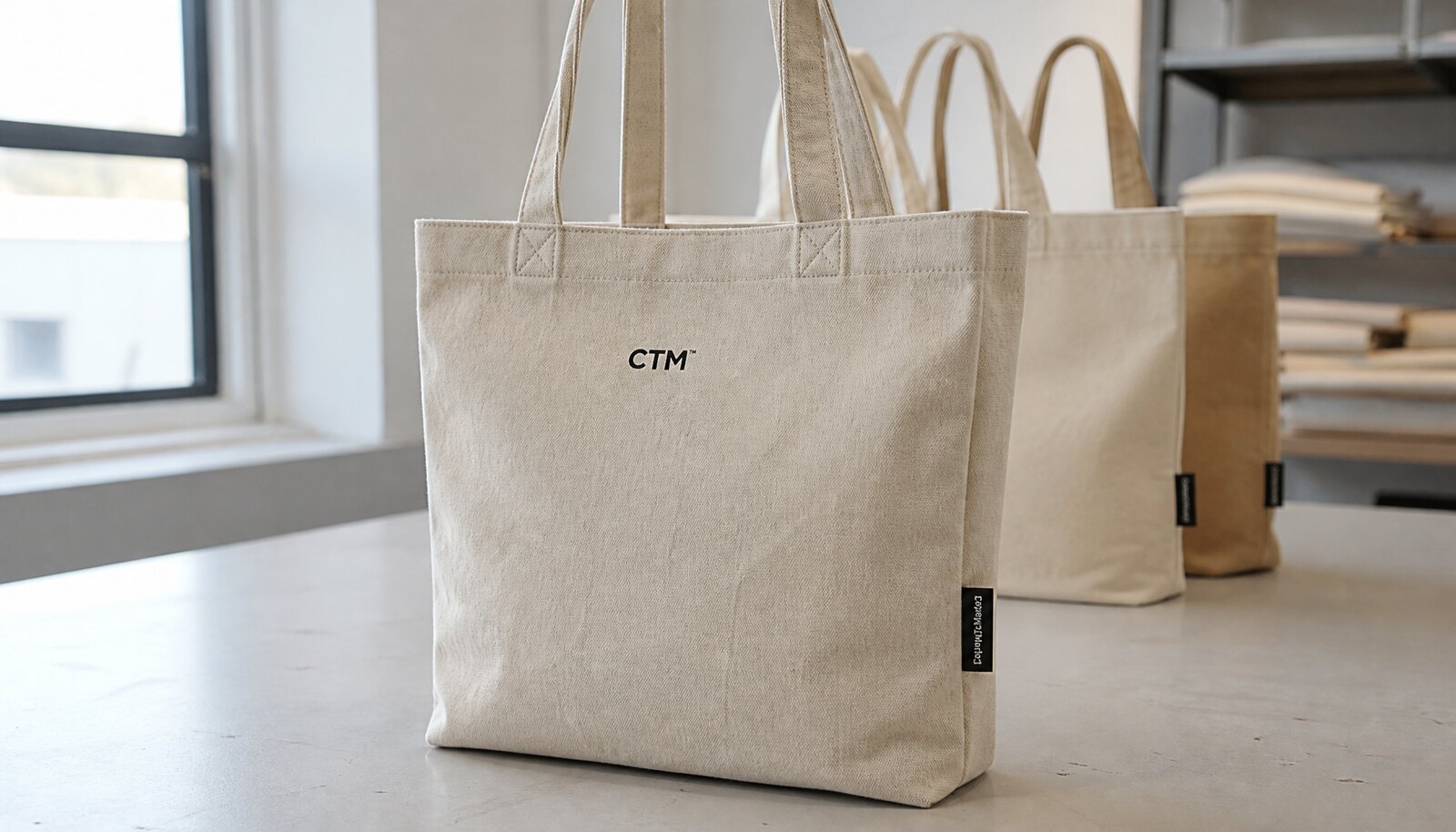
What Usually Fails on Corporate Event Tote Orders
Custom canvas tote bags for corporate events fail in ways that look small on a spec sheet but become visible the moment a delegate picks one up. The common problems are weak handles, off-center logos, short carton counts, and a bag that feels thinner than the sample. None of those issues is trivial when the tote is being used as a working handout at a conference, trade show, roadshow, or internal event. The bag has to perform in real time, under pressure, with no chance to hide defects on a shelf.
The most useful buyer mindset is to treat the tote as a controlled production item, not a promotional accessory. That means the spec has to cover the fabric, construction, decoration, packing, and delivery terms before price is compared. If those details are missing, each supplier will fill in the blanks with its own standard, and the cheapest quote often turns into the most expensive order after corrections, replacements, and freight changes.
- Treat the tote as a functional carry item, not just branded packaging.
- Assume small defects scale fast when the order is split across venues or event days.
- If the quote is vague, the supplier is pricing assumptions, not your requirement.
Freeze the End Use Before You Compare Price
The right tote spec depends on what the attendee will actually carry. A bag that only holds a brochure kit and a pen set does not need the same fabric weight or seam reinforcement as a bag that will carry books, bottles, apparel, or sponsor merchandise. Start by defining the end use, expected load, and whether the bag is meant to be disposable after the event or reused afterward. That one decision drives the right combination of fabric weight, handle construction, and print method.
For procurement, this is where a lot of bad comparisons start. Buyers sometimes ask for one price on a generic canvas tote and then try to compare it across suppliers with different fabric weights, different handle lengths, and different decoration methods. That comparison is not useful. A good sourcing brief says what the bag must do, what it must carry, and what acceptable variance looks like. Once that is fixed, the quote becomes measurable instead of decorative.
- Define the load profile first: papers only, mixed merch, or heavier retail-style contents.
- Decide whether the bag needs short-term giveaway durability or repeated reuse.
- Write the end use into the RFQ so suppliers price the same performance target.
Choose the Bag Build, Not Just the Bag Color
For most event programs, 10 oz canvas, roughly 340 gsm, is the safest default because it balances structure, cost, and print quality. It stands upright better than lighter cloth, feels more substantial in hand, and usually accepts screen print with good opacity. Eight-ounce canvas can work for lighter programs, but it is easier to make it feel cheap if the handles are underbuilt or the print shows through. Twelve-ounce canvas gives a more premium hand feel, but it increases bulk, carton size, and freight cost, so it should be justified by the use case rather than selected by habit.
Construction details matter just as much as cloth weight. A tote with poor bartacks or a weak handle-root seam will fail before a heavier but better-built bag does. Buyers should lock handle drop, top hem width, seam allowance, gusset dimensions, and reinforcement points in the tech pack. If the supplier cannot explain how those details are sewn and where reinforcement is applied, the spec is not tight enough for a corporate event order that has to arrive cleanly and on time.
- 8 oz canvas is acceptable for light inserts and tight budgets.
- 10 oz canvas is the best all-around spec for standard corporate events.
- 12 oz canvas fits premium gifting, retail crossover, or repeat-use expectations.
- Ask for handle bartacks and seam reinforcement to be named in the quote, not implied.
Match Printing to Artwork, Quantity, and Brand Risk
For simple logos on canvas, screen printing is usually the strongest commercial option because it gives good opacity, consistent placement, and predictable unit cost at scale. It is also the easiest method to inspect because the buyer can check registration, curing, and edge sharpness against the approved sample. The main risks are weak ink cure, misregistration, and artwork that is too fine for the chosen mesh or substrate. If the supplier cannot tell you how they control color and cure, the print system is not being managed rigorously enough.
Transfer and digital methods are useful when the art is complex, has multiple colors, or includes fine detail that would be inefficient in screen print. They are not automatically better. They trade some cost and speed advantages for different quality risks, such as edge lift, adhesion weakness, or surface distortion after folding. Embroidery can work for a premium bag, but it can also pull on lighter canvas and distort the front panel. The right question is not which method sounds most sophisticated, but which method survives the event cycle without a complaint.
- Use screen print for bold logos, large quantities, and simple artwork.
- Use transfer or digital methods when the artwork truly needs complexity.
- Require a final production sample with cured ink, not just a layout proof.
Compare Suppliers on the Same Commercial Basis
The comparison table only works if every quote is normalized. A direct factory with in-house sewing and printing usually gives the cleanest accountability because the same team owns cutting, stitching, decoration, and packing. A trading company or sourcing agent can be useful when the event program includes multiple products, but the buyer must still know which factory is actually making the tote and who signs off on defects. Catalog and marketplace suppliers are fine for a test buy, yet they often quote a generic item first and reveal the real limits later, which makes a fair comparison impossible.
You also need to separate product price from delivery terms. An FOB or FCA quote gives the buyer more visibility into freight and insurance, while a DDP quote can be convenient but hides cost structure if the supplier is controlling transport end to end. That does not make DDP bad; it just means the buyer should ask what is included, who clears customs, and what happens if the shipment is delayed at origin or held at destination. The lowest unit price is irrelevant if the landed cost or delivery risk is worse.
- Compare only after fabric, print, packing, and Incoterms are normalized.
- Direct factory control is usually best for repeat orders and tighter QC.
- Ask who owns rework, inspection, and freight exceptions before awarding the order.
Approve the Sample as a Production Reference
A sample is not a formality; it is the production reference the factory should be held against. The right sample is made from the same canvas, thread, ink, handle construction, and packing method that bulk production will use. A blank body with a pasted logo or a mockup that is not built on production materials does not tell the buyer enough about seam quality, print opacity, or how the bag folds in the carton. If the sample is not realistic, it is not useful as an approval standard.
When reviewing the sample, start with measurements and then move to handling. Check width, height, gusset, handle drop, and logo placement first. Then look at seam cleanliness, stitch density, bartack placement, trim quality, and whether the bag smells clean and finished. Finally, fold and open the bag several times to see whether the shape holds and whether any part of the construction twists or pulls. A sample that passes visually but feels flimsy in hand is usually a warning sign, not a finished approval.
- Approve a true pre-production sample made from production materials.
- Measure against the tech pack instead of eyeballing the bag.
- Reject any sample that hides weak construction, poor print opacity, or rough finishing.
Put an Enforceable QC Plan in the Purchase Order
For a procurement buyer, the QC plan should be precise enough that the factory can execute it and a third-party inspector can verify it. A good baseline for tote bags is a formal sampling plan under ANSI/ASQ Z1.4 or ISO 2859-1, using normal inspection Level II, with zero tolerance for critical defects, AQL 2.5 for major defects, and AQL 4.0 for minor defects. Critical defects are the ones that make the product unusable or noncompliant, such as wrong artwork, major seam failure, or contamination. Major defects affect function or brand perception. Minor defects are cosmetic but still worth controlling.
The defect list matters more than the acronym. The buyer should define which issues are rejectable, which are reworkable, and which are acceptable only within the stated AQL. That should include dimension drift, wrong fabric weight, broken stitching, missing bartacks, print misregistration, odor, stains, and incorrect carton counts. If this is a first order or a new supplier, a pre-shipment inspection is worth the time because it catches problems before freight is booked and before the event team is forced into emergency replacements.
- Use a formal AQL plan instead of a vague visual check.
- Define critical, major, and minor defects in the PO.
- Require photo evidence and defect counts before shipment release.
Specify Packing, Cartons, and Event-Site Handling
Packing can save or sink an event order. A tote that is packed loosely without controlled counts creates picking errors, damage in transit, and a lot of time spent sorting on-site. Flat-packed cartons are usually the best option because they reduce volume and make counting easier. Individual polybags can protect the surface, but they add cost, extra waste, and sometimes unnecessary handling if the bags are being handed out immediately after delivery. The right answer depends on how the event team will receive, store, and distribute the goods.
The carton spec should be written with the same discipline as the bag spec. Buyers should define inner pack count, master carton count, carton dimensions, carton strength expectations, outer label format, and whether cartons need to be separated by venue, department, or date. If the order ships to multiple event locations, the labeling needs to support fast receiving without opening every carton. This is where many low-friction tote orders become painful, because the bag itself is fine but the packing logic was never designed for the real distribution path.
- Prefer flat packing unless the program has a specific retail or protection need.
- Write carton counts and destination labels into the shipping instructions.
- If the order is split by venue, label that split on the carton and on the packing list.
Build Compliance and Freight Questions Into the Quote
Procurement teams often ask about product quality but not enough about compliance and freight risk. That is a gap. If your market requires it, ask for relevant documentation on restricted substances, odor or finish concerns, and packaging compliance. Do not ask for generic certificates without context; ask for the test reports or declarations that matter to your destination market and to the ink, fabric, and packaging actually being used. If the supplier cannot support those requirements, the risk should be priced into the decision or removed from consideration.
Freight needs the same discipline. An event tote order that looks cheap at ex-factory can become expensive if the shipping term is unclear, the cartons are too large, or the timeline leaves no buffer for customs and inland delivery. Ask who books the freight, who insures the cargo, who clears export, and who absorbs the cost if the shipment misses the event window. For corporate events, the commercial loss from a late or short shipment is often greater than the margin difference between suppliers, so the buyer should evaluate execution risk as part of landed cost.
- Ask for market-relevant compliance support, not generic certificates.
- Write the Incoterm and named handoff point into the quote.
- Account for insurance, customs, inland transfer, and delay buffer in landed cost.
Protect the Launch Date With a Backward Schedule
The schedule should be built backward from the event date, not forward from the purchase order. Sample approval, bulk start, pre-shipment inspection, freight booking, customs clearance, and final warehouse receipt all need time. If the project depends on custom dyeing, embroidery, special packaging, or a new supplier, the buffer has to be larger because every extra variable adds one more point where the order can stall. The job of procurement is not to hope the date holds; it is to structure the order so the date is defensible.
The cleanest closeout process is simple: approve the sample, freeze the PO spec, inspect the first bulk lot, and only then release shipment. After delivery, reconcile carton counts, compare the received goods to the approval sample, and document any defects by photo and category. That record matters because tote orders are often repeated for the next event, and the buyer should not have to relearn the same problem twice. The best suppliers welcome this discipline because it reduces dispute and makes repeat business easier to win.
- Build the timeline backward from the event date and include transit buffer.
- Do not release shipment until the bulk lot matches the approved sample and packing plan.
- Keep photos, counts, and defect notes so the next order starts from a better baseline.
Specification comparison for buyers
| Decision area | Preferred option | Best for | Buyer control point |
|---|---|---|---|
| Supplier model | Direct factory with in-house sewing and printing | Repeat orders, tighter spec control, and one accountability chain | Verify the factory owns cutting, sewing, printing, and packing in the same operation |
| Supplier model | Trading company or sourcing agent | Multi-item event programs that bundle totes with other giveaways | Confirm who approves samples, who inspects, and who pays for rework |
| Supplier model | Catalog or marketplace supplier | Simple test orders and fast turnaround | Watch for vague fabric specs, limited customization, and weak carton control |
| Fabric weight | 8 oz canvas, about 280 gsm | Light brochure packs and low-cost handouts | Check handle reinforcement, print show-through, and whether the bag collapses too easily |
| Fabric weight | 10 oz canvas, about 340 gsm | The most balanced option for standard corporate events | Lock exact GSM, weave type, and shrinkage allowance |
| Fabric weight | 12 oz canvas, about 406 gsm | Premium gifts, retail crossover, and repeated use | Confirm the higher carton volume, freight cost, and fold thickness |
| Decoration method | 1-color screen print | Large quantities with simple logos | Verify opacity, curing, and registration against the approved sample |
| Decoration method | 2+ color transfer or digital print | Complex art, gradients, or fine detail | Confirm adhesion, edge lift, and rub resistance after packing |
| Packing method | Flat-packed master cartons | Venue delivery, warehouse pick, and easier count control | Verify pack count, carton marks, and destination labeling |
Buyer checklist before sampling
- Write the end use in the spec: brochures, bottles, apparel, samples, or mixed merch, because that determines the load requirement and the bag structure.
- Freeze the fabric spec in GSM and construction terms, including weave, finish, natural or dyed color, and any shrinkage allowance.
- Approve the exact body size, handle drop, gusset depth, top hem, and bartack placement before you ask for bulk pricing.
- Require artwork approval that includes print size, placement, color reference, and safe area, not just a flat digital mockup.
- Ask for a pre-production sample made from the same fabric, thread, ink, and packing method that will be used in bulk.
- Define carton count, pack style, carton labels, and whether the order is split by venue, date, or department.
- Set a written quality standard with critical, major, and minor defects before production starts, including the inspection AQL.
- Confirm compliance needs for your market, such as restricted substances, odor limits, labeling rules, and any requested test reports.
- Normalize every quote to the same Incoterm, freight mode, sample cost, and packaging assumption before comparing unit price.
- Ask for a production schedule that includes sample approval, bulk start, pre-shipment inspection, and ship date, then add a buffer for transit and customs.
Factory quote questions to send
- What exact fabric weight are you quoting in GSM or oz, and what tolerance do you allow on the bulk roll or cut panels?
- Which decoration method are you pricing, how many colors are included, and what setup charges or plate charges apply?
- Is the sample fee credited back against bulk, and will the sample use the same fabric, ink, thread, and handle construction as production?
- What is your MOQ by color, size, and artwork version, and how does it change if we mix versions in one order?
- What is included in your price: packing, inner polybags, hangtags, export cartons, labels, rework, and replacement units after failure?
- Which Incoterm are you quoting, what is the named handoff point, and who is responsible for inland freight, export clearance, and insurance?
- What compliance documentation can you provide for the fabric, inks, packaging, and any market-specific requirements we name in the PO?
- What inspection standard do you follow for major, minor, and critical defects, and can we write the AQL target into the purchase order?
- How do you control carton counts and shipment identity if we need bags separated by event date, destination, or department?
- What is your remake or refund policy if the pre-shipment inspection fails or the bulk output drifts from the approved sample?
Quality-control points to confirm
- Use a formal sampling plan such as ANSI/ASQ Z1.4 or ISO 2859-1, normal inspection Level II, single sampling; a common starting point is zero tolerance for critical defects, AQL 2.5 for major defects, and AQL 4.0 for minor defects.
- Inspect a first article or pre-production sample before bulk release, and make the approved sample the control reference for size, color, print, and pack style.
- Check carton count at the outer carton level before opening bags, and confirm that the shipment matches the packing list by destination or event if the order is split.
- Measure body width, height, gusset depth, and handle drop against the tech pack; use a practical tolerance such as plus or minus 1 cm unless the design needs tighter control.
- Review fabric quality for weight consistency, weave uniformity, contamination, oil marks, dye streaks, odor, and visible slubs or holes that would affect presentation.
- Inspect stitching for skipped stitches, broken seams, loose thread tails, weak bartacks, seam slippage, and handle-root reinforcement.
- Verify print quality under both daylight and indoor lighting for placement, color match, opacity, registration, edge sharpness, and cure resistance.
- Run a functional load test that matches the event use case, such as 5 to 8 kg for several minutes, and reject seam failure, handle creep, or distortion.
- Check packing details: fold method, polybags if required, carton inserts, outer labels, carton strength, and whether cartons can survive stacking and transit.
- Record defects by class, photo, and location, then agree in advance whether the fix is rework, replacement, downgrade, or rejection.