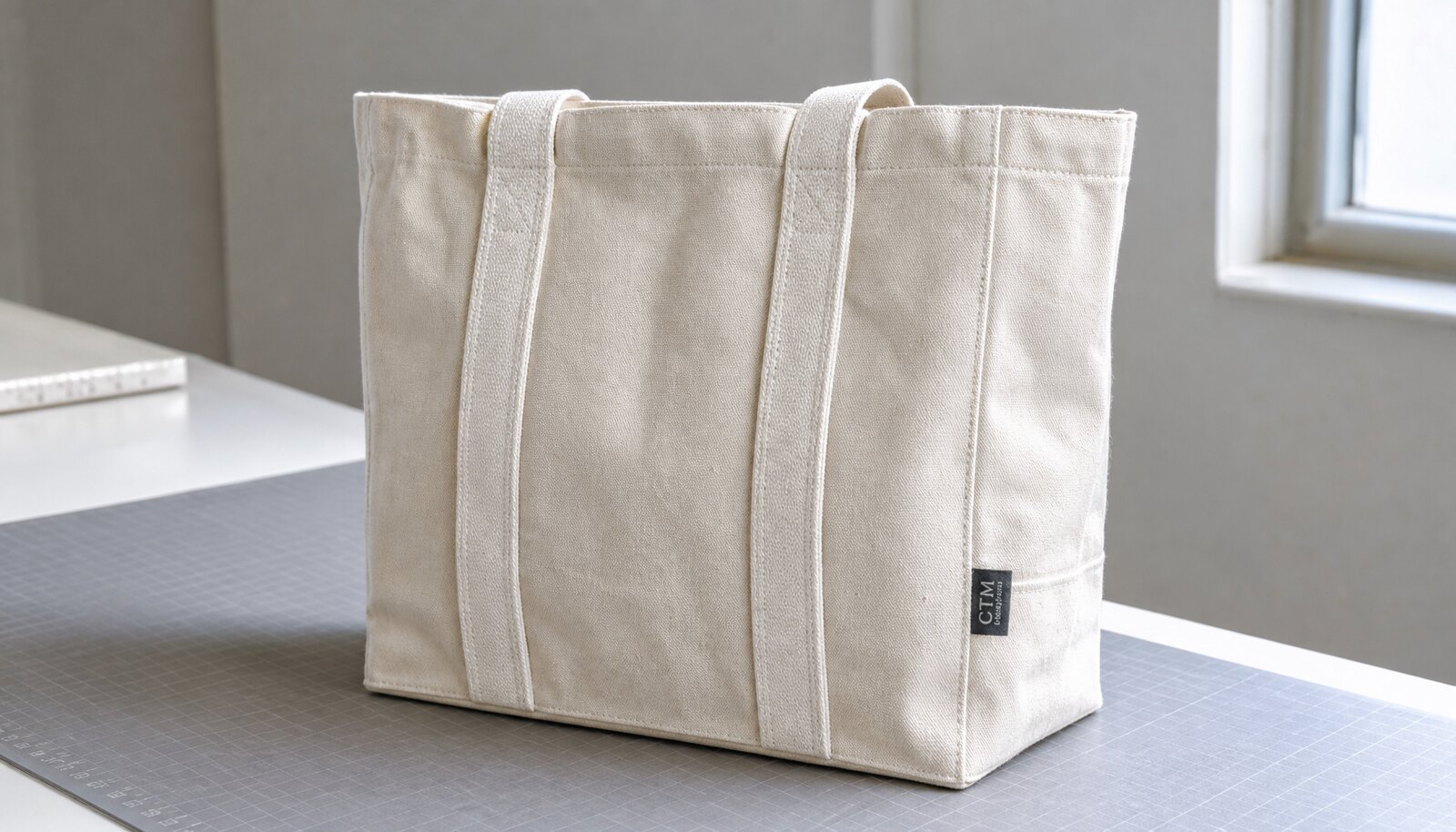
Start With the Tote's Job, Not the Artwork
Custom canvas tote bags for coffee brands are not one generic product. A tote sold as retail merchandise needs a cleaner presentation, tighter stitch control, and a more repeatable size than a tote used only for a giveaway. A subscription add-on has a different priority again: it has to fit a box, pack quickly, and arrive without crushing or excess bulk. If procurement starts with logo art and lets the supplier decide the rest, the quotes will not be comparable and the finished bags will not be suitable for the same use case.
Define the buying job in plain operational terms before you ask for pricing. State whether the tote will carry bagged coffee, merch, or samples; whether it will sit on a shelf or ship inside a carton; and whether the buyer expects a premium retail feel or a low-cost promotional item. That one step prevents most sourcing errors. It also gives suppliers enough context to quote the right fabric weight, handle reinforcement, and finish instead of guessing from the artwork alone.
- Retail SKU: prioritize structure, logo clarity, and shelf appeal.
- Gift-with-purchase: prioritize cost, speed, and a clean single-logo print.
- Subscription add-on: prioritize pack efficiency and foldability.
- Event giveaway: prioritize simple construction and short lead time.
Choose Fabric Weight, Weave, and Finish by the Actual Load
For coffee brands, canvas weight is the first meaningful cost and quality decision. A 10 oz tote can be fine for lightweight promotional use, but it may feel soft, wrinkle more easily, and show less structure when displayed. A 12 oz tote is a common middle ground for wholesale buying because it balances hand feel, print quality, and cost. A 14 oz tote usually reads more premium, holds shape better, and tolerates heavier content, but it also pushes up material cost and sewing time. The right choice depends on what the tote is expected to carry and how the brand wants it to feel in hand.
Weight alone is not enough. Ask whether the canvas is unbleached, bleached, piece-dyed, garment-washed, or softened, because those finish choices change both appearance and production risk. Natural canvas gives a warm, earthy look that fits coffee branding, but it also reveals fiber variation and slub more clearly. Bleached canvas gives cleaner print contrast. Dyed canvas can look premium, but batch consistency and color migration matter more. If the tote will be washed or pretreated, require a shrink target in writing before you approve the sample.
- Ask for GSM or oz weight, not just the word canvas.
- Confirm weave, finish, and fiber content if the buyer needs a specific hand feel.
- Specify whether the bag will be washed, softened, or left raw.
- Set a shrink tolerance before bulk if the tote has any finishing process.
Specify Construction Details That Affect Durability and Look
A tote can look simple and still fail on construction. Handle width, reinforcement placement, seam allowance, and gusset depth all change how the bag carries weight and how long it stays presentable. Coffee brands often want a minimalist product, but minimal does not mean underbuilt. A tote that twists, collapses, or loosens at the handle will be seen as low quality even if the print is perfect. Set the construction details early and ask the supplier to quote the exact version you want, not a generic tote with an estimated build.
Use the spec sheet to make the bag repeatable. Require a clear body size, gusset depth, handle length, handle drop, seam allowance, and reinforcement pattern. For most wholesale programs, the practical question is whether the tote still looks straight after loading. If a bag distorts when filled with two to three coffee bags, it is probably under-specified. The right answer is not always the heaviest fabric; it is the combination of fabric weight, stitch density, reinforcement, and pack-out that matches the use case.
- Confirm handle width and handle drop, not just overall tote size.
- Ask for reinforcement at the handle anchor points and the gusset seams.
- Lock seam allowance in the spec so the final size does not drift.
- Require the supplier to sample the filled bag if the tote will carry coffee.
Pick the Branding Method That Matches the Order Profile
Screen printing is still the most practical branding method for many coffee-brand canvas totes because it works well on natural fabric, is cost-efficient at moderate volumes, and gives stable color on simple artwork. It is usually the first method to consider for one- to three-color logos with strong shapes. If the art includes fine detail, gradients, or photographic elements, transfer methods or digital decoration may be possible, but the buyer should expect higher cost and more risk of a less textile-like finish. Embroidery and woven patches can look premium, but they also add setup cost and can cause puckering on lighter canvas if the backing and placement are not controlled.
Treat decoration as part of the product spec, not as an afterthought. The supplier should quote the exact print area, number of colors, print locations, and any underbase or backing requirement. A proof on paper is not enough. Ask for a strike-off on the same fabric and the same print process that will be used in production. That sample is what tells you whether the logo reads cleanly, whether small reverse text survives the weave, and whether the tote still looks balanced once the art is placed on the body panel or gusset.
- Use vector artwork and lock the Pantone reference if color matters.
- Keep thin reversed type to a minimum because canvas texture can fill it in.
- Confirm whether a white underbase is needed on darker fabric.
- Approve print placement so the logo does not land across a seam or fold line.
Qualify the Supplier, Not Just the Quote
For B2B procurement, supplier qualification matters as much as price. Before sampling, ask for the legal entity name, factory address, production location, main machines, and the name of the person who owns QC. If the seller is a trading company, ask which factory will actually cut, sew, and pack the tote. If the supplier claims compliance or audit status, request the document rather than accepting the statement. This is especially important when the tote will go through a retailer's vendor review or when the buyer needs traceability on recycled, organic, or dyed materials.
Document requirements should match the risk of the program. A coffee brand running a one-off event tote may only need basic factory identification and a confirmed sample route. A retail program usually needs more: business license, export capability, material declarations, inspection record, carton specs, and a clear change-control process. Ask who owns the screens, labels, and packaging artwork, because lost tooling and untracked revisions are a common reason reorders drift from the approved sample. The supplier should be able to show how they keep the order stable across repeat production, not just how they price the first shipment.
- Ask for the actual factory address and the production contact, not only the sales office.
- Request recent photos or a finished-goods inspection record from a similar tote order.
- If your retailer requires it, ask for business license, audit record, and material declarations up front.
- Clarify who owns screens, labels, and artwork revisions before you release the PO.
Normalize Quotes Before You Compare Unit Price
A tote quote is only useful if it is priced on the same basis. One supplier may quote EXW, another FOB, another CIF, and another DDP. Those are not comparable without normalizing inland freight, port fees, export handling, insurance, duty, and local delivery. The same issue appears in the product spec itself. A quote that uses lighter canvas, fewer print colors, a smaller print area, or a simpler fold will always look cheaper, but it is not the same tote. Procurement should force every quote onto one comparison sheet before the decision is made.
The most practical method is to convert every offer to landed cost per sellable tote. Include sample charges, tooling, freight, duty, carton loss, and warehouse handling. Then compare the same assumptions across all suppliers: same body spec, same print method, same carton count, same Incoterm, and same freight scenario. If a supplier refuses to quote a named Incoterm or will not separate body cost from decoration and packing, treat the offer as incomplete. The real buying decision is not only unit cost; it is the cost of getting the exact approved tote into inventory without surprise charges or hidden scope changes.
- Compare landed cost per sellable tote, not just ex-factory price.
- Convert all quotes to the same Incoterm before reviewing them.
- Add freight, duty, inland delivery, sample fees, and packing costs to the model.
- Treat a quote that is far below the others as a spec change until proven otherwise.
Use MOQ and Lead Time to Simplify the First Order
MOQ on canvas totes is often driven by more than fabric. Print screens, dye lots, packaging materials, carton pack rules, and factory line setup can all push the minimum order quantity up or down. That is why the first order should be as simple as possible if the buyer wants a stable program. One body color, one print location, one logo version, and one pack format usually produce the best balance between price and operational control. Adding multiple colorways or packaging variants too early increases the chance of mixed inventory, delayed sample approval, and higher per-unit cost.
Lead time also needs to be broken into stages instead of treated like one number. Ask for the sample window, approval window, material booking time, bulk production time, packing time, and freight booking time. A factory that promises a short total lead time without asking for final artwork is not giving you a useful schedule. For coffee brands, the better approach is to build the launch calendar around the real production path, not the marketing date. That gives procurement room to correct artwork, recheck pack-out, and avoid a late-stage rush that weakens QC.
- Standardize the first launch order before adding seasonal color variants.
- Avoid mixing too many handle lengths, print locations, or packaging options in one PO.
- Ask whether MOQ changes if you move from one print color to two.
- Request a dated production schedule with sample, bulk, pack, and ship milestones.
Approve Samples Like a Production Buyer, Not a Designer
A sample is not a visual placeholder. It is the only realistic check that fabric, sewing, print, and packing work together as a finished tote. Measure the body width, height, gusset depth, handle length, and handle drop. Inspect the stitch line, the reinforcement, and the alignment of the logo relative to seams and edges. If the bag twists when lifted or the print looks centered only in a flat lay photo, that is not good enough. The sample should reflect the same construction and same finishing process that will be used in bulk, not a showroom version made by hand from different materials.
Use the sample stage to eliminate ambiguity in the spec. Keep the approved physical sample, the measured spec sheet, and the print proof together so the production team has one reference set. If you are buying for retail, inspect the sample in the same light and viewing distance that a customer will see it. If you are buying for e-commerce, pack the sample the way the warehouse will pack bulk. The goal is to make the sample function as the contract for what the bulk order is allowed to become.
- Measure at least three samples, not just the best-looking one.
- Check print sharpness, color density, and position on each sample.
- Reject visible puckering, seam distortion, or handle twist in the approved sample.
- Test the bag in the same fill state it will have in real use.
Set Hard QC Acceptance Criteria Before Bulk Starts
QC is where tote orders either stay predictable or become expensive. The acceptance criteria need to be written before production, not invented after defects appear. For a wholesale coffee tote, a practical baseline is AQL 2.5 for major defects and 4.0 for minor defects, unless the retailer asks for tighter control. Then define the defects that matter most to your brand: seam failure, handle misplacement, open stitches, bad print registration, visible stains, and carton damage. If the factory knows those are the real reject conditions, it will inspect to the right standard instead of doing a generic visual check.
The best QC specs are concrete enough that both sides can enforce them. Specify stitch density, maximum size variance, handle symmetry, shrink tolerance, print adhesion, and carton performance. If the tote is washed or pretreated, require a shrinkage test. If the print will be rubbed during normal use, require a rub or tape-pull test. If the bags will be moved through a warehouse network or shipped long distance, define carton drop and compression requirements too. This is the difference between a decorative sample approval and an actual production quality standard.
- Use AQL 2.5 major / 4.0 minor as a practical inspection baseline unless your customer requires tighter limits.
- Set stitch density at 7-9 SPI for body seams and 8-10 SPI for handle reinforcement unless the spec is stronger.
- Hold body size within +/-0.5 cm for premium retail bags or +/-1.0 cm for promo bags.
- Require no open seams, no skipped stitches, and no broken reinforcement at stress points.
- Require no visible ink transfer after a dry rub or tape-pull test on the approved print method.
- Set a static load test at intended use plus a 20% safety margin for 1 minute with no seam failure.
- Require shrinkage within 3% if the tote is washed, softened, or pretreated.
- Use carton drop and compression tests for long-haul freight or retail distribution.
Specify Packing, Cartons, and Warehouse Handling in the RFQ
Packing is where a clean tote can still become an operational problem. Some coffee brands need flat-packed bags with simple folding; others need polybags, paper bands, barcodes, or retail hangtags. If the tote is going to a store or a fulfillment center, the pack format affects labor, scan time, and shelf readiness. A bag that looks fine coming out of the carton but arrives without the correct label placement or carton mark is not actually finished for the buyer's supply chain. That is why the packing spec needs to live in the RFQ instead of being decided after the order is awarded.
Ask for carton details as part of the quote: pieces per carton, dimensions, gross weight, label format, pallet pattern, and whether moisture protection is included. Make sure the pack format fits the receiving warehouse, not just the factory line. If the order will move by sea, carton strength and moisture protection matter. If it will move by air or parcel, dimensional weight becomes part of the cost model. The best packaging spec is the one that minimizes damage, labor, and receiving confusion without adding unnecessary cost.
- Confirm whether the tote ships flat, folded, banded, or polybagged.
- Ask for barcode placement and a sample scan if the warehouse will scan units.
- Keep colors separated if your receiving team does not want mixed cartons.
- Align carton count with palletizing and warehouse handling, not just factory convenience.
Specification comparison for buyers
| Sourcing route | Indicative unit price* | Typical lead time | Best when | Threshold to watch |
|---|---|---|---|---|
| Direct canvas bag factory | US$1.20-US$3.80 | 4-8 weeks | Repeat programs where you need control over fabric, stitching, and packing | Use it only if the factory can name the actual production site and show a sample from the same line |
| Local decorator on stock blanks | US$1.80-US$5.50 | 1-3 weeks | Rush launches, small tests, and simple one-color branding | Blank-bag variation is the main risk, so require the same lot, same body size, and same handle reinforcement |
| Trading company or sourcing agent | US$1.40-US$4.20 | 5-9 weeks | Mixed-product programs, export coordination, or buyers who need a single point of contact | Ask who the real factory is and how much margin sits between you and production |
| Domestic cut-and-sew supplier | US$3.50-US$9.00 | 2-6 weeks | Premium retail, low-volume runs, or programs that need local compliance or faster change control | Unit cost is higher, so only use it if margin, brand positioning, or replenishment speed can absorb it |
| Integrated packaging supplier | US$1.70-US$4.80 | 4-7 weeks | Retail-ready pack-outs, kitting, or bundles with labels and carton inserts | Packaging vendors are not always strong on seam quality, so verify construction with a real sample |
| Marketplace stock program | US$0.90-US$2.80 plus decoration | 1-4 weeks | Promo runs, giveaway campaigns, or early market tests | Stock-line color, hand feel, and carton pack can vary by lot, so inspect the actual inventory before branding |
| Contract decorator with stitched branding | US$2.00-US$6.50 | 2-5 weeks | Premium logos, patches, woven labels, or embroidery on a standard tote body | Heavy decoration can distort lighter canvas, so confirm backing, placement, and puckering risk |
| Hybrid sourcing route | US$1.60-US$4.50 | 5-9 weeks | Programs that need factory production plus local labeling, barcode work, or final pack-out | Two handoffs create two QC gates, so lock responsibility and carton specs before production starts |
Buyer checklist before sampling
- Define the tote's job first: retail SKU, gift-with-purchase, event merch, subscription add-on, or staff use.
- Lock the body size, gusset depth, handle length, handle drop, and base color before you request quotes.
- Choose the fabric weight, weave, and finish before artwork is priced, because those choices change print behavior and cost.
- Set the print method, number of colors, and logo locations before the factory prices setup or screen charges.
- Ask for a pre-production sample made from the same fabric, same decoration method, and same packing format as bulk.
- Request a quote that breaks out bag body, printing, labels, packing, tooling, sample charge, and any freight assumptions.
- Confirm MOQ by color, print version, and packing variant, not just total unit count.
- Ask the supplier to identify the actual factory, the QC owner, and the shipment terms in writing.
- Normalize all quotes to the same Incoterm, the same carton spec, and the same freight assumption before comparing price.
- Approve carton count, barcode placement, carton dimensions, and master carton labels before bulk production starts.
Factory quote questions to send
- What exact fabric weight, weave, fiber content, and finishing process are you quoting, and is it the same material used for the sample?
- Is the price for the blank tote only, the printed tote only, or the printed tote plus label, fold, band, and carton pack?
- What is the MOQ by fabric color, print color, print location, and packaging variant?
- What is the exact handle construction, handle width, handle drop, reinforcement stitch pattern, and seam allowance you will use?
- How many print colors and print locations are included, and what setup, screen, plate, or embroidery charges apply?
- What is the sample charge, sample lead time, and whether the sample fee will be credited against bulk?
- What size tolerance, stitch standard, print tolerance, and shrink tolerance will you hold in production?
- What AQL level do you accept for final inspection, and do you separate major and minor defects?
- Which Incoterm are you quoting, which port or warehouse is named, and what inland or freight charges are excluded?
- What carton quantity, carton size, gross weight, pallet pattern, and outer label format are included in the quote?
Quality-control points to confirm
- Set the inspection plan before production: AQL 2.5 for major defects and 4.0 for minor defects is a practical baseline for retail totes.
- Measure body width, height, and gusset depth against the approved spec, with tighter tolerance on sellable retail SKUs than on giveaways.
- Hold body dimensions within +/-0.5 cm for premium retail bags and within +/-1.0 cm for promo bags unless the buyer spec says otherwise.
- Check handle length and handle drop on both sides; keep side-to-side variance within 0.5 cm and confirm symmetry after stuffing.
- Use a stitch-density target of 7-9 stitches per inch on body seams and 8-10 stitches per inch on handle reinforcement unless a stronger spec is required.
- Reject open seams, skipped stitches, loose thread tails, broken seams, or reinforcement that misses the stress point.
- Set a static-load requirement at the intended carry weight plus a 20% safety margin for 1 minute with no seam failure, tearing, or handle stretch beyond 5%.
- Inspect print registration, edge sharpness, and color density against the approved strike-off, with no smearing, misalignment, or visible ghosting.
- For screen print or transfer print, require a tape-pull or rub test with no peeling, cracking, or ink transfer beyond light cosmetic scuffing.
- If the tote is washed, pretreated, or softened, require shrinkage within 3% in length and width after the agreed treatment or wash cycle.