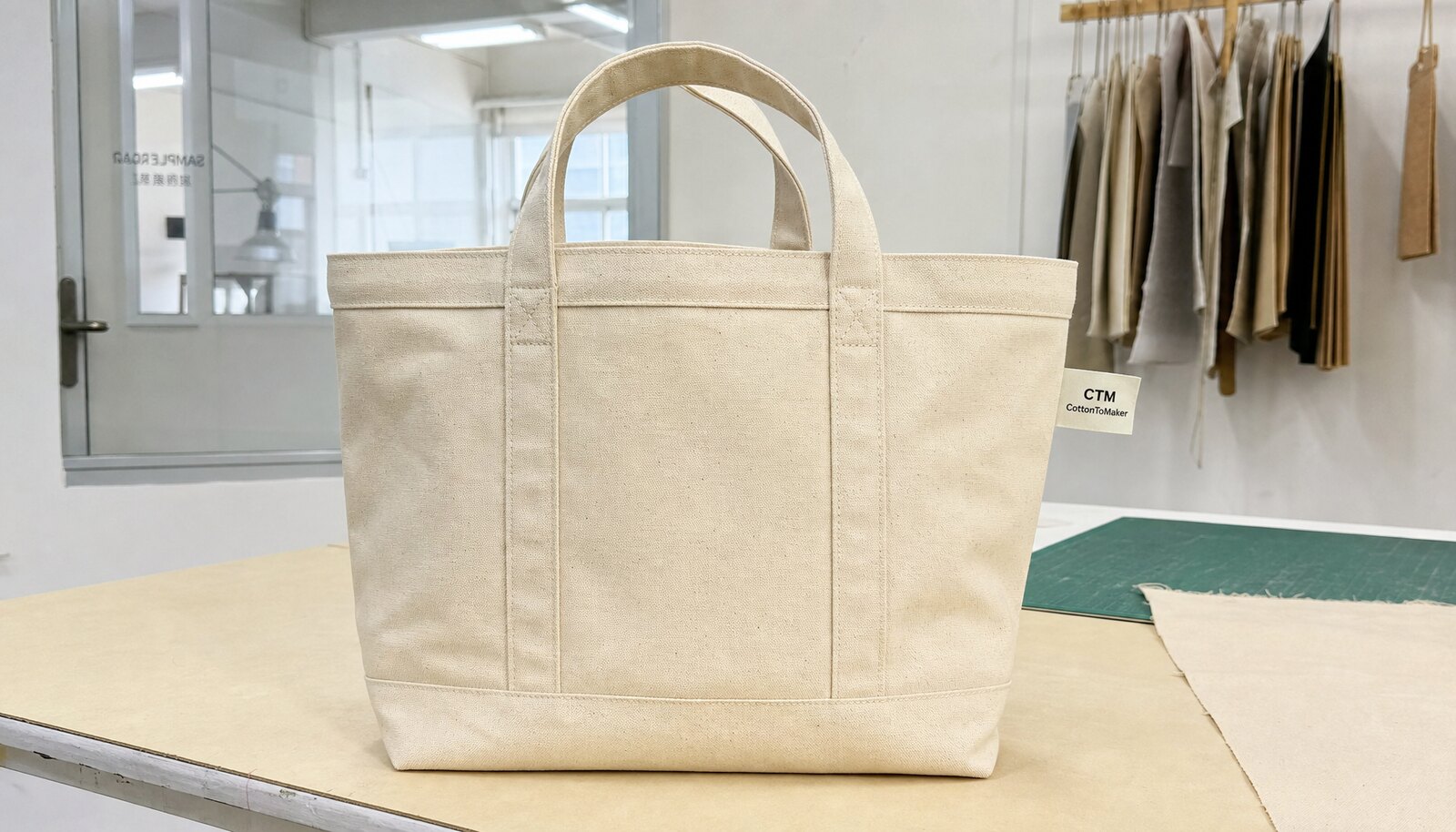
Start With the Use Case, Not the Artwork
Most weak RFQs for coffee-brand totes start with the logo and end there. That creates quote drift because the factory does not know whether the bag is meant for a café counter, a retail wall, a subscription insert, or a heavier carry bag for beans and merch. Each use case changes fabric weight, handle reinforcement, print area, and packing. If the quote does not reflect how the bag will be used, the cheapest price often belongs to the least suitable construction.
Write the brief around real handling conditions. State whether the tote needs to carry one bag of coffee, several retail items, or a heavier mixed order that includes mugs or tins. Also say whether the brand wants a soft, foldable tote or a stiffer retail piece that stands upright on a shelf. That one decision affects GSM, gusset size, and whether the factory should quote a lighter promotional build or a more durable retail build.
- Use case should define load, not just aesthetics.
- A café giveaway and a retail tote should not share the same spec unless the performance target is identical.
- If the bag must sit on a shelf, ask the factory to quote a heavier canvas with cleaner finishing.
Choose the Canvas Weight That Matches the Tote's Job
For custom canvas tote bags for coffee brands, the fabric weight is usually the first real cost driver. A 10 oz canvas, roughly 340 GSM, works for light promotional use, but it can feel thin for retail if the tote carries beans or repeated daily shopping. A 12 oz canvas, about 406 GSM, is a common middle ground because it balances structure, price, and foldability. A 14 oz canvas, around 475 GSM, gives a firmer hand and better shelf presence, but it increases material cost and can make the bag less compact.
Ask the factory to state whether the canvas is natural, bleached, dyed, pre-shrunk, or washed. Those finishes affect both look and shrink behavior. If your tote includes a bright print, a bleached or well-scoured base usually improves color consistency. If the brand wants a rustic, artisan look, a natural unbleached canvas may be better, but the buyer should allow for fiber speckling and shade variation. Do not compare quotes until the fabric basis is identical.
- 10 oz or 340 GSM: acceptable for low-cost giveaways and light inserts.
- 12 oz or 406 GSM: strong default for coffee retail and repeated use.
- 14 oz or 475 GSM: better for premium retail and heavier carry loads.
- Always ask whether the GSM is measured before or after finishing.
Pick the Print Method After You Know the Artwork
A coffee brand logo can look clean on screen print and fail on embroidery, or the reverse. Simple one- or two-color artwork with bold edges usually belongs on screen print because the setup is efficient and the print sits flat on the canvas. If the logo has small text, fine line work, or gradients, ask the factory to explain whether a woven label, sewn patch, or heat-applied transfer will reproduce it more reliably. Decorative choices should come after legibility and cost control, not before.
The print method also affects how factories quote. Screen print usually includes screen or plate setup, color separation, and a print area limit. Embroidery brings digitizing, stitch density, and puckering risk. A sewn woven label may reduce print complexity but adds cut-and-sew steps and placement control. For coffee brands, a clean mark that survives repeated handling matters more than a fancy method that looks good only on the sample sheet.
- Screen print is usually the cleanest choice for bold coffee logos.
- Embroidery is better for a premium patch look, not for tiny detail.
- Woven labels work well when the brand mark is compact and repeated across runs.
- Ask for a print strike-off or lab dip if color accuracy matters.
Set MOQ Logic Before You Compare Quotes
MOQ is not a single number; it is the result of fabric purchase, cutting efficiency, print setup, and packing labor. A factory can usually price one bag color with one print position more cleanly than multiple colorways with different handle colors and back prints. When a buyer asks for a low MOQ without simplifying the build, the quote often looks cheap on paper and then grows through setup fees or minimum-run surcharges. The right way to negotiate MOQ is to reduce complexity first.
For coffee brands, the most efficient first run is often one base canvas color, one logo placement, and one handle construction. If the brand wants seasonal variants, treat them as follow-on SKUs rather than forcing all options into the first order. That approach keeps the sample process manageable and lets the factory optimize cutting yields. It also makes reorders easier because the baseline spec is already locked.
- One fabric color and one artwork version usually gives the lowest quote pressure.
- Handle color changes, lining, zippers, or multiple print positions raise setup costs quickly.
- Seasonal variants should be priced as separate SKUs if the volume is uncertain.
What a Real Factory Quote Should Contain
A useful quote is not just a unit price. It should show the exact canvas weight, dimensions, handle spec, print method, packing method, sample terms, and lead time. If any of those fields are missing, the buyer cannot compare quotes fairly because one supplier may have priced a lighter fabric, a cheaper print method, or a looser packing standard. For procurement teams, the quote has to be structured like a control document, not a sales note.
Ask for the quote in a form that exposes hidden assumptions. The factory should state whether the price includes screens, embroidery digitizing, hangtags, inner bags, carton markings, and testing. It should also show the validity period and the incoterm. For example, EXW and FOB are not interchangeable in landed-cost planning. If the quote does not make those terms visible, the buyer is likely to discover the real cost after approval.
- Required quote fields: fabric weight, dimensions, print method, packing, lead time, and incoterm.
- Hidden cost fields to surface: setup charges, sample charges, cartons, labels, and inspection.
- The best quote is the one another supplier can reproduce line by line.
Sample Approval: The Checks That Prevent Rework
A pre-production sample is the cheapest place to catch a bad tote. Look at the sample as a manufacturing proof, not as a display piece. Measure width, height, gusset, handle drop, and handle width. Check whether the canvas weight feels consistent with the approved spec and whether the bag stands or collapses the way the brand expects. For coffee brands, the tote should also be checked under a realistic load so the handle and bottom seams are not judged only when empty.
The printed sample should be reviewed in daylight and under indoor retail lighting. Confirm logo placement, ink opacity, and edge sharpness. If the artwork includes small text, check that the letters remain readable from normal viewing distance. On sewing quality, look for loose threads, skipped stitches, crooked topstitching, and uneven binding. If the factory is unwilling to make a physical sample before bulk, that is a warning sign, especially on a first order.
- Measure critical dimensions against the approved spec sheet, not guesswork.
- Test the tote with a realistic coffee-brand load before sign-off.
- Reject samples with drifting logo placement, weak handle attachment, or visible seam distortion.
- Keep the approved sample in the order file for bulk comparison.
Packing and Carton Specs for Coffee Retail Channels
Packing affects both landed cost and warehouse handling. Bulk-folded totes in master cartons are usually the most efficient route for wholesale and distributor orders. They save labor and cube, but the buyer must make sure the fold method does not crush the print or create permanent creases across the front panel. If the brand sells through cafés or direct-to-consumer channels, the tote may need individual polybags, size stickers, or barcode labels to speed receiving and retail handling. Those extras should be priced, not assumed.
If the product is going to store shelves, the packing spec needs to be as specific as the bag spec. Define the number of pieces per carton, carton dimensions, gross weight target, and whether the carton must carry a SKU label or country-of-origin marking. For coffee brands that use the tote as a gift-with-purchase, clean folding and a visible front panel matter more than decorative packaging. The operational goal is simple: the warehouse should be able to receive, count, and ship without repacking.
- Bulk fold is efficient, but verify the print does not crease permanently.
- Retail-ready packing adds cost and time, so quote it separately.
- Carton labels, barcodes, and packing lists should match the buyer's SKU system.
- Ask for carton dimensions early if freight cost matters.
Lead Time Risks in Coffee Brand Programs
Lead time is often quoted too casually. A factory may give a production window, but the real schedule depends on fabric sourcing, print setup, sample approval, and packing labor. If the canvas color is standard and the artwork is simple, the order can move faster. If the build needs special dyeing, embroidery, or custom labels, the schedule stretches. Coffee brands that launch around seasonal campaigns should build in time for proofs, corrections, and customer-side approvals before the production clock starts.
The safest way to manage timing is to separate quote date, sample date, approval date, and shipment date. That prevents the common mistake of treating the initial quote as a delivery promise. Ask the factory what can slip the schedule: fabric mill delays, color matching, screen rework, or carton approval. The answer matters more than the nominal lead time because it shows where the supplier expects friction. A quote that ignores those bottlenecks is not useful for launch planning.
- Track schedule by milestones, not one promised finish date.
- Standard canvas and simple print usually move faster than custom-dyed or heavily decorated bags.
- Build time for artwork corrections and packing approvals into the plan.
- Ask which step is the factory's usual bottleneck.
Compare Factory Quotes on Landed Cost, Not Unit Price
The cheapest tote quote is rarely the lowest landed cost. One factory may quote a lower unit price but omit screens, sample fees, or tighter packing labor. Another may be slightly higher on the bag but save freight through better carton efficiency and fewer damaged units. Procurement teams should normalize every quote to the same spec, the same packing method, and the same incoterm before comparing them. If the quotes are not comparable, the unit price is a distraction.
For coffee brands, landed cost should also include the operational cost of mistakes. A cheap tote that arrives with weak handles, poor print registration, or sloppy fold quality can damage the brand more than it saves in procurement. Compare suppliers on their ability to show material evidence: swatches, print samples, measurement sheets, carton data, and clear answer quality. A factory that documents the build well usually produces a cleaner order file and fewer surprises in bulk.
- Normalize quotes to the same fabric, size, print method, and packing method.
- Separate sample cost, tooling cost, and production price.
- Consider freight cube and carton efficiency, not just the bag price.
- A detailed quote is often a better indicator of repeatability than a low number.
Build the RFQ Around Reorders, Not Just the First Run
The first order should be written so the second order is easy. Coffee brands often start with a launch quantity and then reorder after sales data comes back. If the factory does not retain a locked spec, approved sample, and clear artwork file naming, the reorder becomes a new project. That wastes time and creates shade variation, label drift, or packaging changes that make the brand look inconsistent. Treat the RFQ as the beginning of a reusable program file, not a one-off price request.
A good reorder-ready RFQ includes the same bag spec, the same print file version, the same carton standard, and the same acceptance criteria. It also records what can change and what cannot. For example, a seasonal hangtag may change, but the canvas weight and handle reinforcement should not. This discipline helps procurement, merchandising, and the factory stay aligned when the next purchase order arrives and the original contact person is not the one handling production.
- Lock the spec sheet and sample photo set as the reference for future orders.
- Separate permanent construction details from seasonal marketing elements.
- Keep artwork version control strict so reorders do not drift.
- Use the first order to create a reusable supplier record.
Specification comparison for buyers
| Spec decision | Recommended option | When it fits | Buyer risk to check |
|---|---|---|---|
| Supplier route | Direct cut-and-sew factory with in-house print and packing | You need one party to own fabric, sewing, print, and carton pack-out | Confirm whether any print or embroidery is still subcontracted |
| Canvas weight | 12 oz to 14 oz canvas, roughly 406 to 475 GSM | Retail totes, coffee bean carry-outs, and repeat-use merch | Light fabric can sag; very heavy fabric can raise cost and make folding harder |
| Print method | Single- or two-color screen print for simple logos | Brand marks with bold shapes, limited colors, and medium volume | Fine detail, gradients, or small type may fill in or lose edge sharpness |
| Premium branding route | Woven label, sewn patch, or limited embroidery | Higher-end coffee retail or gift set positioning | Check for puckering, thread visibility, and extra setup charges |
| Handle construction | Self-fabric handles with box-X reinforcement at stress points | Totes that will carry bottles, tins, or heavier coffee orders | Weak bar-tacks or short stitch length can fail under load |
| Bag structure | Bottom gusset plus bound or overlocked inner seams | Branded retail bags that need shape and cleaner presentation | Raw seams fray and can reduce perceived quality after repeated use |
| MOQ structure | One base color, one print position, one artwork version | First launch or forecast is still uncertain | Multiple colorways and artwork variants can push MOQ and setup cost up fast |
| Packing route | Flat-folded bulk pack with carton marks and size stickers | Wholesale replenishment, warehouse receiving, and lower freight cost | Retail-ready packing may be cleaner but can add labor, damage risk, and time |
Buyer checklist before sampling
- Define the tote use case first: coffee bean carry-out, café retail, trade show giveaway, or bundled merch set.
- Lock the fabric weight in oz and GSM, not just the word canvas.
- Specify bag dimensions, gusset depth, handle length, and handle width.
- State print method, print location, ink color count, and artwork file format.
- Tell the factory whether the tote must hold a specific load, such as two bags of beans or a ceramic mug set.
- Ask for sample cost, tooling cost, and whether those charges are refundable against the order.
- Require carton quantity, carton dimensions, gross weight, and label text in the quote.
- Compare lead time only after sample approval, not from PO date alone.
Factory quote questions to send
- What exact fabric weight, weave, and finish are you quoting, and can you state it in both oz and GSM?
- Is the quoted print done in-house, or will any part of sewing, printing, or packing be outsourced?
- What is the MOQ for one artwork, one color tote, and one print location?
- Are screen charges, plate charges, embroidery digitizing, or sampling charges included or separate?
- What size tolerance do you guarantee on width, height, gusset, and handle length?
- What packing method is included in the price: bulk fold, individual polybag, hangtag, barcode sticker, or retail insert?
- What is the production lead time after sample approval, and what steps sit on the critical path?
- Can you send a full quote sheet with unit price, sample terms, carton spec, and incoterm on one page?
Quality-control points to confirm
- Fabric weight matches the approved swatch or spec sheet within the agreed tolerance.
- Handle attachment uses reinforcement at the stress points and no loose threads remain after trim.
- Print registration is centered and does not crack, smear, or show pinholes on the approved artwork area.
- Bag dimensions, gusset depth, and handle drop stay within the agreed measurement tolerance.
- Seams are straight, edges are clean, and stitch density is consistent on load-bearing areas.
- Color is consistent across panels, handles, and any printed or sewn labels.
- Carton markings, quantity per carton, and barcode or SKU labels match the packing list.
- A pre-production sample is approved before bulk cutting begins.