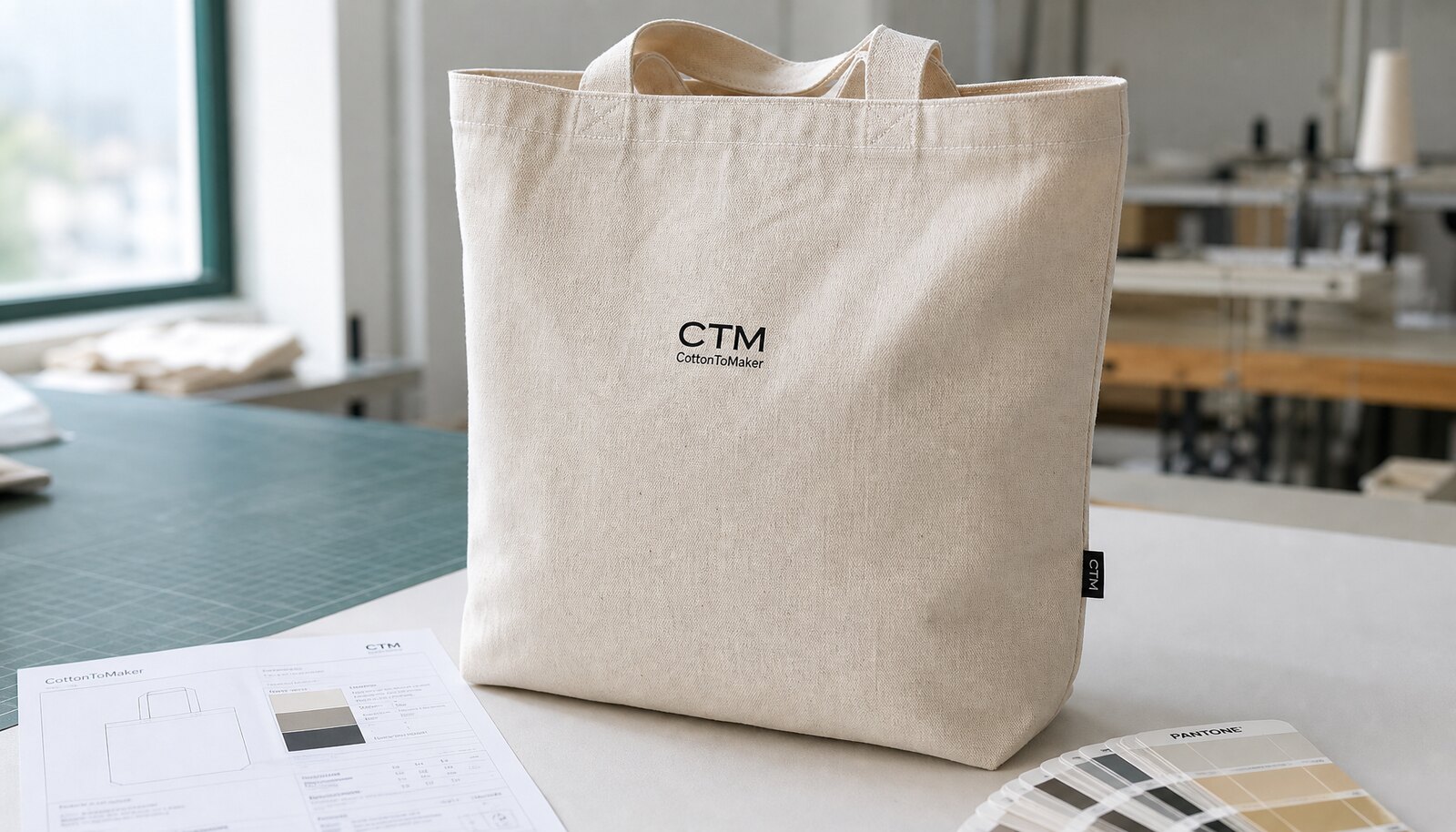
Why coffee brands buy canvas totes differently
Coffee brands do not buy tote bags the same way a generic promo team does. The bag is often part of the product mix, not just a handout. It may sit beside bags of beans on a retail shelf, be bundled with a brewer, or travel in a subscription shipment. That changes the spec. The bag has to look clean in a café, hold real weight without twisting, and reproduce the logo sharply on a textured surface.
The first procurement mistake is to start with the artwork and ignore the use case. A bold one-color wordmark can still fail if the canvas is too light, the handle is underbuilt, or the print sits too close to the seam. For coffee brands, the tote needs to survive actual customer use, not just a product photo. That is why custom canvas tote bags for coffee brands need a tighter order brief than standard promotional bags.
The second mistake is to let unit price decide the build. Totes are bulky relative to their value, so freight, packing density, and defect rates can change landed cost quickly. A bag that looks cheap ex-factory can land expensive if it cubes out badly, requires air freight to meet a launch date, or arrives with enough print and stitching issues to force a rework. A buyer should read the quote as a manufacturing and logistics package, not just a decoration cost.
- Merch tote: prioritize shelf appeal, print quality, and reorder consistency.
- Gift-with-purchase tote: prioritize cost control and predictable packing counts.
- Retail tote: prioritize fabric weight, handle comfort, and stable sizing.
- Event tote: prioritize short lead time and a decoration method that can be repeated cleanly.
Start with the use case, not the logo file
Before you request quotes, define what the tote must do in the coffee program. A bag used for a two-pound bean order needs a stronger handle build than a bag sold next to mugs and filters in a store. A subscription insert can be lighter and flatter. A retail tote needs better shape retention, more consistent stitching, and a finish that can justify a shelf price.
The use case should also control the decoration method. If the artwork is a simple wordmark or icon, screen print is usually the cleanest and most efficient option. If the mark is fine-line, multi-color, or heavily detailed, the supplier may need a different mesh count, more careful registration, or a change in the artwork itself. Buyers should not lock in the print method before the bag function is defined, because that is how teams end up paying for an elegant print on a bag that does not carry well.
A practical way to brief the factory is to state the carry load, the sales channel, and the finish level together. For example, a roastery retail tote might be a 12 oz natural canvas bag with a one-color print and bar-tacked webbing handles, while a free event tote might be 8 oz with a flat open top and a simpler print area. That one difference changes cost, sample approval, and freight planning.
- Define the tote's real carry load before choosing fabric weight.
- State whether the bag is for resale, bundling, or free distribution.
- Choose decoration after the use case, not before it.
- Write the finish level into the RFQ: promo, merch, retail-grade, or premium gift set.
Fabric, construction, and handle build
For coffee-brand programs, the most practical canvas range is usually 8 oz to 12 oz. An 8 oz bag can work for lightweight promo use, but it can look limp and distort once the artwork area is large or the bag is loaded. Ten-ounce canvas is a good middle ground for general merch. Twelve-ounce canvas gives better structure, stronger shelf presence, and less risk of a wrinkled print surface, but it costs more and usually takes up more freight volume.
Construction matters as much as the cloth. A tote that carries a bag of beans, a tumbler, and a small accessory needs more than a decorative stitch. Ask for the exact handle width, handle length, attachment method, and reinforcement details. If the handle is self-fabric, clarify whether it is folded, turned, or edge-finished. If it is cotton webbing, ask for the webbing weight and color consistency. These are not cosmetic details; they directly affect load performance and defect rates.
A good buyer brief also specifies the body shape. A flat tote is cheaper and lighter to ship. A gusseted tote holds shape better and works better for retail or gift sets, but the gusset adds sew time and raises the chance of a crooked seam if the factory is rushed. Pocket, zipper, lining, and snap closures all add value, but they also change the quote and the inspection plan. If the tote is meant to be a premium retail item, write those features into the spec; do not rely on a factory to infer the same quality target from a logo file.
- 8 oz: acceptable for light promo or insert use, not ideal for loaded retail bundles.
- 10 oz: balanced choice for branded merch and moderate carrying weight.
- 12 oz: better for premium retail, stronger shape, and heavier fills.
- Reinforced handles: specify bar-tack or double-needle reinforcement at both ends.
Print methods that work on textured canvas
Screen print remains the default for most coffee-brand logos because it is clean, repeatable, and economical at scale. It works best when the artwork is simple, the color count is low, and the print area is large enough to hold crisp edges on woven canvas. Ask the supplier how they control ink deposit and curing. Under-cured print can crack, feel tacky, or rub off during packing, which is a real problem for shelf-ready merch.
Heat transfer, embroidery, and woven labels solve different problems, but each comes with a tradeoff. Heat transfer can reproduce detail, but it may age poorly if the tote is folded tightly or handled often. Embroidery looks premium, but it can pucker lighter fabric and increase cost quickly. A woven side label or small woven patch is useful when you want secondary branding without covering the main panel. For coffee brands, the right answer depends on the actual artwork, the sell-through channel, and the price point you need to defend.
Artwork prep matters more than many buyers expect. File format, line thickness, negative space, and Pantone matching all influence the outcome on canvas. Ask the factory to confirm minimum line thickness for the chosen process, and request a strike-off or printed sample before mass production. If the logo has small type or fine rules, it may need to be simplified for a woven or stitched application. That is a design decision, not just a production detail.
- Use screen print for bold logos and stable reorder quality.
- Use embroidery only when the canvas weight and logo geometry support it.
- Use woven labels for subtle branding or a premium secondary mark.
- Require a print strike-off or color sample before bulk production.
Where to source, and why route matters
The sourcing route matters as much as the tote spec. A direct factory quote is usually the best option when you need tighter control over cutting, sewing, print registration, and carton packing. That is especially useful for repeat coffee merch programs, because reorder consistency is often more valuable than a slightly lower first-order price. A direct factory in South China, for example, is often the easiest benchmark when you want quick sample turnaround and broad decoration choices, but the only number that matters is the full landed cost after freight and duties.
India can be attractive when the program leans into natural cotton and textile-led sourcing. It is often a strong fit for larger fabric orders or buyers who can plan farther ahead, but approval cadence and inland logistics can add time. Vietnam is a reasonable second-source option for simple cut-and-sew builds when you want to reduce concentration risk outside China. Local decorators or domestic resellers can solve rush programs or store openings, but the unit price is usually much higher and the product options are narrower.
For procurement, the question is not which country is cheapest in the abstract. It is which route can repeat the same product with stable fabric shade, handle length, print placement, and carton count. If the tote is going to be a permanent coffee merch item, process control matters more than the headline quote. If the tote is a one-off event item, speed may matter more than material variety. The sourcing route should match the business problem.
- Direct factory: best when you need control over process and repeatability.
- Trading company: useful for mixed sourcing, but verify the real factory and final QC point.
- Domestic decorator: best for speed, not usually for lowest landed cost.
- Second-source planning: useful when you want to avoid dependence on one region or one workshop.
Supplier comparison that a buyer can actually use
Do not compare suppliers only on unit price. Compare them on cost, lead time, capability, and risk together. A cheaper quote may be missing carton data, a real sample, or in-house packing. Another supplier may be more expensive but able to hold print placement, handle quality, and reorder consistency across multiple coffee launches. The right comparison has to expose those tradeoffs before you issue a PO.
Use the table to sort suppliers by what they can reliably deliver. South China direct factories are often the baseline for broad capability. India can be stronger when the build leans into cotton textiles and you are willing to absorb longer planning windows. Vietnam can be a good fit for straightforward orders and second-source coverage. Domestic decorators can fill gaps when timing matters more than margin. If a supplier cannot quote carton dimensions, CBM, or a clear inspection standard, that is already a risk signal.
Freight also belongs in the supplier comparison. Canvas totes are bulky, so air freight can erase margin quickly. If you are launching a small order or a store opening, air or courier can be justified. For replenishment, ocean freight is usually the better default, especially when cartons are dense and the tote is sold at a low or mid ticket. Ask every supplier to quote ex-factory and to provide carton weight and CBM so you can calculate the landed cost rather than guessing.
- Write the same spec to every supplier so the numbers are comparable.
- Ask for unit price, carton price, and freight assumptions separately.
- Compare capability as well as cost: print quality, sewing control, and packing accuracy.
- Treat carton dimensions and CBM as part of the commercial quote, not an afterthought.
How MOQ and quote math really work
MOQ for custom canvas tote bags is rarely driven by the logo alone. It is usually driven by fabric availability, bag size, decoration method, and whether the factory has stock cloth in the right width and finish. A supplier may quote a low MOQ for a natural canvas tote with one-color screen print, then raise the minimum sharply once you add dyed fabric, a contrast handle, a zipper, or multiple print placements. Buyers should expect that pattern and plan the launch volume accordingly.
Quote structure matters just as much as MOQ. A low unit price can hide a larger screen charge, a separate sample fee, a packing surcharge, or an unplanned carton upgrade. A strong quote should show the exact assumptions: fabric weight, dimensions, print color count, inner pack count, carton spec, and trade term. Ask for a price ladder by quantity because tote pricing often falls in steps rather than a smooth curve. That lets you see where the marginal cost really changes.
A useful budgeting rule is to think in landed-cost bands rather than unit cost alone. For standard coffee merch programs, ex-factory pricing may look inexpensive, but freight, duty, and warehouse handling can materially change the margin. The effect is bigger when the order is small, the bag is oversized, or the destination is far from the port. If the supplier cannot tell you how many cartons fit in a cubic meter, they are not helping you price the program correctly.
- Low MOQ usually means standard fabric and one simple print version.
- Custom fabric, special handles, and extra trims usually raise the minimum.
- Ask for a price ladder at multiple quantities, not just one number.
- Compare quote assumptions line by line before comparing the total.
Samples, QC thresholds, and escalation rules
A blank sample is not enough for this category. Coffee-brand totes usually need a printed pre-production sample that matches the final fabric, final print method, final artwork placement, and final packing plan. Otherwise, the bulk may arrive with a logo that looks too small on the bag, a handle that sits too low, or a print that appears washed out on the actual cloth. The sample must represent the final production method, not just the intended design.
Set concrete acceptance criteria before you approve the sample. Measure finished dimensions, check logo position from the top seam and side seam, and verify the print density under the light you expect in retail or café use. Then test the sample the way a customer would: load it with a few pounds of product, carry it by hand, and fold it the way a shopper or store associate would. If the sample fails there, it will fail later at scale.
Escalation rules should be written in the PO or quality agreement, not invented after the problem appears. A good default is simple: critical defects are a stop-ship issue with zero tolerance; major defects trigger a hold-lot review and possible 100% sort; minor defects are only acceptable if they stay within the agreed inspection limit and do not affect the retail face of the product. If the sample shows recurring stitch or print drift, do not wait for bulk shipment to confirm the problem.
- Approve a printed pre-production sample, not only a blank build.
- Record finished size, logo position, and handle drop on the approved sample.
- Keep one signed golden sample for the factory and one for your team.
- Escalate critical defects immediately: wrong artwork, wrong color, missing units, open seams, mold, or odor.
Packing, carton data, and warehouse handling
Packing is where many tote orders lose money quietly. Natural canvas bags can trap dust and pick up scuff marks if they are packed loosely. If your retail buyer expects shelf-ready product, specify whether each bag needs a polybag, tissue insert, or only a bulk pack by inner bundle. Also state the exact inner pack count, because a carton built for 50 units is very different from one built for 100. Packing affects not only presentation but also count accuracy and storage density.
Ask the supplier for master carton dimensions and gross weight before booking freight. That data affects ocean bookings, courier pricing, warehouse receiving, and carton handling at destination. For coffee brands that ship to distributors or store networks, clear carton labeling matters too. Put style name, color, quantity, PO number, and carton number on the outer carton so receiving teams can count accurately without opening every box. If the bags are going into retail, protect the print face so the logo is not creased or rubbed during transit.
Freight planning should be part of the quote review. Tote bags are bulky relative to their value, so the wrong packing method can push the order into a higher freight class or increase the number of cartons. If you are buying under a few thousand units and do not need immediate stock, ocean freight is usually the economical path. Use air freight only when the margin can absorb it or when the program is time-sensitive enough to justify the extra cost.
- Specify inner pack count and whether bags are folded, nested, or tissue-wrapped.
- Require clean carton markings with PO, style, color, and count.
- Confirm whether the bags are polybagged, tissue-wrapped, or bulk packed.
- Check that the packing method does not crush the print or crease the logo area.
Lead time and reorder planning
A realistic tote lead time includes material booking, sample approval, printing, sewing, inspection, packing, and export handling. Buyers often lose time by treating approval as a formality. If the artwork is still changing or the sample is not signed off, the production clock is not really running. For seasonal coffee launches, add buffer for print correction and carton finalization because those are common delay points.
The biggest schedule risks are usually coordination points, not sewing speed. Fabric shade approval can stall the job. A late Pantone decision can push the print schedule. A packing change can require a carton resize and force a new packing sequence. Build the schedule around actual process steps and ask for a dated production calendar. If the supplier cannot break the job into checkpoints, they probably do not have enough process control for a repeat coffee program.
Reorders deserve special treatment. If the bag is likely to come back every quarter or every season, lock the approved spec, the golden sample, the carton plan, and the artwork version so the next run does not drift. The best repeat programs are boring in the right way: the same cloth hand, the same print tone, the same fold, and the same carton counts every time. That is what makes a coffee merch tote easy to replenish.
- Build time for sample approval before mass production starts.
- Separate printing, sewing, inspection, and packing in the schedule.
- Add buffer for artwork changes and carton finalization.
- Treat peak shipping periods and holiday retail windows as hard constraints.
Specification comparison for buyers
| Supplier route | Typical ex-factory price band | Lead time profile | Best fit | Risk / tradeoff |
|---|---|---|---|---|
| South China direct factory | $1.20-$3.50 for a standard 10-12 oz one-color tote, before freight and duties | Fast for samples and repeat orders if fabric is in stock; changes to artwork or carton specs can still slow the line | Repeat coffee merch, retail replenishment, and programs that need tighter process control | Verify whether printing, sewing, and packing are all in one site; a low quote can hide subcontracting drift |
| India cut-and-sew factory | $0.90-$3.00 depending on fabric, decoration, and build complexity | Can be competitive on natural cotton builds, but approvals and inland moves often add days | Natural-fiber programs, larger fabric-led orders, and buyers who can plan farther ahead | Ask about dye lot control, seam consistency, and whether export packing is handled in-house |
| Vietnam cut-and-sew factory | $1.10-$3.20 for straightforward builds | Often a stable middle ground for simple constructions; options narrow as trims and decoration get more complex | Simple retail totes, promo bundles, and buyers who want a second source outside China | Check decoration capability, sample turnaround, and whether the exact canvas weight is stocked locally |
| Domestic decorator or local reseller | $3.00-$8.00+ depending on quantity and decoration | Fastest for rush programs, but capacity and fabric options are narrower | Events, store openings, and emergency replacements | Higher unit cost, less control over textile sourcing, and freight may still be charged on bulky cartons |
| Material | 8-12 oz cotton canvas, 120-220 gsm cotton, recycled cotton, or blended fabric selected by use case and target price | Before price comparison | Different cloth weights, backing, or certification claims make quotes hard to compare | |
| Construction | bag size, gusset, handle drop, seam allowance, stitch density, reinforcement patch, and loading expectation | Before sampling | Weak stress points create returns and failed inspections | |
| Decoration | screen print, heat transfer, embroidery, woven label, or hangtag matched to fabric texture and brand durability needs | Before artwork approval | The wrong method can crack, bleed, pucker, or fail on the chosen fabric | |
| MOQ | Base MOQ plus change drivers | During quote review | Custom colors, trims, and packing can change minimums |
Buyer checklist before sampling
- Finished tote size in inches or millimeters, plus acceptable tolerance on width, height, and gusset
- Fabric weight in oz or GSM, weave type, finish, and whether the canvas is natural, bleached, dyed, or recycled
- Handle length, handle width, attachment method, stitch pattern, and target carry load
- Decoration method, artwork format, Pantone references, print size, print placement, and whether a woven label or embroidery is also required
- Use case definition: retail merch, gift-with-purchase, subscription insert, event giveaway, or bundled coffee set
- Required sample stage: blank sample, printed pre-production sample, or signed golden sample
- Packing spec: inner pack count, master carton count, fold direction, polybag or tissue requirement, and outer carton markings
- Commercial terms: target ex-factory price, Incoterm, destination port or warehouse, and who pays for sample freight
- Inspection standard, defect thresholds, photo reporting requirement, and escalation rule if the sample or bulk order fails
- Target ship date, approval window, and any shelf, launch, or event deadline that cannot move
Factory quote questions to send
- Which factory, workshop, or subcontracted site will actually cut, sew, print, and pack the bags?
- What exact fabric weight, weave count, and finish are included in the quoted price, and what changes the price band?
- Is the price based on screen print, heat transfer, embroidery, woven label, or a combination, and how many colors are included?
- What is the MOQ by size, color, print version, and decoration method, not just the overall order quantity?
- What dimensions, handle length, handle width, gusset depth, and carton count are assumed in the quote?
- What are the sample cost, sample lead time, and the number of revision rounds included before pre-production approval?
- What are the quoted terms: EXW, FOB, CIF, or DDP, and what freight assumptions are already built into the number?
- Can you quote unit price, carton price, gross weight, and CBM so we can estimate landed cost accurately?
- Which process steps are done in-house and which are outsourced, and who signs off final QC before shipment?
- What inspection standard do you use, what defect thresholds trigger rework, and what happens if the inspection fails?
Quality-control points to confirm
- Use a signed golden sample as the master reference for fabric, print, handle build, folding, and carton packing.
- Check finished dimensions against the agreed spec before packing release; as a practical benchmark, keep retail-facing totes within about +/-0.25 in, and tighten the tolerance if the bag is being sold at shelf price.
- Verify that the handle anchors match the approved position and that all stress points have clean reinforcement, with no open seams, skipped stitches, or broken bar-tacks.
- Inspect print placement, color, ink density, and edge sharpness under consistent light; hold the lot if the logo shifts visibly from the approved sample or if the ink looks under-cured.
- Run a bend, rub, and load check on production samples; reject any print that cracks, smears, transfers, or becomes tacky after handling.
- Set a visible-finish rule for threads and fabric flaws: trim loose threads, but reject any bag with frayed edges, needle holes, stains, oil marks, mildew, or odor.
- Use a clear defect policy: critical defects such as wrong artwork, wrong color family, missing units, open seams, or mold are a stop-ship issue with 0 tolerance.
- Treat major defects such as print misplacement, handle weakness, or repeated size drift as a hold-lot issue that requires rework or a 100% sort before shipment.
- Check carton count, inner pack count, and outer markings against the packing list; if count variance appears in more than one carton, quarantine the lot and trace the root cause.
- Require photo evidence of samples, carton labels, and packed units before booking freight, and keep the approved spec version attached to the PO.