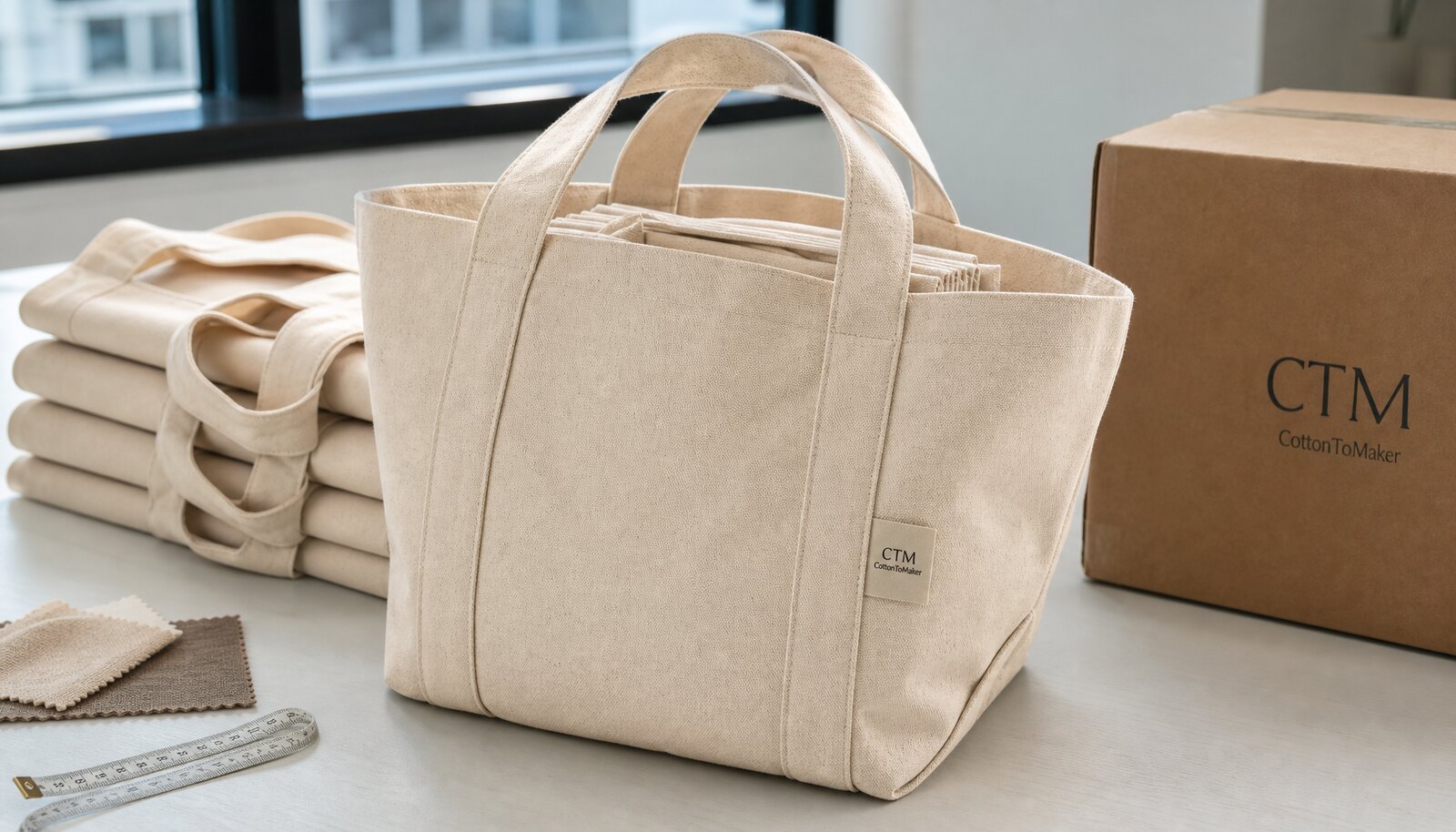
Why carton planning changes the real cost of boutique totes
For custom canvas tote bags for boutiques, the carton plan can change landed cost as much as a small fabric or print upgrade. A tote that looks inexpensive on the quote sheet can become expensive once the packing footprint grows, the carton weight rises, or the receiving team has to sort and restack product. Shipping carton planning is not an afterthought here. It is part of the product spec.
The other cost is quality drift. A neat tote packed too tightly can pick up crease marks, pressure lines, and handle distortion before it ever reaches the sales floor. If the same bag is packed loosely, the carton cube gets worse and freight cost climbs. The buyer is trying to balance three things at once: shelf appearance, transit protection, and warehouse efficiency. The right carton is the one that supports all three without forcing a rework step at receiving.
- A tote that is easy to sew is not automatically easy to ship.
- The carton should protect the logo face, the handle shape, and the folded footprint.
- Receiving labor is part of landed cost, even when it never shows up in the unit price.
Start with the retail job, not the bag size
The same canvas tote behaves differently depending on where it is sold and how it is handed to the customer. A shelf-sold accessory needs a clean folded profile and a carton that preserves presentation. A premium shopping bag needs enough body to look intentional on the floor or at checkout. A gift item often needs fast replenishment and predictable count more than display perfection.
That is why the first decision is not fabric weight or carton dimension. It is the retail job. If the tote must sit visible on a fixture, the pack should preserve a crisp front panel and keep the handles from springing open. If the tote is going straight from back room to counter, you can often accept denser packing and use a simpler carton. If the program is a limited seasonal drop, the carton should make receiving fast and boring rather than clever.
- Shelf-sold programs usually need the tightest fold control.
- Checkout or gift programs can tolerate more compression if the bag still looks clean when opened.
- Seasonal launches should avoid extra features that complicate the first packed carton, such as unnecessary inserts or mixed inner packs.
Choose tote materials and construction for fold stability
Fabric choice affects carton behavior before the carton is even drawn. Many boutique buyers start around 10 oz to 12 oz canvas, roughly 340 to 410 GSM, because it gives enough body to feel substantial without making the carton too heavy or bulky. Lighter canvas can work for promotional use or pilot runs, but it is more likely to collapse into a wrinkled stack. Heavier canvas has a better hand feel, yet it raises freight weight and can make a packed carton harder to handle manually.
Construction details matter just as much. Self-fabric handles look clean, but they should be backed by a repeatable reinforcement method such as bar-tacks or X-box stitching. If the tote is expected to carry heavier retail items, wider handles or a double-layer handle body may be worth the extra labor. Print choice also changes the packing outcome. Simple screen print is often the easiest to pack consistently because it sits flatter under fold pressure than thicker transfers or layered decoration. If the artwork is delicate, confirm that the logo stays clear of the fold line and that the print can survive carton compression without scuffing.
- 10 oz to 12 oz canvas is a common starting zone for boutique retail totes.
- Heavier canvas can look premium, but it should be checked against carton weight and freight cube.
- Screen print is often the most predictable option for repeat orders and flat packing.
- If the artwork is close to a seam or fold, the supplier should show the packed sample under real compression, not only on a flat table.
Compare supplier routes by control, not quote speed
The sourcing route changes how much control you have over packing, carton data, and rework. A direct factory usually gives the cleanest line of ownership because one team is responsible for sewing, printing, folding, and carton labels. A trading company can be helpful when you need fast comparison quotes across several factories, but the buyer should confirm who actually approved the packed sample and who pays for correction if the first carton is wrong. Nearshore converters can shorten transit and reduce communication friction, but the unit price is usually higher and the material options can be narrower. Stock-bag programs with local decoration are useful for pilots, but the blank bag still has to fold and pack consistently if you want the program to scale.
Use the comparison table to separate route from spec. A fair supplier comparison asks a simple question: who can prove the packed carton and keep it stable on reorder? If the answer is unclear, the quote is not ready for procurement review, no matter how attractive the unit price looks.
- Direct factory: strongest path when carton consistency matters across multiple reorders.
- Trading company: useful for fast market coverage, but verify the real production site.
- Nearshore converter: good when lead time matters more than the lowest possible unit cost.
- Stock bag plus local decoration: practical for test buys and launch experiments.
Size the carton around handling, not around a guess
Carton design should begin with the folded tote footprint, not with a random master carton size. The right box needs to hold the packed count, protect the print, and stay within a gross weight that the receiving team can actually handle. Many buyers test carton sizes such as 45 x 35 x 30 cm or 50 x 40 x 35 cm as starting points, but those are examples, not universal defaults. The better method is to measure the folded bag, add clearance for the fold method and inner pack, then check whether the result fits your warehouse handling rules.
Gross weight deserves the same discipline. A carton that is too heavy slows down receiving and increases damage risk at dock level. Many programs aim to keep manual-handling cartons in a comfortable range, then adjust the piece count if the tote fabric is heavier or the destination requires palletized delivery. If you are shipping on pallets, ask for the pattern on the pallet, the max height, and the number of cartons per layer. That information matters more than the bag unit price when you are trying to estimate freight and warehouse effort together.
- Start from folded size, then work back to carton dimensions.
- Treat 45 x 35 x 30 cm and 50 x 40 x 35 cm as examples to test, not fixed rules.
- Ask for the gross weight at the target piece count before you compare quotations.
- If pallets are used, the carton pattern and stack height should be visible in the quote, not added later.
Pick the packing format that matches the finish
Packing is where a good tote can become either retail-ready or annoying. Flat-fold packing is the default for most custom canvas tote bags for boutiques because it is simple to count, easy to receive, and easy to repeat. It works best when the print can tolerate the fold line and the handles can lie flat without forcing the carton to bulge. If the artwork is sensitive, a tissue interleaf can reduce friction and protect the print face, but that extra material should be justified by the decoration method, not added automatically.
One-by-one polybags improve presentation and protect against moisture, but they also add cost, air, and waste. They make sense when the tote is itself a premium retail item or when the retailer requires individual protection. For warehouse programs, consistent bundle counts are usually more useful than mixed inner packs. The point is to make the carton easy to open, count, close, and ship again if needed. If the warehouse team has to steam, restack, or manually tune the bags to make them look right, the packing method is too fragile.
- Flat fold is usually the best starting point for boutique tote programs.
- Use tissue only when the print or finish really needs friction protection.
- Use polybags when presentation or moisture control justifies the extra labor and waste.
- Standard inner pack counts are easier to receive than mixed or improvised counts.
Set QC thresholds that match the route to market
Quality control should be written as a program requirement, not left as a broad factory promise. The PO should define what counts as a critical defect, what the major and minor targets are, and what happens when the packed carton fails inspection. Many buyers start with no critical defects, AQL 2.5 for major defects, and AQL 4.0 for minor defects, but those numbers should be replaced if the retailer or import program uses stricter rules. The point is not the exact threshold; the point is to force the factory to inspect against a clear standard.
The tote itself and the carton need separate checks. Handle anchors should be reinforced evenly, seams should not skip or pucker, and print placement should stay inside the agreed tolerance. For standard boutique totes, some buyers use a pull test benchmark around 15 kg as a starting point, while heavier retail programs may need more. For packing, ask the supplier to run a test that fits the route. A 1 meter drop sequence and a stack simulation are common examples, but they should be aligned to board grade, carton height, and the actual distribution channel. Add a dry rub check and a packed-carton rub check if the artwork is sensitive to pressure or transfer.
- Critical defects should be zero unless your contract says otherwise.
- AQL settings are a starting point, not a substitute for retailer standards.
- Use a pull test benchmark that fits the tote's actual load case.
- Test the packed carton, not only the loose product sample.
- If the print cannot survive compression in the carton, the packing method needs to change before bulk release.
Ask RFQ questions that make quotes comparable
A lot of tote quotes are hard to use because the supplier is pricing a different packing reality behind the same unit price. One factory may include tissue and carton printing, another may exclude them. One may quote 20 pieces per carton, another 25. One may use a slightly heavier board or a different fold direction. If the buyer does not standardize the request, the comparison is mostly noise.
The fix is to request the same dataset from every supplier. Ask for finished size, canvas GSM, weave or shrinkage assumptions, handle construction, print method, inner pack count, outer carton size, gross weight, pallet pattern, and lead time split by stage. Then ask for proof: a blank sample, a printed sample, and one packed carton photo or short video. If the supplier cannot show where the logo sits relative to the fold, or cannot say who owns carton rework, the quote is not ready for a buying decision.
- Ask every supplier for the same bag spec and the same packing spec.
- Request both the price and the carton math behind it.
- Treat a packed carton photo as a required input, not a nice-to-have.
- Separate raw material booking, printing, sewing, packing, and export booking in the timeline.
Understand what actually moves MOQ and lead time
MOQ is usually driven by how many variables are being changed at once. A simple first order with one fabric color, one print location, one handle style, and one carton spec is easier to source than a program that also adds lining, zippers, custom trims, or multiple retail pack formats. If you need a lower MOQ, keep the spec stable and ask the supplier to price a few quantity breakpoints instead of changing the bag every time the order size changes.
Lead time should be broken into stages because the risk sits in different places. Material booking, printing, sewing, packing, carton labeling, and export booking do not happen on the same schedule. A supplier who gives only one total lead time is hiding where delays can happen. For seasonal launches, book freight capacity early enough that the finished tote does not sit waiting for a vessel or truck slot. For replenishment, keep the carton spec unchanged unless the receiving team tells you the current pack is causing damage or unnecessary labor.
- Simpler spec usually means lower MOQ and less approval churn.
- Ask for pricing at your target quantity and the next two breakpoints.
- Do not hide labeling, packing, or export booking inside a vague lead time.
- Keep carton spec stable on reorder unless there is a clear receiving problem to solve.
Use a pre-shipment approval checklist before the booking goes out
Before you book freight, you should be able to answer a small set of questions without calling the factory back and forth. What is the final tote size, what is the carton size, how many pieces are in each carton, what is the gross weight, what does the packed carton look like, and what test method was used? If any of those are missing, the order is not fully ready for shipment. This is where many programs lose time: the bag is approved, but the pack is still ambiguous.
A strong approval pack is simple. It should show the blank sample or base material, the printed sample, the packed carton, the carton label, and the pallet pattern if pallets are part of the plan. It should also show the receiving rules from the destination warehouse, because the warehouse may care more about hand-carry weight and label placement than the production line does. The goal is to remove surprises before the carton moves. For boutique buyers, that is where margin protection usually lives.
- Blank sample approved with final fabric, handle, and size.
- Printed sample approved with artwork position and color tolerance.
- Packed carton approved with exact fold, piece count, and tape seal.
- Carton dimensions, gross weight, and pallet pattern confirmed.
- AQL plan, pull test, drop test, and stack test documented.
- Carton labels, SKU codes, country of origin, and export marks verified.
- Packing photos or video received before shipment booking.
- Receiving rules from the destination warehouse checked against the carton spec.
Specification comparison for buyers
| Supplier route | Best when | Watch-outs | Carton proof to request |
|---|---|---|---|
| Direct factory | You need repeatable production, private label control, and one team owning sewing plus packing | Quotation speed may be slower at the start, but the packed carton is usually easier to standardize | Packed sample, carton dimensions, gross weight, pallet pattern, and the factory's test sign-off |
| Trading company | You want to compare several factories quickly or build an early sourcing shortlist | The quote can hide where the real production risk sits, so carton data and rework ownership must be verified | Factory name, who approves the packed sample, and which party owns carton changes or rework |
| Nearshore converter | Transit time matters and the order needs faster replenishment or easier communication | Unit price is often higher and the material range can be narrower, so carton weight and stack limits still need checking | Board grade, max carton weight, stack guidance, and a packed carton photo from the actual line |
| Stock bag with local decoration | You need a pilot buy, a fast seasonal launch, or a low-risk test of sell-through | The blank bag may be easy to source, but pack consistency and logo repeatability still need proof | Blank bag fold consistency, print placement repeatability, and carton labels for the decorated run |
| Material | 8-12 oz cotton canvas, 120-220 gsm cotton, recycled cotton, or blended fabric selected by use case and target price | Before price comparison | Different cloth weights, backing, or certification claims make quotes hard to compare |
| Construction | bag size, gusset, handle drop, seam allowance, stitch density, reinforcement patch, and loading expectation | Before sampling | Weak stress points create returns and failed inspections |
| Decoration | screen print, heat transfer, embroidery, woven label, or hangtag matched to fabric texture and brand durability needs | Before artwork approval | The wrong method can crack, bleed, pucker, or fail on the chosen fabric |
| MOQ | Base MOQ plus change drivers | During quote review | Custom colors, trims, and packing can change minimums |
Buyer checklist before sampling
- Confirm the final tote size, canvas GSM, handle length, and whether the bag must stand upright on a shelf or only ship flat.
- Lock the print method before sampling so logo placement, edge sharpness, and color tolerance are tied to one production route.
- Approve the fold method and inner pack count in the pre-production sample, not after bulk packing starts.
- Ask for carton dimensions, gross weight, and estimated cartons per 20-foot or 40-foot container before you compare suppliers.
- Define acceptable seam tolerance, handle reinforcement, print misalignment, and carton labeling rules in writing.
- Request a photo or video of one packed carton, one open inner pack, and one finished bulk carton label before shipment.
- Check whether the supplier quote includes polybag, tissue, desiccant, carton testing, pallet wrap, and export marks, or only the tote itself.
- Confirm who owns carton artwork, barcode setup, and carton rework if the first packed sample is wrong.
Factory quote questions to send
- What canvas GSM, weave density, and shrinkage allowance are you using for this tote, and what finished size will you guarantee after sewing?
- Which print method is included in the quote, how many colors are covered, and what is the surcharge for extra locations or Pantone matching?
- How many pieces per inner pack and outer carton are planned, and what carton dimensions and gross weight do you estimate for this order quantity?
- Is the quote based on flat packing, stuffed packing, or tissue interleaf, and does that change labor cost or carton count?
- What is the MOQ for the exact combination of fabric color, print method, handle length, and packing specification?
- What sample stage do you provide: blank fabric sample, printed pre-production sample, or packed pre-shipment sample?
- What QC standard do you use for stitch density, handle pull strength, print registration, carton drop resistance, and stack resistance?
- What lead time is given separately for raw material booking, printing, sewing, packing, carton labeling, and export booking?
Quality-control points to confirm
- Set the defect plan before bulk production. A common starting point is no critical defects, AQL 2.5 for major defects, and AQL 4.0 for minor defects, but the retailer's own standard should override these defaults if it is stricter.
- Handle anchors should be reinforced evenly on both sides with no skipped stitches, loose backstitching, or uneven bar-tack placement.
- For standard boutique totes, many buyers use a pull test benchmark around 15 kg as a starting point; heavier retail programs may need a higher target depending on fabric weight, handle width, and intended load.
- Print placement should stay within the agreed tolerance. On many programs, a 5 mm window is a practical starting point, but seam-adjacent artwork or small logos may require tighter control.
- If the print is sensitive, require both a dry rub check and a packed-carton rub check so fold pressure does not leave visible scuffing or transfer.
- Packaging tests should match the route, carrier, and board grade. A 1 meter drop sequence and a stack simulation are common starting points, but they should not be treated as universal defaults.
- Packing acceptance should require exact piece count, intact tape seal, legible barcode and SKU labels, and no crushed corners or bulging lids.
- If any tote needs re-folding, steaming, or hand-tuning to pass packing, the packing spec is not stable enough for bulk approval.