1. Start with the retail job, not the bag style
A boutique launch usually needs a tote that does three jobs at once: carry purchased goods, support the store’s visual identity, and survive enough reuse that customers keep seeing the brand. That means the sourcing decision should begin with the retail role, not with a generic canvas tote description. A bag that works as a gift bag at checkout may be too thin for daily use. A bag that feels premium on shelf may be overpriced if the launch margin is tight.
For procurement teams, the most useful way to frame the RFQ is by use case. State whether the tote is a paid retail item, a customer gift, or a packaging bag that leaves the store with other products inside. A buyer who defines the job clearly will get better quotes, because the factory can size the fabric, handle reinforcement, print method, and packing around a real target instead of guessing from a photo.
- Retail item: prioritize hand feel, seam finish, and presentation.
- Gift-with-purchase: prioritize unit cost, speed, and clean print.
- Checkout carry bag: prioritize strength, handle reinforcement, and carton efficiency.
2. Choose fabric weight by shelf look and carry load
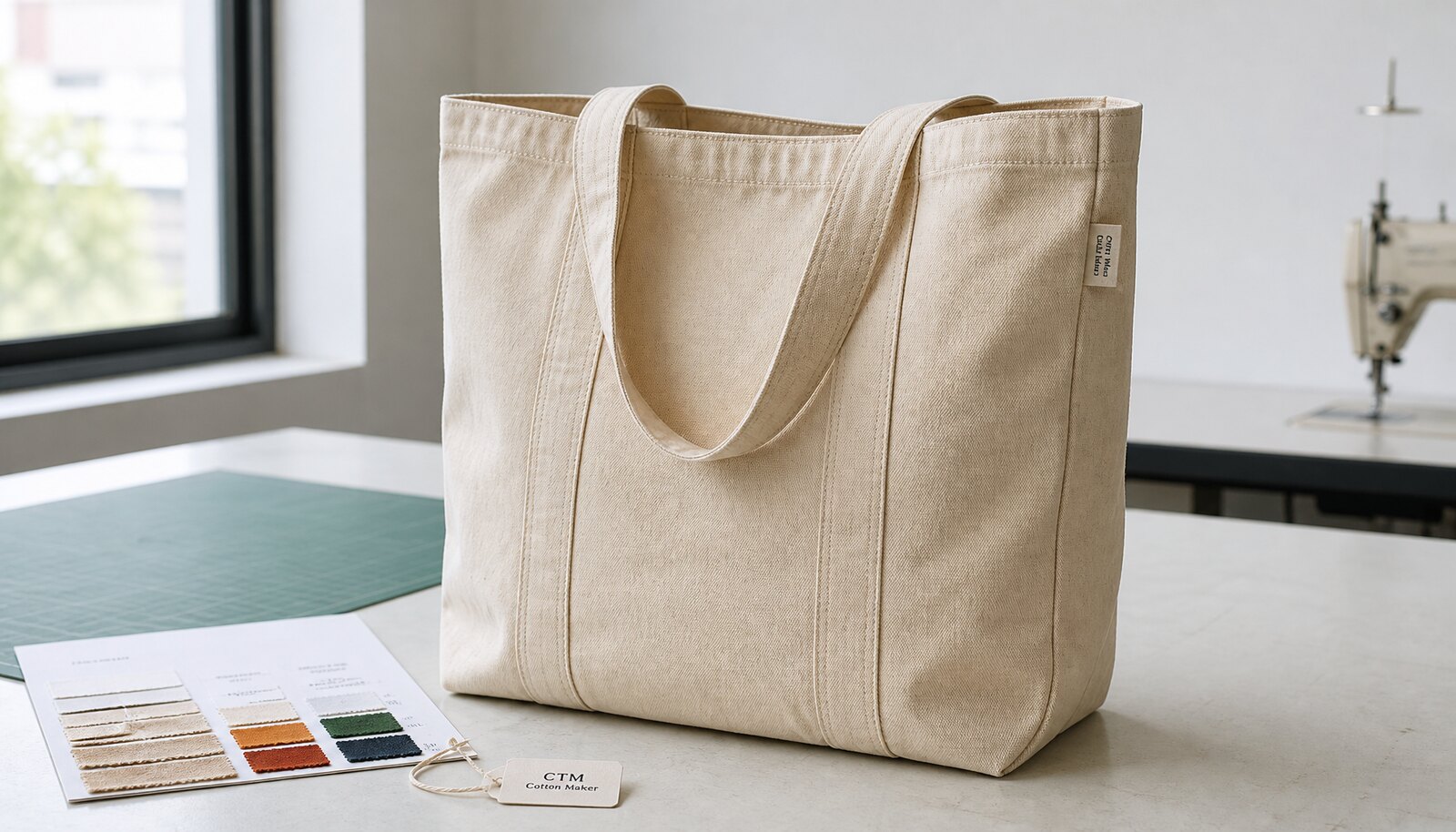
Canvas weight is the first commercial decision that changes both appearance and cost. For most boutique launches, 10–12 oz cotton canvas is the practical middle ground. It looks structured enough for retail presentation and still keeps sewing time, fabric cost, and freight under control. If the bag needs more body, stands upright on shelf, or carries heavier goods such as candles or boxed accessories, 14 oz becomes easier to sell and easier to justify.
Do not specify only “heavy canvas” or “natural canvas.” That language leaves too much room for supplier interpretation. Give the factory a target weight in oz or GSM, plus whether the weight is before or after washing or finishing. If you need a premium hand feel, request a prewashed or enzyme-washed finish and accept that the price and lead time may rise. A lighter bag can still work, but only if the retail concept is casual and the tote is not expected to hold dense goods.
- 10 oz: lower cost, softer drape, better for light fashion or promo retail.
- 12 oz: balanced option for most boutique launches.
- 14 oz: better structure, higher perceived value, stronger shelf presence.
- Prewashed canvas: softer touch, but allow for possible size shift and higher cost.
3. Match print method to artwork and order size
Most boutique buyers lose time on the print decision because they treat every logo the same. If your artwork is one or two solid colors, screen print is usually the lowest-risk option and the easiest to reorder. It handles bold logos well and keeps unit cost under control when the run is large enough to cover setup. If the design includes gradients, photo-style art, or multiple small colors, heat transfer or digital printing may be the safer route for a launch run.
The right choice depends on repeat volume as much as artwork complexity. Screen printing is efficient once setup is absorbed, but the cost structure penalizes small runs with multiple colors. Digital or transfer printing reduces setup burden for short runs, but the buyer must inspect hand feel, wash resistance, and edge durability. For bags sold at retail, the finish should survive handling in-store and at home. A logo that looks sharp on day one but cracks after a few uses creates a return and brand problem, not just a quality issue.
- Use screen print when the logo is simple and future reorders are likely.
- Use transfer or digital when artwork complexity matters more than setup efficiency.
- Always request artwork proof at actual size on the chosen fabric color.
- If the tote will be washed by customers, insist on a durability reference or test method.
4. Read supplier quotes by total setup cost, not only unit price
A useful quote for custom canvas tote bags for boutiques retail launch buying guide should separate the visible bag price from the hidden setup items. Unit price alone can mislead buyers into choosing the cheapest-looking offer, only to discover that color matching, print screens, labeling, or carton changes were excluded. The better comparison is landed cost by sellable unit, including setup, packing, and freight assumptions.
A direct factory quote is usually the best path if the order is large enough and the spec is stable. A trading company can be helpful when the first order is small, the artwork is still changing, or the buyer needs mix-and-match packaging support. Local converters may cost more, but they can reduce communication friction and shorten the reorder cycle. The right route depends on how much spec control the team needs, how many SKUs are in the launch, and whether the brand is trying to lock a long-term supplier or simply test the market.
- Compare ex-factory bag price, setup charges, sample charges, and carton charges separately.
- Ask whether the quote includes printed carton marks, polybags, or insert cards.
- Check if the supplier priced one artwork color or the whole design structure.
- Request a second quote using your target carton pack to see freight impact.
5. Use MOQ logic that reflects fabric, print, and packing reality
MOQ is not just a style minimum. For canvas tote bags, the real constraint often comes from fabric color booking, print setup, and how the bags are packed for shipping. A factory may quote a low bag MOQ, but if each color or logo version needs its own screen, your total commitment can rise quickly. That matters for boutique launches, where assortment planning often includes several colorways, seasonal graphics, or store-specific messages.
The cleanest RFQ is to state MOQ expectations in three layers: total units, units per color, and units per design. That lets the buyer compare a single-color launch against a multi-SKU launch on equal footing. If the launch is exploratory, reduce artwork variety before reducing the bag quantity. A simpler launch with one color and one print often saves more money than forcing a low MOQ across several SKUs that all carry setup costs.
- MOQ by style only is incomplete if color or print varies.
- Multiple colorways can create fabric dye or stock booking constraints.
- One strong design often beats three weak variants for launch economics.
- Ask for the MOQ break at 1-color, 2-color, and 3-color print versions.
6. Review sample approval like a production control step
For a retail launch, the sample is not just for approval aesthetics. It is the reference that governs the cut size, print placement, stitch standard, and packaging method for the production run. Buyers should treat the pre-production sample as a controlled document. If the sample is too loose in size, too soft in body, or has a logo placed slightly off-center, those traits can repeat in bulk unless they are corrected before cutting.
A practical sample review should include flat measurements, handle drop, seam appearance, print opacity, and the way the tote sits when empty. Put the acceptable variance in writing. For example, a small deviation in width may be acceptable if the bag still folds and stacks correctly, but print drift or uneven handle length should not pass. If the artwork has fine lines, inspect it on the actual bag color, not on a white proof sheet. Canvas texture changes the visual result more than many buyers expect.
- Measure body width, height, gusset, and handle length on the finished sample.
- Open and close the bag several times to see if seams distort.
- Check print edge sharpness at normal viewing distance and under daylight-like light.
- Keep a sealed signed sample and label it as the production reference.
7. Set QC thresholds for stitching, print, and dimension tolerance
Canvas tote QC should be simple enough for a warehouse team to execute, but strict enough to catch the failures that affect retail value. The most common issues are weak handle attachment, uneven stitch lines, and print misalignment. In boutique retail, these defects are visible immediately because the bag is handled at the counter and often sold in transparent or open merchandising displays.
Acceptable quality should be stated as thresholds, not vague language. For example, define the print placement window from the top edge or centerline, define the handle attachment stitch pattern, and define whether loose threads are acceptable at all. If the bag is unlined, the interior seam finish becomes part of the customer experience. If the bag is lined, the lining color and edge finishing need the same attention as the outer shell. A quote that looks good but hides weak QC terms is a false economy.
- Reject obvious print tilt, color breakout, or image blur.
- Reject handle stitch gaps or loose ends at stress points.
- Define whether the tote must stand upright when empty.
- Use a simple pass/fail sheet for carton count and appearance checks.
8. Compare sourcing routes before you commit the launch PO
The cheapest quote is not always the best route for a boutique launch. Buyers should compare at least three sourcing paths: direct factory, trading company, and local converter or stock-decorating route. Each one has a different balance of control, speed, and cost. A direct factory is strongest when the artwork is fixed, the order is big enough to absorb setup, and the buyer wants long-term repeat production. A trading company can be useful when the internal team needs help coordinating fabric, printing, and packaging across multiple SKUs. A local route can support a quick launch or emergency reorder, but the unit price often reflects lower scale and higher domestic labor cost.
The right comparison is the same bag spec quoted through each route, not three different interpretations of the brief. If one supplier quotes 12 oz canvas with screen print and another quietly quotes a lighter fabric or thinner handle, the comparison is invalid. Ask each route to quote the same fabric weight, same handle spec, same pack count, and same artwork size. Then compare the landed cost and the amount of risk you are taking on.
- Direct factory: best for repeat programs and tighter spec control.
- Trading company: best for coordination when the team is short on bandwidth.
- Local converter: best for urgent timing or small test runs.
- Always normalize the spec before comparing quotes.
9. Pack the tote for shelf use, warehouse handling, and freight efficiency
Packing is one of the easiest places to lose margin on a boutique launch. If the tote is folded inconsistently, the carton cube increases and the store team spends time reworking units on arrival. If bags are packed too tightly, the canvas creases deeply and the product can look tired before it reaches shelf. The best approach depends on whether the tote is sold folded, hung, or displayed in bins. Define the fold size and pack count before production starts.
For import programs, inner packing should support clean counts and low damage risk. Polybagging each tote may help keep units clean, but it adds material and labor cost. Nested bulk packing with a fixed number per carton can lower cost and freight volume, though the bags may need more pressing before retail display. For launch orders, many buyers choose a simple retail-ready fold with a master carton count that is easy for receiving teams to verify. Whatever the method, carton marks should match the PO exactly, including color, style, and quantity.
- Specify folded dimensions or folding method if retail presentation matters.
- State carton pack count and whether the count is the same for every color.
- Request master carton size and gross weight for freight planning.
- Confirm whether insert cards, hangtags, or barcodes are factory-applied.
10. Use landed-cost comparison to protect launch margin
Boutique buyers often focus on unit factory price and miss the real margin picture. For a launch tote, the true cost includes sample work, print setup, packing materials, inland freight, export handling, and ocean or air freight. If the order is small, setup charges can make the landed unit cost look far higher than expected. If the order is large, freight efficiency and carton size become major cost levers. The question is not only what the bag costs to make, but what each sellable unit costs to arrive ready for store use.
A practical way to compare offers is to build a one-line landed-cost view for each option: ex-factory bag price plus setup divided by units, plus packing, plus shipping, plus an allowance for defects or rework. This makes it easier to see whether a lower price with higher waste really wins. In many boutique launches, the best answer is a slightly higher unit price with cleaner packing, stable print quality, and fewer surprises during receiving. That is especially true when the tote is part of the brand presentation rather than a back-of-house supply item.
- Use one landed-cost model across all supplier quotes.
- Include setup and sampling in the comparison if they are not reusable.
- Factor in retailer handling time if the packing is not shelf-ready.
- Do not compare a bare bag price to a fully packed and labeled quote.
Specification comparison for buyers
| Spec decision | Recommended option | When it fits | Buyer risk to check |
|---|---|---|---|
| Fabric weight | 10–12 oz cotton canvas for retail, 14 oz if you need more structure | Boutique launches where the tote is sold at checkout or used as a branded shopping bag | Too-light fabric can collapse on shelf and show print distortion; too-heavy fabric raises unit cost and slows sewing |
| Handle construction | Self-fabric handles with box-x stitching or cross-stitch reinforcement | Mid-range retail programs where appearance and cost both matter | Short handles or weak stitch count will show early wear, especially if customers carry bottles or boxed items |
| Print method | Screen print for simple 1–3 color logos; heat transfer or digital for short-run full-color | Launches with stable artwork and predictable repeat orders | Fine details can fill in on screen print; transfers can crack or peel if the fabric finish and curing are not right |
| Supplier route | Direct factory for scale and custom control; trading company for small mixed orders; local converter for fast reorders | When you need the best fit between MOQ, speed, and specification control | Middleman pricing can hide fabric substitution or quote gaps; local sourcing may cost more but reduce communication risk |
| MOQ logic | Plan MOQ by fabric color, print plate count, and carton pack, not just bag style | When multiple colors or seasonal artwork are involved | A low bag MOQ can still create high total commitment if each color or print version needs its own setup |
| Packing method | Bulk polybagged in fixed counts or nested with divider sheets for retail-ready units | For warehouse receiving and store replenishment where SKU control matters | Loose packing leads to scuffing, dust, and count disputes; over-packaging raises carton cube and freight cost |
| Lining and structure | Unlined for basic value programs; partial lining or cardboard insert for premium boutique use | When the bag will hold apparel, candles, or fragile impulse items | Adding structure changes sewing time and quote terms; if omitted, bag may look too casual for premium retail |
| Lead time route | 30–45 days after sample approval for standard canvas; longer if fabric dyeing or special washing is needed | Launches with a fixed merchandising calendar | Shipping windows can slip if artwork approval, fabric booking, or carton artwork is late |
| Compliance and evidence | Request fabric composition, color tolerance, stitch spec, and carton packing proof before PO | For importers and distributors managing multiple stores or regions | Missing documentation makes claim handling difficult if the shipment arrives with shade variation or quantity shortfall |
Buyer checklist before sampling
- Confirm target use: resale tote, checkout bag, gift-with-purchase bag, or staff carry bag, because each use changes fabric weight, handle length, and acceptable unit cost.
- Lock artwork before sampling: logo size, placement, Pantone reference if needed, and the number of print colors.
- Set the fabric spec in ounces or GSM, plus whether the canvas must be bleached, natural, dyed, or prewashed.
- Define handle length, handle width, and reinforcement stitch standard so samples are not judged only by appearance.
- State packing format: folded size, polybag count, carton pack, carton mark text, and whether retail hangtags are inserted by the factory.
- Request sample and production tolerances for dimensions, print registration, and stitch alignment before approving the PO.
- Ask for a quote split between bag unit cost, setup charges, sample charges, and freight assumption so the real landed cost is visible.
Factory quote questions to send
- What fabric weight do you propose, and is that finished fabric weight or greige fabric before washing?
- How many print screens, setup charges, or color-matching fees are included in the quote?
- What is your MOQ by color, by print design, and by total order value?
- Can you quote both self-fabric handles and cotton webbing handles so we can compare hand feel and price impact?
- What is your standard tolerance for bag dimensions, handle length, and print placement?
- How are the bags packed inside the carton, and what is the master carton size and gross weight?
- What sample stage do you provide before bulk production, and what must be approved in writing before cutting?
- What production lead time applies after sample approval, and what can delay it?
- Can you separate ex-factory price, domestic carton charge, and any packaging or compliance extras?
Quality-control points to confirm
- Fabric weight and finish match the approved reference sample.
- Handle reinforcement is visible, centered, and secure at stress points.
- Print color density is even with no bleeding into the weave.
- Dimensions are within an agreed production tolerance.
- Carton counts, labels, and folding method match the PO packing instructions.