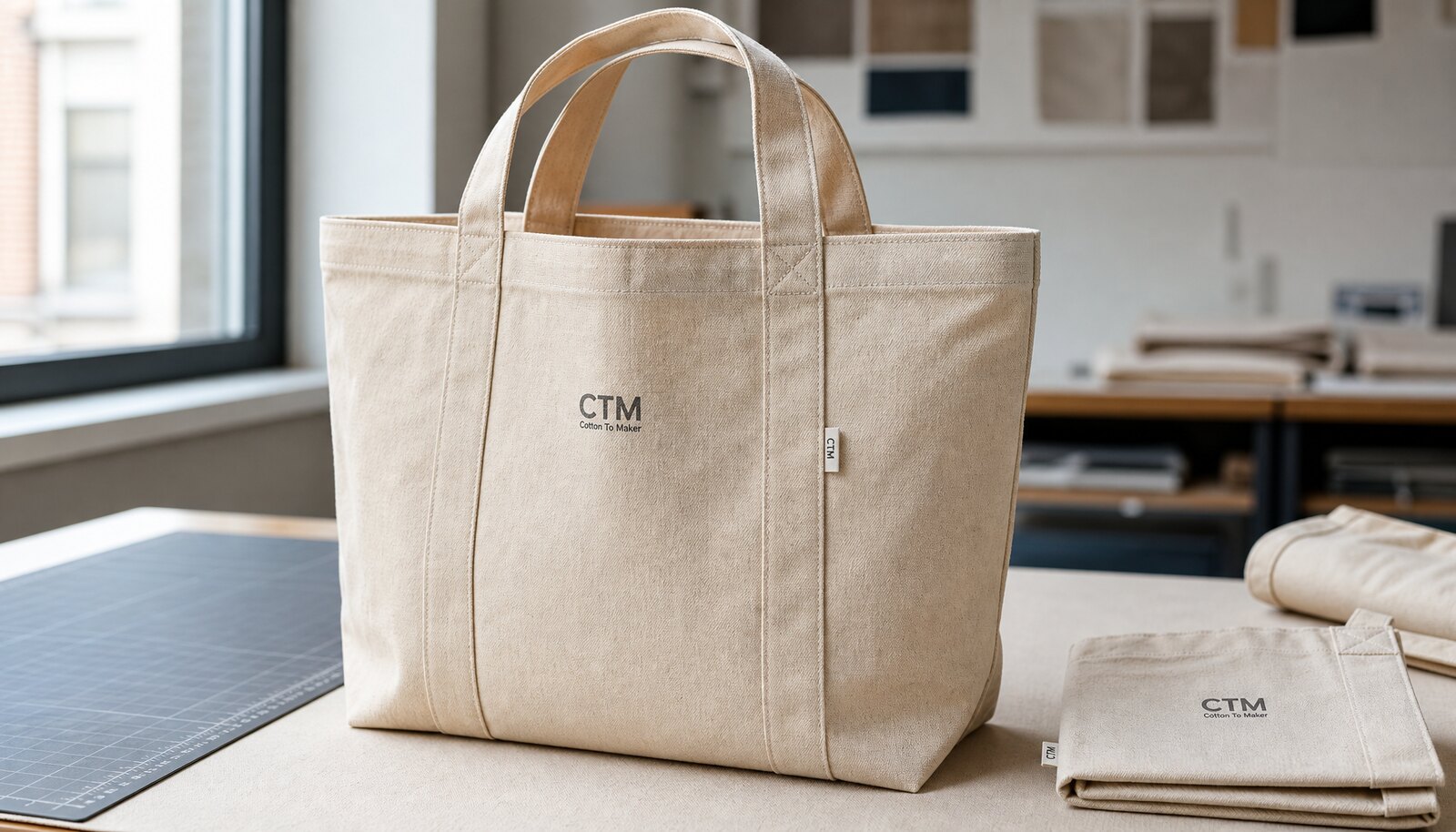
What This Buyer Problem Really Is
Boutique buyers usually do not need a generic tote bag. They need a package carrier that also acts like part of the brand experience, so the bag has to look right on arrival, hold up at checkout, and stay on message after the customer leaves the store. That means the spec is not just fabric and print. It is the full set of choices that determine appearance, handling, shelf readiness, and repeat-order stability.
The common mistake is to ask for a tote by size alone. A 14 x 16 bag can still be too soft, too thin, too wrinkled, too noisy in print, or too awkward in packaging if the construction is vague. For boutiques, the buying problem is to define a bag that can sit next to premium merchandise without looking like a giveaway item.
- Treat the tote as retail packaging, not only as a carry bag.
- Define how the bag should look in the store and how it should arrive in cartons.
- Separate what the customer sees from what the factory needs to build.
Choose Canvas Weight Around the Retail Job
Canvas weight drives the first impression more than most buyers expect. Around 8 oz canvas, or roughly 270-300 gsm, gives you a lighter bag with lower cost and easier folding, but the bag can feel promotional if the print is large or the contents are heavy. Around 10 oz, or roughly 340-370 gsm finished, is the most practical middle point for boutique packaging because it balances stiffness, print clarity, and unit cost. Around 12 oz, or roughly 400-450 gsm, moves the bag into a more premium feel with better structure and better resistance to distortion.
Do not compare only raw cloth quotes. Ask whether the gsm is measured before or after wash, whether the fabric is single-fill or double-fill, and whether the weave is dense enough to hold a crisp logo edge. A heavier fabric is not automatically better if the store needs easy folding, low carton volume, and a softer hand for gift packaging. The right answer depends on how the tote will be used after the sale.
- 8 oz works for lighter retail kits and lower-price programs.
- 10 oz is the safest default for most boutique packaging projects.
- 12 oz is appropriate when presentation and durability matter more than carton efficiency.
Pick the Print Method for the Artwork, Not the Trend
For boutique branding, single-color screen print is still the most dependable option when the logo is clean and the order size is large enough to absorb setup. It gives strong coverage on natural canvas and usually looks better at distance than cheaper transfer methods. If the logo has fine lines, small type, or multiple colors, the spec needs tighter controls on line thickness, registration, and curing, or the final tote will look rushed. That is where many quote comparisons fail, because the factory may be pricing a visual idea rather than a printable file.
A woven label or sewn patch is worth considering when the logo should feel premium without covering the whole face of the bag. It is also useful when the brand wants a subtle mark on a side seam or handle area instead of a loud front print. The tradeoff is that the decoration becomes a sewn component with its own color, stitch, and fray risks. If you choose embroidery, transfer, or mixed decoration, define the maximum stitch density, logo size, and exact placement before sample approval.
- Use screen print for simple logos, repeat orders, and strong coverage.
- Use woven labels or sewn patches for smaller brand marks or premium positioning.
- Avoid detailed artwork unless the printer has shown a true production sample on the same canvas weight.
Set Size, Handles, and Closure Before You Price It
Boutique canvas totes often fail on proportions rather than on materials. A bag that is too tall and narrow can look elegant but carry poorly. A bag that is too wide can sag when it is filled with boxed goods. The better approach is to define the bag around the retail use case: gift handoff, customer shopping bag, event bundle, or premium reusable carrier. From there, lock the width, height, and gusset so the factory can build a shape that matches the contents instead of forcing the contents to fit a random size.
Handle length matters as much as fabric weight. A short hand-carry handle feels neat at checkout but may become uncomfortable if the bag is reused for commuting or market shopping. A longer shoulder-drop handle increases utility but changes the look and the sewing load. If the tote needs a zipper, snap, or magnetic closure, that should be stated early because closure hardware changes both the BOM and the sewing sequence.
- Use a gusset when the bag needs to hold boxed goods or layered packaging.
- Specify handle drop, not only handle length, so wearability is clear.
- Treat closures as a functional requirement, not as an optional accessory.
Specify the Retail Presentation, Not Just the Tote
For boutique packaging, the way the tote is folded and packed can matter almost as much as the tote itself. A bag shipped loose in a carton may arrive with hard creases, print scuffing, or a wrinkled opening edge. A bag packed in an individual polybag may stay cleaner, but it can feel more industrial unless the inner pack is handled properly. Some brands prefer a flat fold with a belly band or a barcode label so the store can move it directly to shelf display or backroom storage without rework.
The packaging spec should also define what goes inside the bag if anything is included. Insert cards, tissue, care slips, or silica gel can affect appearance, moisture control, and carton density. If the tote is part of a boutique gift set, the buyer should control the exact fold direction, label position, and outer carton marks so the warehouse does not need to unpack and repack product on arrival.
- Lock the fold style so the retail face is visible and the print is protected.
- Choose inner packing based on how the store will receive, display, and store the bags.
- Add barcode or SKU labeling only if the warehouse flow actually needs it.
Build the Quote So Real Costs Show Up
A clean quote for custom canvas tote bags for boutiques should separate fabric, cutting, sewing, print setup, decoration, packing, carton work, and any testing or external fees. If those items are bundled into one number, it becomes impossible to compare suppliers on equal terms. Two offers that look close on unit price can diverge sharply once you add setup charges, packing upgrades, or rework for a corrected logo. Ask for the quote at more than one quantity so the setup dilution is visible. A quote at 500 units, 1,000 units, and 3,000 units usually tells you more than a single price line ever will.
MOQ logic matters because the cheapest fabric quote may still lose once the factory buys more material than needed or has to run a separate print setup. If the supplier quotes by fabric roll, print screen, and carton size, those breakpoints should be visible. This is where buyers protect margin: not by chasing the lowest nominal unit price, but by comparing the same spec, the same pack format, and the same order volume across every supplier.
- Request separate lines for fabric, trim, decoration, packing, and testing.
- Compare at multiple quantities so setup cost is not hidden inside the unit price.
- Ask whether MOQs apply to fabric color, logo color, or total order value.
Approve the Sample Like a Production Tool
A sample should not be judged as a pretty object. It should be judged as a production control point. The pre-production sample needs to match the final fabric weight, print method, stitching approach, handle reinforcement, and pack format. If the sample uses different cloth, different thread, or a different print path, it is only a visual reference and cannot be used to approve the bulk run. Make the supplier label the sample stage clearly: sales sample, development sample, pre-production sample, or shipment sample.
For acceptance, use measurable criteria. Dimensions should stay within the agreed tolerance, the logo should sit in the approved location, and the handle seams should not pull under the intended retail load. Print should remain clean after curing, with no tackiness and no obvious ghosting. If the tote has a premium position, test the bag by loading it with the expected gift or shopping weight and carrying it for a realistic distance, because a tote that looks fine on the table can fail when the strap angle changes under load.
- Approve the exact production fabric, not a substitute cloth.
- Use a load test that matches real boutique use, not a light hand test.
- Keep one signed sample as the reference for bulk inspection.
Set QC Thresholds Before the Cartons Close
Quality control for boutique totes should start with the defects that would hurt a retail shelf the fastest. Wrong size, wrong logo, poor print registration, weak handle stitching, and visible staining are all more serious than minor thread trimming issues. The buyer should define which defects are critical, major, and minor before production starts. That lets the factory inspect against a known standard instead of arguing after the fact about what counts as acceptable. If you expect a premium hand feel, also define what unacceptable fabric variation looks like, especially with natural canvas where shade banding can show up from roll to roll.
Inspection should also cover packing and transit survival. Cartons that collapse in stacking or scuff the tote face can undo otherwise good production work. Check whether the master carton count is consistent, whether the labels are on the agreed side, and whether the inner packs stay aligned after compression. For a tote that will be sold in boutiques, cosmetic consistency matters almost as much as structural function because the customer judges the bag before the first use.
- Critical defects: wrong artwork, broken handle seams, wrong size, contamination.
- Major defects: crooked print, weak stitching, bad fold, open seam, color mismatch.
- Minor defects: loose threads, small wrinkles, slight label tilt within tolerance.
Plan Lead Time as a Retail Calendar, Not a Factory Calendar
A tote program can slip because of details that look small in the office but consume real time in the factory. Artwork changes, weave changes, print changes, and packaging changes can each force a new sample cycle or delay bulk slotting. If the tote is tied to a boutique launch or seasonal refresh, the schedule should be built backward from the store date, not forward from the sample approval date. That gives you time for corrections, freight, and a second review if the first sample misses the mark.
Reorder planning is easier when the first order is built with continuity in mind. Keep the same size, the same logo format, the same trim source, and the same pack count if you expect a repeat program. If the brand wants flexibility, hold spare artwork files, confirm whether the factory can repeat the same print screens or labels, and agree what can change without triggering a new MOQ. The best repeat order is the one that does not require relearning the spec.
- Build extra time for sample revision if the artwork is not production-ready.
- Protect the launch date by fixing the spec early and changing only what is necessary.
- Keep the reference sample, spec sheet, and approved packing photo with the reorder file.
Compare Sourcing Routes by Risk, Not Just by Price
A direct factory is usually the best route when the tote is a repeat item and the spec is stable. You get cleaner control over fabric, sewing, and packing, and the factory can usually hold the same process from one reorder to the next. A trading company can help when the buyer needs multiple product categories in one shipment, but the spec control may sit one step further away from the workshop. A stock decorator is useful when the launch is urgent and the buyer can accept more limited customization, but the tradeoff is less control over exact materials and fewer options for fine-tuning the pack format.
For boutiques, landed cost should include more than the unit price. Add freight, carton volume, customs clearance, duties, label changes, sample costs, and any extra packing labor. A slightly higher factory price can still be the better deal if the bag ships flatter, packs more efficiently, or avoids a repack step at the warehouse. That is why quote comparison should use the same spec sheet and the same delivery term. Otherwise, the buyer is comparing different products that happen to share a similar logo.
- Direct factory: best for stable specs, repeat orders, and deeper QC control.
- Trading company: useful for mixed programs, but insist on spec traceability.
- Stock decorator: fastest route, but least flexible on fabric and construction.
Specification comparison for buyers
| Spec decision | Recommended option | When it fits | Buyer risk to check |
|---|---|---|---|
| Fabric weight | 10 oz canvas, or about 340-370 gsm finished | Most boutique packaging bags that need a balanced hand feel, print clarity, and reasonable cost | Raw fabric gsm can differ from finished gsm; confirm shrinkage, weave tightness, and opacity after wash or steam |
| Heavy-duty upgrade | 12 oz canvas, or about 400-450 gsm | Premium retail bags, higher merchandise weight, or brands that want a more structured feel | Higher cost, slower sewing, and more visible needle marks if the factory is not set up for dense fabric |
| Lightweight option | 8 oz canvas, or about 270-300 gsm | Promotional bags, softer hand feel, or lower-price seasonal programs | More show-through with dark ink, easier wrinkling, and lower perceived value on shelf |
| Print method | Single-color screen print with controlled ink coverage | Simple logos, high repeat volume, and natural canvas backgrounds | Fine lines can fill in, ink can crack if curing is weak, and registration must be held tightly |
| Decoration route | Woven side label or sewn patch for small logos | Brands that want a premium, durable mark without large print areas | Label color and stitch quality must match; low-cost labels can fray or distort after packing |
| Closure | Open top for shopping use, zipper for security-sensitive retail kits | Open top for simple boutique carry bags; zipper for gift sets, cosmetics, or travel sets | Closure changes material cost, sewing time, and lead time; zipper tape quality often gets missed in quotes |
| Handle build | Self-fabric or cotton webbing handles with bar-tack reinforcement | Reusable bags that may carry heavier items or be used repeatedly by customers | Handle drop, stitch count, and reinforcement patch size must be locked before sampling |
| Sourcing route | Direct factory for stable specs, trader for low-volume multi-item programs, stock decorator for urgent launches | Factory for repeat orders; trader when you need mixed categories; stock decorator for short deadlines | Quotes may look cheaper or faster until you compare setup, freight, and rework risk on the same basis |
Buyer checklist before sampling
- Lock the finished size, gusset, handle drop, and closure style before asking for a price.
- State the target canvas weight in gsm or oz, plus whether you want raw, washed, or pre-shrunk fabric.
- Provide the logo file, print colors, print area, and whether the artwork has fine lines or halftones.
- Specify the retail pack format: flat-packed, folded with insert, individual polybag, belly band, or barcode label.
- Request the quote on at least two order quantities so setup cost and unit cost are visible.
- Ask for pre-production sample, bulk shipment sample, and carton pack photos before release.
- Define acceptable color tolerance, stitch quality, and seam strength in writing.
- Confirm carton count, master carton dimensions, and whether cartons need shipping marks or retail labels.
Factory quote questions to send
- What is the finished fabric weight in gsm, and what tolerance do you control on incoming cloth?
- Which print method are you quoting, and what is the setup cost, plate cost, or screen cost?
- What is the MOQ by fabric color, print color, and total order quantity?
- How do you package the bags for shipment, and how many pieces per inner pack and master carton?
- What is the lead time for sample approval, bulk production, and packing after artwork is finalized?
- What tests or internal checks do you run for seam strength, colorfastness, and dimensional accuracy?
- What is included in the unit price, and what is extra for labels, hangtags, inserts, or special folding?
- Can you quote the same spec at 500, 1,000, and 3,000 units so I can compare setup cost properly?
Quality-control points to confirm
- Finished dimensions should stay within the agreed tolerance, especially after print curing or steam pressing.
- Fabric weight and weave density should match the approved sample, not just the supplier's catalog spec.
- Logo placement should stay aligned within a practical retail tolerance, with no obvious skew or double-image effect.
- Stitching should show consistent SPI, secure bar-tacks at stress points, and no broken seams at the handles.
- Ink should cure fully with no tackiness, cracking, or heavy bleeding into the canvas weave.
- Handles should pass a load test at the expected retail fill weight plus a safety margin.
- Cartons should survive transit without crushed corners, loose pieces, or mixed SKUs.
- Packaging should preserve the retail fold and not leave strong crease marks, dirt transfer, or moisture damage.