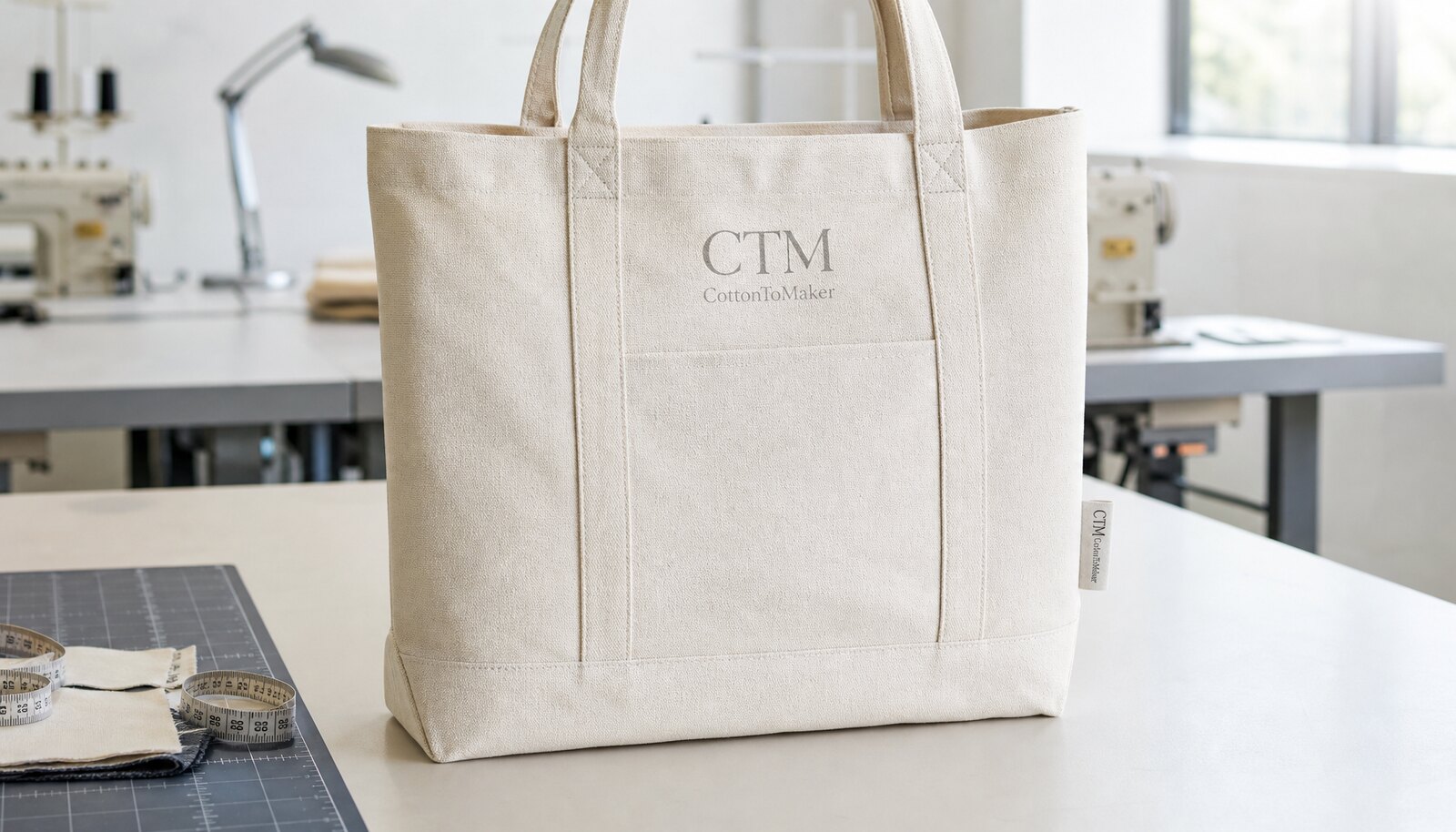
Why fabric choice matters more for boutiques than for generic promo bags
Boutique tote buyers are not buying a blank commodity. They are buying a retail-ready accessory that has to support display, checkout, and brand perception at the same time. A tote that looks acceptable in a photo may still fail if the canvas sags on the shelf, the print sits crooked after sewing, or the bag feels too flimsy for shoppers to reuse. That is why the custom canvas tote bags for boutiques material selection guide starts with fabric, not decoration. The material choice influences print quality, structure, freight, and the number of avoidable customer complaints later.
For procurement teams, the important question is not whether canvas is durable in the abstract. It is whether the chosen canvas matches the merchandising job. A tote sold next to candles or skincare needs a different handfeel than a tote used for bookstore carryout or an event gift set. If the bag is meant to be impulse-purchased, a softer and lighter canvas may be enough. If it needs to feel premium on a hanger or display hook, a tighter and heavier fabric usually performs better. The right answer depends on use case, not preference alone.
One reason boutique projects go off track is that suppliers often quote from a generic tote template. If the buyer does not specify the retail context, the factory may choose a lighter canvas, standard handles, and the fastest decoration method. That can be perfectly functional but wrong for the shelf. Better procurement starts by defining where the tote will be seen, how it will be carried, and whether reorder continuity matters more than initial savings.
Canvas weight, weave, and finishing: compare performance, not just ounces
Most boutique tote programs land in the 10 oz to 12 oz range, with 14 oz reserved for bags that need a visibly firmer body. The weight number is useful, but it is not enough on its own. Two fabrics with the same stated weight can behave very differently if one uses tighter yarn, a denser weave, or a more controlled finish. A 10 oz bag with a good plain weave may hold print better than a poorly made 12 oz fabric that has uneven slub or loose face texture.
Buyers should think about three variables together: weight, weave, and finishing. Weight affects feel and freight. Weave affects print sharpness, fabric stability, and how much the bag distorts at the seams. Finishing affects size consistency, softness, and shrink risk. If the tote has a gusset, lining, pocket, or logo that must align to a seam, uncontrolled finishing can turn a good sample into a problem on bulk production. If you are comparing supplier quotes, ask whether the quoted weight is raw fabric weight or finished weight after washing and pressing, because that difference can change the true feel and the landed cost.
A practical sourcing path is to ask for two fabric options side by side: one cost-optimized option around 10 oz and one presentation-focused option around 12 oz. Request a photo of each under the same lighting, then ask for physical samples with the same print and handle spec. That comparison makes the cost tradeoff visible. The 12 oz version may increase unit cost and freight, but if it reduces print show-through or helps the bag stand better on shelf, it can support a stronger retail price point. In a boutique setting, that tradeoff often matters more than a small difference in fabric spend.
Use the spec comparison below to narrow the right build for your retail channel
The most useful material decision is the one that matches how the tote will be sold. A bag for a fashion boutique does not need the same build as a bag for a trade show or a grocery-style carryout. Procurement teams save time when they compare specs against presentation, durability, and cost impact instead of only comparing unit price. The table below is meant to help buyers decide what to ask for before they request quotes or approve samples.
When reading the comparison, focus on what changes the customer actually sees: bag shape, print clarity, handle comfort, and how premium the bag looks once packed and hung. Those are the factors that support retail value and reorder potential.
- Define the retail role first: gift bag, resale accessory, checkout bag, or promotion add-on.
- Choose one primary quality goal per order: lower cost, higher shelf presence, stronger print clarity, or better repeat use.
- Do not approve a sample until fabric, print, handles, and packing are all shown on the same build version.
Supplier route affects traceability, reorders, and who owns the problem when quality slips
The sourcing route is not a paperwork detail. It changes how much control you really have over fabric origin, lot continuity, and defect responsibility. A direct factory is usually the strongest option when the tote needs repeat ordering or a stable seasonal program. The factory can usually quote the fabric, cutting, sewing, and print together, which makes it easier to lock the spec and follow the same build on reorder. That matters when a boutique wants the tote to remain consistent across multiple drops.
A trading company can still be useful, especially when the buyer wants to test several concepts quickly or combine totes with other packaging items. The advantage is flexibility. The tradeoff is less visibility into the actual fabric mill, dye lot, or finishing process. If the supplier changes fabric source between runs, the bag may look close in a photo but behave differently in hand or under print. For buyers who need traceability, ask for mill identification, fabric lot confirmation, and a written statement on whether the same lot can be reserved for repeat production.
Stock-base sourcing is fastest, but it is the least forgiving route for custom detail. It works when speed matters more than exact spec control. The downside is that the supplier may only offer fixed handle lengths, standard canvas weights, or limited packing options. That can be acceptable for a launch test, but it becomes expensive if you later need to change a detail after the first sell-through. If the tote may become a recurring boutique item, direct-factory sourcing usually gives better reorder stability even when the first sample takes a little longer.
Print method should follow artwork, not supplier habit
Screen print is still the most dependable choice for many boutique totes because it gives strong opacity on natural canvas and keeps unit cost manageable once the setup is spread across the run. It is especially appropriate for one- to three-color logos, simple type, and shapes that can tolerate the texture of woven cotton. The main risk is assuming that a paper proof tells the whole story. On canvas, fine strokes can lose edge definition, and very small type can fill in if the weave is open or the ink deposit is too heavy.
Heat transfer and digital print are worth considering when the artwork is detailed, the order is short, or the brand expects frequent design changes. They are often easier to approve early because the art can be reproduced quickly, but they still need to be tested on the actual fabric. Ask the supplier for a strike-off on the exact canvas, not just a sample on a different substrate. Then inspect the result in daylight, not under only factory lighting. If the logo sits near a seam, gusset, or pocket edge, check for distortion after sewing, because a print that looks centered before assembly can shift once the panels are joined.
For procurement, the cleaner quote is the one that names the print method, the number of colors covered, the setup cost, and the re-run cost for repeat orders. A cheap screen-print quote can become expensive later if the art changes every season and new screens are needed each time. By contrast, a digital option may look expensive per unit but save time when the design changes often. Match the process to your launch rhythm, not to a generic rule.
Construction details that change comfort, shelf appeal, and return rates
Handle spec is one of the most important details in a boutique tote, and it is often underexplained in quotes. A handle that is too short can look neat on a spec sheet but feel awkward when carried. A handle that is too narrow can dig into the hand and visually cheapen the product. For most retail use, a handle width of roughly 3 to 4 cm and a drop around 25 to 30 cm is a useful starting point, but the final choice should reflect how the bag will be worn and what is likely to be packed inside. If the tote is intended as a shoulder bag, test that use case before final approval.
Reinforcement matters more than style language. Bar-tacks or X-box stitching should be placed consistently, with clean thread trim and no puckering around the anchor point. That is where failures usually start when the bag is loaded with books, cosmetics, or boxed merchandise. Ask the factory to show a close-up of the handle attachment on the sample and, if possible, on the pre-production sample too. If the construction is weak in the sample room, it will not improve in mass production.
Gussets, lining, pockets, and closures should be treated as commercial choices. A gusset gives more usable volume and a better boxy shape on shelf, but it increases fabric use and can complicate the print area. Lining adds perceived value and can hide inside seams, yet it raises sewing complexity and adds one more place where shrink or twist can appear. Pockets are useful only if the shopper has a real need for keys, cards, or a phone. Closures such as zippers or snaps add security, but they also add hardware sourcing, function testing, and one more defect mode. If the bag is meant for easy retail checkout, an open top is usually the cleanest and least risky option.
How to read a quote so the headline price does not hide the real cost
The best factory quote is itemized enough that you can see why one bag costs more than another. At a minimum, it should separate fabric weight, finishing, print method, handle construction, lining status, packing method, and sample charges. Without that detail, the quote is hard to compare and easy to misread. A lower price may simply mean lighter canvas, smaller print area, weaker reinforcement, or looser packing. If those choices are deliberate, that is fine. If they are hidden, the buyer is taking avoidable risk.
MOQ and setup charges deserve special attention because they shape the real unit cost on small orders. If the supplier is screen printing, screens and setup need to be spread across the run. If the run is short, the price can climb quickly. Some suppliers try to hit a target by quietly simplifying construction. That is where a buyer needs to ask direct questions: what exactly is included, what is excluded, and what changes if the order is repeated later. Ask for the same tote quoted in lined and unlined versions so the impact on cost, lead time, and packaging becomes visible. If you need to compare suppliers, make sure every quote uses the same fabric weight, same print size, same handle spec, and same carton configuration.
The most useful sourcing path is often a two-step RFQ. First, request a baseline build with the minimum acceptable spec. Then ask for one upgraded option with better weight, tighter weave, or cleaner trim. That gives you a real view of how much each improvement costs. In boutique retail, a small increase in unit cost can be justified if the tote becomes more presentable, stands better on shelf, or holds print more cleanly. What should not happen is paying a premium for a vague spec that turns out to be ordinary canvas dressed up with strong marketing language.
Sampling should prove structure, print behavior, and fabric lot consistency
A sample that looks good on a table is not enough. For boutique tote procurement, the sample has to prove how the bag behaves when carried, folded, packed, and inspected in real light. Check whether the opening stays square, whether the tote stands upright enough for shelf presentation, and whether the handles feel balanced when the bag has weight in it. If the tote is intended to be reused, do a simple load check and a flex check on the printed area. You are looking for the kind of failure that customers notice after the first or second use, not just the kind that shows up in a close-up photo.
If the order matters commercially, ask for the sample to be made from the exact intended production fabric lot. A print approved on one lot can look different on another lot if the weave, shade, or finishing changes. This is especially important for natural cotton canvas because subtle shade variation is normal but must be controlled. Keep the approved sample, record the lot number if the factory provides one, and save daylight photos of the print placement, handle location, and internal construction. If the bag includes lining or a pocket, confirm that those elements do not twist the opening or pull the side seams out of square.
A useful pre-production workflow is simple: approve the physical sample, then request a pre-production sample on the actual bulk materials, then inspect the first run before the order is packed. That sequence catches most avoidable issues. It also makes it easier to prove what was approved if a later dispute arises. Buyers who skip pre-production often end up debating photos instead of actual construction.
QC thresholds that make bulk inspection usable in real procurement
Quality control should be written in a way that the factory and buyer can both follow. The goal is not to create a long list of minor complaints. The goal is to identify the defects that matter to the customer and the retailer. For custom canvas tote bags for boutiques, the most visible issues are wrong dimensions, crooked print, weak handles, dirty fabric, poor folding, and inconsistent color or weave across the run. Those are the things that affect shelf value and resale confidence. A buyer should define acceptance criteria before the bulk order starts so that inspection does not turn into a negotiation after the goods are complete.
Use an AQL-based plan rather than inspecting only the first few units. A common procurement approach for retail accessories is to inspect to a normal AQL standard, often around 2.5 for major defects and 4.0 for minor defects, with the exact threshold set in the purchase order or quality agreement. Take samples from the beginning, middle, and end of production, and from more than one carton lot if the order is split. This matters because canvas batches can drift in shade or texture, especially if the factory changes fabric lots mid-run.
For pass/fail criteria, define what is unacceptable in plain language. Examples of major defects: holes, broken stitches at stress points, missing reinforcement, severe print smear, obvious shade mismatch, loose hardware, or a zipper that does not function smoothly. Examples of minor defects: trimmed thread tails slightly over the agreed limit, a small print shift within tolerance, or a light wrinkle from packing that clears after conditioning. Set a clear ruling on each type before shipment. If lining or a pocket is included, check whether the inner construction pulls the outer shell or creates bubbles at the base. That is the kind of defect that often gets missed if the inspection only focuses on the outside face.
Carton checks are just as important as sewing checks. Verify style, color, quantity, carton count, and label accuracy, and make sure the carton density does not crush the tote into a shape that creates permanent fold lines. If the order is retail-bound, confirm whether each bag is folded the same way and whether insert cards or barcode stickers are positioned consistently. Freight and warehouse handling are part of QC because a bag can arrive technically sewn correctly and still look unfit for the shelf if it was packed badly.
Lead time, packaging, and freight implications should be reviewed before order release
Lead time is usually shaped by more than sewing capacity. The biggest variables are sample approval speed, fabric availability, print complexity, and packaging requirements. A simple unlined tote on stock canvas can move quickly once artwork is approved. A lined bag with a woven label, insert card, and custom carton marks will take longer because each added element creates another sourcing step and another inspection point. For seasonal boutique launches, that difference matters. If the tote is tied to a holiday, store opening, or promotional window, build buffer into the schedule before releasing the order.
Packaging changes the true landed cost in ways that buyers often underestimate. Individual polybags, insert cards, barcode labels, and tight carton specs all affect how many bags fit in a carton and how much the freight bill will be. A thicker canvas already increases weight; if the bag is also individually packed with extra inserts, carton density falls and freight cost rises. That is why the cheapest ex-factory quote is not always the cheapest landed result. Ask the supplier for carton dimensions, gross weight, and carton count by style and color so you can estimate warehouse handling and shipping more accurately.
For repeat programs, packaging should be standardized early. A stable fold direction, carton quantity, and label format make reorders easier to receive and count. They also reduce the chance that a new production run arrives with a slightly different packed feel that changes shelf presentation. If the tote is a core boutique accessory, the packaging spec is part of the product spec, not an afterthought.
Specification comparison for buyers
| Spec decision | Recommended option | Buyer-facing performance impact | Cost and risk impact |
|---|---|---|---|
| Canvas weight | 10 oz for light retail carry; 12 oz for better shape and repeat use; 14 oz only when structure matters more than softness | 10 oz feels lighter and folds smaller; 12 oz holds print better and looks fuller on shelf; 14 oz stands up better but can feel stiff | Heavier fabric raises fabric cost, sewing resistance, and freight weight; underweight fabric can look cheap, distort print, and trigger higher complaint rates |
| Weave and yarn quality | Tight plain weave with low slub count; ask for mill and lot identification if the bag is a repeat program | A tighter weave gives cleaner print edges, more even ink laydown, and a neater retail face; visible slubs can make the bag look irregular | Better yarn and weave quality usually cost more, but it lowers visible defect risk and improves reorder consistency across lots |
| Finishing | Pre-shrunk or controlled-wash finish when final size matters; raw canvas only when you can accept movement | Pre-shrunk fabric keeps the finished tote closer to target size after pressing, steaming, or light washing; raw fabric can soften more but move more in production | Controlled finishing can add cost, but it reduces size drift, artwork shift, and handle-drop variation after production |
| Print method | Screen print for solid logos and repeat orders; heat transfer or digital for short runs or complex art | Screen print usually gives stronger opacity on natural canvas; transfer and digital are better for gradients, fine detail, or smaller batches | Screen print has setup cost but lower unit cost at scale; digital and transfer may be easier for small quantities but can cost more per piece and be less durable if the substrate is not matched well |
| Handle spec | 3 to 4 cm width, 25 to 30 cm drop for most boutique carry, with bar-tacks or X-box reinforcement | Wider handles spread load better and feel more premium; correct drop makes the bag comfortable in hand or on shoulder | Narrow or under-reinforced handles are a common failure point and can create returns, while oversized handles increase material use and sewing time |
| Base and gusset | Flat bottom with 8 to 12 cm gusset if display shape and usable volume matter | A gusset improves shelf presence and lets the bag hold boxed merchandise better; flat bags are cleaner and cheaper | Gussets increase fabric consumption, sewing steps, and carton volume; poorly balanced gussets can make the tote twist or sag |
| Lining | Unlined for cost-sensitive retail; light cotton or polycotton lining for premium presentation or cleaner interior | Lining improves perceived value and can hide inner seam construction; unlined bags are simpler and lighter | Lining adds sewing labor, can introduce shrink or twist if the lining is uncontrolled, and usually raises lead time and sample iterations |
| Closure | Open top for quick retail use; zipper or snap only when product security justifies it | Open-top bags pack faster and keep the shopper experience simple; closures improve security but add hardware and function testing | Hardware creates defect points, adds approval steps, and can slow production if the supplier lacks consistent sourcing |
| Supplier route | Direct factory for repeat programs; trading company for mixed bundles or small tests; stock base for speed | Direct factories usually offer better spec control and clearer repeatability; stock programs move fast but limit customization | Indirect routes can hide fabric origin and make reorders inconsistent; stock-based sourcing can lower lead time but often limits size, color, and trim options |
Buyer checklist before sampling
- Confirm finished dimensions in millimeters or centimeters, not only flat cut size, and set tolerance bands for width, height, and gusset depth.
- State canvas weight in oz and GSM, plus whether the fabric is raw, washed, pre-shrunk, or enzyme-softened.
- Ask for mill name or fabric source, fabric lot confirmation, and whether the same lot can be reserved for reorder continuity.
- Attach artwork files, Pantone targets, print placement measurements, and whether the print crosses seams, gussets, or pockets.
- Specify handle width, handle length, handle drop, reinforcement pattern, and stitch count at each stress point.
- Decide on lining, pocket, zipper, snap, woven label, swing tag, and any interior branding before sampling starts.
- Define packing: bulk fold, individual polybag, insert card, barcode label, carton quantity, carton mark format, and whether cartons must be single-style or mixed.
- Set approval milestones for sample, strike-off, pre-production sample, and final bulk shipment, with written sign-off on each step.
- Ask for overrun and underrun policy, plus whether final quantities can be combined across colors or sizes.
- Request carton dimensions, gross weight, and carton count by order line so freight cost, warehouse handling, and shelf replenishment can be estimated accurately.
Factory quote questions to send
- What is the exact finished fabric weight in oz and GSM after finishing, and what lot-to-lot tolerance do you hold?
- Is the canvas pre-shrunk, washed, or raw, and what shrinkage should we expect after steaming or light washing?
- Can you identify the mill or upstream fabric source, and can the same fabric lot be reserved for repeat orders?
- Which print method is included in the quote, how many colors are covered, and what setup charges apply if we change artwork size or placement?
- What is the exact MOQ by color, by print design, and by woven label or hang tag type?
- What reinforcement method do you use at the handle attachment points, and can you share a close-up photo or construction spec?
- What is included in unit price for packing, and are polybags, insert cards, barcode stickers, or custom carton marks extra?
- Can you quote the same tote in unlined and lined versions so we can compare landed cost, lead time, carton density, and retail margin?
- What are your production tolerances for dimensions, print placement, and stitch defects, and how do you handle out-of-tolerance pieces?
- What is the sample lead time, bulk lead time, and latest ship date you can commit to after sample approval?
Quality-control points to confirm
- Use an AQL-based inspection plan before shipment, not a visual yes/no check after arrival. For most boutique tote programs, many buyers use a normal inspection standard around AQL 2.5 for major defects and AQL 4.0 for minor defects, then define any tighter brand-specific limits in the contract. The exact AQL target should be aligned with the order value and launch risk.
- For bulk inspection, take samples from the beginning, middle, and end of production, plus from each carton lot if the order is split across fabric batches. A practical sample size is often based on ISO 2859-1 or a buyer-specific AQL table; the key is to inspect enough units to catch lot drift, not only a random handful from one carton.
- Finished dimensions should be measured after pressing or light conditioning, not only straight off the sewing line, with width, height, and gusset all within the agreed tolerance band.
- Fabric weight should be verified by lot against the approved spec, using the same measurement method each time. A practical tolerance of about +/- 5 percent is common unless the product is highly weight-sensitive or the fabric is unusually expensive.
- Canvas surface should be checked for holes, broken yarns, oil stains, heavy slubs on the logo face, and shade variation that is obvious across the front panel. If the bag is sold as a premium retail item, even a small number of visible stains on the outer face should be treated as a major defect.
- Handle attachment should use consistent bar-tacks or X-box stitching, with no skipped stitches, loose thread tails longer than the agreed trim standard, or visible seam distortion under load. Pull one unit from the first carton and one from a later carton and apply a simple loading check to see whether the attachment points hold shape.
- Print registration should stay within the approved placement tolerance, usually about 2 mm to 3 mm for simple logos, with no smear, ghosting, or patchy coverage on the first carton inspection.
- Ink opacity should be judged on the actual canvas color, not on a paper proof. Reject bleeding, cracking, flaking, or severe loss of opacity that appears during a simple flex or rub test on the approved fabric.
- Seams at the side panels, gussets, and bottom corners should stay flat, with no puckering strong enough to distort the bag shape or print area. If the tote stands poorly because of seam imbalance, it should be treated as a functional defect, not only a cosmetic one.
- If lining or pocketing is included, the inner construction should not twist the outer shell, pull the opening out of square, or create visible bubbles at the base. Confirm that the lining was cut and sewn on the same grain orientation as the outer shell.