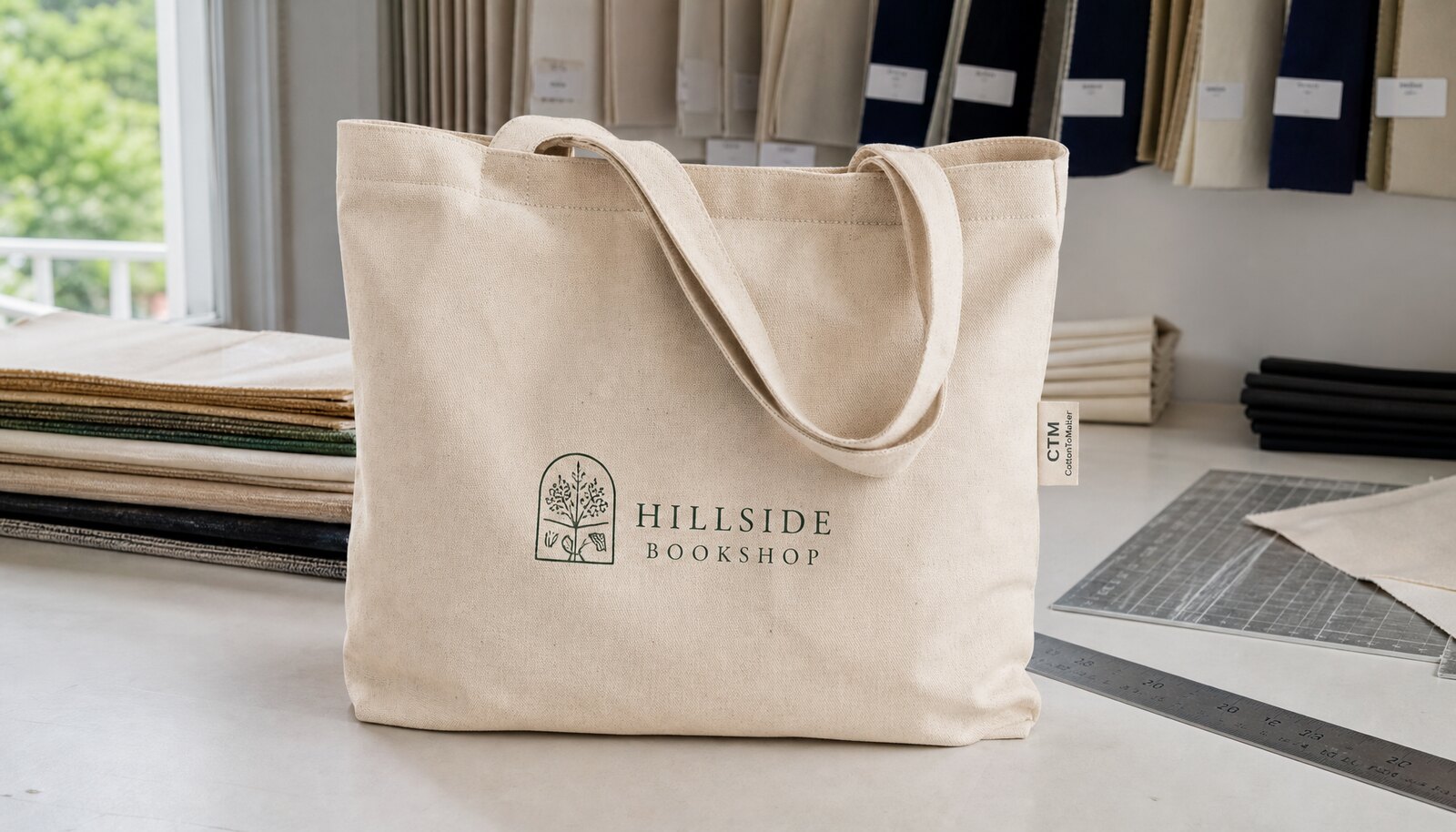
Define the reorder job before you price it
For bookstores, a canvas tote is not a one-time promo item. It is a repeat SKU that needs to match the last run closely enough that customers and staff do not notice drift. The real sourcing risk is usually not the first sample; it is the second or third PO when the fabric hand changes, the print shifts, or the cartons arrive packed differently than the first shipment.
Start with the commercial use case, not the artwork. A tote sold at the register, bundled with a book launch, or placed on a retail shelf needs a different cost and durability target than a free giveaway. A useful reorder memo should state the target sell-through window, the last approved sample, the replenishment trigger, and the channel that will receive the bags.
- Define whether the tote is a checkout add-on, event item, membership perk, or shelf SKU.
- Keep one master sample and one written spec in circulation at all times.
- Tie reorder timing to sell-through instead of waiting for a visible stockout.
- Match the pack format to the receiving route: store, DC, or direct-to-location.
Choose the bag build that can repeat
For most bookstores, 10 oz to 12 oz finished canvas is the practical middle ground. Eight-ounce canvas can work for low-cost giveaway bags, but it often feels too soft once printed and folded. Fourteen-ounce canvas looks more premium, but it increases freight, material cost, and stiffness, and that may not be the right trade if the tote is meant to feel casual and easy to carry.
Construction matters as much as fabric weight. A simple open-top tote with self-fabric handles, reinforced handle anchors, and a clean gusset is easier to reorder than a fashion-led build with lining, zippers, or contrast trim. When you add extra pieces, you add more chances for variation. Lock handle drop, gusset depth, seam allowance, and stitch style before you start comparing quotes.
- Use 10 oz to 12 oz as the default range unless the merch plan says otherwise.
- Keep handle drop consistent across all sizes in the line.
- Avoid decorative construction unless the tote has a premium shelf price to support it.
- State the finished size in inches or millimeters, not as an estimate like "book size".
Set the fabric and print spec in buyer language
Suppliers often quote canvas in oz, GSM, or both, and those numbers are not always comparable unless you know whether they refer to raw fabric or finished fabric. For a reorder, request the exact fabric basis weight, the weave count if available, and whether the number is before or after washing, coating, or printing. A buyer can only compare offers when the measurements sit on the same basis.
Bookstore artwork is usually simple, which is helpful. A one-color screen print remains the most repeatable choice for a reorder because the ink deposit is predictable and the setup cost can be spread over future POs. If the artwork includes fine serif type, small subtext, or a thin border, ask the supplier to show the minimum line thickness and minimum text height they can hold without fill-in.
- Ask for finished GSM, not only a fabric name like "heavy canvas".
- Limit the first run to one or two print colors if the bag is a replenishment item.
- Keep reverse-side printing out unless the sales plan proves it adds value.
- Use the same Pantone or ink reference across every reprint.
Compare sourcing routes before you compare price
A direct factory quote is usually the cleanest route when you expect repeat orders, but only if the factory actually controls cutting, sewing, printing, and packing. If the print is subcontracted, the low quote can become a weak quote the moment you need the same shade, the same registration, or the same carton count again. A trading company can be useful for coordination, but the buyer should pay for that service explicitly rather than assuming it is built into the price.
For urgent bookstore top-ups, a local decorator or domestic converter can make sense even when the unit cost is higher because it shortens the risk chain. The tradeoff is that the bag body and the print may come from different sources, which makes shade control and repeatability harder. Use the source route that fits the reorder rhythm, not just the cheapest first PO.
- Direct factory: best for stable repeat programs and lower setup repetition.
- Trading company: useful when you need multi-step coordination or factory consolidation.
- Local converter: useful for rush replacement or small emergency top-ups.
- Single-source builds reduce quote noise and make defect ownership clearer.
Build the quote so every supplier prices the same bag
A usable factory quote should separate bag body cost, print setup, print run cost, stitching extras, labels, packing, carton charge, and shipping basis. If a supplier gives one rounded number, you cannot tell whether the bag is cheap because the fabric is lighter, the print is smaller, or the pack-out is incomplete. The same is true of words like "standard canvas" or "high quality"; those phrases do not help a buyer compare offers.
For bookstores, the commercial question is often not the lowest unit price but the best cost to replenish without retooling the whole line. A quote that exposes setup costs will usually look worse on a small trial order and better on a repeat order. That is useful because it shows where the break-even point sits and whether the next reorder should move from a pilot to a standing program.
- Separate blank bag price from print and packing charges.
- Request the quote basis: EXW, FOB, or delivered.
- Ask for carton quantity, carton size, and gross weight.
- Require the supplier to state overrun or underrun tolerance.
Use samples to lock the next run
The first sample is not only a visual approval; it is the standard for the next production batch. For reorder planning, the factory should send a preproduction sample with the final fabric weight, final thread color, final print position, and final packing method. Photo approval alone is weak because it hides hand feel, stitch tension, and actual color under real light.
Once the sample is accepted, keep a sealed reference sample in the buyer file and in the factory file. If the next PO shows a color shift, print shift, or size drift, you need a hard reference to settle the dispute quickly. This matters even more for bookstores that restock the same tote season after season, where a small variation becomes obvious on the shelf.
- Approve one physical sample, not just a PDF mockup.
- Seal the master sample with the date, PO number, and SKU code.
- Review seam strength, handle attachment, and print cure before bulk release.
- Reject any sample that uses substitute fabric or a different print method.
Pack for retail receiving, not just factory shipping
Bookstore buyers usually inherit two downstream realities: receiving teams want clean cartons, and store staff do not want to sort mixed packs. A good packing spec says how many totes go into one polybag or inner bundle, how many units go into one master carton, and whether the cartons are all one SKU or mixed by color. If the item will be redistributed to stores, barcode and carton-mark accuracy matter as much as the bag itself.
The cheapest pack is not always the cheapest landed solution. Mixed assortments can save carton count, but they create labor at receiving and increase the chance of a wrong color moving to the wrong door. For a reorder, decide whether the tote is a DC item or a direct-to-store item, then pack accordingly. If the route is unclear, the quote will not be clear either.
- Use one SKU per carton whenever possible.
- Put SKU, color, quantity, and PO number on the outer carton.
- Decide whether individual polybags are needed for shelf presentation.
- Match carton dimensions to pallet or parcel limits before production starts.
Plan the lead time around the reorder calendar
A tote reorder rarely fails because the sewing took too long; it fails because the buyer started too late. Production time, sampling time, freight booking, customs clearance, and receiving all sit on the critical path. If the bookstore has a seasonal promotion, event series, or holiday launch, build a calendar backwards from the date the bags must be on shelf, not from the date the PO is issued.
The safer practice is to reorder before the line is visibly low. For moving retail accessories, a 60% to 70% sell-through trigger is often safer than waiting until stock looks scarce. That buffer covers the inevitable delays: a changed logo file, a carton-label revision, a fabric backorder, or a ship date that slips by a week.
- Back-plan from the in-store date, not from the PO date.
- Add time for sample signoff and artwork correction.
- Hold safety stock for events that cannot slip.
- Make partial-shipment rules explicit if the line is seasonal.
Set QC thresholds that catch repeat-order drift
Reorders fail when the second run looks close but not identical. The most common drift points are fabric shade, print placement, handle length, and stitch quality. Set an acceptance range before production starts, then inspect against the approved sample under daylight or a standardized light source. If you use an AQL process, state the defect classification in the PO so the factory knows what will be rejected.
The buyer should care less about abstract defect language and more about what the customer will see on the shelf or in the hand. A slightly off-center print may be acceptable on a backstage textile, but it is not ideal on a retail tote that hangs in a bookstore display. The QC standard should reflect what a customer notices from arm's length, because that is where the sale happens.
- Compare bulk goods to the sealed master sample.
- Check dimensions, handle drop, and print position on every lot.
- Open cartons across the shipment, not just the top row.
- Reject tacky ink, weak bar-tacks, and obvious shade mismatch.
Use landed cost to decide whether to stay or switch
The right reorder decision is based on landed cost, not factory cost. Freight, duties, carton volume, pallet efficiency, and receiving labor can erase a small unit saving. A supplier with a slightly higher ex-works price may still win if they pack more efficiently, reduce defects, and ship on time. For bookstore programs, that stability is often more valuable than squeezing the quote down by a small amount.
If your current supplier cannot repeat the same bag twice, the hidden cost is rework, markdown risk, and staff time spent sorting problems. At that point, the question is not whether the unit price is lower, but whether the supplier can support the next three reorder cycles without escalating friction. That is the real test for a retail tote program.
- Compare EXW, FOB, and delivered cost on the same carton count.
- Include receiving labor when packs are not store-ready.
- Track defect rate by supplier, not only by shipment.
- Switch suppliers when repeatability becomes more expensive than a higher quote.
Specification comparison for buyers
| Spec decision | Recommended option | When it fits | Buyer risk to check |
|---|---|---|---|
| Supplier route | Direct factory with in-house cutting, sewing, printing, and packing | Repeat programs with stable artwork and a clear spec sheet | Risk if printing is subcontracted and each quote covers a different service level |
| Backup sourcing route | Local decorator or domestic converter for rush top-ups | When the next shelf date is more important than unit cost | Risk of shade drift or a bag body that does not match the last import run |
| Fabric weight | 10 oz to 12 oz finished canvas, quoted on the same basis by all suppliers | Most bookstore retail totes that need a premium hand feel without high cost | Risk if suppliers quote yarn weight instead of finished fabric weight |
| Print method | 1-color or 2-color screen print with fixed artwork placement | Repeatable logos, simple artwork, and reorder-driven programs | Risk of ink cracking, poor registration, or hidden setup charges |
| MOQ strategy | One colorway per PO and one production standard | When the buyer wants cleaner inventory and fewer leftover cartons | Risk of split runs inflating setup cost and creating carton mix-ups |
| Sample path | Preproduction sample plus sealed master sample | New supplier, new artwork, or any spec change | Risk of approving from mockups or edited photos only |
| Packing route | Carton-pack by SKU with barcode labels and no mixed assortments | Multi-store replenishment and DC receiving | Risk of store-level sorting cost and mis-ships |
| Lead-time route | Plan a 15% to 20% calendar buffer before the in-store date | Seasonal launches and event-heavy bookstore calendars | Risk of missing floor resets because transit and revision time were ignored |
Buyer checklist before sampling
- Final size, gusset, handle drop, and artwork placement are frozen before RFQ.
- Canvas weight is stated as finished GSM or oz, not just "heavy canvas".
- Print color count, ink type, and print area are locked to one approved file.
- One physical master sample is signed and retained by both buyer and factory.
- Carton pack, barcode format, and outer label content match the receiving plan.
- Overrun or underrun tolerance is written into the PO and quote summary.
- The reorder trigger is tied to sell-through, not to a last-minute stockout.
- Shipping terms, delivery window, and any partial-shipment rule are confirmed.
Factory quote questions to send
- Is your canvas weight quoted as finished fabric, and what tolerance do you allow?
- What exact MOQ applies per size, per colorway, and per print design?
- Do you make the bag and print in-house, or is any step subcontracted?
- What is the setup charge per screen or per color, and is it recurring on reorders?
- What carton pack, carton size, and gross weight do you quote for this tote?
- Can you supply a preproduction sample and a sealed master sample before bulk?
- What is your lead time after sample approval, artwork signoff, and deposit?
- What overrun or underrun tolerance do you allow, and how do you handle shortages?
Quality-control points to confirm
- Finished canvas weight stays within about ±5% of the approved spec.
- Body dimensions stay within about ±0.5 in / ±10 mm of the approved sample.
- Handle drop and handle length stay consistent from the first to the last carton.
- Stitching is clean, with no skipped stitches, loose seams, or weak bar-tacks.
- Print registration is within about 2 mm, with no smudge, pinholes, or cracking on a light flex test.
- Fabric shade matches the sealed master sample and does not vary visibly panel to panel.
- Loose thread tails are trimmed; no visible fraying or exposed raw edges on customer-facing areas.
- Carton count is exact, with no mixed SKU cartons unless mixed packing was approved in writing.
- Carton labels, SKU codes, and PO numbers match the packing list and the master order file.
- Bags are dry, clean, and odor-free enough for immediate retail receiving.