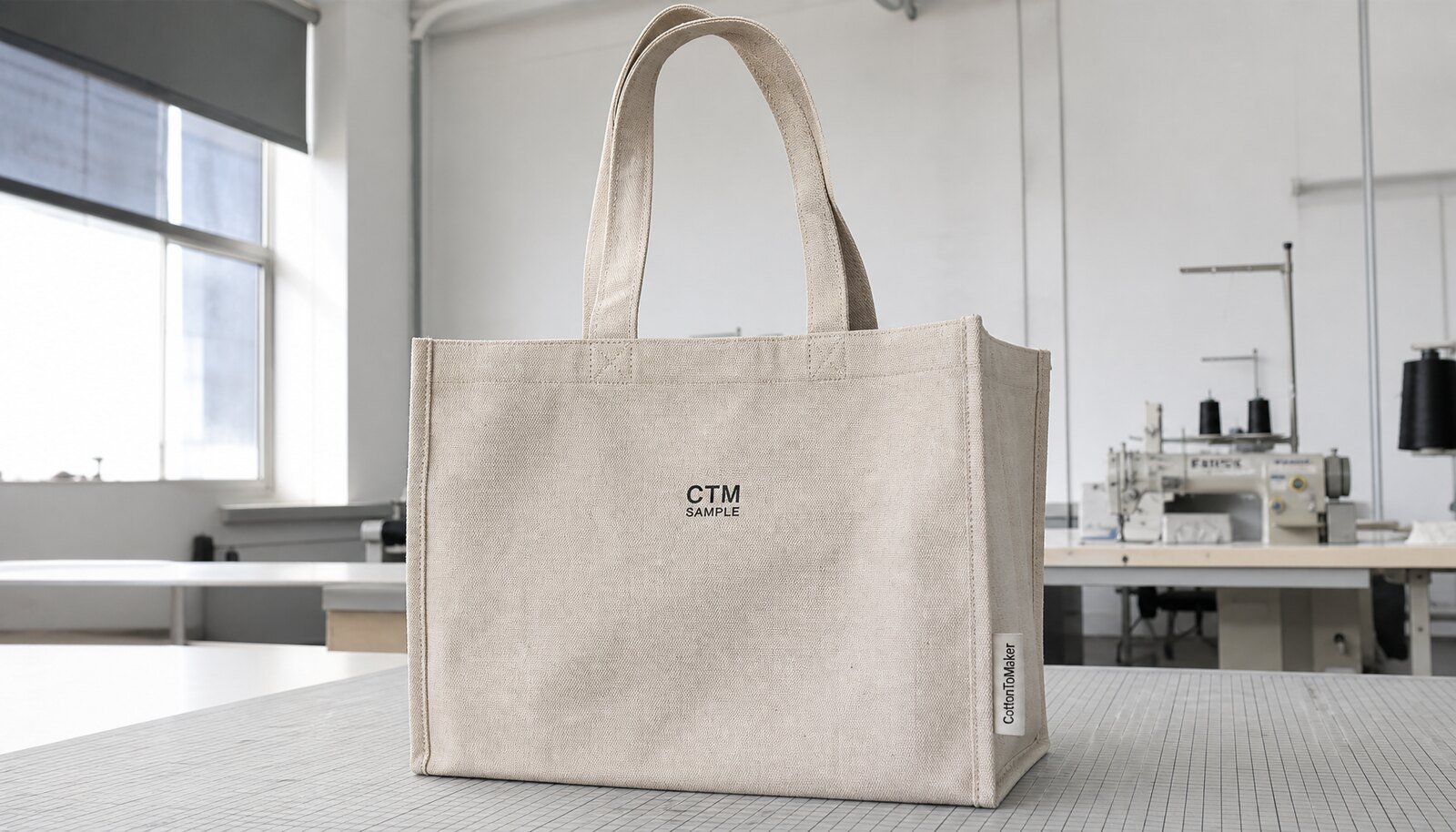
Start With the Use Case, Not the Bag
Apparel brands buy canvas totes for different jobs, and the job determines the spec. A tote used as a shopping bag in a retail store needs a different balance than a tote used as a gift-with-purchase insert, a launch giveaway, or a resale item in a collection. If you do not define the use case first, suppliers will quote a generic bag that looks fine on paper but misses the real requirement. The result is usually overpaying for features you do not need or ordering a bag that feels too flimsy for the merch strategy.
Before collecting quotes, define the job in one sentence: what goes inside, how far the bag will be carried, how visible the logo must be, and whether the tote is part of the product experience or only a transport item. That answer drives fabric weight, handle build, print method, packing, and even the quote basis. A buyer who can describe the use case clearly gets comparable quotes faster and avoids the common problem where every supplier is quoting a different interpretation of the same tote.
- Retail shopping tote: higher perceived quality, stronger handles, cleaner decoration.
- Gift-with-purchase tote: lower unit cost, easier packing, simple one-color print.
- Merch or event tote: faster production, limited colors, and a practical size that folds flat.
- Premium resale tote: heavier canvas, tighter construction, and packaging that looks deliberate.
Pick Fabric Weight and Structure That Match the Brand Use
For custom canvas tote bags for apparel brands, fabric weight is the first real cost and quality decision. As a practical starting point, 8 oz canvas is usually light-duty and works for giveaways or low-cost event bags. 10 oz canvas is the common middle ground for retail and merchandising programs because it balances body, hand feel, and price. 12 oz canvas gives the bag more structure and usually feels better in a fashion retail setting. 14 oz and above starts to behave like a premium carry product, but it increases cost, sewing difficulty, and fold bulk.
Do not treat weight as the only variable. Weave density, yarn quality, pre-wash treatment, and whether the canvas is plain, duck, or washed all affect how the bag looks and performs. A slightly lighter but denser canvas can outclass a heavier fabric that is loose and floppy. For apparel brands, the right answer is often a clean 10-12 oz canvas with reinforced handles, a neat top hem, and a stable bottom seam. That spec gives enough structure for retail without making the tote expensive to pack or store.
- 8 oz, roughly 270-300 gsm: suitable for promo use, not ideal for heavy daily carry.
- 10 oz, roughly 320-350 gsm: a solid default for standard apparel retail totes.
- 12 oz, roughly 380-420 gsm: better shape, better perceived value, more sewing load.
- 14 oz and above: premium feel, but check handle stress, fold volume, and cost impact.
- Double-layer handles and bar-tacks matter more than many buyers expect.
Choose Decoration That the Factory Can Hold Consistently
The safest wholesale decoration for canvas is usually screen print, especially when the logo is simple and the order needs repeatability. Screen print handles bold type, large solid areas, and one- or two-color branding well. It is usually the cleanest option for apparel brands that want the tote to feel like a real branded product rather than a promotional item. If the artwork has fine lines or small type, the factory needs a clear vector file and a realistic print size. Canvas texture affects edge sharpness, so the same artwork that looks perfect on a flat mockup can lose detail in production.
Heat transfer can be useful for lower quantities or complex graphics, but it can change the hand feel and may age worse than a direct print if the tote is used heavily. Embroidery works best as a small logo or patch, not as a large filled design, because heavy needle coverage can distort canvas and raise cost quickly. Woven labels, side labels, and small sewn patches are good brand signals when the front panel should stay clean. Whatever method you choose, define the print area in relation to seams, gussets, and handles so the factory is not guessing where the logo should land.
- Use screen print for clean logos, flat color blocks, and predictable repeat orders.
- Use transfer only when the artwork or MOQ makes direct printing impractical.
- Use embroidery or a patch for small premium marks, not large artwork fills.
- Send vector artwork, Pantone targets, and a minimum line thickness if the logo is detailed.
- Require the supplier to confirm the exact print position from seam edge and bottom hem.
Know Which Supplier Route Fits the Order
The cheapest-looking supplier is not always the best route. A direct factory is usually the best choice when you need stable quality, custom sizing, or a repeat program that will be reordered. A trading company can be useful if you need one point of contact for mixed products or do not yet have reliable factory access, but the quote can hide multiple margin layers. A local decorator or printer is fast for small domestic runs, but it usually loses on landed cost when you are buying at wholesale scale from a sourcing market.
MOQ is not arbitrary. It is usually driven by fabric sourcing, screen setup, sewing line allocation, color change, and packing labor. If a factory already stocks the right canvas, can use one print color, and can keep the tote in a standard size, MOQ can be lower. If you want custom dye, multiple print colors, lining, or special labels, the order gets heavier and the minimum rises. Buyers who understand the real MOQ drivers can negotiate intelligently instead of asking for a number that has no production logic.
- Direct factory: best for control, repeatability, and clean quote structure.
- Trading company: useful for mixed SKUs or when you need more sourcing support.
- Local printer: useful for short deadlines, but rarely best for imported wholesale volume.
- Lower MOQ usually means more setup cost per bag, not a free discount.
- Ask whether MOQ changes by color, decoration, label type, or packing format.
Write an RFQ That Produces Comparable Quotes
A tote RFQ fails when every supplier fills in the gaps differently. The buyer sends a logo and a target quantity, and one factory quotes a simple stock bag while another quotes a fully customized build with printed labels and retail packing. Those prices are not comparable. A proper RFQ should describe the finished size, fabric weight, handle length, closure style if any, print size and location, label details, packing format, destination, and the forecast quantity by color or style. If the buyer needs more than one size, separate the sizes into distinct line items so the supplier does not blend assumptions.
Also force the quote basis to be consistent. Ask every supplier to state the incoterm, currency, sample cost, setup charges, lead time after final sample approval, and overrun or underrun tolerance. If one quote includes cartons and another excludes them, the unit price is meaningless. The fastest way to compare suppliers is to remove ambiguity before price is discussed. A buyer who controls the spec sheet usually gets cleaner answers, fewer follow-up emails, and a much better negotiating position.
- Include finished dimensions, not only nominal size.
- State fabric weight, canvas color, and whether the material is stock or custom.
- Define decoration method, number of colors, and maximum print area.
- Specify packing format and carton count per master carton.
- Request a separate line for setup, sample, freight, and any accessory charges.
Approve Samples Against Functional Criteria, Not Just Appearance
A tote sample that looks acceptable on a table can still fail in bulk if the fabric or packing changes. The sample process should include a proto or development sample, then a pre-production sample made from the actual fabric, actual print method, final labels, and final packing. The pre-production sample is the one worth signing off. If the supplier sends a blank bag or a sample with substitute labels, the approval is weaker than it looks because the real production variables are still untested.
Use measurable acceptance criteria. Size tolerance, print alignment, stitch consistency, and handle placement should be written down before bulk begins. For an apparel tote, practical tolerances are usually tighter on visible panels than on hidden seams. Run a load test that matches the intended use, not a generic lab target. A promo tote that carries a folded tee does not need the same test as a retail bag carrying multiple garments or a denim purchase. The point is not to create a laboratory spec; it is to prevent a visually nice sample from becoming a weak production batch.
- Measure finished size, handle length, and gusset depth against the approved sample.
- Confirm print registration, logo placement, and color against the signed artwork target.
- Check for skipped stitches, loose thread ends, and uneven top hems.
- Verify that labels, hang tags, and care or country-of-origin marks are in the right position.
- Test the bag under realistic weight for the intended retail or promotional use.
Specify Packing for Retail, E-commerce, or Distribution
Packing is where many tote orders quietly lose money. If the buyer does not define how the bag should be folded, whether it goes into a polybag, where the barcode sits, and how many units go into each carton, the supplier will default to a convenient factory method. That method may be acceptable for export, but it may not be acceptable for retail receiving or e-commerce fulfillment. Creased fronts, mismatched carton counts, and dirty outer surfaces are usually packing problems, not sewing problems.
For apparel brands, packaging should match the channel. A retail tote may need a neat fold that preserves the front panel and makes shelf display easier. A gift-with-purchase tote may need a simple bulk pack to protect cost. A distribution-center shipment may need carton dimensions optimized for palletization, with strong outer cartons and clear marks. If the tote is part of the customer experience, then the packing spec is part of the product spec. It should be written with the same care as the logo placement.
- State the fold size so the bag opens cleanly and stores efficiently.
- Decide whether each tote gets a polybag, tissue, desiccant, or no inner pack.
- Add barcode, SKU, and carton marks before production, not after packing starts.
- Use master carton counts that fit your warehouse receiving process.
- If retail-facing, require clean outer cartons and no visible dirt or loose fibers.
Plan Lead Time Around the Real Bottlenecks
Lead time for custom canvas tote bags is usually driven by a few predictable bottlenecks: fabric availability, screen or plate preparation, sample approval, sewing capacity, and packing. If the factory already has the right canvas in stock and the artwork is simple, the order can move faster. If you need custom color, special labels, wash treatment, or multiple artwork versions, the schedule stretches quickly. The buyer who wants a reliable launch should ask the supplier to identify the longest step, not only the total production time. That tells you where the risk actually lives.
Most delays are preventable. Late artwork revisions can force a new screen. Color changes can require a new sample. Holiday shutdowns and peak export periods can push sewing queues back. Carton shortages and label shortages can also stall shipment even when the bags are finished. For that reason, the production schedule should include checkpoints: artwork sign-off, sample sign-off, material confirmation, packing sign-off, and inspection booking. A tote order is simple only when those checkpoints are already controlled.
- Lock artwork before screen making begins.
- Confirm fabric and label availability before the pre-production sample is approved.
- Book inspection and freight early if the delivery date is fixed.
- Ask the factory what inputs can delay packing, not just sewing.
- Build buffer time if the order lands near a holiday or peak export window.
Compare Landed Cost, Not Just Unit Price
A low quote can hide the true cost of the order. Screen charges, label charges, packing upgrades, carton marks, export documents, inland trucking, and freight all change the final landed number. If one supplier quotes a low unit price but excludes packing and another quotes a higher unit price with all retail preparation included, the second quote can actually be cheaper at the warehouse door. For apparel brands, the landed cost should include the cost of fixing mistakes too, because rework on a tote order often costs more than the margin saved on a cheap quote.
The best negotiation position is not to push for the lowest FOB at any cost. It is to compare all suppliers on the same basis and then decide where quality risk is acceptable. A slightly higher price is often justified if the supplier consistently holds print alignment, handles, and packing across repeats. That matters more when the tote is part of a brand launch, a seasonal drop, or a retail program where the bag is visible to the customer. Cheap units that arrive with defects are not cheap.
- Compare FOB with FOB, or EXW with EXW, never mixed bases.
- Add setup charges, sample fees, packing, labels, freight, and duty to the comparison.
- Watch for hidden adders on custom colors, extra print positions, or special cartons.
- Use the same quantity break when comparing suppliers.
- Treat a repeat order quote as a separate number if the first run has setup costs.
Avoid the Mistakes That Inflate the First Order
The most common first-order mistakes are simple. Buyers over-spec the bag, under-spec the artwork, or forget that packing is part of the product. A fashion brand may request a premium tote and then send a low-resolution logo that forces compromise in print quality. Another buyer may approve a nice sample and then fail to lock the same fabric, label, and fold method for bulk. A third buyer may compare suppliers on unit price only, then discover the cheapest quote excluded the accessories needed to make the tote sellable.
The fix is discipline at the spec stage. Use one approved reference sample, one approved artwork file, and one quote format. Keep the tote simple where the customer will not notice complexity, and spend money where the customer will notice it, such as fabric hand feel, print clarity, handle strength, and shelf presentation. That is the buying logic that keeps custom canvas tote bags useful, repeatable, and profitable for apparel brands.
- Do not approve a sample without the real print method and final packing.
- Do not let suppliers quote different incoterms or quantity breaks in the same comparison.
- Do not add decoration features that do not improve the customer experience.
- Do not ignore carton dimensions if the bags will be stored or palletized.
- Do not release bulk until the signed sample and the PO match line by line.
Specification comparison for buyers
| Spec decision | Recommended option | When it fits | Buyer risk to check |
|---|---|---|---|
| Sourcing route | Direct factory with cut-and-sew capability | Best for repeat apparel programs, custom sizes, and tighter control over print and packing | Confirm the factory really sews the bag in-house, not only trades it |
| Fabric weight | 10-12 oz cotton canvas | Works for most apparel brand retail totes, gift-with-purchase bags, and event carry bags | Check whether the quote is based on true finished GSM or a lighter greige fabric |
| Handle build | Double-layer handles with bar-tack reinforcement | Needed when the bag will carry folded apparel, catalogs, or heavier retail purchases | Ask for handle width, stitch count, and pull-test evidence |
| Decoration method | One- to two-color screen print | Best for logo-led branding, clean merchandising, and predictable wholesale pricing | Watch for setup charges, color limits, and print registration on textured canvas |
| Logo placement | Front panel plus small side or woven label | Useful when the bag must stay clean-looking and the artwork should not fight the garment packaging | Make sure seams, gussets, and handle placement do not cut into the print area |
| Sample stage | Pre-production sample with final fabric and packing | Needed when the bag must match a retail launch or seasonal drop | Do not approve a blank or proto sample without the real print and labels |
| Order structure | Two to three quantity breaks with a clear MOQ | Helpful when buyers need planning flexibility across colorways or store chains | Check whether each color, print, or size has its own MOQ and surcharge |
| Quote basis | FOB quote with separate packaging and freight lines | Best when your team controls shipping and wants comparable supplier pricing | Avoid mixed quotes that hide inland cost, carton charges, or export documents |
Buyer checklist before sampling
- Define the bag's end use: retail purchase, gift-with-purchase, event tote, or shipping insert.
- Lock the finished size, gusset depth, handle length, and whether the tote needs structure or a soft fold.
- Specify fabric weight in oz and GSM, plus color and any washing or shrinkage expectations.
- Choose the decoration method, artwork placement, logo colors, and the maximum print area.
- Send the logo in vector format and include Pantone references or an approved color target.
- State the MOQ by color, size, and artwork version, not just one blanket number.
- Ask for a pre-production sample made with final fabric, final labels, and final packing.
- Write the packing spec: folding method, polybag, barcode label, carton count, and carton marks.
- Request a quote on the same incoterm and currency from every supplier.
- Set the inspection standard, acceptable tolerance, and delivery window before releasing the PO.
Factory quote questions to send
- What fabric weight, weave, and finish will you use, and is it stock material or custom woven?
- What is the MOQ for each size, color, and print version, and how does pricing change at higher quantities?
- Which decoration method do you recommend for this artwork, and what are the limits on line thickness and color count?
- Please separate the quote into unit price, setup charges, sample fee, packing, and export-related costs.
- Can you quote the same order on FOB and EXW so we can compare landed cost correctly?
- What sample stage will you provide before bulk, and what is the sample lead time?
- What tolerance do you allow on size, print placement, stitch quality, and overrun or underrun?
- How will the bags be folded, packed, labeled, and carton-marked for retail or warehouse receiving?
Quality-control points to confirm
- Finished dimensions stay within the agreed tolerance for body width, height, and gusset depth.
- Fabric weight, weave density, and hand feel match the approved sample or signed swatch.
- Handles are centered, even in length, and secured with clean bar-tacks or equivalent reinforcement.
- Stitching is straight, with no skipped stitches, broken thread, loose ends, or seam puckering.
- Print color, registration, coverage, and placement match the approved artwork reference.
- No oil stains, dirt marks, odor, loose fibers, or visible fabric defects on outer panels.
- Packing, folding, polybagging, labels, and carton counts match the purchase order.
- The bag passes a realistic load test for its intended use without handle failure or seam damage.