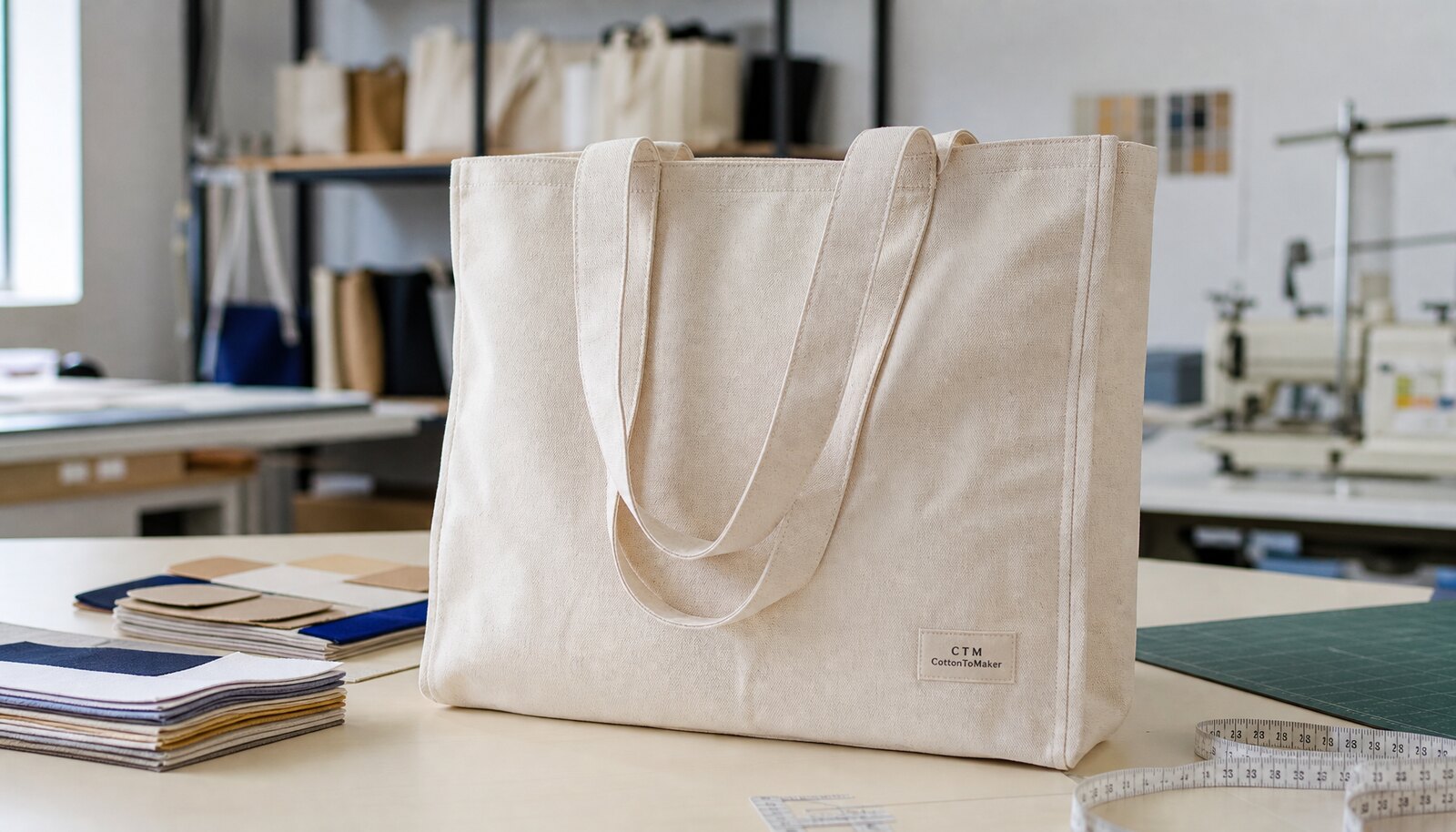
Why apparel brands lose money on canvas tote sourcing
For apparel brands, canvas totes are rarely a standalone product. They are usually a retail add-on, a gift-with-purchase item, a packaging alternative, or a small-margin branded SKU that must fit the rest of the collection. That is why the material choice matters more than the artwork. A tote that looks fine in a sample room can still create problems in bulk if the fabric is too thin, too rough for print, or inconsistent between rolls.
The most common sourcing mistake is buying by price only. A low quote often hides a lighter fabric, lower stitch density, cheaper handle tape, or a print method that only works on a perfect sample. If your tote will sit next to apparel in a store, go through warehouse handling, or ship by sea, the material needs enough body to hold shape and enough surface consistency to accept the brand mark cleanly.
- Use the tote’s real job to define the fabric, not the other way around.
- A retail tote needs more visual control than a giveaway tote.
- Bulk consistency matters more than a single good sample.
Start with the right canvas weight and fabric hand feel
For most apparel brand programs, the practical starting point is 12 oz canvas, roughly 340-380 GSM. That weight usually gives enough stiffness for a clean retail look without making the bag overly heavy or expensive to ship. If the tote is meant to hold folded garments, catalog inserts, or a light daily load, this range is often the best balance between appearance, durability, and landed cost.
If you go below that range, the tote may feel soft, collapse at the bottom, or show print distortion after use. If you go much heavier, you may gain structure but lose margin quickly because fabric cost, sewing time, and freight all climb. The right answer also depends on the weave: a well-controlled plain weave can look better at 12 oz than a rougher 14 oz fabric with visible slubs and uneven yarns.
- 10-11 oz / 280-320 GSM: lighter feel, lower cost, but less structure.
- 12 oz / 340-380 GSM: common retail sweet spot for apparel brands.
- 14 oz+ / 400 GSM and above: better structure, higher cost, more freight.
Match fabric weight to the tote’s actual retail role
A tote used as purchase packaging has different requirements from a tote sold as a separate accessory. Packaging totes can be lighter if the buyer only needs visual branding and one-time or occasional reuse. Retail-sold totes need more abrasion resistance, a cleaner fold, and better seam appearance because the customer inspects them more closely.
If the tote is going into an apparel launch box, consider how it will sit beside folded garments. A stiff, dark canvas can look premium, but it may also pick up lint and show creases in shipping. Natural canvas is easier to match across seasons, while dyed canvas needs tighter shade control if you plan a repeat order. The best sourcing brief separates the product’s visual job from its logistics job.
- Packaging tote: optimize for print surface and cost.
- Retail tote: optimize for shape retention and finishing.
- Launch campaign tote: optimize for first impression and packing efficiency.
Choose the supplier route that matches your order pattern
The right sourcing route depends on whether you are buying one SKU repeatedly or testing several branded versions. Direct factories usually offer better control on fabric weight, stitch details, and print execution when your spec is clear. They are also easier to manage if you need the same tote repeated every season with only minor artwork changes.
Trading companies can be helpful when your team needs mixed products, faster coordination across categories, or lower internal workload. But they can also blur the real factory spec, which makes it harder to compare like-for-like quotes. For canvas totes, the big risk is not the advertised price; it is the hidden difference in fabric source, process control, and packing detail behind that price.
- Direct factory: best for repeatable private label tote programs.
- Trading route: useful for mixed baskets, but compare the same fabric and print specs.
- Always compare quote inclusions line by line, not just unit price.
How to compare supplier quotes without getting fooled by a low unit price
When you request quotes, ask each supplier to break the price into fabric, handle, sewing, print, packing, and any setup or sampling charges. A quote that looks 8% lower may simply exclude carton labeling, polybagging, or a better handle tape. For apparel brands, that creates problems later because the real landed cost is higher than planned and the packing standard may not match your warehouse needs.
Use the comparison table as a sourcing filter. A fair quote should show the same GSM, the same print method, the same handle construction, and the same packing assumption. If one supplier quotes 12 oz canvas and another quietly uses a lighter material, the numbers are not comparable. The goal is to force every supplier onto the same spec sheet before you negotiate.
- Ask for quote basis by component, not only unit price.
- Make sure all suppliers quote the same GSM and same size.
- Include packing and carton terms in the comparison.
Print method choice affects both appearance and failure rate
Screen print is usually the most economical option for simple logos, solid blocks, and one- to three-color branding. It performs well on canvas if the fabric is stable and the print area is not too fine. For apparel brands, this is often the best method when you want a clean brand mark without a high per-piece cost. But if the art has fine lines, gradients, or many colors, the risk of blur or poor registration goes up quickly.
Heat transfer and digital methods can be useful for short runs, seasonal graphics, or detailed imagery. They are easier to change between drops, but you should test how they hold up on coarse canvas and whether they crack after folding. A tote used in a retail environment gets handled more than a garment hangtag, so the print must survive abrasion, not just look good on day one.
- Screen print: best for durable, simple branding at scale.
- Heat transfer: useful for short runs and design changes.
- Digital print: good for complex art, but test wash and rub performance if relevant.
MOQ logic: how to keep the order flexible without fragmenting cost
MOQ on canvas totes is usually driven by fabric roll usage, print setup, and sewing line efficiency. If you split an order across multiple colors, handles, or logos, the MOQ per variant can rise fast because each change adds downtime and material handling. For most apparel brands, the smarter strategy is to keep one core body spec and vary only the print or label if you need multiple SKUs.
If your launch is still being tested, it is often better to place one controlled order with a single canvas color and one print version than to spread the same budget across too many versions. That approach reduces approval risk and gives you a clean read on real sell-through. Once the tote proves itself, you can expand into alternate colors, larger sizes, or upgraded handles with real sales data behind the decision.
- One body spec + one print version is usually the most efficient first order.
- Every extra color or material change can increase MOQ pressure.
- Use repeat orders to expand the range after the first sell-through result.
Sample approval should test construction, not just appearance
A good tote sample is more than a visual proof. It should tell you whether the bag holds shape, whether the handles sit correctly, and whether the print survives a close look under natural light. In sample approval, the biggest mistake is approving based on front-face appearance alone. A tote can look perfect from one angle and still fail on seam alignment, handle symmetry, or panel puckering.
Your sample check should include real handling. Load the tote with a plausible retail weight, check the handle comfort, and inspect the bottom seam after the bag is filled. If the supplier proposes a woven label or side label with the CTM / CottonToMaker mark, make sure its placement does not interfere with fold lines, shipping pack size, or print area. Small details like label stiffness can affect how the tote folds in bulk cartons.
- Measure finished dimensions after pressing, not only before packing.
- Check handle symmetry, seam straightness, and bottom shape under load.
- Inspect print clarity in daylight and under warehouse lighting.
Packing and carton rules that protect margin in transit
Packing is often treated as a minor line item, but for canvas totes it affects freight efficiency, folding quality, and warehouse receiving speed. Flat-packed totes are usually the default for bulk imports because they save carton volume. Still, the fold position matters: a poor fold can leave permanent creases across the logo or distort the bag body before it reaches the store. If the tote is premium, you may need a cleaner fold direction or a single polybag to preserve appearance.
Carton dimensions should be part of the quote. A slightly larger carton may seem harmless, but it can reduce pallet efficiency and raise freight cost. If your buyer team is comparing landed cost, ask the supplier to show cartons per cubic meter or estimate how many pieces fit in a standard export carton without crushing the canvas. For apparel brands with warehouse receiving rules, carton labeling and quantity accuracy are just as important as the tote itself.
- Flat pack by default unless brand presentation requires a special fold.
- Include carton size, piece count, and outer marking in the PO.
- Protect printed surfaces from abrasion during transit.
Lead time risk comes from artwork, not sewing alone
Most buyers think the sewing line determines lead time, but artwork approval and packing details often cause the delays. A supplier can cut fabric quickly, yet still wait for final print files, corrected color references, or revised packing instructions. If the tote is tied to a retail launch, add time for sample approval, print strike-off review, and carton artwork verification before bulk starts.
A realistic sourcing plan usually includes three timing blocks: sample development, bulk production, and shipping. If the supplier says the bulk lead time is short, ask what happens after sample approval and whether fabric is already in stock. Apparel brands should also think about seasonal risk: if the tote supports a garment launch, any slippage can affect the entire campaign, not just the accessory line.
- Sample delays often come from print file correction or material substitution.
- Bulk starts should not begin until sample and packing are approved.
- Seasonal launches need schedule buffer for shipping and customs.
Specification comparison for buyers
| Spec decision | Recommended option | When it fits | Buyer risk to check |
|---|---|---|---|
| Canvas weight | 12 oz / 340-380 GSM for most apparel retail programs | Fashion retail, brand merch, and everyday carry bags that need structure without feeling heavy | Too-light fabric can warp after print and feel cheap; too-heavy fabric raises freight and sewing cost |
| Base fabric construction | Plain canvas with even weave and controlled slub | Brands wanting a clean, consistent print surface and predictable bulk production | Very rough or irregular weave can distort logos, especially large screen prints |
| Handle material | Same canvas as body or slightly lighter cotton webbing | Mid-range retail totes where the handle must look integrated and match the brand aesthetic | Handle tape quality affects pull strength; thin tape can twist, fray, or fail at the bar-tack |
| Print method | Screen print for solid logos; heat transfer or digital for short runs and multi-color art | Simple branding, campaign drops, or seasonal SKUs with controlled artwork | Large filled areas may crack on weak ink systems; fine details can blur on coarse canvas |
| Closure choice | Open top for low-cost retail use; zipper or snap only if the buyer needs security | Apparel packaging, store purchases, and giveaway programs with a clear use case | Extra hardware adds cost, sewing time, and more sample approval points |
| Supplier route | Direct factory for steady repeats; trading company only when you need mixed items or low admin load | Private label buyers with clear specs and repeat orders benefit most from direct sourcing | Trading quotes may look easier to buy but hide fabric substitution or extra handling cost |
| MOQ strategy | Use one core color/fabric spec and vary print or label details | Brands testing a tote in stores or e-commerce without committing to many colors | Splitting into too many fabric colors, handles, and print versions pushes MOQ per variant up |
| Packing method | Flat-packed with size-counted cartons and moisture protection if shipping by sea | Bulk importers, distributors, and warehouse-fed retail supply | Overstuffed cartons increase dents, fold marks, and carton burst risk during transit |
| Quality target | Defined stitch density, load test, and print coverage standard in the PO | Any apparel brand that wants repeatable supplier performance instead of sample-only quality | If acceptance criteria are vague, the supplier may meet only visual approval and miss durability |
Buyer checklist before sampling
- Finalize canvas GSM, fabric hand feel, and whether you want a stiff or soft tote before asking for quotes.
- Specify tote dimensions, handle length, handle width, and any gusset or bottom board requirement.
- Define the print method, logo size, color count, and whether print placement must match brand packaging or garment labeling.
- Set a minimum sample standard for stitching, edge finishing, seam alignment, and print sharpness.
- State packing rules: individual polybag or bulk pack, carton count, master carton mark, and moisture protection.
- Request supplier evidence for material consistency, production capacity, and prior tote experience with similar fabric weight.
Factory quote questions to send
- What canvas GSM do you recommend for this size and use case, and what is the weight tolerance per roll or batch?
- Is the quoted price based on full body canvas, handle material, thread, print, and packing, or are any items extra?
- What print method is included, how many colors are covered, and what is the setup fee if artwork changes?
- What is the MOQ per color and per print version, and can one order mix sizes or handle types?
- What is the sample lead time, bulk lead time, and what causes delay if the artwork or packing spec changes after approval?
- What carton size, carton quantity, and packing ratio do you propose for sea freight efficiency and warehouse handling?
- What QC standard do you use for seam strength, measurement tolerance, and print defect acceptance?
- Can you show recent photos or records of similar canvas tote production in the same GSM range?
Quality-control points to confirm
- Fabric GSM must match the approved range with tolerance stated in the PO.
- Tote dimensions should be measured after production pressing and before packing.
- Handle stitching must show reinforcement at stress points with no skipped stitches.
- Print must be centered within the agreed placement zone and free of major color shift.
- No visible oil stains, frayed edges, broken threads, or seam puckering on front panels.
- Cartons must match the agreed pack count and label information exactly.