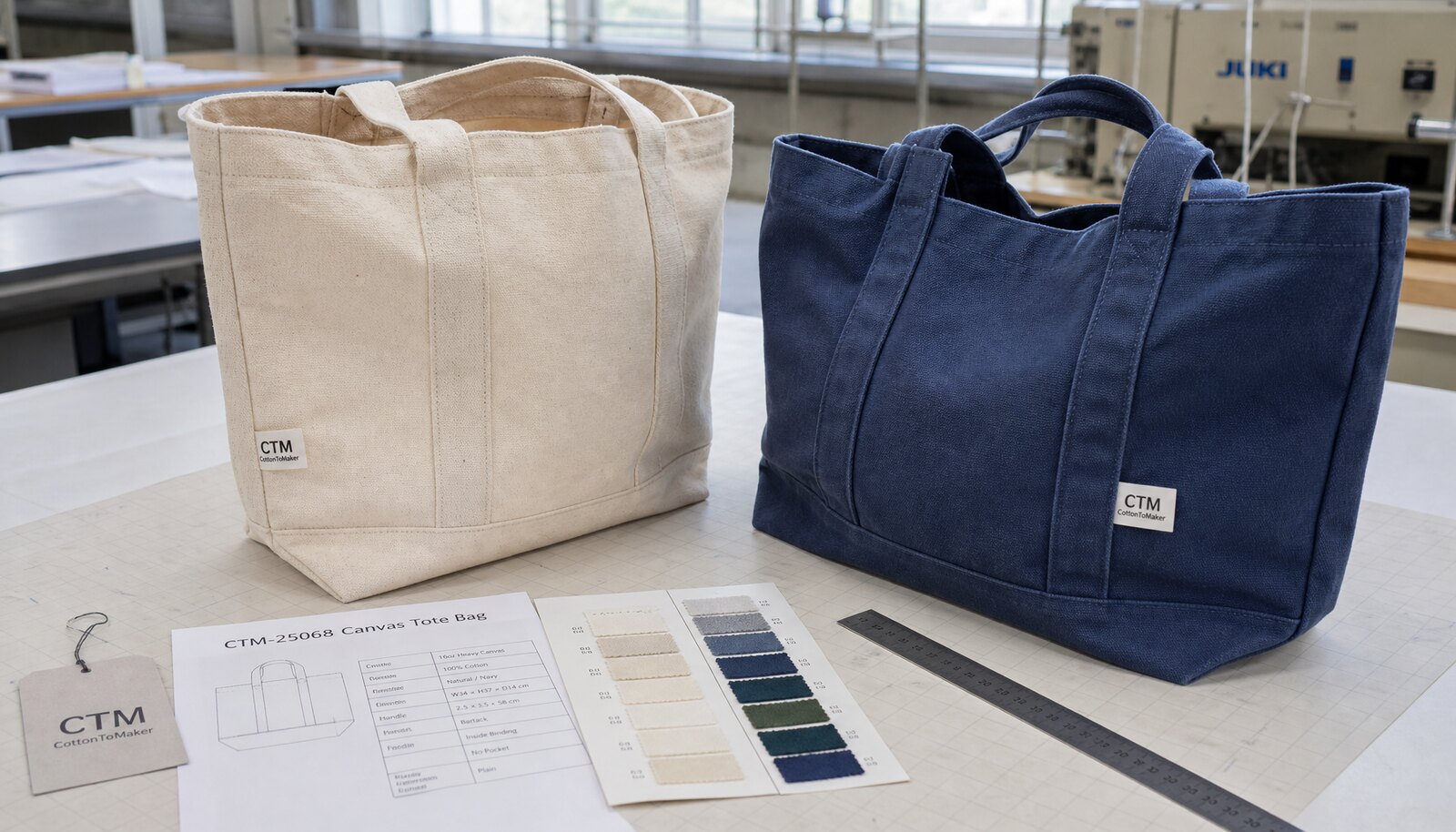
Start With the Retail Use Case, Not the Tote
The fastest way to overbuy or under-spec custom canvas tote bags is to start with the tote itself instead of the job it needs to do. An ecommerce buyer should first define how the bag will be used: product insert packaging, premium gifting, paid retail, bundle add-on, trade show giveaway, or warehouse-complete order insert. Those use cases drive the real spec more than any generic tote description.
A tote that looks fine in a supplier catalog can fail once it moves through fulfillment, customer hands, and repeated reuse. A paid retail tote needs better fabric recovery, cleaner stitching, and more reliable print durability than a short-life promo bag. If the bag is being packed next to cosmetics, food, or apparel, the print and fabric finish also need to be evaluated for transfer, odor, and dust risk. Buyers who define the use case early usually get better quotes because the supplier can match the construction and packing method instead of guessing.
For custom canvas tote bags for ecommerce brands, the commercial question is not whether the bag is attractive in a sample photo. It is whether the bag fits the channel, survives the handling path, and reorders without spec drift.
- Define the channel first: retail, promotional, bundle, or fulfillment insert.
- State the expected load, handling pattern, and product category that will ride inside the tote.
- Document whether appearance, durability, or landed cost is the primary decision driver.
Compare Supplier Routes Before You Compare Unit Price
A quote that looks low can be a poor sourcing decision if the supplier route is wrong for the program. Direct factories usually give the cleanest control over fabric, sewing, and print because the buyer is closer to the line. Trading companies can simplify communication and bundle related items, but the underlying manufacturing source may be less visible, which makes defect investigation slower when something goes wrong. Stockholders and importers are useful when speed matters more than customization, but they often limit your control over exact weight, handle construction, and logo placement.
The right route depends on reorder expectations. If the tote will be a continuing product, control and repeatability matter more than shaving a small amount off the first order. If it is a short campaign tied to a launch window, stock availability and turnaround may matter more than full customization. If you plan to compare two or three suppliers, compare them on the same order profile: same fabric weight, same dimensions, same decoration method, same packing, and same carton target. Otherwise the quote comparison is not useful.
Ask the supplier to state who owns each process step. Buyers lose time when sewing, printing, and packing are split across separate subcontractors and no one takes responsibility for the finished lot.
- Direct factory: best for repeat orders, spec control, and production transparency.
- Trading company: useful for one-stop buying, but verify the actual manufacturing site.
- Stockholder or importer: best for speed, weakest for exact customization.
Lock the Fabric and Construction Spec First
Canvas weight is one of the few choices that buyers can feel immediately and measure later. For ecommerce programs, 12 oz to 14 oz is often the practical middle ground because it tends to photograph well, hold shape better, and feel more substantial in hand than a thin utility tote. Lighter canvas can be acceptable for low-cost bundles or event use, but it usually shows wrinkling, softer shape, and less visual presence after printing. Heavier canvas can improve perceived value, though it also raises sewing load, material cost, and shipping weight.
Do not stop at the weight number. Ask the factory whether the fabric is raw, bleached, dyed, pre-washed, coated, or pre-shrunk, because those finishing choices change drape and color consistency. Then pin down the build details that affect durability: top hem style, seam allowance, thread color, handle width, handle drop, bottom reinforcement, and whether the bag has a lining or inner binding. These are the details that determine whether the tote survives a fulfilled order or becomes a customer complaint.
The right way to write the spec is to treat it as a measurable product sheet, not a marketing description. The supplier should be able to repeat it on reorder without asking the buyer to reinterpret what “premium canvas” was supposed to mean.
- State fabric weight in both oz and GSM where possible.
- Specify finish state: raw, bleached, dyed, washed, coated, or pre-shrunk.
- Write the construction details in measurable terms: seam allowance, stitch density, reinforcement, and handle geometry.
Choose the Decoration Method for Failure Modes, Not Just Appearance
For custom canvas tote bags for ecommerce brands, decoration choice affects complaint rate as much as it affects appearance. Screen print is still the default for many branded totes because it is predictable, scalable, and usually the easiest to inspect for alignment and coverage. It is often the best option for a logo that uses one to three solid colors and needs to stay consistent across reorders. The key control points are ink deposit, cure, edge sharpness, and registration.
Heat transfer can be appropriate when the artwork changes often, when there are many colors, or when the first order is small. The tradeoff is that transfers are more sensitive to heat, pressure, fold lines, and edge lift. Embroidery can add a premium feel but introduces thread density, pull, and backing issues that need their own approval process. Woven labels or sewn patches can be a smart option for subtle branding, but the buyer should still confirm placement, edge finish, and how the attachment behaves after packing and unboxing.
A useful sourcing habit is to ask the supplier to state the pass criteria for the decoration method in writing. If they cannot explain what they check for after curing, pressing, or stitching, they are likely relying on visual judgment alone, which is not enough for a branded ecommerce program.
- Screen print: strongest default for repeatable brand logos and stable production.
- Heat transfer: useful for short runs or complex art, but test edge lift and cracking risk.
- Embroidery or sewn labels: premium look, but check thread pull, backing, and attachment strength.
Build a Quote That Can Actually Be Compared
Many tote quotes are impossible to compare because each supplier has quietly chosen a different spec. One may use a lighter fabric, another may exclude polybags, and a third may include a lower-cost print method that will not meet your durability target. The fix is to force the same commercial frame across all suppliers. Keep the dimensions, fabric weight, artwork size, handle construction, packing method, and carton loading identical. Then ask for a line-by-line quote rather than a single lump sum.
A serious quote should separate recurring cost from setup cost. Setup items can include screen making, embroidery programming, print calibration, label development, and artwork review. Recurring items include bag sewing, decoration, packing, and carton labeling. When those are blended into one number, buyers lose leverage on reorders because they do not know which part of the price is tied to the first run and which part should fall away later. That matters if you expect the tote to become a standard SKU.
Also ask what is not included. Shipping, testing, third-party inspection, warehouse labeling, and rework can move the landed cost more than the unit price itself. A quote that spells out exclusions is usually more trustworthy than a quote that looks cheap because it hides the inconvenient parts.
- Use the same spec sheet across all suppliers before asking for price.
- Separate setup charges from recurring production cost.
- Require a written list of exclusions so the landed cost is visible early.
Treat Sampling as a Functional Test, Not a Photo Shoot
A sample is not approved because it looks close enough in a picture. It is approved because the supplier has shown that the finished bag can be repeated. The buyer should inspect the sample in hand, under load, and in the same fold pattern that will be used for packing. Check whether the bag sits flat, whether the handles pull evenly, and whether the seams distort when the tote is filled with a realistic weight. That is the difference between a merchandising sample and a production reference.
Keep one golden sample and mark it clearly with the version number, approval date, fabric weight, print method, and any exceptions that were accepted. If the supplier sends a revised sample, compare it directly against the golden sample with a ruler, not against memory. This avoids one of the most common sourcing disputes: the production lot matches the last sample the factory sent, but not the one the buyer approved. For ecommerce buyers, that is a preventable process failure, not bad luck.
If the tote includes any special detail such as an inside pocket, lining, snap, coated surface, or custom label, test it during sampling. Those details often fail later than the bag body, which means they can slip through a casual sample review and only become obvious once production is already underway.
- Load-test the sample using the weight the bag is expected to carry in real use.
- Measure the finished tote after full construction, not before finishing.
- Retain a golden sample with clear version control for future reorders and dispute resolution.
Set Inspection Thresholds Before Production Starts
The most useful quality inspection checklist is the one that defines pass and fail before the factory begins bulk production. For canvas totes, the biggest practical failures are usually not catastrophic; they are the defects that make the bag look cheap, function poorly, or receive inbound rejection at the warehouse. That includes seam opening, thread breakage, misaligned print, size drift, loose trim, dirty marks, and carton count errors. If the buyer only says “good quality,” the factory will fill in the blanks with its own standard, which may not match the brand standard.
A workable QC plan should separate critical, major, and minor defects. Critical defects are the ones that make the tote unusable or noncompliant, such as open seams, broken handles, or wrong artwork. Major defects are visible problems that would likely trigger customer complaints or a refusal at receiving, such as obvious print misplacement or large size deviations. Minor defects are cosmetic issues that do not affect use, but still need a tolerance threshold so the supplier knows what is acceptable. The point is not to make the spec impossible; it is to make it unambiguous.
For a branded ecommerce program, ask the factory what they measure on the line and what they measure again before packing. If their internal inspection only checks appearance, you need a stronger pre-shipment inspection on your side or through a third party.
- Define critical, major, and minor defects in writing.
- Set measurement tolerances for width, height, gusset, handle drop, and artwork position.
- Require the factory to document its in-process checks, not only the final packing check.
Make Packing and Cartonization Part of the Product Spec
Packing is not a secondary detail for ecommerce tote bags; it is part of the product experience and part of the warehouse receiving process. Decide whether the tote will ship flat, folded, stuffed, belly-banded, or individually polybagged. Then confirm how the fold affects the print surface. A print that looks fine on the table can pick up crease marks, scuffing, or dust transfer when the bag is packed tightly for export. For lighter-color canvas or large ink coverage, that risk deserves explicit review.
If the bags go to a fulfillment center or 3PL, carton marks and label placement matter as much as the bag itself. The receiving team may reject cartons with mismatched counts, missing barcodes, poor lot traceability, or unclear size labels. Buyers should ask for carton dimensions, carton weight, pack quantity, and master carton markings before production starts. Those details determine receiving speed, stackability, and freight efficiency.
If you want retail-ready packing, ask for sample carton photos or a packing mockup. The objective is to verify that the bag can survive storage and transport without looking wrinkled, dirty, or mispacked when it reaches the warehouse or customer.
- Choose a fold method that does not damage the print or finish.
- Specify barcode, size label, and carton mark placement before mass packing starts.
- Confirm carton counts and dimensions for warehouse receiving and freight planning.
Control Lead Time by Separating the Real Schedule Drivers
Lead time slips on tote programs usually happen for a few predictable reasons: late artwork, sample revisions, fabric sourcing, print setup, or packing changes. The problem is that suppliers often quote a single lead time number without telling the buyer where the clock actually starts. A buyer who thinks the timer starts at deposit receipt may be surprised to learn that the factory only begins after artwork approval, sample signoff, and receipt of the packing spec. That gap creates avoidable schedule pressure.
The better approach is to split the schedule into stages. Track the time for sample production, sample review, bulk production, internal QC, packing, and booking or transit handoff. If the tote uses custom dyed canvas, special finishing, or retail-ready packing, give those steps separate deadlines because they often consume more time than the sewing itself. For seasonal campaigns, build a buffer for one revision cycle rather than assuming the first sample will pass.
When reordering, ask the supplier which part of the lead time is fixed and which part varies based on order size or decoration complexity. That question surfaces whether the quoted schedule is realistic or just optimistic.
- Ask when the lead-time clock starts and what approvals must happen first.
- Split sample time, production time, QC time, and shipping handoff into separate milestones.
- Treat artwork changes as schedule resets unless the factory confirms they are non-impacting.
Use Landed Cost, Not Factory Price, for the Final Decision
The cheapest tote at the factory gate can become the most expensive tote in the order file once packing, freight, inspection, and rework are added. That is why procurement buyers should compare landed cost instead of unit price alone. A slightly higher-cost tote may still win if it ships more efficiently, arrives with fewer defects, and reduces the chance of customer complaints or warehouse delays. In practice, the real commercial decision is usually about total cost of ownership, not just the invoice line.
A useful landed-cost comparison should include the manufacturing price, setup charges, packing, internal QC, third-party inspection if used, freight volume, and the risk cost of defects or late delivery. If two quotes are close but one supplier is more transparent about fabric weight, printing, and cartonization, that transparency itself has value because it reduces the chance of spec drift on reorder. For ecommerce brands, consistency is often worth more than a small initial savings.
Before approving the order, review the full package together: specification sheet, sample, quote, inspection plan, packing plan, and delivery timeline. If all six agree, the order is usually ready. If one of them is still vague, the risk is not fully controlled.
- Compare landed cost, not just factory price.
- Include setup, inspection, packing, freight, and defect risk in the decision.
- Approve only when the spec, sample, quote, QC plan, and timeline all match.
Specification comparison for buyers
| Supplier type | Typical cost profile | Control and defect risk | Best use case | What to confirm in writing |
|---|---|---|---|---|
| Direct factory | Usually the lowest unit cost once MOQ is met, but setup charges still matter | Best control over fabric, sewing, and print; lower risk of spec drift if the factory owns the process | Repeat branded programs, private label launches, and buyers who need stable reorders | Legal factory name, production site, who actually sews and prints, sample approval owner, and inspection scope |
| Trading company | Often mid-range or slightly higher because a middle layer is included | Convenient communication, but defect root cause can be harder to trace if work is subcontracted | Multi-item sourcing, mixed product bundles, or teams that need one buying contact | Actual manufacturing site, subcontractor list if used, who signs off on the final spec, and how defects are handled |
| Local stockholder or importer | Highest unit price in exchange for speed and low setup friction | Lower customization control; quality depends on the original blank and storage condition | Urgent replenishment, fast campaign launches, and short-lived seasonal runs | Exact stock code, fabric weight, lot traceability, carton condition, and return or replacement policy |
| Domestic printer or contract decorator | Labor cost can be higher, but transit and communication may be simpler | Good for artwork-heavy runs, but blank bag quality and print durability must be checked separately | Regional fulfillment, short lead-time programs, and buyers who need closer oversight | Blank source, print method, cure standard, wash or rub test basis, and who owns the blank inventory |
| Material | 8-12 oz cotton canvas, 120-220 gsm cotton, recycled cotton, or blended fabric selected by use case and target price | Before price comparison | Different cloth weights, backing, or certification claims make quotes hard to compare | |
| Construction | bag size, gusset, handle drop, seam allowance, stitch density, reinforcement patch, and loading expectation | Before sampling | Weak stress points create returns and failed inspections | |
| Decoration | screen print, heat transfer, embroidery, woven label, or hangtag matched to fabric texture and brand durability needs | Before artwork approval | The wrong method can crack, bleed, pucker, or fail on the chosen fabric | |
| MOQ | Base MOQ plus change drivers | During quote review | Custom colors, trims, and packing can change minimums |
Buyer checklist before sampling
- Final artwork in vector format, with approved print size, placement, color count, and a written Pantone or reference color target.
- Confirmed fabric weight in oz and GSM, plus whether the canvas is raw, bleached, dyed, washed, coated, or pre-shrunk.
- Approved tote dimensions, handle length, handle width, handle drop, gusset depth, and any pocket or lining requirement.
- Written construction spec covering seam allowance, stitch density, thread color, handle reinforcement, and top-hem finish.
- Named print method, number of setup screens or plates, and the expected rub, wash, or adhesion standard for the decoration.
- Approved packaging spec for fold method, polybag requirement, barcode label location, carton count, and master carton marks.
- A golden sample retained by both buyer and supplier, labeled with version number, approval date, and spec revision.
- A line-by-line quote showing unit cost, decoration setup, packing cost, testing cost, inspection cost, and any excluded item.
- Lead time broken into sample making, sample revision, production, internal QC, and outbound booking or freight handoff.
- A written defect policy that defines critical, major, and minor issues, plus the actions for rework, replacement, or credit.
Factory quote questions to send
- What is the exact fabric weight in oz and GSM, and is that measurement based on finished fabric or greige fabric before washing or finishing?
- Who makes the bag, who applies the print, and can you confirm whether any part of the order is subcontracted?
- What is included in the unit price: bag sewing, print, label, hangtag, polybag, barcode sticker, carton, and internal QC?
- How many setup charges apply for this artwork, including screen making, color separation, embroidery programming, or print calibration?
- What are the MOQ values separately for fabric, decoration method, label type, and packing style if those differ?
- Can you provide close-up sample photos of the handle reinforcement, top hem, side seam, and bottom seam before bulk approval?
- What are the actual measurement tolerances for height, width, gusset depth, handle drop, and logo placement?
- What test standard do you use for stitch strength, rub fastness, seam slippage, or color transfer if the tote is printed or dyed?
- How do you package the goods for outbound shipment, and what carton quantity and carton weight should we expect at full order volume?
- What is the realistic production timeline after sample approval, and what usually causes delay on this type of tote order?
Quality-control points to confirm
- Fabric weight should match the approved range with no obvious thin spots, uneven weave, weak selvedge, or inconsistent dye shade across visible panels.
- The bag should maintain a clean shape when filled with a realistic test load, without excessive sagging, twisting, or loss of side-wall structure.
- Handle reinforcement should be symmetrical on both sides, with no skipped stitches, loose ends, pulled threads, or tunnel distortion where the handle joins the body.
- Stitch density should be consistent across samples and production pieces, and seam allowance should stay within the written tolerance band.
- Seams should lie flat with no open stitches, seam slippage, puckering, or visible hole growth at corners, gusset turns, and load points.
- Printed artwork should match the approved position, scale, orientation, and color target, with no major misregistration, bleeding, or ghosting.
- Ink or transfer should pass the agreed rub check, with no flaking, tackiness, or visible color transfer onto adjacent packaging materials.
- Finished dimensions should remain within tolerance for width, height, gusset depth, handle length, and handle drop, especially when the tote must fit retail inserts or warehouse bins.
- Labels, care tags, and barcodes should be legible, correctly positioned, and attached in the agreed orientation without covering the brand artwork.
- Carton counts should match the packing list exactly, with the right assortment, the correct master carton marks, and no mixed lot contamination.