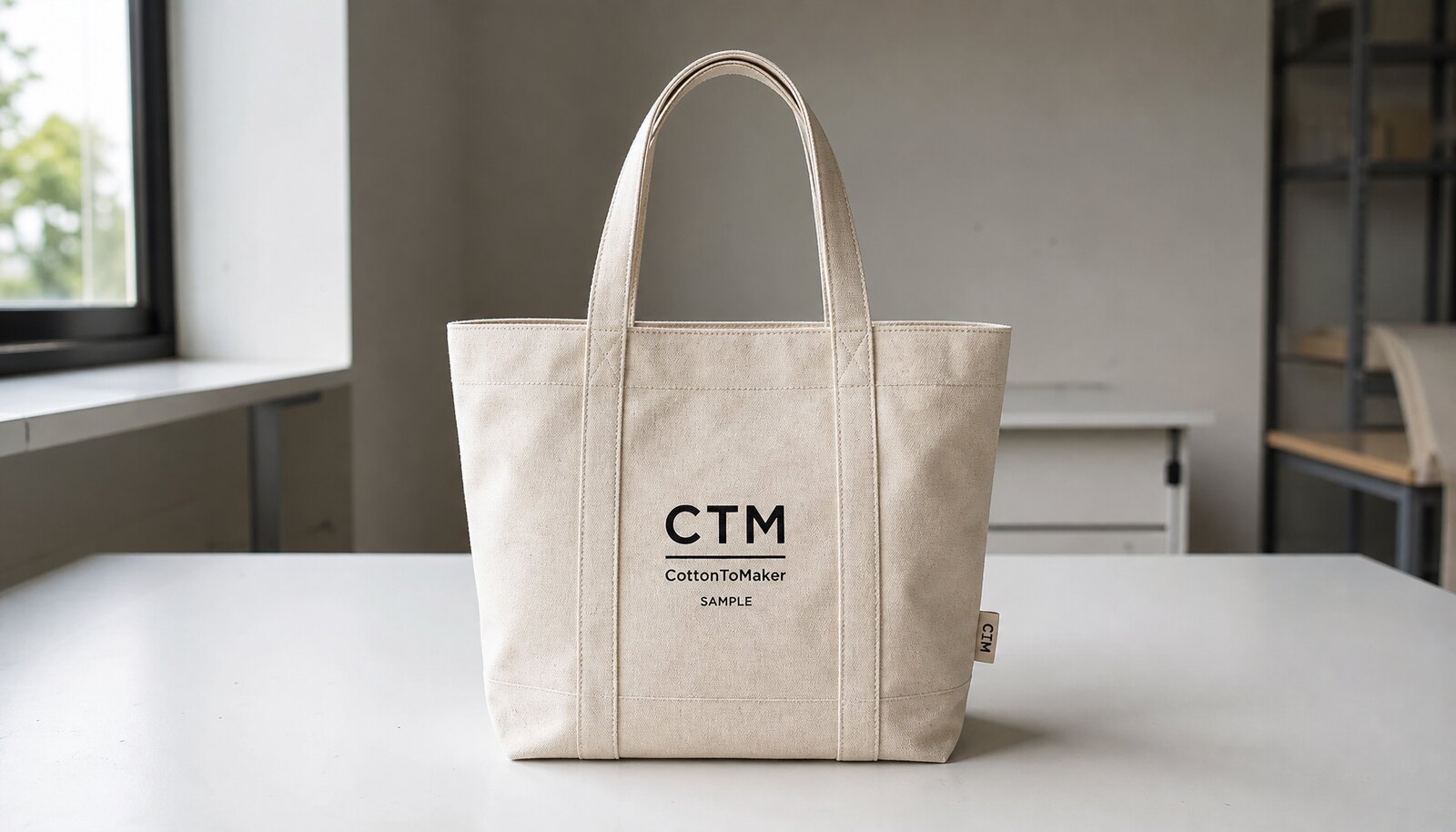
Start With the Event Job, Not the Bag
The biggest mistake in event tote sourcing is starting with a generic bag spec and trying to force it into a campaign later. A corporate event giveaway has a real job: hold printed materials, carry a few bought-in items, look consistent in photos, and survive being taken home and reused. If you do not define that job first, the quote will drift between low-cost promo quality and overbuilt retail quality without giving you a useful comparison.
For custom canvas tote bags for corporate events event giveaway planning, the right starting point is a use case sheet. Write down what goes inside the bag, how long the bag should last, whether the bag needs to stand upright, and whether the brand wants a polished premium feel or a practical utility feel. That single page will do more to align factory quotes than a long email about design taste.
- List the event contents by size and weight, not by marketing category.
- State whether the bag is expected to be reused after the event or only carried once.
- Include the audience: executives, trade show visitors, staff, or retail customers.
- Define what failure looks like: broken handles, poor print, thin fabric, or wrinkled packing.
Choose Fabric Weight for the Actual Load
Canvas weight should be selected around the event load and the brand position. For a light literature bag, 8 oz canvas can be enough if the bag is not carrying heavy items. For most corporate events, 10 oz to 12 oz feels safer because it holds shape better, photographs better, and reduces complaint risk from weak handles or see-through fabric. Heavier fabric also helps if the tote may be reused after the event, which is often the real reason buyers choose canvas instead of a lighter nonwoven option.
Do not rely on the supplier's shorthand alone. Ask whether the quoted weight is raw fabric weight, finished fabric weight, or a marketing description. A factory can quote the same bag as 10 oz, 12 oz, or 340 gsm depending on how they describe the cloth. For procurement, gsm is easier to compare than ounces because it anchors the quote to a measurable fabric standard. If a supplier will not state the fabric weight clearly, the quote is not yet usable.
- 8 oz: acceptable for light handouts and lower-cost giveaways.
- 10 oz to 12 oz: the most practical range for standard corporate events.
- 14 oz and above: more premium, better structure, but higher material and freight cost.
- Ask for a swatch or finished sample from the same fabric lot when possible.
Size, Gusset, and Handle Length Drive Usability
A tote that looks correct on a spec sheet can still fail on the event floor if the internal volume is wrong. Standard flyer sizes, notebooks, water bottles, and sample kits all behave differently in the bag. A flat tote without a gusset may look clean, but if the event kit includes a box, a bottle, or a folder stack, the bag can bulge awkwardly or tear at the seams. In corporate events, that is a usability problem and a brand problem at the same time.
Handle length deserves the same attention. Short handles can make the bag feel cheap and awkward on the shoulder, while overly long handles can drag or tangle in a crowded venue. The right length depends on whether the bag is hand-carried, shoulder-carried, or packed into a larger mailer. Give the factory an intended carry method, not just a dimension. That allows the sample to be judged against actual behavior rather than a flat drawing.
- Use gusset depth to control volume, not just height and width.
- Ask for finished dimensions, not cut size only.
- Check whether the handle seam sits inside or outside the finished body, because that changes the carry feel.
- If the bag must fit into cartons with inserts, confirm packed thickness as well as flat dimensions.
Print Method Should Match the Artwork and Run Size
For most corporate event orders, screen printing is the most predictable choice because it handles bold logos, simple messages, and larger volumes with stable cost. It is usually the right answer when the artwork uses one or two colors and the brand wants clean edges on a natural canvas background. If the design includes a small full-color image, gradients, or a detailed sponsor layout, then heat transfer or digital transfer may be more practical, but the buyer should expect a different feel on the fabric and a different durability profile.
The mistake is choosing print method by artwork file alone instead of by the use case. A tote that will be handed out to thousands of attendees and carried once can tolerate a lighter print solution than a retail tote meant for repeated use. A bag that will be photographed in press backdrops may need thicker ink coverage and stricter placement control. You should ask the factory to quote the same design in the preferred method and the fallback method so the commercial tradeoff is visible before you commit.
- Screen print is usually strongest for one-color or two-color logos.
- Transfer methods can help with complex art but may change hand feel and durability.
- Ask for exact print size in millimeters and placement from the top edge and side seam.
- If the logo depends on a fine line or small text, request a print strike-off before bulk approval.
Read the Quote as a Cost Breakdown, Not a Single Price
A usable factory quote for tote bags should separate the real cost drivers. Material, sewing labor, print setup, packing, carton labeling, and sample cost should be visible. If the supplier only gives one unit price, you cannot tell whether the quote is driven by fabric quality, artwork complexity, or packing assumptions. That creates problems when the order later needs a carton change, a barcode sticker, or a different print size.
For event planning, tiered pricing matters more than the lowest headline number. Many buyers need to compare a 1,000-unit run against a 3,000-unit run and a 5,000-unit run because event attendance forecasts change. A good quote should show how the unit price moves with volume, what triggers setup fees, and whether there is a surcharge for multiple delivery addresses. That tells you where the real leverage is in the order and whether consolidation is worth it.
- Request price breaks at at least three quantity tiers.
- Separate sample fee, tooling fee, print setup, and bulk unit price.
- Ask whether pricing changes if packing becomes individual polybag instead of bulk carton.
- Check if the quote includes export cartons and outer marks or treats them as extras.
MOQ Logic Matters More Than the Number Alone
Minimum order quantity is often treated as a fixed factory rule, but for tote bags it usually reflects production efficiency. The MOQ can be driven by fabric roll usage, print setup, color change, sewing line efficiency, or carton packing. If a supplier quotes a high MOQ for multiple colors, it may be because each color needs separate fabric cutting or separate print screens. If you understand the reason, you can negotiate a better order structure rather than just asking for a lower number.
For corporate event planning, the right question is whether the MOQ matches the event calendar. A high MOQ can still work if the bag will support several events or internal programs across the year. A low MOQ can be expensive if it forces the factory into a lot of setup labor. The buyer should compare MOQ against total planned demand, not just the first event. That is especially true for brands and distributors who may reorder the same tote after the event response is known.
- Ask what part of the MOQ is tied to fabric cutting, printing, or packing.
- Check whether one artwork can be used across multiple delivery dates.
- If the order includes multiple SKUs, confirm whether each SKU has a separate MOQ or a pooled MOQ.
- Use forecasted reorders to justify a slightly higher first run if it improves per-unit economics.
Sampling Should Prove the Weak Points, Not Just the Look
A sample is only useful if it tests the failure points. A visually good sample can still be wrong in handle length, seam balance, fabric feel, or print thickness. For custom canvas tote bags for corporate events event giveaway planning, the sample should be reviewed with the actual insert set or a close physical substitute. Put brochures, bottle, notebooks, and the planned giveaway item inside the sample to see how the bag behaves when full. That catches gusset problems, handle stress, and opening width issues before the order is committed.
The approval chain should include a pre-production sample and, when the order is large enough, a production reference sample kept by the buyer. The pre-production sample validates the spec. The production reference sample is the standard for inspection. If the factory changes fabric shade, handle width, print position, or thread color without notice, the buyer needs a physical reference to compare against. Photo approval alone is too weak when the event date is fixed and the shipment window is narrow.
- Measure the sample against the final spec with a ruler, not by eye.
- Test load with the actual intended contents or a matching weight.
- Inspect the inside seams, handle reinforcement, and print alignment under good light.
- Keep one approved sample at the factory and one with the buying team.
Packing and Cartons Can Change the Landed Cost
Packing is often treated as an afterthought, but it affects freight, labor, and damage risk. Bulk packing in a master carton is usually the most efficient choice for event giveaways, especially if the bags will be counted and inserted at the venue or by a local fulfillment partner. Individual polybag packing adds protection and keeps bags cleaner, but it raises labor and material cost and creates more volume to ship. That tradeoff matters when the order moves by air or when warehouse space is limited.
The buyer should also think about carton loading and distribution. If the bags will be shipped to multiple event sites, the carton count and carton weight need to be practical for manual handling. Ask the factory to state carton dimensions, gross weight, and pack count so your logistics team can estimate pallet fit and final freight charges. A quote that looks good per unit but produces oversized cartons can become more expensive on a landed basis than a slightly higher ex-factory price with better packing density.
- Use bulk packing when the venue or fulfillment partner can handle insertion.
- Use individual polybags only when cleanliness, retail presentation, or storage requires it.
- Confirm if barcode labels, inner tissue, or inserts are included in the packing charge.
- Check carton strength if the bags will be stacked in transit or stored for several weeks.
Supplier Evidence Should Be Concrete, Not Promotional
When comparing factories, prioritize evidence that relates to your exact bag type. A supplier can look credible on a website and still be weak on cotton bag production. Ask for pictures of current production, not only polished catalog images. Ask whether they produce canvas tote bags in-house, what machines they use for sewing and printing, and whether they handle export packing themselves. This is not about collecting marketing claims. It is about knowing where the risk sits if there is a delay or quality issue.
The strongest supplier evidence is practical: a sample room with the same fabric weight you want, a process flow that matches your order, and a documented inspection step before shipment. If the vendor cannot explain how they control color consistency, seam strength, and packing accuracy, the buyer will carry that burden later. For importers and distributors, the cost of weak supplier evidence is not just defects. It is also the extra time spent resolving rework, missing cartons, and inconsistent replenishment on the next order.
- Ask for photos or video of recent tote production, not only finished lifestyle shots.
- Confirm whether cutting, sewing, printing, and packing happen in one facility or across multiple sites.
- Request a summary of inspection points before goods leave the factory.
- Compare responsiveness: a factory that answers technical questions clearly is usually easier to manage during production.
Use a Buyer Checklist Before You Send the RFQ
An RFQ for event totes should not be a blank request for a price. It should read like a compact production brief. That brief should lock the dimensions, fabric weight, print area, handle type, packing method, target quantity, and delivery timing. If one or two of those items are still open, say so clearly and ask the supplier to quote both options. That gives you a controlled comparison instead of a stack of inconsistent offers.
Before sending the RFQ, align procurement, marketing, and the event owner on what is non-negotiable. If the logo position matters more than the handle style, say that. If freight speed matters more than color accuracy, say that too. The more precise the priority order, the fewer surprises when the supplier proposes a tradeoff. A tote bag is simple to buy only when the buyer has already done the work of defining what simplicity means in the final use case.
- Confirm the final artwork file format and color references.
- Lock the physical dimensions and acceptable tolerance.
- State whether the order is single-drop or split across locations.
- Define the event deadline and the latest acceptable ship date.
Specification comparison for buyers
| Spec decision | Recommended option | When it fits | Buyer risk to check |
|---|---|---|---|
| Sourcing route | Direct factory with in-house sewing and printing | Best for controlled branding, repeat orders, and event timelines that cannot absorb handoffs | Confirm whether the same factory handles cutting, print, stitching, and packing or only assembles from subcontracted parts |
| Fabric weight | 10 oz to 12 oz canvas for most corporate giveaways | Works for a bag that should feel substantial without becoming expensive or too heavy to ship | Check actual gsm, not just ounces, and make sure the supplier is quoting finished fabric after shrinkage |
| Bag size | Approx. 15 x 16 in with 4 to 6 in gusset | Good for brochures, notebooks, water bottles, and standard event kits | Verify usable internal volume after seams and base construction; some bags measure large flat but carry poorly |
| Print method | Screen print for one to two colors; heat transfer only for short-run complexity | Fits bold logos, simple event graphics, and large quantity runs | Watch for ink cracking, weak wash fastness, or poor registration on textured canvas |
| MOQ strategy | Tiered MOQ by color and print complexity | Useful when one event needs multiple audiences or when the brand wants a test run | Make sure MOQ applies to the full order, not separately to each size, print color, or handle style |
| Handle construction | Self-fabric handles with box-X reinforcement | Best for catalog inserts, samples, and event attendee use with moderate weight | Check handle length, stitch density, and seam pull strength; thin handles fail first |
| Packing format | Bulk packed with carton marks; individual polybag only when needed | Best when buyers want lower freight and faster unpacking at the venue | Confirm whether polybags are counted in the quote and whether they add labor, plastic compliance, or disposal issues |
| Approval route | Pre-production sample plus production reference sample | Necessary when color accuracy, print placement, and seam finish must match a brand standard | Do not approve from photos alone; require physical or couriered samples for final sign-off |
Buyer checklist before sampling
- Define the event load: brochures only, mixed kit, or product samples, because that drives fabric weight and gusset depth.
- Specify the exact artwork count, print colors, and print placement with a measured template.
- Set the target fabric weight in gsm and ask the factory to confirm whether that is raw fabric or finished bag weight.
- Decide whether you need reinforced handles, base board, inner pocket, zipper, or open-top only.
- Request quotes at more than one quantity break so you can compare MOQ logic, not just unit price.
- Ask for sample timing, pre-production approval timing, and bulk production lead time in writing.
- Confirm carton size, carton quantity, and packing method to estimate freight and warehouse handling.
- Define acceptance criteria for color variance, stitch quality, print clarity, and dimensional tolerance before production starts.
Factory quote questions to send
- What is the finished bag size, fabric gsm, and construction method you are quoting?
- Is the quoted price for direct factory production or through a trading company, and what work is subcontracted?
- What print method is included, how many colors, and what setup or plate charges apply?
- What are the MOQ and price breaks at each quantity tier, and do they change by color or artwork?
- What is the sample fee, sample lead time, and will the sample fee be deducted from the bulk order?
- What packing method is included, and are polybags, inserts, or barcode labels extra?
- What is the bulk production lead time after sample approval, and what part of the lead time is fixed versus estimated?
- What is your carton spec, gross weight estimate, and carton mark format for export shipping?
- What inspection standard do you use before shipment, and can you share defect tolerance limits for stitching and print?
Quality-control points to confirm
- Finished dimensions should stay within the agreed tolerance for height, width, and gusset, with enough usable volume for the event kit.
- Handle stitching should use reinforced bar tack or box-X construction and show no loose threads at stress points.
- Print registration should stay centered within the approved template, with no blur, pinholes, or obvious color drop-off.
- Ink adhesion should survive a basic rub test and, if the bag is meant for re-use, a light wash or damp-cloth test.
- Canvas should be free of obvious weaving defects, oil marks, and heavy shade variation within the same order.
- Seams should be straight and secure, with no skipped stitches, broken stitch lines, or exposed raw edges unless specified.
- Cartons should match the agreed pack count, label format, and pallet/load plan, with no mixed sizes unless approved.
- Production samples should match the approved pre-production sample for color, print position, and trim details.