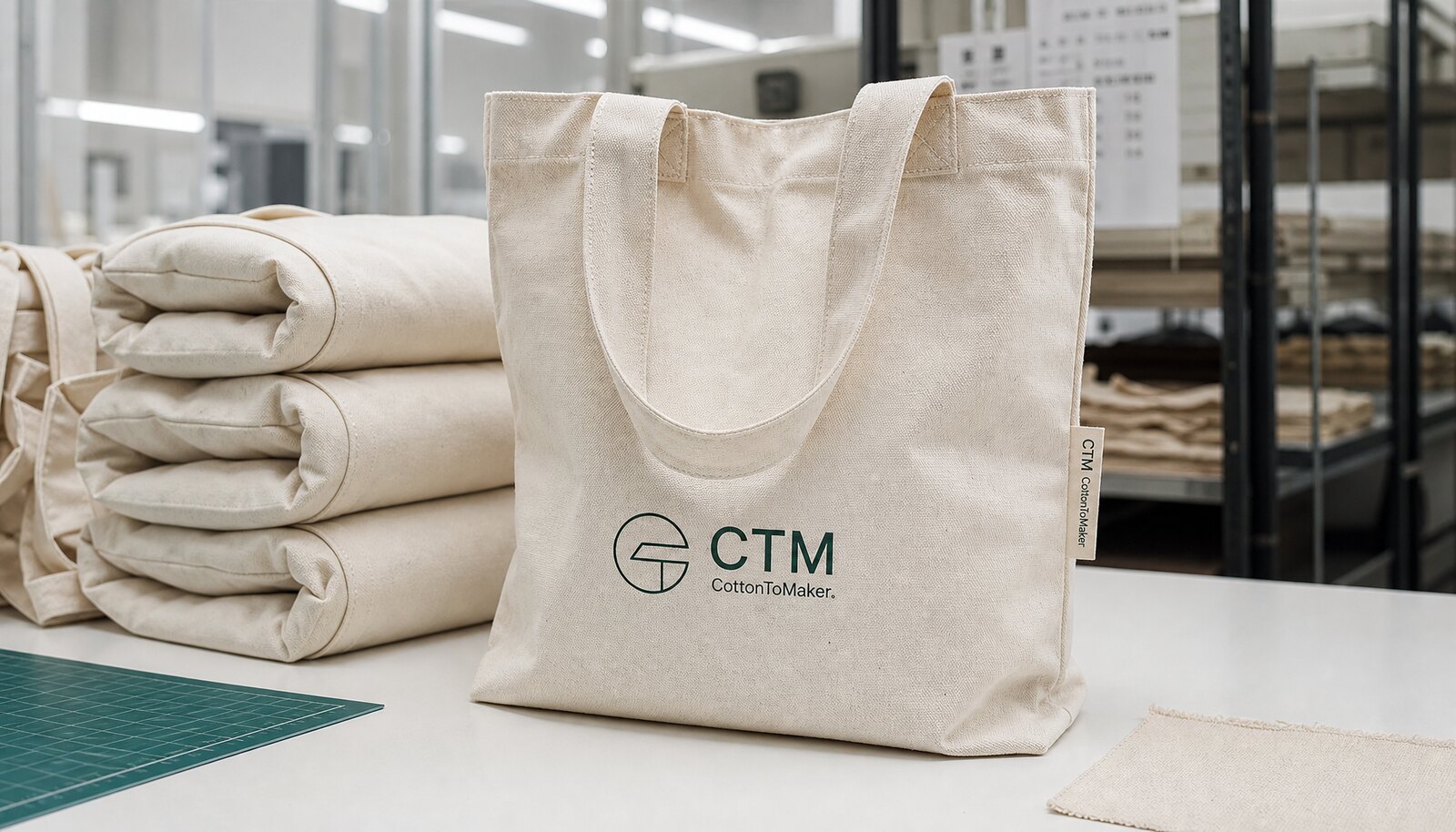
Start with a quote brief the factory can actually price
When buyers request a custom canvas tote bags bulk quote, the most common error is to lead with artwork and leave the product definition open. A tote cannot be priced accurately until the supplier knows the finished size, fabric weight, handle build, print method, packing format, and delivery term. If those inputs are vague, each factory will quote a different assumption and the numbers will not compare cleanly.
Treat the RFQ like a production brief. Include the finished dimensions, target GSM or oz weight, fabric composition claim, color, handle length and width, reinforcement method, decoration placement, packing requirement, and destination. If you need a woven label, side tab, or hangtag, state that in the initial quote request rather than after sample approval.
Use a spec sheet with enough detail to prevent quote drift
A useful tote spec sheet should let a factory price the same article every time. The easiest way to reduce confusion is to separate required specs from optional upgrades. That gives buyers a clean base quote and a fair way to compare add-ons such as bottom board inserts, lining, zipper closures, or reinforced gussets.
Add the commercial fields too. Ask suppliers to quote the same Incoterm, freight basis, payment term, currency, and quote validity period. A low unit price can disappear fast if one supplier includes inland freight or duty exposure and another does not. Quote comparison only works when the commercial assumptions are aligned.
- Use one tech pack or RFQ sheet for every supplier
- Keep artwork, packing, and size tolerances identical across quotes
- Separate base spec from optional upgrades so add-on pricing stays visible
Choose fabric weight based on use, not just target cost
Canvas tote pricing moves quickly with fabric weight. A lighter 8 oz canvas, roughly 260-280 gsm, can work for promotions or events, but it may feel too soft for heavy retail use or oversized graphics. A 10 oz canvas, around 320-340 gsm, is often the most balanced starting point for branded shopping bags. A 12 oz canvas, around 380-420 gsm, gives a firmer hand and better perceived value, but it also raises material cost and can increase folding bulk.
Do not compare suppliers on price alone if they are quoting different weights. Ask them to restate the fabric weight in both oz and gsm if possible, and confirm whether the quote includes pre-shrunk fabric, enzyme wash, or any finishing that changes feel and shrink behavior. If the bag must keep a clean retail shape, include a tolerance on shrinkage or finished size after pressing.
- 8 oz: lower cost, lighter carry, best for giveaways
- 10 oz: balanced option for most retail and shopping programs
- 12 oz: better structure, higher cost, better for heavier contents
Lock the print method before you compare decoration pricing
Artwork can change the quote as much as the fabric. Screen printing is often the most efficient choice for simple logos and repeatable artwork because the setup cost is fixed and the unit price can scale well at volume. If the design has several colors, fine detail, or frequent version changes, the supplier should explain how many screens, passes, or setup steps are needed and whether a white underbase is required on colored canvas.
Ask for the print area in exact measurements, not just a casual placement description. A center-front logo should still be defined in millimeters or inches from the top edge and side seam. If the design uses embroidery, a woven patch, foil, or heat transfer, make the quote line separate so you can compare decoration methods without mixing labor and material assumptions.
- Require artwork placement in measured terms, not visual terms
- Ask whether one or both sides are decorated
- Separate print setup from unit price so reorder economics stay clear
Read MOQ logic instead of accepting one vague number
MOQ on canvas tote bags is rarely a single universal number. It usually changes with fabric color, print color count, style complexity, and packing format. A natural canvas tote with one screen color is easier to batch than a dyed bag with multiple decoration steps or retail-ready packaging. That is normal, but the supplier should explain the reason so you can judge whether the minimum is operational or arbitrary.
For quote comparison, ask for price breaks at the volumes you actually buy, such as 500, 1,000, 3,000, and 5,000 pieces. The useful question is not only the lowest unit price. It is where setup and sampling are amortized and where the factory can stabilize production. If you expect repeat orders, ask how the quote behaves on reorders and whether tooling, screens, or sample charges are charged again.
- Ask MOQ separately for each color and artwork version
- Confirm whether setup is one-time or repeated on reorders
- Check whether mixed sizes or mixed artwork can share one MOQ
Use samples to prove the quote matches the real bag
A clean quote can still hide a poor sample. Before bulk approval, ask for a sample that reflects the final fabric, stitching, handle construction, print method, and any brand label. A photo sample is useful for layout review, but it cannot prove seam quality, texture, stiffness, or print curing. For a production decision, insist on a physical sample whenever the order value justifies it.
Review the sample against a short checklist. Measure the bag, check symmetry, pull on the handles, inspect bartacks, and compare the logo against the approved artwork file. If the tote is meant to stand upright, test whether the base holds shape. If it must fold for retail packing, confirm the fold does not crush the print or distort the side seam. Set the approval status clearly: sample approved for appearance only, or sample approved for production release.
- Request a physical pre-production sample when possible
- Check handle stress points and stitch density under hand pull
- Approve only against a signed spec and tolerance sheet
Define QC targets before production starts
Quality control is stronger when the buyer defines the checkpoints before sewing starts. Ask for a first article check, in-line inspection, and final inspection report tied to the PO. A practical starting point for bulk tote programs is AQL 2.5 for major defects and AQL 4.0 for minor defects, unless your category or customer standard requires something tighter. The supplier should state whether those levels are used in-house or by a third-party inspector.
Set measurable acceptance criteria. Typical examples include finished dimensions within +/- 0.5 cm to +/- 1.0 cm, print placement within 3 mm to 5 mm of the approved position, and fabric weight within about +/- 5% of the target unless otherwise specified. For load performance, define a target that matches use, such as 5-10 kg for standard shopping totes or a buyer-defined higher load with a hold time. The point is not to invent one universal number, but to make the factory quote and inspect against something objective.
- Set AQL levels before production, not after defects appear
- Define a load test target and hold time in the RFQ
- Ask for measured inspection photos, not only pass/fail statements
Build packing and carton data into the quote
Many tote bag disputes start after sewing, not during sewing. If the quote does not define packing, two factories can deliver very different outcomes. Some programs need bulk folded packs for warehouse distribution; others need each bag polybagged with an insert card, barcode, or size sticker. The supplier should price the packing method as part of the core quote, because labor and carton utilization change with every option.
For retail or e-commerce programs, request carton data in advance. That includes pieces per carton, gross weight, carton dimensions, carton label content, and whether palletization is required. If the tote is printed on both sides, ask how stacking pressure will be handled so the ink does not transfer or scuff during transit. Good packing details reduce damage claims and make freight quotes more accurate.
- Specify bulk fold, polybag, or retail-ready pack format
- Ask for carton count, gross weight, and dimensions before approval
- Confirm that packing protects the printed surface in transit
Specification comparison for buyers
| Spec decision | Recommended starting point | When it fits | Buyer risk to check |
|---|---|---|---|
| Fabric weight | 8 oz / 260-280 gsm | Low-cost promos, event giveaways, light carry | Can feel thin if the tote is oversized or the print area is large |
| Fabric weight | 10 oz / 320-340 gsm | Retail, general shopping, branded merch | Confirm shrinkage, handle stitch density, and seam reinforcement |
| Fabric weight | 12 oz / 380-420 gsm | Premium retail, heavier carry, better structure | Higher cost, stiffer fold, and more shipping volume |
| Size tolerance | +/- 0.5 cm to +/- 1.0 cm on key dimensions | Most bulk tote programs with repeatability goals | Ask whether tolerance applies before or after washing/pressing |
| Print placement tolerance | Within 3 mm to 5 mm of approved position | Simple screen print or label placement | Require a measured template, not a visual-only approval |
| Seam strength check | Handle bartack and side seam tested to an agreed load target | Retail and shopping-use bags | Define the test load and hold time in the RFQ, not after production |
| Inspection standard | AQL 2.5 major / 4.0 minor as a common starting point | General bulk shipment checks | Confirm whether the factory will inspect in-house or through a third party |
| Packing format | Bulk fold, polybag, or insert-card retail pack | Distribution, warehousing, or retail-ready programs | Quote packing separately because it changes labor, carton volume, and damage risk |
Buyer checklist before sampling
- State finished dimensions, fabric weight, color, handle length, handle width, and reinforcement before asking for price
- Define the tote use case: promo giveaway, retail merch, grocery carry, or heavier utility use
- Provide artwork files, print size, print colors, placement, and whether one side or both sides are decorated
- Ask for MOQ by color, artwork version, and any special fabric or print setup
- Request sample path, sample fee, sample lead time, and the exact approval stage required before bulk release
- Confirm packing format, pieces per polybag or inner pack, carton dimensions, gross weight, and carton mark content
- Ask for inspection standard, AQL level, load-test target, and who pays for third-party inspection if used
- Include Incoterms, freight basis, destination, duty/tariff responsibility, payment terms, currency, quote validity, and quote expiration
- Ask whether setup, screen, tooling, sampling, and test fees are one-time, amortized, or recharged on reorders
- Request compliance evidence for fiber content claims, dye/ink safety, and any market-specific labeling requirement
Factory quote questions to send
- What exact finished size, fabric GSM or oz weight, and seam allowance are you quoting?
- What is the fabric composition claim: 100% cotton, cotton blend, recycled cotton, or another blend, and how will it be labeled?
- What print method are you pricing: screen print, heat transfer, embroidery, woven label, or sewn patch?
- How many screens, setup fees, or tooling charges apply, and are they repeated on reorders?
- What is the MOQ by fabric color, print color, and style variation?
- What sample is included: photo sample, pre-production sample, lab dip, strike-off, or production-like sample?
- What are the approved tolerances for size, color shade, print position, and stitch appearance?
- What inspection standard do you use, and what AQL level applies to major and minor defects?
- What load test do you apply to the handles and seams, and for how long is the load held?
- What packing method is quoted: bulk fold, polybag, inner pack, insert card, or retail-ready carton pack?
Quality-control points to confirm
- Measure finished width, height, gusset, handle length, and stitch spacing against the approved tech pack
- Use an agreed tolerance sheet, such as +/- 0.5 cm to +/- 1.0 cm on dimensions and +/- 5% on fabric weight, unless the program requires tighter limits
- Check fabric shade consistency, weave balance, and surface defects across the bulk lot, especially on natural canvas that can vary by mill
- Inspect handle bartacks, side seams, corner reinforcement, and thread trimming under normal light and raking light
- Run a load test on handles and seams to the agreed target, such as 5-10 kg for standard retail totes or a buyer-defined higher target for heavier-use bags
- Review print opacity, registration, edge sharpness, rubbing resistance, and cure quality after drying or pressing
- Check for needle damage, dropped stitches, puckering, and distortion after folding or packing
- Verify carton count, carton marks, SKU labels, barcodes, and inner pack quantity against the PO
- Use AQL sampling for bulk inspection, commonly AQL 2.5 for major defects and AQL 4.0 for minor defects, unless your QC plan specifies otherwise
- Request photo evidence of pre-production approval, first article check, in-line inspection, and final packing inspection before shipment