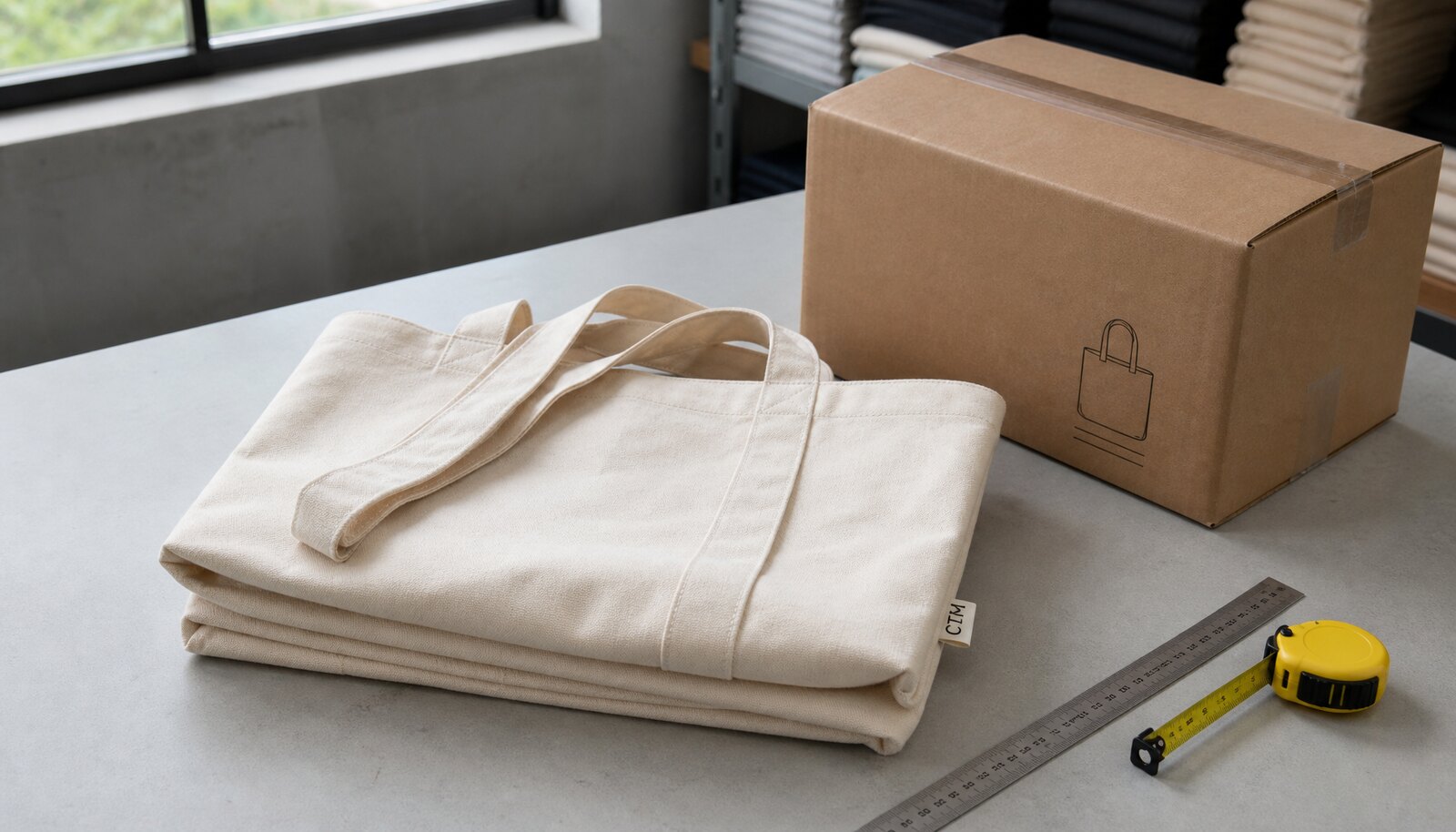
Why carton planning belongs in the tote spec
For apparel brands, custom canvas tote bags are not difficult to make, but they are easy to ship badly. The carton plan drives freight cost, warehouse handling, and damage risk, so it should be part of the RFQ from the first draft. If the tote is folded too loosely, the carton cube grows. If the carton is too small, the print scuffs and the handles crease. If the packed weight is too high, receiving teams reject it or repack it on arrival.
The commercial problem is usually not the bag itself. It is the mismatch between product spec and shipping spec. A buyer may approve a nice sample, then discover that the approved fold size creates a carton over the receiving limit, or that a retail carton needs different labeling than the bulk export carton. The right approach is to define the bag, the fold, and the case pack together so the factory can quote one usable production plan instead of three disconnected numbers.
- Define the finished bag size and the folded size before you request carton pricing.
- Set a target master carton weight early, especially if the shipment goes to a retail DC.
- Treat carton marks, barcode labels, and pack count as production requirements, not warehouse notes.
Choose the tote construction that fits the shipment
Canvas weight changes how the bag folds, how much air sits in the carton, and how the finished product behaves in transit. For apparel merch programs, 8 oz canvas, about 270 GSM, is common when the buyer wants a lighter promotional feel. 10 oz to 12 oz canvas, roughly 340 to 400 GSM, gives a fuller handfeel and better structure for retail use. Heavier cloth usually looks more premium, but it also increases carton weight and reduces the number of pieces per case.
Construction details matter just as much as fabric weight. A gusset adds volume and changes the carton footprint. Longer handles can force a different fold direction. Double-stitched seams, bar tacks, and lining make the bag more durable, but each of those choices affects the flat-pack shape. If the tote will be printed, screen print usually sits flatter than bulky embroidery, which matters when the bags are stacked tightly in export cartons.
- 8 oz canvas is usually enough for lower-cost brand merch, but it may not hold shape as well in retail presentation.
- 10 oz to 12 oz canvas is a safer middle ground when the buyer wants a sturdier handfeel and lower complaint risk.
- Embroidery, patches, and linings increase bulk; use them only if the brand value justifies the extra cube and labor.
Compare sourcing routes before you quote cartons
Not every supply route handles shipping cartons the same way. A direct factory quote usually gives the cleanest pack-out and the fewest handling steps. A trading company may combine products from different factories, which is useful for multi-SKU programs but makes carton control harder. A local 3PL can add flexibility when the retailer needs case packs, re-labeling, or mixed cartons, but every extra handoff creates another chance for wrong labels or damaged goods.
The buyer should pick the sourcing route based on the receiving plan, not just the unit price. If the brand ships to one warehouse and wants the lowest landed cost, a direct factory, flat-packed export carton is usually the best baseline. If the route includes retailer routing guides, pallet rules, or mixed orders across colors and sizes, a consolidation or 3PL route may be worth the added cost because it reduces receiving failures and chargebacks.
- Use the simplest route that still meets the receiving rules of the destination warehouse.
- If you need carton relabeling, confirm whether it happens at the factory, the port warehouse, or the destination 3PL.
- Ask who is responsible for carton pack-out, repacking, and damage claims at each handoff.
How to build the carton plan from real pack-out data
A good carton plan starts with an actual pack-out test, not a theoretical estimate. The factory should fold a production-intent sample, place it into a sample carton, and confirm the count, height, and gross weight with the bag exactly as it will be shipped. One style may fit 100 pieces per carton while a heavier version of the same bag only fits 60. That difference can change the freight quote more than the sewing price does.
Buyers should look at carton dimensions in relation to cube, not just piece count. A carton with more pieces is not automatically cheaper if it pushes the shipment into a higher volumetric weight band or makes the pallet unstable. For apparel brands, a useful target is often a carton that stays easy to lift, stacks cleanly, and keeps the gross weight within the receiving team’s preferred range. If the order is going to e-commerce fulfillment, the carton should also unpack quickly and avoid excessive void fill.
- Run pack-out testing with production fabric, not a placeholder sample made from lighter cloth.
- Measure five random folded bags and use the largest one to set the carton layout.
- If the carton approaches the site’s weight limit, reduce the piece count before you increase board strength.
Print and finish choices that change shipping efficiency
Print method affects more than decoration. A thick ink deposit can make the bag harder to fold, and a raised graphic may scuff when bags are stacked face to face. For most custom canvas tote bags for apparel brands, screen printing is the most predictable option for clean artwork and flat packing. Heat transfer can work for smaller runs or multi-color graphics, but the buyer should confirm that the transfer film will not crack when the tote is folded in the carton. Embroidery looks premium, yet it adds thickness and can telegraph through the stack.
Surface finish also matters. Washed or softened canvas folds differently from stiff raw canvas. A tote with lining, base board, or zipper closure will need a different pack pattern than a simple open tote. If the buyer wants the product to arrive retail-ready, the factory should pack each unit so the front panel remains visible and the print face is protected. That often costs more than bulk packing, but it reduces rework at the receiving center and protects the unboxing experience.
- Use screen print when you need the flattest pack and the most stable repeatability.
- Treat embroidery, patches, and thick transfers as higher-risk for carton scuff and bulk.
- If the tote has a lining or zipper, request a pack-out test with the final fold direction.
Sample approval should include the carton, not only the bag
Many tote programs fail because the buyer approves the garment sample and ignores the shipping sample. The pre-production sample should show the actual fabric weight, actual print method, actual stitching, and the actual folding method. It should also come with a sample carton, carton mark artwork, and a pack count. If the factory cannot show the carton plan during sample approval, the production line will usually improvise later, and improvisation is expensive once the goods are in motion.
A proper approval set should let procurement compare the bag against the packing plan in one review. The buyer can then catch problems like a fold that hides the logo, a handle that creates a carton bulge, or a carton that fails the warehouse dimension limit. For a new program, the factory should submit a photo sequence of the folded tote, the inner pack, and the filled master carton before bulk production starts. That review is cheaper than correcting a full container of the wrong pack format.
- Approve the bag sample and the packed sample together.
- Request photos of the folded tote inside the chosen carton before mass production.
- Use the sample stage to confirm carton marks, barcode placement, and gross weight.
Packing instructions that prevent receiving problems
Packing instructions should be written like a manufacturing spec. State whether each tote goes loose, wrapped in tissue, or inside a polybag. State the exact quantity per inner bundle and master carton. State the label position, barcode format, and whether the carton needs a country-of-origin mark. If the buyer is shipping to a retailer or distribution center, the carton rules should follow the receiving guide, not the factory's habit. Good factories can work with strict packing instructions, but they need the format before the cutting line starts.
Carton strength should match the route. A standard export carton may be fine for short domestic handling, but ocean freight, humid conditions, and double stacking can justify stronger board, a tighter tape spec, or a double-wall carton. Palletization also needs attention. If the pallet pattern is unstable or the cartons overhang, the receiving team may refuse the shipment or charge a rework fee. For high-value brand programs, a small spend on better outer packaging often costs less than a single receiving dispute.
- Specify whether the tote is packed flat, folded once, or folded with tissue protection.
- Use double-wall carton or stronger board when the route includes long transit, humidity, or heavy stacking.
- Keep carton overhang off the pallet and lock the stacking pattern before production starts.
What to separate in the factory quote
A useful quote should break the order into visible cost lines. At minimum, it should separate fabric, cutting and sewing, print setup, print run, labels, packaging, carton, and export preparation. If those items are blended into one number, the buyer cannot compare suppliers on the same basis. A low unit price may hide a weak carton, a lighter fabric, or a missing carton label charge that appears later as a surprise invoice.
MOQ logic should also be clear. Custom canvas often has a different minimum than stock canvas because dyeing, screen setup, and cutting efficiency change the batch economics. A buyer ordering stock canvas in one print color may get a lower MOQ than a buyer requesting custom-dyed fabric, multiple print placements, or custom packaging. The quote should show where the threshold moves, because that is usually where the commercial decision shifts from launch quantity to full program quantity.
- Ask for separate pricing on stock canvas and custom-dyed canvas.
- Request the cost for extra print colors, lining, or reinforcement as separate lines.
- Make sure the quote states what is excluded, especially freight, duty, and destination handling.
Lead time and landed-cost risk from factory to DC
For custom canvas tote bags, the lead time is usually built from several smaller blocks: artwork and spec review, sample production, sample approval, fabric reservation, mass production, carton printing, packing, and transit. A simple stock-canvas order can move faster than a custom-dyed, multi-color print program, but the schedule only stays realistic if the buyer approves samples quickly and the factory books raw materials before the line starts. A late artwork change can reset screens, labels, and carton marks, which is why the carton plan should be frozen before bulk sewing begins.
Landed cost changes when the carton plan changes. More air in the carton means more freight. More handling points mean more labor. Heavier board and better print on the outer carton raise unit cost but can lower damage and receiving issues. For apparel brands, the right comparison is not just factory price versus factory price. It is factory price plus packing cost, export prep, freight cube, damage allowance, and the cost of any warehouse rework. The best quote is the one that survives the whole trip, not the one that looks lowest on page one.
- Expect longer timelines when the order needs custom dye, special labels, or retail-ready cartons.
- Compare landed cost using the same carton count, same pack method, and same shipping term across suppliers.
- Treat art changes after sample approval as schedule risk, because they often affect screens, labels, and carton printing together.
Specification comparison for buyers
| Spec decision | Recommended option | When it fits | Buyer risk to check |
|---|---|---|---|
| Direct factory, flat-packed master cartons | Have the sewing factory pack bags flat with one carton spec and one pack count | Best for bulk apparel programs where you control the forwarder and want the lowest handling cost | Confirm the folded size, carton dimension, and whether the factory can hold the pack count within carton weight limits |
| Factory with inner polybag or tissue | Use a simple protective wrap only when print rub, dust, or moisture are real concerns | Fits darker printed totes, premium retail deliveries, or long ocean transit | Watch for extra labor, higher cube, and cartons that become too dense for easy receiving |
| Trading company or sourcing agent consolidation | Use a middle layer only when you need multiple tote styles or factories combined into one shipment | Useful for brands buying several SKUs and wanting one export plan | Check whether the carton spec is standardised across factories or repacked later at added cost |
| Buyer-appointed 3PL cartonization | Ship bulk goods to a local 3PL for final packing and carton labels | Works when retailer routing guides require mixed packing or custom case packs | Risk is double handling, more damage points, and extra inventory dwell time |
| Stock canvas instead of custom-dyed canvas | Choose stock canvas if launch timing and carton consistency matter more than exact shade matching | Good for fast programs, replenishment, and lower MOQ orders | Ask whether shade variation is acceptable across production lots and whether the supplier holds stock by roll lot |
| Custom-dyed canvas for one brand color | Use custom dye only when the brand spec depends on a precise body color | Best for premium retail programs and consistent repeat orders | Lead time, dye lot variation, and higher MOQ can change the carton plan and the approval sequence |
| Standard export carton | Use standard single-SKU cartons with clear marks and stable dimensions | Most efficient for direct factory shipping and warehouse receiving | Verify the carton burst strength, board grade, and whether the tote handles create an uneven stack |
| Retail-ready carton or shelf-ready tray | Use only when the buyer needs store-ready presentation or shelf replenishment | Fits specialty retail, chain stores, and programs with strict DC routing guides | Expect higher packaging cost, lower pack density, and stricter artwork approval for carton graphics |
Buyer checklist before sampling
- Finished tote size, folded size, and handle drop in millimeters
- Canvas weight or GSM, fabric finish, and whether the cloth is stock or custom dyed
- Print method, print size, ink count, and whether scuff protection is needed
- Target pieces per inner pack, master carton, and pallet layer
- Maximum carton weight and carton size limits from the receiving warehouse or retailer
- Labeling format for SKU, PO number, carton mark, and country of origin
- Sample approval points for fabric, print, stitching, folding, and carton pack-out
- Expected production lead time, booking date, and shipping mode
Factory quote questions to send
- What is the price break by quantity for stock canvas versus custom-dyed canvas?
- How many pieces per master carton can you pack while staying under our target carton weight and cube?
- What carton size, board grade, and print specification are included in the quote?
- Does the quote include sampling, plate or screen charges, and pre-production approval samples?
- What is the surcharge for extra print colors, lining, or reinforced handles?
- Can you provide a pack-out test with the actual folded tote before mass production?
- What is your standard production lead time after sample approval, and what steps can delay it?
- Which shipping terms are included in the quote, and which costs are excluded?
Quality-control points to confirm
- Fabric weight matches the approved GSM or ounce target within the agreed tolerance
- Finished bag dimensions, gusset depth, and handle length stay within spec after trimming and sewing
- Print placement, color density, and cure quality match the approved sample without offset or cracking
- Stitch count, bar-tack strength, and handle attachment are consistent on both sides of the bag
- Folded size fits the approved carton layout without forcing or wrinkling the print area
- Master carton pack count, gross weight, and carton dimensions match the shipping plan
- Carton marks, SKU labels, and barcodes are readable and placed on the agreed faces
- Random drop and compression checks do not damage seams, print, or handles during transit simulation