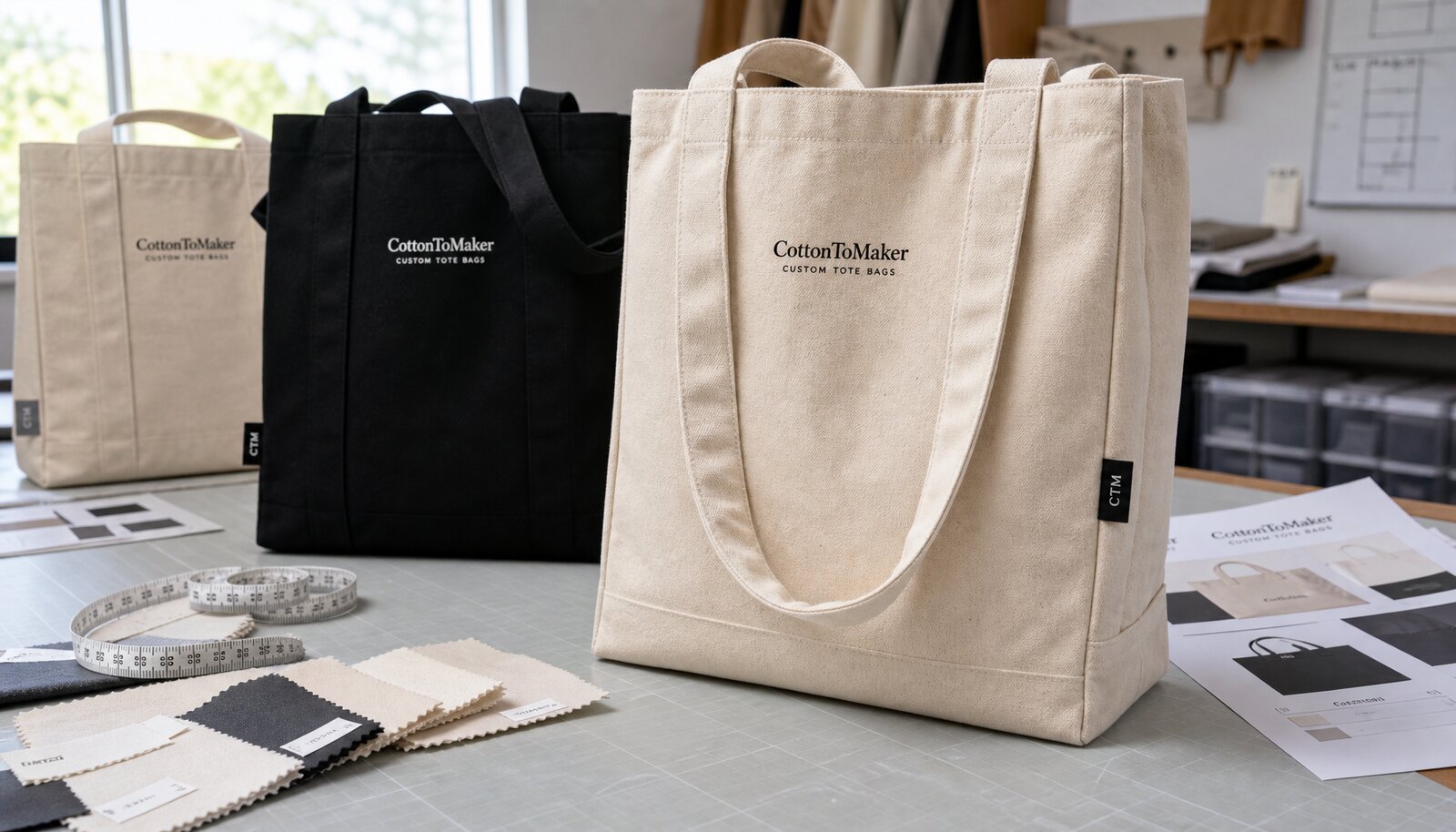
The Main Buying Problem: Quotes Are Not Comparable
When a retailer asks several factories for a custom canvas tote bag quote without a tight specification, the lowest price is often built on a different product. One supplier may quote 8 oz canvas, another may quote 12 oz. One may include reinforced handles and export cartons, while another prices a basic promotional bag with loose packing.
For procurement teams, the goal is not only to get a unit price. The goal is to make every supplier quote the same construction, same print requirement, same packing method, and same approval process. That is the only way to compare cost, lead time, and production risk fairly.
- Do not ask only for a canvas tote bag price; ask for a price against a controlled specification.
- Separate the bag body, printing, labels, hangtags, packing, and sample cost in the RFQ.
- Ask each supplier to confirm any deviation from your spec instead of silently substituting cheaper materials.
- Keep one approved sample as the control standard for bulk production and final inspection.
Choose Fabric Weight Based on Retail Use, Not Guesswork
Canvas weight is one of the biggest cost and quality drivers. For retail tote bags, 10 oz to 12 oz cotton canvas, roughly 340 to 407 GSM, is a common balance between structure, durability, and printable surface. It feels more retail-ready than a thin promotional cotton bag but does not become as heavy or expensive as 16 oz canvas.
Buyers should also confirm how the supplier measures fabric weight. Some quotes refer to greige fabric before dyeing or washing; others refer to finished fabric. Natural canvas, dyed canvas, and washed canvas can all feel different even when the quoted GSM looks similar.
- 8 oz canvas: suitable for lighter retail promotions, but may not feel premium on a store shelf.
- 10 oz to 12 oz canvas: suitable for most paid retail tote bags and reusable shopping programs.
- 14 oz to 16 oz canvas: suitable for premium merchandise, heavy books, gift sets, or boutique retail.
- Ask for shrinkage data if the bag will be washed, dyed, or made from untreated cotton canvas.
Specify the Bag Construction Before Discussing Price
A custom canvas tote bag supplier for retailers should be asked to quote the finished construction, not just the material. The same fabric can produce very different bags depending on gusset style, seam allowance, handle reinforcement, thread type, and stitch density.
For retail orders, the dimensions should be written as finished size: width x height x gusset. If the tote must hold shoeboxes, books, packaged cosmetics, or folded apparel, provide the product dimensions and target load weight. A factory can then suggest whether a bottom gusset, side gusset, boxed corners, or flat tote construction is more practical.
- State finished bag size and tolerance, for example plus or minus 0.5 cm or another agreed tolerance.
- Define handle length and drop length so the bag works for hand carry or shoulder carry.
- Request cross-stitch, bartack, or reinforced handle stitching for heavier retail use.
- Confirm whether seams are overlocked, bound, folded, or French seamed depending on the desired inside finish.
- Ask if the quoted thread color matches the fabric, logo, contrast design, or buyer artwork.
Match the Print Method to Canvas Texture and Artwork
Canvas is textured, so the printing method must be chosen with the fabric weight and artwork in mind. Screen printing is usually the most stable option for solid logos, slogans, and simple graphics. It gives good coverage and is efficient at scale, especially when the design has limited colors.
Heat transfer can work for detailed multi-color artwork, gradients, or small production runs, but the film hand-feel and edge durability should be checked. Embroidery can add a premium touch for small marks, but it is not ideal for large filled graphics on tote panels because it adds cost, weight, and possible puckering.
- Provide vector artwork with Pantone references instead of low-resolution JPG files.
- Specify print size, print position, number of print colors, and whether printing is one side or two sides.
- Request a print strike-off on the actual canvas fabric before approving bulk printing.
- Check rubbing, cracking, ink smell, and print edge sharpness on the approved sample.
- For dark canvas, ask whether underbase printing is required to keep logo color accurate.
Understand MOQ Logic Before Rejecting a Quote
MOQ for custom canvas tote bags is not only about sewing quantity. It can be driven by fabric dyeing, canvas stock availability, print setup, label weaving, hangtag printing, carton marking, and packing materials. A supplier may accept a lower bag quantity if natural canvas and standard handles are used, but require a higher MOQ for custom dyed canvas or special webbing.
Retail buyers should ask suppliers to break down the MOQ drivers. This helps buyers adjust the specification without weakening the product. For example, using standard natural canvas with a custom printed logo may be more efficient than requiring a custom dyed fabric for a first test order.
- Natural canvas usually has more flexible MOQ than custom dyed canvas.
- Multi-color printing increases setup work and may affect minimum print quantity.
- Custom woven labels, care labels, hangtags, and barcode stickers can each have separate MOQs.
- Special handle webbing color may require a separate material MOQ.
- Mixed colors or mixed designs should be priced clearly, not assumed under one bulk MOQ.
Use Samples to Prevent Expensive Bulk Mistakes
A sample is not just for sales approval. It is the control document for production. For retail tote bags, buyers should approve fabric hand-feel, color, construction, print, labels, packing, and carton marking before bulk cutting. If any of these are missing, the factory and buyer may have different assumptions.
A practical sample process can include a fabric swatch, blank shape sample, print strike-off, pre-production sample, and packed sample. Not every project needs every stage, but higher-value retail programs should not skip the pre-production sample after all trims and artwork are finalized.
- Check fabric weight by hand and, where possible, by GSM measurement.
- Load the sample with realistic product weight and hold it by the handles for several minutes.
- Check whether the bag stands, folds, or hangs as expected for retail display.
- Confirm print size and placement using a ruler, not by visual judgment only.
- Keep the signed sample, approved swatch, and print strike-off together for inspection reference.
Packing Details Affect Retail Operations and Freight Cost
Packing is often treated as a minor detail, but it affects creasing, barcode scanning, warehouse receiving, carton cube, and freight cost. A tote bag for a retail chain may need flat packing, barcode label placement, carton marking, and carton weight limits. A distributor may need inner bundles for easy counting and repacking.
Buyers should decide whether bags are individually packed, bundled, paper banded, or bulk packed. Individual polybags can protect the product but add material, labor, and sustainability concerns. Paper bands or bulk packing may be acceptable if the bags go directly to store backrooms or distributor warehouses.
- Specify flat pack or folded pack depending on shelf display and print crease risk.
- Confirm pieces per inner bundle and pieces per export carton.
- Ask for carton size, gross weight, net weight, and carton material strength.
- Provide barcode file, label size, label position, and carton mark layout if required.
- Request moisture protection for sea freight, especially for natural cotton canvas.
Lead Time Depends on Approvals, Materials, and Print Capacity
Lead time should be discussed from sample approval, not from the first email. A realistic schedule includes artwork confirmation, material sourcing, sample making, sample transit, buyer approval, bulk cutting, printing, sewing, finishing, inspection, and export packing. If the buyer delays artwork or changes print color after sampling, the schedule moves.
Retail buyers should ask for a production timeline with dependencies. This makes internal planning easier and reduces disputes when launch dates are tight. If a program has a fixed store delivery date, share the required ex-factory date and warehouse receiving date early.
- Ask when fabric will be booked and whether it is in stock or custom produced.
- Confirm whether printing happens before sewing or after sewing, because this affects scheduling.
- Ask how many days are needed for pre-production sample approval after final artwork.
- Build inspection time into the schedule before shipment booking.
- Avoid changing logo size, fabric color, or packing after sample approval unless the timeline is revised.
Specification comparison for buyers
| Spec decision | Recommended option | When it fits | Buyer risk to check |
|---|---|---|---|
| Main fabric weight | 10 oz to 12 oz cotton canvas, approx. 340-407 GSM | Retail tote bags that need structure, shelf appeal, and repeated daily use | Confirm whether quote uses finished fabric weight or greige fabric weight before washing and finishing |
| Economy retail version | 8 oz cotton canvas, approx. 270 GSM | Promotional retail bundles, light grocery use, or lower-price seasonal programs | Bag may feel thin if buyer expects premium canvas; request physical hand-feel sample |
| Premium heavy-duty version | 14 oz to 16 oz canvas, approx. 475-542 GSM | Boutique merchandise, bookstore totes, wine and gift retail, or paid-for reusable bags | Higher fabric cost, heavier carton weight, and longer drying time after printing |
| Handle construction | Self-fabric handles with cross-stitch reinforcement or cotton webbing handles | Retail bags carrying books, packaged goods, apparel, or multiple small items | Ask for handle pull test method and stitch density, not only handle length |
| Print method | Screen printing for solid logos; heat transfer for multi-color artwork; embroidery only for small premium marks | Most retail logo and brand graphic applications | Large ink coverage on heavy canvas can crack or feel stiff if ink type is not matched to fabric |
| Packing method | Flat packed, 25-50 pieces per polybag or paper band, export carton with inner moisture protection | Retail replenishment, distributor warehousing, and e-commerce pick-pack operations | Loose packing can crease printed panels; over-tight cartons can distort handles and gussets |
Buyer checklist before sampling
- Define the retail use case: paid merchandise, reusable shopping bag, gift-with-purchase, or distributor resale.
- Specify fabric composition, canvas weight in oz and GSM, color, shrinkage tolerance, and whether washed or unwashed finish is required.
- Confirm bag dimensions as width x height x gusset, plus handle length, handle width, and drop length.
- Send logo artwork in vector format and state print size, print position, Pantone references, and acceptable color tolerance.
- Request pre-production sample approval for fabric, construction, print, label, packing, and barcode placement before bulk cutting.
- Ask suppliers to separate tooling, sampling, bag unit cost, label cost, packing cost, and inland freight where relevant.
- Confirm carton dimensions, gross weight, pieces per carton, and pallet loading if warehouse intake rules apply.
- Set inspection criteria for fabric defects, print defects, broken stitches, loose threads, handle strength, stains, odor, and carton marking.
Factory quote questions to send
- What exact canvas weight are you quoting in oz and GSM, and is it measured before or after dyeing, washing, or finishing?
- Is the quoted fabric natural, dyed, bleached, recycled cotton blend, or organic cotton, and can you provide the fabric specification sheet?
- What MOQ applies to the bag body, fabric color, printing color count, woven label, hangtag, and custom packing separately?
- Which print method do you recommend for our artwork size and color count, and what are the print limitations on heavy canvas?
- What sample types are included: blank shape sample, fabric swatch, print strike-off, pre-production sample, or full packed sample?
- What handle reinforcement is included in the quote, and can you share your normal handle pull test standard or internal test method?
- What is the estimated production lead time after sample approval and deposit, and which inputs from the buyer can delay the schedule?
- How many pieces per carton, what carton size and gross weight, and will the bags be flat packed, folded, or individually packed?
Quality-control points to confirm
- Check fabric GSM against approved swatch, because a small weight reduction can change hand feel and perceived retail value.
- Measure finished bag size after sewing, including gusset depth and handle drop, not only cutting panel size.
- Inspect handle reinforcement, bartack or cross-stitch position, thread tension, and loose thread trimming.
- Compare print color, registration, edge sharpness, ink coverage, and rubbing resistance against the approved strike-off.
- Open packed cartons to check odor, moisture, mold risk, carton strength, barcode readability, and packing consistency.
- Run a practical load test using the intended retail product weight, especially for bookstores, grocery, beverage, or gift sets.