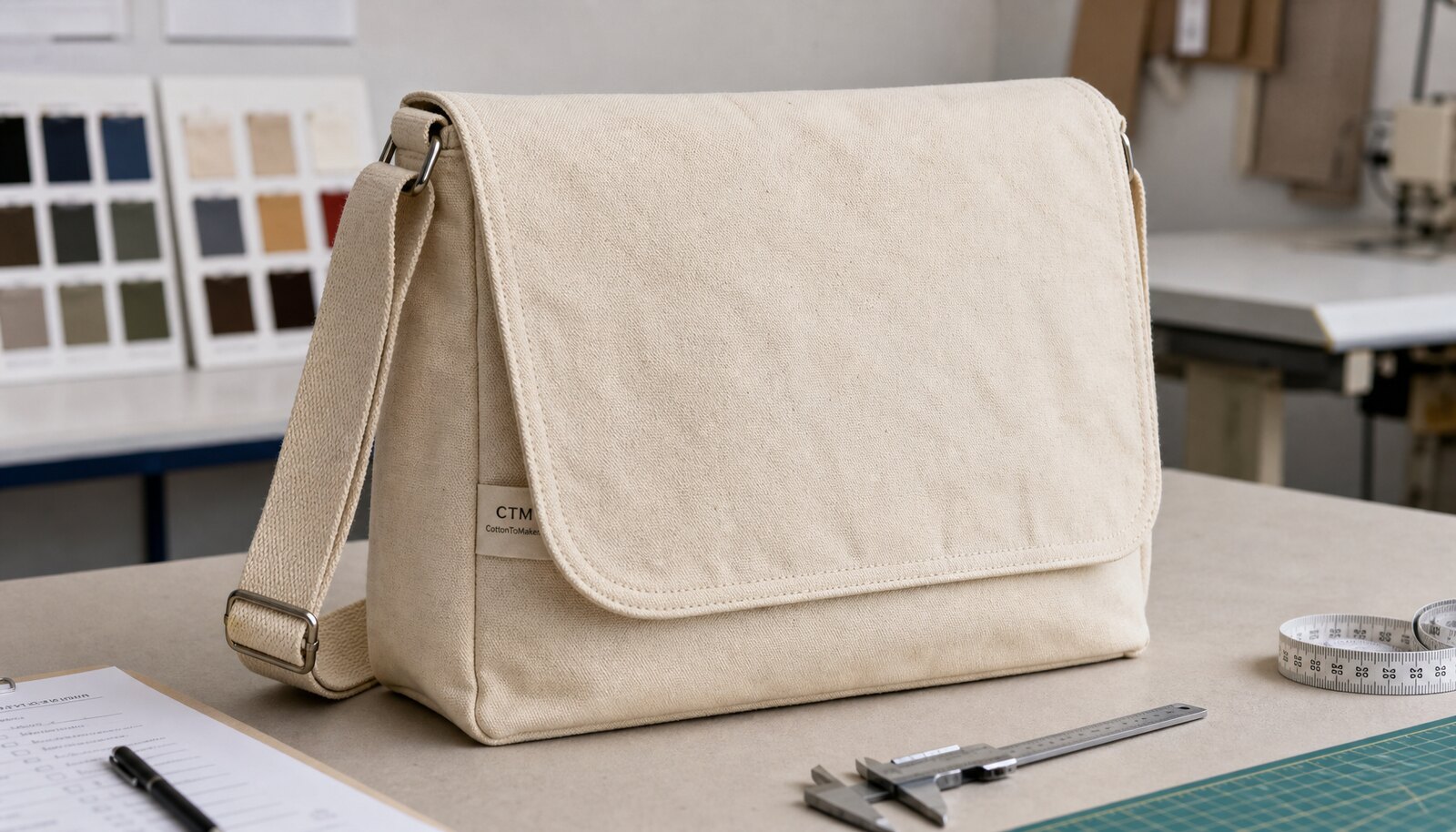
The Buying Problem: Similar Photos Hide Different Costs
A canvas shoulder bag can look straightforward in a product photo, but two factory quotations may describe very different products. One supplier may price a 10 oz unlined bag with a basic one-color print. Another may price 16 oz canvas, cotton lining, zipper closure, reinforced strap joints, metal adjuster, woven label, and export packing. Both may call the product a canvas shoulder bag, but they are not quoting the same item.
For a procurement team, the goal is not to collect the lowest unit price first. The goal is to make each factory quote answer the same specification. A clear RFQ reduces sample revisions, prevents late cost changes, and makes internal comparison easier for merchandising, compliance, finance, and logistics teams.
- Define the use case first: retail product, corporate gift, school bag, conference bag, employee kit, or brand merchandise.
- Separate design appearance from construction requirements so the factory does not make hidden assumptions.
- Ask every supplier to quote from the same written specification sheet, artwork file, quantity table, and packing requirement.
- Compare quotations by fabric, dimensions, lining, pockets, hardware, stitching, logo method, packing, inspection standard, and lead time.
- Require suppliers to state exclusions clearly, such as test fees, sample freight, special packing, inspection cost, or document fees.
Supplier Qualification: Screen the Factory Before Comparing Price
A custom canvas shoulder bag factory supplier should be evaluated on more than unit price. Buyers should confirm whether the supplier actually controls cutting, sewing, printing coordination, inspection, and export packing, or whether important steps are outsourced without clear accountability. Outsourcing is not automatically a problem, but the supplier should explain how quality is controlled across each process.
For first orders, procurement teams should ask for practical qualification evidence: business registration, export experience, production photos, available machines, product category experience, internal QC workflow, and the ability to support required compliance documents. If a customer or retailer requires audits, restricted-substance controls, or social compliance documentation, raise that requirement before sampling, not after the order is placed.
- Confirm whether the supplier is a factory, trading company, or factory-supported exporter, and who is responsible for final QC.
- Ask for recent product photos that show similar canvas messenger or shoulder bag construction, not unrelated tote bags only.
- Check whether printing, embroidery, dyeing, washing, and metal accessory supply are in-house or subcontracted.
- Request the normal production capacity for similar bags and whether peak-season capacity is already committed.
- Clarify who signs the quality standard, who approves the pre-production sample, and who handles corrective action if bulk fails inspection.
Fabric Weight: Use Real Specifications, Not Generic Conversions
Canvas is often discussed in ounces, while some buyers require GSM. The two values are commonly compared, but they are not always interchangeable without knowing fabric width, weave density, yarn count, and finishing. A responsible RFQ should ask the supplier to state the actual fabric specification and, when needed, provide a mill data sheet or fabric test report rather than relying on an approximate online conversion.
For many shoulder bag programs, 12 oz to 16 oz cotton canvas gives a practical balance of structure, sewing efficiency, durability, and freight weight. Lighter 10 oz canvas may suit short-term promotional use, while 18 oz to 20 oz canvas can create a rugged premium look but increases material cost, needle wear, sewing difficulty, and shipping weight.
- 10 oz canvas: cost-sensitive promotions, lightweight events, and simple flat bags with limited load expectation.
- 12 oz canvas: balanced option for basic shoulder bags, branded merchandise, and moderate structure.
- 14 oz to 16 oz canvas: stronger choice for retail messenger-style bags, heavier daily use, and better body shape.
- 18 oz to 20 oz canvas: premium rugged appearance, but check sewing feasibility, finished weight, needle marks, and freight cost.
- Natural canvas may show seed flecks and shade variation; dyed canvas needs shade approval and colorfastness control.
- Washed canvas has a softer hand feel but needs tighter control of shrinkage, shade variation, and finished dimensions.
Construction Details That Change the Quote
Construction is usually the largest reason one quote is higher than another. A simple flap shoulder bag with one compartment is very different from a messenger bag with lining, zipper pocket, pen slots, reinforced bottom, metal adjuster, padded shoulder section, custom woven label, and retail hangtag. Every added component changes material consumption, labor minutes, inspection points, and possible defect risk.
If the bag will carry books, documents, product samples, bottles, or electronics, state the expected load in the RFQ. This helps the supplier recommend strap width, seam type, reinforcement, and closure. For heavier use, ask for box stitching, bartacks at stress points, proper seam allowance, and reinforcement patches behind snaps or strap joints.
- Confirm finished measurements, not cutting measurements, because seam allowance, washing, and pressing affect final size.
- Define gusset width clearly if the bag must hold folders, catalogues, tablets, folded apparel, or sample kits.
- Specify whether the flap is decorative or functional, and whether it closes with zipper, snap, magnet, buckle, or hook-and-loop.
- List internal pocket requirements, including pocket size, zipper type, divider stitching, pen slots, and reinforced pocket openings.
- Confirm hardware color, material, plating, adjuster size, zipper gauge, zipper tape color, and puller style.
- Ask for close-up photos of reinforcement stitching before approving bulk if load strength is important.
Closures and Hardware: Match Convenience With Risk Control
Closures influence both user experience and inspection requirements. A magnetic snap can look clean and retail-friendly, but buyers should confirm its strength, backing reinforcement, and suitability for the intended contents. Magnetic parts may not be appropriate for all use cases, particularly where customers may carry magnetic-stripe cards, hotel keys, or sensitive items near the closure. The risk depends on magnet strength, distance, and product use, so it should be treated as a design decision rather than a default choice.
Zippers provide better document security but add cost and create inspection points such as slider movement, zipper end finishing, tape color, and tooth alignment. Hook-and-loop is practical for school, event, and utility bags, but it can collect lint and may feel less premium. Press snaps and buckles can work well when installed with enough backing reinforcement to avoid tearing through thick canvas.
- Use zipper under flap when document security is more important than the lowest labor cost.
- Use magnetic snap only after checking magnet strength, backing reinforcement, and the intended contents carried near the closure.
- Use hook-and-loop when fast access and cost control matter more than a premium feel.
- Use press snaps or buckles when the design requires visible hardware, but test pull-out strength and fabric tearing.
- Check hardware for rust, plating defects, sharp edges, loose installation, and color consistency before packing.
Logo Method: Approve Branding on Actual Canvas
For canvas shoulder bags, screen printing is usually practical for large solid logos on the front flap or body panel. The uneven texture of canvas can break fine lines, reduce edge sharpness, or change perceived color. Heat transfer can reproduce detailed artwork but should be checked for hand feel, cracking, adhesion, and wash or rub performance. Embroidery gives a premium look for smaller marks, but dense stitching can pucker if backing, thread tension, and stitch count are not controlled.
Brand owners should provide vector artwork, Pantone references, exact logo size, and placement from fixed edges. If the logo sits on a flap, confirm its position when the bag is closed, not only when the panel lies flat before sewing. This avoids a common sampling problem where the artwork looks centered during production but appears too high or low in actual use.
- Screen print: suitable for solid logos, one to four colors, and larger flat front areas.
- Embroidery: suitable for small premium marks, but confirm stitch count, backing, and puckering tolerance.
- Woven label: suitable for subtle retail branding on side seam, flap edge, interior pocket, or strap.
- Patch: suitable for lifestyle branding, but confirm PU, leather, or alternative material compliance if required.
- Request a strike-off on actual canvas before bulk production when color accuracy, opacity, or fine detail matters.
MOQ Logic: Ask What Drives the Minimum
MOQ is not only a sewing-line decision. It may be driven by fabric dyeing, webbing color, zipper tape, metal accessories, woven labels, printing setup, packing materials, or carton purchasing. A supplier may offer a lower MOQ for stock natural canvas with a one-color print, but a much higher MOQ for custom dyed canvas, matched webbing, custom zipper tape, or plated hardware.
Buyers should ask the factory to separate the base bag MOQ from each customized component. This makes it easier to decide whether a first order should use stock materials or whether the brand value of custom components justifies higher quantity, longer lead time, and more sampling risk.
- Lower MOQ is more realistic with stock canvas, stock webbing, standard zipper, standard hardware, and simple printing.
- Higher MOQ is common for custom dyed fabric, custom zipper tape, woven labels, custom metal color, or custom retail packaging.
- Pilot orders should limit custom materials unless the buyer accepts longer approval time and higher inventory risk.
- Ask whether overrun or underrun tolerance applies, especially when fabric is dyed or printed specifically for the order.
- Request price breaks by quantity only after the specification is fixed; otherwise the comparison may be misleading.
Sample Approval: Set Acceptance Criteria Before Bulk
A sales sample proves the general shape. A pre-production sample should prove the actual material, actual color, actual logo method, final hardware, final labels, final construction, and intended packing. Procurement teams should not approve bulk production based only on a front-view photo for first orders or retail programs.
Before approval, define what is acceptable and what is not. This includes dimensional tolerance, shade tolerance, logo placement tolerance, defect classification, and whether inspection will follow a buyer-specific checklist or an AQL plan. If the buyer requires formal test standards, identify the standard and laboratory process before the factory buys bulk materials.
- Measure width, height, gusset, flap length, strap length, strap drop, pocket size, and closure position.
- Compare fabric shade, hand feel, weight, and surface defects against the approved swatch or signed sample.
- Load the sample with the expected carrying weight and inspect strap joints, seams, and fabric distortion afterward.
- Rub and flex the print surface to check curing, cracking, opacity, adhesion, and edge sharpness.
- Open and close zippers, snaps, magnets, buckles, and adjusters repeatedly before approval.
- Seal, date, photograph, and reference the approved sample in the purchase order or production file.
Specification comparison for buyers
| Spec decision | Recommended option | When it fits | Buyer risk to check |
|---|---|---|---|
| Main canvas weight | 12 oz to 16 oz cotton canvas, with GSM confirmed by the mill or fabric test report | Retail shoulder bags, campus bags, brand merchandise, light daily carry, and reusable corporate programs | Oz and GSM are not directly interchangeable unless fabric width, weave, and finishing are known; request the supplier's actual fabric specification instead of relying on a generic conversion |
| Lining construction | Unlined, bound seams, or 5 oz to 8 oz cotton/poly-cotton lining | Unlined for cost-controlled promotions; bound seams for cleaner interiors; lining for retail finish, inside pockets, and document protection | Lining can shrink, bleed, or twist after washing; check shade, seam allowance, and colorfastness if dyed lining is used |
| Shoulder strap | 38 mm to 50 mm cotton webbing or canvas self-fabric strap with reinforced box stitch and bartack where needed | Adjustable shoulder or crossbody carry where comfort and load strength matter | Narrow straps may twist or cut into the shoulder; weak bartacks, short stitch length, or insufficient seam allowance can cause pull-out under load |
| Closure | Zipper under flap, magnetic snap, press snap, buckle, or hook-and-loop based on use case | Zipper for document security; magnetic snap for clean retail appearance; hook-and-loop for school, event, or utility bags | Magnetic snaps may affect products sensitive to magnets and can weaken if installed through thick fabric without backing; metal parts need rust, plating, and pull-strength checks |
| Logo method | Screen print, embroidery, woven label, or patch approved on actual canvas | Screen print for large solid artwork; embroidery or woven label for premium smaller marks; patch for lifestyle branding | Canvas texture can break fine print lines; embroidery may pucker; patches and labels may require material compliance confirmation |
| Packing method | Flat packed or controlled single-fold packing with carton liner, desiccant if needed, and approved carton marks | Flat packing protects flap shape and print surface; folded packing reduces CBM when creasing is acceptable | Over-compression can crease prints, deform snaps, bend zipper teeth, or cause moisture issues during sea freight |
Buyer checklist before sampling
- Confirm finished bag width, height, gusset, flap depth, pocket layout, strap length, and strap drop with tolerances, not only a reference photo.
- Specify canvas by oz and/or GSM, fabric width if relevant, weave, color, finish, shrinkage expectation, and whether natural seed flecks are acceptable.
- Define construction in writing: lining, seam binding, zipper pockets, bottom reinforcement, closure type, hardware color, label placement, and thread color.
- State intended load, such as documents, books, tablet, samples, or promotional contents, so the factory can choose strap width and reinforcement.
- Provide vector artwork, Pantone references, logo size, placement from fixed edges, print method, and acceptable placement deviation.
- Request a pre-production sample made with actual fabric, actual logo method, final hardware, final lining, final labels, and intended packing.
- Set sample and bulk acceptance thresholds for measurements, color shade, print position, workmanship defects, and closure function before production starts.
- Ask for supplier qualification documents, including business license, export experience, relevant audit status if required, and material compliance capability.
- Confirm required import documents such as commercial invoice, packing list, bill of lading or airway bill, certificate of origin if needed, and any destination-specific declarations.
- Separate sample lead time, material lead time, bulk sewing time, inspection window, export booking time, and transit time in the purchase schedule.
Factory quote questions to send
- Which exact canvas are you quoting: oz, GSM, fabric width, weave, finish, color process, and whether it is stock fabric or custom dyed fabric?
- Can you provide the fabric mill specification or test report for weight, colorfastness, and shrinkage when required by our order?
- Is the quoted price based on unlined construction, bound seams, lining, zipper pocket, internal organizer, or reinforced bottom panel?
- What strap width, strap material, stitch pattern, seam allowance, and reinforcement method are included at the stress points?
- Which closure is included, and what are the hardware material, plating, pull-strength expectation, and rust-prevention controls?
- Which logo method is included, how many print colors or embroidery stitches are assumed, and is a strike-off included before bulk production?
- What is the MOQ for stock natural canvas, dyed canvas, custom webbing color, custom zipper tape, custom label, and custom metal accessories?
- What are your normal overrun or underrun tolerances for dyed fabric, printed fabric, and finished bags?
- Can you quote tooling, sample cost, sample lead time, sample freight, and the policy for one or more sample revisions separately?
- What inspection standard do you follow, such as AQL level, internal final inspection checklist, or buyer-specific acceptance criteria?
Quality-control points to confirm
- Measure finished bag width, height, gusset, flap length, pocket size, strap length, and strap drop against the approved specification sheet and stated tolerances.
- Verify canvas weight against the approved material reference by fabric report or controlled incoming inspection, and compare shade to the approved swatch under consistent lighting.
- Check shrinkage and colorfastness requirements according to the buyer's intended use; where formal testing is needed, agree on applicable ISO, AATCC, or buyer-specific methods before production.
- Inspect fabric for stains, holes, weaving defects, excessive slubs beyond the approved standard, odor, uneven dyeing, and unacceptable shade variation between panels.
- Test strap attachment by agreed pull or load method, then inspect box stitches, bartacks, seam allowance, broken threads, skipped stitches, and fabric tearing around stress points.
- Inspect logo placement, print opacity, edge sharpness, ink curing, rubbing performance, embroidery puckering, thread trimming, label angle, and patch stitching.
- Operate zippers, snaps, magnetic closures, buckles, adjusters, and hook-and-loop repeatedly to confirm alignment, smooth use, and secure attachment.
- Check metal accessories for rust marks, sharp edges, plating defects, magnetic strength consistency where applicable, and secure installation with backing washers or reinforcement when needed.
- Inspect internal seams, binding, loose threads, needle damage, flap symmetry, pocket alignment, and bottom shape before final packing.
- Confirm packing against the approved method, including fold position, polybag or paper band, desiccant or carton liner if used, carton strength, carton marks, SKU, quantity, PO number, and destination information.